Foreign
Rocket Attack Intercepted Over US Embassy In Baghdad
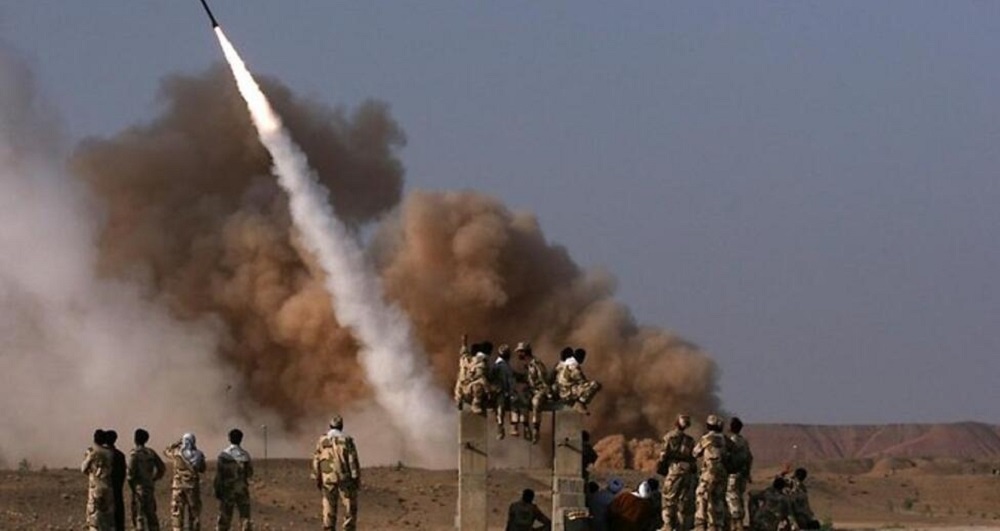
Air defence systems intercepted rockets fired at the US embassy in Baghdad, security sources told AFP.

It is the first such attack on the embassy in Baghdad since the start of the war in the Middle East, triggered by a joint US-Israeli attack on Iran, into which Iraq has been dragged.
Loud bangs were heard on Saturday night in Baghdad, AFP journalists said, with a witness near the fortified Green Zone, which houses the US embassy, reporting seeing air defences activated over the area.

“Four rockets were launched… toward the embassy,” a security official said, adding that air defences intercepted three, while one fell in an open area in the embassy’s airbase.
Two other security sources confirmed the attack, with one saying that all rockets were downed, including the one that fell in the airbase.
Prime Minister Mohammed Shia al-Sudani, ordered security forces to find the perpetrators of “the terrorist act” against the US embassy.
He said that “targeting diplomatic missions and embassies operating in Iraq is an act that cannot be justified or accepted under any circumstances.”
Iraq, long a proxy battleground between the US and Iran, had said it did not want to be dragged into the conflict engulfing the Middle East, but it has not been spared.
It was drawn into the war from the outset, with strikes blamed on the United States and Israel targeting Iran-backed groups, which have since claimed attacks on US bases in Iraq and the region.
Drone and rocket attacks have targeted Baghdad International Airport, which houses a military base and a US diplomatic facility, as well as oil fields and facilities.
The northern autonomous Kurdistan region, which hosts US troops, has also been a main target of drone attacks that were largely intercepted.
Late on Saturday, an AFP journalist reported hearing the sound of a drone followed by at least three loud bangs in Kurdistan’s capital Erbil, which also houses a major US consulate complex.
Airstrikes
On Saturday, airstrikes hit military bases belonging to the former paramilitary coalition Hashed al-Shaabi in the northern Nineveh province, the government’s security media cell said.
One fighter was killed and three other wounded.
The Hashed al-Shaabi, or the Popular Mobilisation Forces (PMF), is an alliance of factions now integrated into the regular army, including several Iran-backed groups, which have a reputation for acting on their own.
Bases belonging to Hashed al-Shaabi have been hit several times since the start of the war.
The group’s media cell said Saturday’s strikes were carried out by “unidentified aircraft,” but a PMF official told AFP that “an airstrike, likely American, hit a Hashed base” near the city of Mosul.
Kurdish militants
Iraq’s Kurdistan also hosts camps and rear bases operated by several Iranian Kurdish rebel groups, which Iran has struck repeatedly since the start of the war.
Iran’s Revolutionary Guards said Saturday they have targeted “separatist groups” in Iraqi Kurdistan, after Tehran threatened to target “all the facilities” of Kurdistan if militants were allowed to enter the Islamic republic.
So far, no forces have entered Iran, Iraq’s border guards said.
The Iraqi government and the autonomous region said Friday that Iraq must not be a launchpad for attacks against neighbouring countries.
AFP
Foreign
Magyar slams Orbán for shunning Hungarians, calls Russia ‘security risk’
Prime Minister of Hungary Péter Magyar on Monday scolded Viktor Orbán for not paying attention to the problems affecting Hungarians while focusing on issues in other countries.
In a speech after the electoral victory, Magyar assured his administration would refrain from interfering in the domestic affairs of other nations, urging foreign governments to do the same.
The prime minister noted that Orbán played a five-dimensional chess game, saying the attitude was probably one of the reasons for his defeat at the polls.
According to Magyar, his predecessor often talked about Ukraine, Russia, Iran, the Iranian Shah, the Iranian Ayatollah, and the United States presidential election.
“If he had been woken from his sleep, he would have said that he won the US presidential election, not Donald Trump,” the PM mocked.
Magyar criticized the Kremlin and advised Europe to prepare to protect itself. “The Russian state is a security risk,” he declared, recalling Hungary “felt the Russian bear before.”
The leader vowed his government will do “everything for diversification” of Hungary and Russia, but clarified that Budapest will not “decouple” relations with Moscow.
The PM, however, expressed opposition to Ukraine’s accelerated accession to the EU: “It is absolutely absurd for a country at war to be admitted to the European Union.”
Magyar also said he will not initiate a phone conversation with President Donald Trump and President Vladimir Putin but will respond if the leaders or their officials reach out.
Russian Foreign Minister Sergey Lavrov on Monday declined a detailed response to Magyar’s comment that he will not engage in negotiations with Russia
“We are ready to build relations with the new government,” the diplomat told reporters. “Much will depend on how it defines and pursues its national interests.”
Foreign
Facing Backlash Trump Deletes AI Jesus-Like Image
U.S. President Donald Trump has removed an artificial intelligence-generated image of himself from social media after it sparked widespread backlash from religious groups and commentators who described it as offensive and inappropriate.
The image, originally shared on his Truth Social account late Sunday, portrayed Trump in flowing robes with a glowing hand placed on a seemingly ill individual, while other figures appeared to look on in reverence. An American flag was also visible in the background of the scene.
The post was deleted on Monday following growing criticism, including strong reactions from Christian leaders who accused the president of crossing a line with religious symbolism.
Responding to questions about the image, Trump denied any intent to portray himself as Jesus Christ. “I did post it, and I thought it was me as a doctor and had to do Red Cross,” he told reporters. “It’s supposed to be me as a doctor, making people better. And I do make people better. I make people a lot better.”
However, the explanation did little to calm concerns, as several religious commentators and conservative Christian voices within his political base condemned the post as disrespectful.
Among the critics was journalist Megan Basham, who described the image as “OUTRAGEOUS blasphemy” and called for an immediate apology. She further urged the president to retract the post and seek forgiveness.
The controversy also drew a formal response from the Knights Templar, which publicly condemned the image and demanded an apology, arguing that the depiction disrespected core Christian beliefs.
This is not the first time Trump has faced scrutiny over religious-themed imagery. In previous instances, he has shared or been associated with posts placing him alongside biblical figures or in symbolic religious settings, often drawing mixed reactions from supporters and critics alike.
Some of his close allies have also previously used religious comparisons in describing his political role, further intensifying debates about the intersection of politics, personality, and religious symbolism in his public communications.
The latest incident has reignited discussion over the use of AI-generated imagery in political messaging and the boundaries of religious representation in modern digital campaigning.
Foreign
US official denies report Washington agreed to unfreeze Iran assets
A senior US official denied on Saturday a report saying Washington had agreed to release Iran’s frozen assets held in Qatar and other foreign banks.
Iranian and US delegations have arrived in Islamabad, Pakistan for talks aimed at ending the war in the Middle East.
Tehran earlier said any agreement on a permanent end to fighting must include the unfreezing of sanctioned Iranian assets and an end to Israel’s war on Hezbollah in Lebanon.
An unnamed “senior Iranian source” told news outlet Reuters that the United States had agreed to unfreeze the assets and that the move was directly linked to ensuring safe passage in the Strait of Hormuz.
In a message from the White House, a senior US official responded to the report saying, “False. The meetings have not even started yet.”
On Saturday, Pakistan Prime Minister Shehbaz Sharif met US Vice President JD Vance in Islamabad, the former’s office said, adding that peace talks to end the Middle East war had “commenced.”
AFP
-
News18 hours agoEx-Gov El-rufai to remain in detention until bail condition is fulfilled
-
News24 hours agoWAR: US, Israel ground Iran’s aircraft
-
News23 hours agoSupreme Court to hear appeals on PDP leadership crisis on April 20
-
News21 hours agoGbajabiamila lauds FCT Minister over landmark Hypercity-Carrefour deal(Photos)
-
News20 hours agoAccreditation begins as 3,000 delegates arrive at ADC national convention venue
-
News16 hours agoReps Halt Payments to ZTE Over CCTV Project, Demand Full Accountability
-
News16 hours agoJust in: ADC, fires Bala, Abejide, others as crisis escalates
-
News18 hours agoDe recognition: Supreme Court to hear leadership suit on April 22