News
Xenophobia: 30th June deadline: Fear grips migrants in South Africa
- /home/naijuinz/public_html/wp-content/plugins/mvp-social-buttons/mvp-social-buttons.php on line 27
https://naijablitznews.com/wp-content/uploads/2026/06/IMG_8181.jpeg&description=Xenophobia: 30th June deadline: Fear grips migrants in South Africa', 'pinterestShare', 'width=750,height=350'); return false;" title="Pin This Post">
- Share
- Tweet /home/naijuinz/public_html/wp-content/plugins/mvp-social-buttons/mvp-social-buttons.php on line 72
https://naijablitznews.com/wp-content/uploads/2026/06/IMG_8181.jpeg&description=Xenophobia: 30th June deadline: Fear grips migrants in South Africa', 'pinterestShare', 'width=750,height=350'); return false;" title="Pin This Post">
… as Ndabandaba warns as deadline looms for migrants to leave South Africa

Ndabandaba, one of the main South African protesters has vehemently warned that: “on 30 June I can’t control the people of South Africa.”
This warning was as a result of the deadline looms for migrants to leave South Africa.

Lines of vehicles are reportedly backed up at Mozambique’s border post with foreigners anxious to leave.
South Africa has become a hostile place for undocumented migrants, as a deadline set by protesters for them to leave the country approaches.
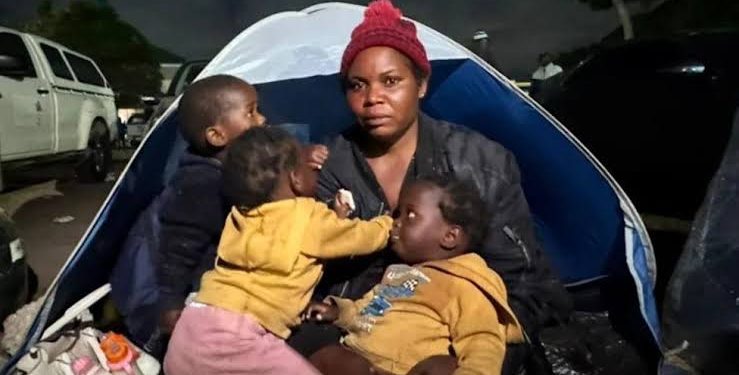
“I am very scared and traumatised,” Esnat Joseph, a 36-year-old Malawian woman, told the BBC as she tried to comfort her crying one-year-old triplets.
She fled her home in an informal settlement in the port city of Durban, in KwaZulu-Natal province, seeking refuge in an open field where up to 7,000 foreigners – mainly Malawians – began gathering with their belongings two weeks ago.
“The people came to my house and told me: ‘You must leave. We don’t want you people to stay here any longer, so you have to go to your country.’ There were 10 and they were carrying weapons,” she said, describing how the group of South African men were holding machetes and whips.
“They cut my husband on his head and his neck. They were holding his neck like they wanted to kill him. Because of God he still survived, but he’s in the hospital.”
Many others at the field, where aid groups have been giving out blankets and food, report such door-to-door intimidation.
It follows a series of mainly peaceful protests this year led by the anti-migrant group March and March, opposition party ActionSA and others which have set 30 June as the deadline for undocumented migrants to leave.
Sticks in hand, the marchers have been chanting “Mabahambe” – a Zulu phrase meaning “They must go”.
As the countdown continues, President Cyril Ramaphosa warned South Africans on Tuesday that the “scapegoating of vulnerable people” was not the solution to country’s complex economic challenges.
Joseph came to South Africa three years ago and was working as a domestic servant before having her children.
Her legal status is not clear – she says she lost her passport and other paperwork in a robbery. She aims to go back to Malawi on one of the buses the Malawian consulate has been arranging with the help of donations for its desperate citizens to leave Durban.
Ghana, Mozambique, Nigeria and Zimbabwe have also been organising repatriations by air or bus over the last few weeks – with about 3,500 foreigners volunteering to leave so far.
The South African authorities said the more than 500 Nigerians recently repatriated had been in the country illegally, although this was disputed by the Nigerian authorities.
Arriving in Lagos last week after nearly nine years in South Africa, Benjamin, a returnee who only gave his first name, told the BBC: “South Africans don’t like foreigners, especially Nigerians. South Africa is not a place to be – it’s a place you can lose your life at any time.”
Protest organisers deny their actions are xenophobic. They say they are sick of other Africans abusing the system and, as March and March leader Jacinta Ngobese-Zuma put it, “playing the victim card”.
“If you come into South Africa with a passport that allows you to stay for 30 days. When it’s 50 days, when it’s two years, when it’s five years, you know you’re breaking the law,” she told the BBC at one protest in Durban.
“We can’t have South Africa being turned into a refugee site for all failed African states… every country prioritises its citizens and we want the South African government to do the same.”
Latest figures show South Africa is home to more than three million foreigners, about 5% of the population – most from neighbouring countries in southern Africa.
But the statistics do not record the many more migrants believed to be in the country without papers – a bone of contention for the protesters.
Their anger is rooted in growing hardship as the country grapples with growing youth unemployment and economic inequality.
South Africa has one of the highest rates of unemployment in the world at 32.7%, according to Statistics South Africa, which recorded 350,000 job losses in the first quarter of 2026 – the majority of whom are young people.
However, the continent’s most-developed economy remains a magnet for citizens of poorer countries who risk their lives to go there to seek work such as security guards and domestic servants.
Protesters, like Mecha Ramorola, also point to the country’s strained public services with South African “people fighting for scarce resources”.
“We are struggling to get our children into schools. We are struggling to get our old people into hospitals,” Ramorola told the BBC during a march in the capital, Pretoria.
But there are fears these protests could lead to a repeat of the violence that broke out in 2008, when 62 people, including 21 South Africans, were killed in riots that forced thousands from their homes. There were also outbreaks of xenophobic violence in 2015, 2016 and 2019.
Last month the Mozambique government said five of its citizens had been killed in xenophobic attacks in Western Cape province. South Africa’s foreign minister disputed this, saying two Mozambicans had died and that the circumstances of their deaths were being investigated.
Videos on social media are fuelling the hostility towards foreigners.
In one, a Ghanaian man is harassed by protesters telling him to go home, which prompted Ghana to summon South Africa’s ambassador to demand better protection for foreign nationals.
Another widely shared one shows prominent protester Nkosikhona Ndabandaba, popularly known as Phakel’umthakathi and who has 1.4 million followers on Facebook, approaching a man standing by the roadside and asking him his nationality.
When he replies that he is Congolese, Ndabandaba – wearing his trademark Zulu headdress – tells him in a polite tone but without inquiring about his legal status: “30 June is the deadline, but it’s not that you have to leave on 30 June. Leave now.”
But foreigners living in the country legally say they are also being targeted – some are camping outside Durban’s Home Affairs office for protection.
“I have my own document that recognises my refugee status in South Africa, but all of us are still being chased away,” a Burundian woman, who was there with her four children, told the BBC.
“I am very afraid for my life. The children are afraid. There is no respect. When you pass by here, you are insulted. The children are insulted even at school,” she said as she wrapped herself in a blanket to shelter from the cold of the southern hemisphere winter.
Just going to the shops can be intimidating these days, a Malawian beauty therapist in Cape Town, who has lived in South Africa for 16 years without legal status, told the BBC.
She, her husband and their nine-year-old daughter had a scary incident in a taxi on the way to a shopping centre: “We were in an Uber, just the three of us, and we were being asked by an Uber driver where are your papers? Where are you from? You sound different.”
The beauty therapist says she can understand why Ramaphosa recently set out an action plan to deal with illegal migration – but stressed that human beings, legal or not, had a right to safety.
“My child is not even going to school because we’re scared. We’re terrified of what would happen now.”
In a special national address earlier this month, the president warned that no individual or group had the right to demand proof of nationality from people in public spaces and said government would act against them.
“There is no space for xenophobia, racism, sexism, Afrophobia or any other forms of intolerance in South Africa,” he said, explaining his coalition government’s five-point strategy to deal with the crisis.
These include refusing asylum claims from people who had travelled through other “safe” countries, the introduction of a quota for the naturalisation of citizens and extending the reach of digital IDs to non-citizens.
There will also be jail terms for employers who give low-paying jobs to undocumented migrants.
“You find an immigrant being employed in jobs that a South African will ordinarily not accept, or that pays less than what the government demands, because one, they’re desperate, two, they’re open to abuse in being short changed,” analyst Prof Shepherd Mpofu told the BBC.
Ramaphosa said efforts would also be made to crack down on corruption within the system.
A 36-year-old Malawian woman in Johannesburg, who asked not to be named for fear of reprisal, told the BBC that she came to South Africa on a visitor’s visa and had been bribing border officials to stamp her passport for a fee every couple of months without crossing the border.
“I have decided to go back home for a while and close down my hair salon because of threats,” she said, explaining that she feared for her young children’s safety.
The latest spike in protests comes as political parties seek support ahead of local government elections in November.
Some unscrupulous politicians have been using misinformation to fuel fear and anger over illegal migration – sharing old videos and confusing the narrative.
A debunked claim that South Africa has 15 million undocumented migrants, first popularised five years ago by ActionSA leader Herman Mashaba, who is campaigning to become mayor of Johannesburg, keeps resurfacing.
“Political parties are scraping the bottom of the barrel in trying to lie to people that all our problems are the migrants, and if we get rid of the migrants, then we’ll have no problems in South Africa,” says Sharon Ekambaram, a human rights lawyer and member of the Kopanang Africa Against Xenophobia movement.
“This has been an ongoing phenomenon in South Africa and more recently, it has been associated with elections.”
The government keeps pushing back – its ministerial task team on migration saying this week that 40,000 illegal immigrants have been arrested so far this year for contravening the Immigration Act.
The public face of this – known as Operation New Broom – can be seen in downtown Johannesburg where for the last few months excavators have been demolishing informal corrugated iron shops set up on pavements.
Officials see the areas as possible “hot spots” for criminals and illegal migrants.
On the day I visited, Ethiopian migrants looked on at horror at the destruction – though they had been warned by the authorities.
Such measures as well as the protests are leaving many migrants feeling like the walls are closing in.
uMkhonto we Sizwe (MK), the country’s third largest party led by former President Jacob Zuma and which has a lot of support in KwaZulu-Natal, has not backed the deadline for migrants to leave – but endorses its sentiments.
“We all agree that undocumented migrants are breaking the law… They must leave our country peacefully without any violence or intimidation,” MK member Bonginkosi Khanyile told the BBC.
Nonetheless there is a tangible fear nationwide given the ominous warning from Ndabandaba, one of the main protesters.
Back at the field in Durban, terrified Malawians – most, according to officials, without papers – cannot wait to get out.
When the first bus arrived to evacuate some of them on Sunday, the crowds chanted in Zulu “Siyahamba”, meaning “We’re leaving”.
News
Rep OK Chinda’s political network sparks across Rivers
The battle for the political soul of Rivers State gathered fresh momentum on Monday, August 3, 2026, as supporters of the former House of Representatives Minority Leader, Hon. Kingsley Chinda, activated what appears to be an early statewide mobilisation strategy, extending their campaign machinery to all 23 local government areas and ward structures ahead of the 2027 governorship election.
The development signals that while the official electioneering whistle is yet to be blown, political camps are already laying claim to the grassroots in what analysts describe as a familiar contest where influence, structure and strategic alliances often determine who eventually occupies Brick House.
The pro-Chinda support group, Our Will, announced the expansion of its political network across the state, directing its state executive members to immediately establish functional local government and ward executives capable of driving voter mobilisation before formal campaigns commence.
State Chairman of the group, King Okene, said the organisation was determined to transform Chinda’s existing political popularity into what he described as an “unstoppable electoral mandate,” insisting that every ward must become a political fortress for the lawmaker’s governorship aspiration.
According to him, the publication of the electoral timetable has effectively opened a new phase of political calculations, making early grassroots organisation a strategic necessity rather than a luxury.
“We should double our efforts to ensure we meet the targets before electioneering campaigns officially begin. Every local government and ward structure must be fully operational within the first week of August,” he charged members.
In what appeared to be a calculated attempt to frame Chinda as the political heir to a tested governance model, President-General of Our Will, Glory Wobo, declared that the federal lawmaker’s years of public service and close political association with the Minister of the Federal Capital Territory, Nyesom Wike, have adequately prepared him for the state’s highest office.
Wobo argued that leadership is cultivated through mentorship rather than chance, maintaining that Chinda’s political apprenticeship under Wike – combined with his experience as commissioner and long-serving legislator – has equipped him with the administrative depth required to govern Rivers State.
He cited ongoing infrastructure renewal in the Federal Capital Territory as evidence of the leadership tradition from which Chinda emerged, suggesting that effective governance leaves measurable footprints rather than campaign slogans.
According to Wobo, Chinda enjoys goodwill that cuts across political parties, ethnic groups and religious divides, describing the lawmaker as a consensus figure whose appeal extends beyond partisan politics into credibility, accessibility and public service.
The latest mobilisation drive underscores the intensifying political chess game ahead of the 2027 governorship election, where aspirants are increasingly investing in grassroots structures long before formal campaigns begin.
With support groups already deploying ward-by-ward political architecture and competing camps quietly consolidating influence, Rivers State is once again demonstrating that, in Nigerian politics, the contest for power often begins long before the first ballot is printed.
News
NBC files fresh appeal, justifies N5m fine regime for broadcasters
The National Broadcasting Commission (NBC) has filed an application seeking the permission of the court of appeal to file a fresh appeal against the judgement of the federal high court in Abuja barring it from imposing N5 million fines on erring broadcast stations.
In the application filed at the court of appeal in Abuja by Dapo Akinosun, counsel to the NBC, the commission argued sanity in Nigeria’s broadcasting sector is under threat and that the public interest would be better served if the court grants the application.
In the application, the NBC urged the court to grant it leave to raise and argue a fresh issue on appeal relating to the legal capacity of MRA to institute and maintain the original suit before the lower court.
The commission argued that the defect in the earlier notice of appeal, which resulted in the dismissal of its appeal, arose “solely from an inadvertent misdescription” of its name by its lawyer.
The NBC told the court that the subsisting judgement raises questions on the commission’s statutory powers to regulate broadcasting and enforce compliance with broadcasting standards in Nigeria.
The commission argued that the subsisting judgment is capable of creating uncertainty regarding its regulatory powers if it is allowed to stand.
The NBC also argued that without the pronouncement by the appellate court on the issues raised in the appeal, its regulatory framework would be weakened.
“A weakened regulatory framework may embolden non-compliance with established broadcasting standards, thereby increasing the dissemination of false, misleading and unverified information capable of causing unnecessary public anxiety, panic and social unrest,” the NBC said.
“Absence of effective regulatory oversight may further encourage irresponsible broadcasting practices and the misuse of broadcast and digital media platforms by persons who deliberately publish sensational, inaccurate or inflammatory content to intimidate, harass or unduly influence individuals, institutions and public discourse.”
News
Senate threatens sanctions as CBN, NUPRC, NDDC, others shun committee
The Senate’s ambitious investigation into the billions of naira in oil and gas revenues suffered a setback yesterday after several key government agencies failed to honour summons before the Senate Public Accounts Committee over issues arising from the Nigeria Extractive Industries Transparency Initiative (NEITI) audit reports.
Affected were the Central Bank of Nigeria (CBN), the Nigerian Upstream Petroleum Regulatory Commission (NUPRC) and the Niger Delta Development Commission (NDDC).
The committee, chaired by Senator Ibrahim Hassan Dankwambo (PDP, Gombe North), reacted angrily to the agencies’ absence, describing it as a blatant disregard for the National Assembly’s constitutional oversight powers and a direct affront to Nigerians who expect transparency and accountability in the management of public resources.
Yesterday’s hearing marked the commencement of a comprehensive legislative investigation into the 2021, 2022 and 2023 NEITI Oil and Gas Industry Audit Reports, a process expected to scrutinise oil sector revenues, remittances to the Federation Account, statutory financial obligations, royalty payments, regulatory compliance and the operational activities of over 60 Ministries, Departments and Agencies (MDAs), regulators, government-owned enterprises, as well as indigenous and multinational oil companies.
Despite formal invitations, public notices published in national newspapers and weeks of advance notice, the invited agencies failed to appear before the committee. Their absence forced the lawmakers to suspend the proceedings after waiting for over an hour.
Visibly displeased, members of the committee accused the agencies of treating the Senate with contempt and undermining legislative efforts to ensure accountability in one of Nigeria’s most strategic economic sectors.
Leading the criticism, Senator Babangida Hussaini described the repeated failure of government agencies to honour Senate invitations as a “recurring decimal,” arguing that such conduct erodes public confidence in democratic institutions and weakens parliamentary oversight.
According to him, the committee derives its investigative powers from the Constitution and the Senate Standing Orders, making compliance with its summons a legal obligation rather than a matter of discretion.
He lamented that lawmakers had cut short their yearly recess and constituency engagements to attend the hearing, only to discover that none of the invited agencies considered it necessary to send either their chief executives or representatives to explain their absence.
Hussaini warned that if the Senate of the Federal Republic of Nigeria could summon heads of agencies and they failed to appear without consequences, it would send the wrong message about accountability in government. He urged the committee to invoke the appropriate constitutional powers to address what he described as a disgrace to the nation.
Similarly, Senator Francis Ndubuezecriticised the agencies for failing to provide any explanation for their absence, noting that no letters were written, no excuses offered and no representatives sent to brief the committee. He argued that such conduct showed a lack of respect for the Senate and its constitutional oversight responsibilities, insisting that the integrity of the National Assembly must be protected.
Following the debate, the committee unanimously resolved to grant the defaulting agencies one final opportunity to appear before it on Thursday, August 6, 2026.
The committee also directed its secretariat to immediately communicate the resolution to all affected organisations and notify them that failure to honour the rescheduled hearing could compel the Senate to invoke its constitutional powers to enforce compliance.
MEANWHILE, the federal government has barred MDAs from awarding contracts, signing agreements, or incurring financial obligations without approved expenditure warrants and cash backing, in a move aimed at strengthening fiscal discipline and improving public financial management.
The directive, contained in a Federal Treasury Circular dated July 31, 2026, and released yesterday, introduces stricter guidelines for implementing the 2026 capital budget as the government seeks to curb the award of unfunded contracts and ensure that spending aligns with available resources.
Signed by the Accountant-General of the Federation, ShamseldeenOgunjimi, the circular was addressed to ministers, permanent secretaries, heads of extra-ministerial departments and agencies, service chiefs, the CBN Governor, the Clerk of the National Assembly, the Chief Registrar of the Supreme Court, heads of diplomatic missions and other federal institutions.
Under the new guidelines, MDAs are prohibited from issuing letters of award, signing contracts, or entering into any financial commitment unless they have first received the appropriate Warrant or Authority to Incur Expenditure (AIE) covering either the full contract value or the portion to be committed.
“In compliance with the provisions of Financial Regulations 318 and 415, respectively, no expenditure shall be incurred except on the authority of a Warrant/AIE (including employee payables),” the circular stated.
-
News20 hours agoAtiku, Obasanjo face-off may not stop until one finally dies– Shehu Sani
-
News20 hours agoKidnapped Kebbi Judge Faruku Bunza finally goes home after relaxing in abductors ‘paradise’ for one week
-
News20 hours agoTehran Denies Negotiating With US After Trump Announces Talks
-
Economy20 hours agoSee Dollar to Naira exchange rate today, August 3, 2026
-
Sports20 hours agoInfantino Could Have Earned £47m Annually From Abandoned World Cup Proposal
-
News20 hours agoINEC unveils Final list of candidates for 2027 elections, Jonathan, Nwoko, Goje, others missing
-
Education19 hours agoNYSC makes NERD clearance mandatory for corps members’ mobilisation
-
Economy19 hours agoCBN lists 5 strategies to drive next stage of Fintech growth in Nigeria