

News
From Blackouts to Breakthroughs: Why West Africa’s Energy Story Is Far From Finished
- /home/naijuinz/public_html/wp-content/plugins/mvp-social-buttons/mvp-social-buttons.php on line 27
https://naijablitznews.com/wp-content/uploads/2026/06/IMG-20260619-WA00321-1000x600.jpg&description=From Blackouts to Breakthroughs: Why West Africa’s Energy Story Is Far From Finished', 'pinterestShare', 'width=750,height=350'); return false;" title="Pin This Post">
- Share
- Tweet /home/naijuinz/public_html/wp-content/plugins/mvp-social-buttons/mvp-social-buttons.php on line 72
https://naijablitznews.com/wp-content/uploads/2026/06/IMG-20260619-WA00321-1000x600.jpg&description=From Blackouts to Breakthroughs: Why West Africa’s Energy Story Is Far From Finished', 'pinterestShare', 'width=750,height=350'); return false;" title="Pin This Post">
By Gloria Ikibah
For millions of people across West Africa, electricity remains a privilege rather than a guarantee. While cities grapple with frequent blackouts and ageing infrastructure, many rural communities still live beyond the reach of national grids, relying on candles, kerosene lamps and diesel generators to power their daily lives.
Yet a quiet energy revolution is unfolding across the region.
From Senegal to Ghana, Cabo Verde and Nigeria, solar mini-grids and off-grid renewable energy systems are gradually changing the story, bringing power to villages that have waited decades for electricity. The transformation is creating businesses, improving healthcare, supporting education and opening new economic opportunities.

But as promising projects emerge, a new challenge is becoming clear: generating electricity is no longer the biggest problem. Keeping pace with rising demand, financing expansion and building sustainable systems are proving to be the real test.
Access to electricity has long been one of West Africa’s greatest development challenges. According to the ECOWAS Centre for Renewable Energy and Energy Efficiency (ECREEE), millions of people in the region, particularly in rural areas, still lack reliable access to electricity despite significant progress over the past decade.
The ECOWAS Vision 2050 framework identifies energy access as a critical driver of industrialisation, regional integration and poverty reduction, recognising that economic growth cannot thrive without dependable power supply.
The situation reflects a wider African reality. While investment in renewable energy is increasing, expanding electricity access remains a major challenge because of population growth, financing gaps and ageing transmission infrastructure.
International agencies and reports by Reuters have repeatedly highlighted how frequent power shortages continue to slow industrial production, discourage investment and increase the cost of doing business across the region.
Against this backdrop, renewable energy has emerged as one of West Africa’s most practical solutions.
In Senegal’s Fatick Region, the rural community of Ndiob offers a glimpse of what is possible.
During a recent field mission, members of the ECOWAS Parliament’s Joint Committee on Energy and Mines, Infrastructure, Agriculture, Environment and Natural Resources travelled from Dakar to inspect a solar-powered mini-grid serving three villages.
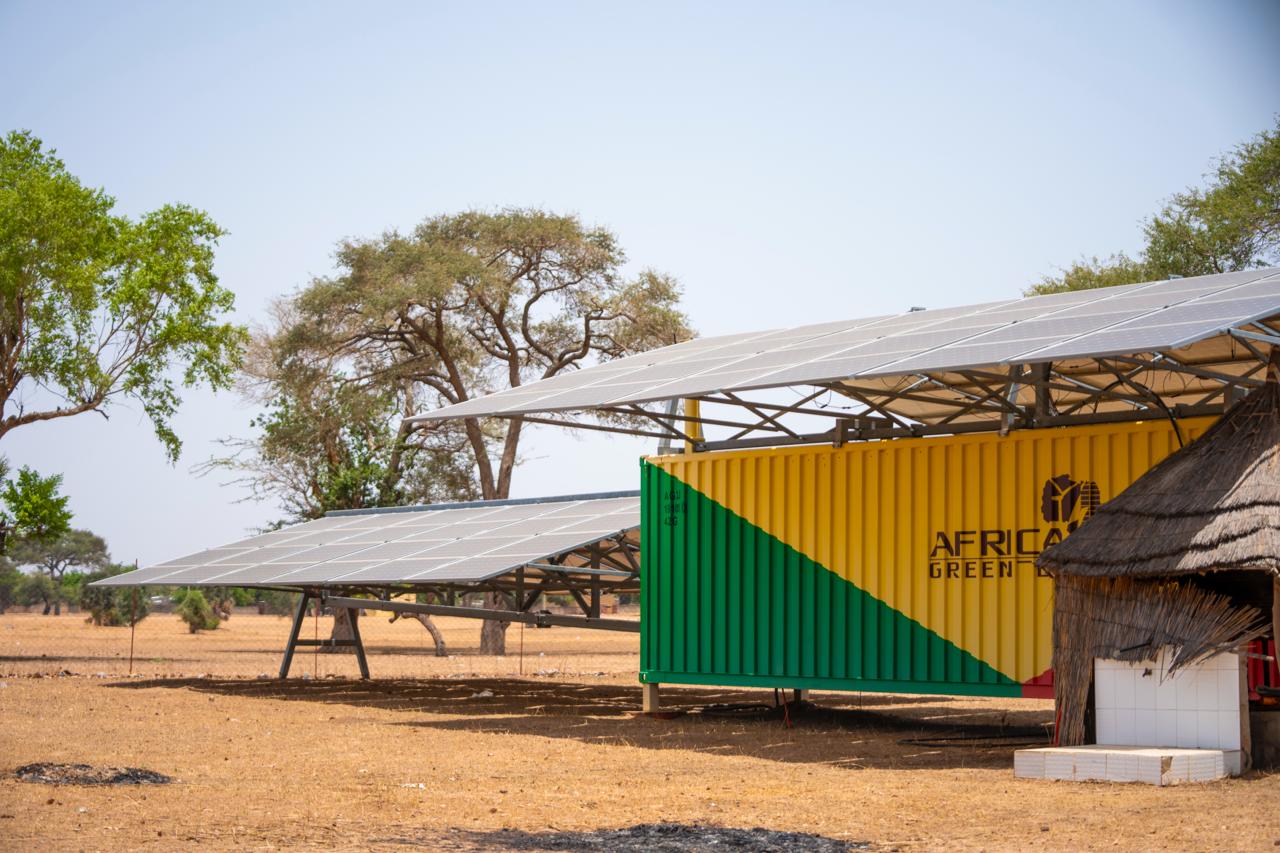
Managed by Green Impact West Africa under the supervision of Senegal’s Rural Electrification Agency (ASER), the project uses a containerised solar plant equipped with photovoltaic panels and lithium-ion battery storage to supply homes, schools, health centres and small businesses.
The impact is visible everywhere, as street lights illuminate roads that were once dark after sunset. Health centres preserve medicines safely. Schools enjoy longer study hours, while artisans such as welders, tailors and carpenters have expanded their businesses because electricity is available throughout the day.
Women have found new opportunities through food preservation and small-scale processing, while young people are being employed as technicians responsible for maintaining the solar facilities.
For residents, electricity has become more than a public service; it has become an economic asset.
As local resident Mustafa Faye told visiting lawmakers, thst the village now resembles a growing town, attracting residents who work in Dakar but choose to live in Ndiob because of improved living conditions.
Ironically, the success of the Ndiob project has exposed one of renewable energy’s biggest challenges.
Demand is growing faster than supply, especially when more households now own refrigerators and electrical appliances, while businesses require greater power capacity than the original installation was designed to provide.
Residents complain of low voltage and irregular supply, making it impossible to operate high-energy equipment such as air conditioners and larger machinery.
But the problem is not peculiar to Senegal. Across West Africa, many mini-grid projects were initially designed as pilot schemes serving small populations. As communities expand and local economies improve, electricity consumption rises sharply, placing enormous pressure on existing infrastructure.
Battery storage remains another major constraint.
Solar energy is abundant throughout West Africa, but without sufficient storage capacity, electricity generated during the day cannot always meet evening demand when households and businesses consume the most power.
Operators also face high maintenance costs, logistical difficulties in reaching remote communities and the challenge of replacing specialised equipment.
The biggest obstacle may not be technology but investment. This is because renewable energy projects require significant upfront capital, while returns often take years to materialise. Rural communities with low incomes may also struggle to pay electricity bills consistently, especially during agricultural off-seasons.
This makes long-term sustainability difficult without continued support from governments, development finance institutions and private investors.
Recognising these challenges, lawmakers at the ECOWAS Parliament’s five-day delocalised meeting in Dakar adopted resolutions calling for accelerated deployment of decentralised renewable energy systems across the region.
The Parliament recommended stronger financing mechanisms, harmonised regulations, improved quality standards for renewable energy equipment and greater support for productive uses of electricity that generate income for rural communities.
The lawmakers also urged increased backing for ECREEE and renewed efforts to address financial challenges affecting the West African Power Pool (WAPP), the regional electricity integration project designed to enable cross-border power trading.
For many policymakers, sustainable rural electrification will depend on community ownership rather than government intervention alone.
Speaking after the field visit, ECOWAS Parliament Vice Chairman of the Committee on Infrastructure, Hon. Ahmed Munir, said renewable energy projects are already creating jobs and reducing poverty across rural communities.
According to Munir, lawmakers witnessed women producing and selling ice blocks, tailors expanding their businesses and young technicians maintaining solar installations.
“We saw prosperity, not just electricity,” he said.
Munir argued that communities should actively invest in renewable energy enterprises instead of waiting for governments or foreign investors to solve every problem.
His position reflects a growing consensus among energy experts that local participation increases project sustainability while creating stronger economic incentives for maintenance and expansion.
The experience in Ndiob demonstrates that electricity is not simply about switching on lights.
Reliable power supports cold storage for farmers, reduces post-harvest losses, improves healthcare delivery, strengthens education and creates opportunities for entrepreneurship.
Every additional connection has the potential to generate employment and stimulate local economies. The visit also exposed a broader reality confronting West Africa’s energy transition: solar panels alone will not solve the region’s electricity deficit.
Greater investment in battery storage, stronger transmission systems, local technical skills, supportive regulations and innovative financing models will all be required if renewable energy is to achieve its full potential.
West Africa possesses one of the world’s richest solar resources, but the challenge is no longer whether the region has enough sunshine.
The real question is whether governments, investors and communities can work together to transform that natural advantage into reliable electricity capable of powering homes, businesses and industries for generations to come.
If the lessons from Ndiob are any guide, the future is already taking shape. What remains is ensuring that the infrastructure grows as quickly as the ambitions of the people it serves.
News
Police arrest suspected bandit, recover ammunition in Kano
The Kano State Police Command has arrested a 28-year-old suspected bandit and recovered an AK-47 magazine, 109 rounds of live ammunition, suspected military uniforms and other incriminating items during an operation in Bichi Local Government Area of the state.
In a statement by the Police Public Relations Officer, CSP Abdullahi Haruna Kiyawa, the arrest was made by operatives of the Bichi Divisional Police Headquarters following credible intelligence provided by a member of the public regarding a man allegedly wearing a suspected military uniform at Rimaye Village in Bichi LGA.
According to the statement, the police team, working in collaboration with members of the Rimawa Community, intercepted the suspect, identified as Mohammed Isah Haruna of Dan Dinshe Yamma Quarters in Dala Local Government Area.
A search of his bag led to the recovery of one AK-47 magazine loaded with 30 rounds of live ammunition, an additional 79 rounds of AK-47 ammunition, two sets of suspected military uniforms, three military caps, a suspected fake military identity card, personal identification documents, four ATM cards and a pair of desert boots.
The command said the suspect confessed during interrogation that he was in the area to deliver the recovered items to bandits operating in nearby forests. It added that the suspect is currently in police custody while investigations have commenced to apprehend other members of the criminal network before the case is charged to court.
The Commissioner of Police in Kano State, CP Ibrahim Adamu Bakori, commended the vigilance of the Rimawa Community for promptly alerting the police, describing the arrest as another demonstration of the importance of community participation in combating crime.
News
Court stops FG from retiring education directors before 65
The National Industrial Court of Nigeria has voided the Federal Government’s policy requiring education directors to retire after spending eight years in office, ruling that teachers and education officers who become directors are entitled to remain in service until they attain 65 years of age or complete 40 years of pensionable service.
Delivering judgment in Abuja on July 10, 2026, Justice O. Y. Anuwe nullified circulars issued by the Office of the Head of the Civil Service of the Federation and the Federal Ministry of Education seeking to enforce the eight-year tenure rule against teachers and education officers serving as directors.
According to the CTC obtained by our correspondent on Tuesday, the court held that the circulars were inconsistent with the provisions of the Harmonised Retirement Age for Teachers in Nigeria Act, 2022, and were therefore invalid to the extent that they applied to teachers and education officers.
“A teacher or education officer, whether he or she got to the post of director or not, is entitled to retire from service on attaining 65 years of age or 40 years of service,” Justice Anuwe held.
The judge added that serving as a director for eight years “is not a retirement condition for teachers any longer.”
The suit, marked NICN/ABJ/79/2025, was instituted by Mrs Rakiya Gambo Iliyasu, a Grade Level 17 director in the University Education Department of the Federal Ministry of Education, who challenged directives requiring directors who had spent eight years in office to retire.
Iliyasu argued that as an education officer, she qualified as a teacher under the Harmonised Retirement Age for Teachers in Nigeria Act, 2022, which guarantees compulsory retirement only at the age of 65 years or after 40 years of pensionable service.
She contended that the February 2026 circulars issued by the Head of the Civil Service of the Federation and the Federal Ministry of Education unlawfully sought to compel her and other education directors to retire before reaching the statutory retirement age.
Agreeing with the claimant, Justice Anuwe held that Section 3 of the Teachers’ Retirement Age Act expressly exempts teachers from any Public Service Rule requiring retirement before the age of 65 years or 40 years of pensionable service.
The judge also relied on the Act’s definition of a teacher, which expressly includes education officers, holding that the claimant fell squarely within the category of officers protected by the law.
The court further observed that the Office of the Head of the Civil Service of the Federation had, in an earlier 2025 correspondence, acknowledged that education officers covered by the Act were exempt from the eight-year tenure policy, making the government’s subsequent issuance of retirement directives inconsistent with its earlier position.
Consequently, the court declared the February 10, 2026, circular issued by the Head of the Civil Service of the Federation and the February 24 and February 26, 2026, circulars issued by the Federal Ministry of Education illegal, null and void insofar as they applied to teachers and education officers.
Justice Anuwe also set aside the three circulars and granted a perpetual injunction restraining the Federal Government and the Ministry of Education from implementing the eight-year tenure policy against teachers and education officers in a manner inconsistent with the Harmonised Retirement Age for Teachers in Nigeria Act.
Each party was ordered to bear its own costs.
The dispute arose after the Office of the Head of the Civil Service of the Federation and the Federal Ministry of Education issued circulars in February 2026 directing that directors who had spent eight years in office should retire in line with Rule 020909 of the Public Service Rules.
The directives affected several directors in the Federal Ministry of Education who are career education officers, despite the enactment of the Harmonised Retirement Age for Teachers in Nigeria Act, 2022, which extended the retirement age of teachers in public educational institutions to 65 years or 40 years of pensionable service.
The 2022 Act was signed into law to address the shortage of experienced teachers, improve retention of skilled education personnel and strengthen the quality of teaching and learning in Nigeria.
It also broadened the definition of teachers to include education officers, a provision that became central to the legal dispute.
The judgment is expected to have significant implications for director-level education officers across the Federal Ministry of Education and other education-related federal agencies, as it clarifies that the provisions of the Teachers’ Retirement Age Act override the eight-year tenure rule in the Public Service Rules for officers protected under the law.
News
NANS declares emergency on dilapidated hostels
The newly inaugurated President of the National Association of Nigerian Students, NANS, Akinteye Babatunde Afeez, on Tuesday declared a state of emergency on the worsening condition of students’ hostels across Nigeria’s tertiary institutions, describing the facilities as unfit for human habitation and a major threat to learning.
Speaking at his inauguration in Abuja, Afeez painted a grim picture of accommodation in universities, polytechnics and colleges of education, accusing authorities of neglecting hostel infrastructure while millions of students are forced to live in unsafe, overcrowded and unhealthy environments.
He warned that the continued deterioration of hostel facilities could no longer be tolerated, insisting that students’ welfare, safety and dignity would become the defining focus of his administration.
“The state of students’ hostels across our tertiary institutions is pathetically disheartening. Many hostels are in a deplorable and dilapidated condition, and they continue to deteriorate with little or no attention from the relevant authorities,” he said.
Lamenting poor sanitation, inadequate facilities and exposure to environmental hazards, the NANS president declared: “I hereby declare a state of emergency on students’ hostels across tertiary institutions in Nigeria. The welfare, safety and dignity of Nigerian students can no longer be compromised.”
Beyond accommodation, Afeez promised to transform NANS into a more proactive pressure group capable of compelling government institutions to respond to students’ concerns.
He said the era of symbolic activism was over, stressing that the association would focus on advocacy, accountability and measurable outcomes.
“NANS must return to being the true voice of every Nigerian student,not just in words but in action. You deserve an association that is fearless in advocating for you, pragmatic and transparent in its actions, and consistent in delivering results,” he stated.
Highlighting achievements recorded within his first 50 days in office, Afeez said the association had intervened in the rescue efforts involving abducted students and teachers in Orire Local Government Area of Oyo State and facilitated the reinstatement of suspended students at the Ladoke Akintola University of Technology ,LAUTECH, and the Federal University Oye-Ekiti ,FUOYE.
He also disclosed that NANS had constituted monitoring committees to track interventions by the Tertiary Education Trust Fund ,TETFund, Niger Delta Development Commission ,NDDC, North East Development Commission ,NEDC,and the Industrial Training Fund ,ITF, with the aim of ensuring that students fully benefit from government programmes.
On the Nigerian Education Loan Fund (NELFUND), Afeez said the association would closely monitor implementation of the student loan scheme and confront challenges affecting beneficiaries.
He announced that payment of students’ upkeep allowances would begin within the week and revealed that NANS had published a list of institutions allegedly withholding refunds due to students despite receiving NELFUND disbursements.
The student leader also unveiled plans to mobilise students ahead of the next general elections, saying NANS would spearhead a nationwide campaign for Permanent Voter Card (PVC) registration to increase youth participation in governance.
“As Nigerian students, and with NANS as our umbrella body, we constitute a large percentage of the nation’s population. We must be actively involved in determining who governs us,” he said.
He further pledged to pursue stronger partnerships aimed at expanding access to scholarships, employment opportunities, telecommunications support and quality education while preparing Nigerian students to compete in a technology-driven global economy.
Representing the Minister of Education, Dr Tunji Alausa, the Director of Polytechnic and Allied Institutions, Mrs Amy Igwe, urged the new NANS leadership to promote peace, unity and responsible engagement in advancing students’ interests.
She said the Federal Ministry of Education regarded NANS as a strategic partner in the development of the country’s education sector and advised the new executives to embrace dialogue in resolving challenges.
“The Ministry of Education recognises NANS as a critical stakeholder and partner in the development of our education sector. I charge you to lead with vision, unity, responsibility and patriotism,” the minister said.
In a keynote address, the Vice-Chancellor of Olusegun Agagu University of Science and Technology, Okitipupa, Prof. Temi Ologunorisa, challenged the new leadership to champion accountability, innovation, security and students’ welfare.
He urged NANS to monitor the implementation of government intervention programmes to ensure no student was denied access to available support and called on the association to launch a national innovation initiative within its first 100 days in office.
Goodwill messages were also delivered by the Minister of Interior, Olubunmi Tunji-Ojo; the Minister of Youth Development, Ayodele Olawande; Managing Director of NELFUND, Akintunde Sawyerr; and the Senior Special Assistant to the President on Students’ Engagement, Sunday Asefon.
They congratulated Afeez on his emergence and pledged continued collaboration with NANS in advancing students’ welfare, empowerment and youth development across the country.
-
News23 hours agoUnited States Lobbying Firm Offers Asylum Support To Adeniyi Adeyemi Amid PFIPC Scandal
-
News14 hours agoVIDEO: DAY 25 of Projects Commissioning in FCT: Watch Wike’s brief dancing steps
-
News23 hours agoArmy Hands Over Rescued Oyo Teachers, Pupils To Governor Makinde
-
News18 hours agoSAD: UK based young Nigerian mum takes own life over mental challenges
-
News18 hours agoOrire: Nigerian Army gives reasons why drones could not locate kidnappers
-
Sports23 hours agoDutch Referee Rob Dieperink Dies Weeks After World Cup Removal
-
News23 hours agoTinubu Made Buhari President — And Buhari Returned the Favor, Gowon Reveals
-
News23 hours agoMakinde Urges UN To Probe Circumstances Surrounding Oyo Schoolchildren’s Abduction