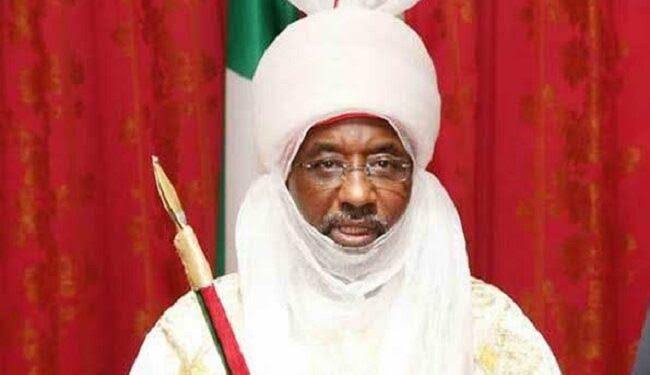
The Emir of Kano, Muhammadu Sanusi II, has attributed the roots of Nigeria’s worsening insecurity to years of ethnic, religious and regional divisions, arguing that inflammatory political rhetoric and media narratives helped create conditions in which violent movements could emerge.


Sanusi made the remarks on Wednesday in Abuja at the launch of a book documenting the tenure of retired Lieutenant General Tukur Yusuf Buratai as Chief of Army Staff.
The former Central Bank of Nigeria (CBN) governor said the country’s security crisis should not be examined solely through the lens of terrorism, banditry, kidnapping and other violent crimes. 
According to him, the deeper problem lies in the gradual erosion of a shared Nigerian identity and the increasing tendency to define citizens according to their ethnic, religious and regional affiliations.
Sanusi argued that repeated political and media references to Nigerians as Northerners or Southerners, Muslims or Christians, and members of particular ethnic groups had contributed to an environment that could facilitate the emergence and expansion of violent movements.
“The fundamental point I wish to emphasise is that the security crisis in this nation did not commence with violence as we currently witness it, nor did it commence with banditry. It did not commence with Boko Haram and terrorism,” he said.
He added that the divisions were reinforced through political discourse and newspaper narratives, which, in his view, contributed to the conditions that allowed violent groups to emerge.
Sanusi warned that continued exploitation of ethnic and religious identities for political purposes could create conditions for another cycle of violence.
“We are only laying the foundation for a new round of violence,” he said, urging Nigerians to place national identity and development above ethnic and religious affiliations.
The monarch also called for clearer boundaries between politics and religious leadership, arguing that politicians should concentrate on governance and development while religious leaders should focus on their spiritual responsibilities.
“It is not the responsibility of politicians to give us religion. They are there to give us education, to give us healthcare, to give us an economy and allow the religion to be in the hands of those who are religious leaders,” he said.
Sanusi similarly cautioned religious leaders against becoming deeply involved in partisan politics, saying the growing overlap between religious institutions and political interests could make it harder for citizens to hold political leaders accountable.
He argued that institutions such as the military, police and Central Bank must operate with long-term national objectives rather than the short electoral cycles of elected politicians.
“The army cannot think in four-year cycles. The police cannot think in four-year cycles. The central bank cannot think in four-year cycles. We have to think 20 years, 30 years, 50 years, whereas elected officers are thinking in four-year cycles,” Sanusi said.
Nigeria has faced multiple and overlapping security challenges over the past two decades, including the Boko Haram insurgency in the North-East, armed banditry and mass kidnappings in the North-West and parts of the North-Central region, as well as communal and separatist-related violence in other parts of the country.
Sanusi’s comments come amid continuing national debate over the underlying causes of insecurity and the roles played by governance, poverty, political mobilisation, ethnic and religious tensions, weak institutions and organised criminal networks.
While security operations remain central to the government’s response, Sanusi argued that addressing the deeper social and political divisions within the country must also form part of any long-term strategy to restore stability.