Connect with us

News

BREAKING: Building Collapses in Enugu Community, Casualties Feared

Published

on

ADVERTISEMENT
Zoom Ad
ADVERTISEMENT
Zoom Ad

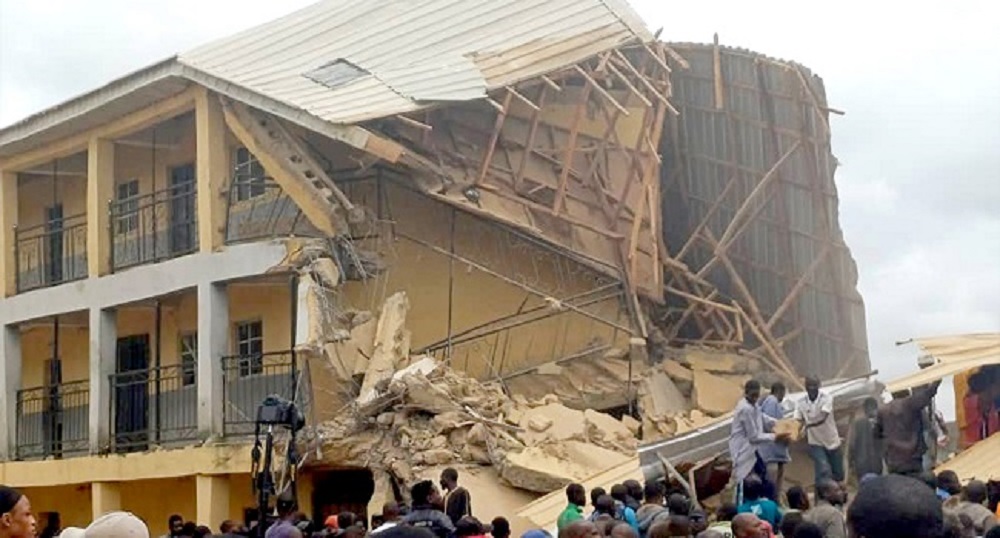
A building has reportedly collapsed in Newnenta, Awgu Local Government Area of Enugu State, raising fears that several people may have been trapped beneath the rubble.


The incident reportedly triggered panic in the community as residents rushed to the scene, where efforts were underway to search the debris and determine whether anyone was trapped inside.

Videos circulating from the scene showed residents gathered around the collapsed structure as rescue efforts continued.

The number of casualties, if any, could not immediately be confirmed, while authorities had yet to issue an official statement on the incident at the time of filing this report.

Advertisement

The cause of the collapse also remains unknown, with details of the incident still emerging.

Rescue efforts are reportedly focused on clearing the debris and determining the extent of the damage, as well as accounting for people who may have been inside the building when it collapsed.
Continue Reading
Advertisement

News

“Taiwan Roads” Washing Away? Anambra Creators Challenge Soludo Over Road Projects

Published

on

ADVERTISEMENT
Zoom Ad
ADVERTISEMENT
Zoom Ad

Two Anambra-based content creators, Waga Ge Comedy and Ozigbondu Mmuo, have criticised Governor Chukwuma Soludo’s administration over the condition of some roads reportedly constructed under his government.

In a social media commentary, the creators claimed they had previously warned residents of Anambra State against supporting Soludo’s re-election, alleging that some newly constructed roads were already showing signs of deterioration following heavy rainfall.

They also accused the governor of devoting attention to criticism of former Anambra governor Peter Obi while allegedly failing to ensure the durability of some projects executed by his administration.

«“We warned Ndi Anambra not to vote for Governor Soludo’s re-election, but you people didn’t listen. Prof. Soludo is busy attacking Peter Obi, while the ‘Taiwan roads’ he promised Ndi Anambra are being washed away by rain. Meanwhile, the roads constructed by Peter Obi that he is attacking are still very intact,” the creators said.»

Advertisement

Their comments have reignited debate over Soludo’s infrastructure record, particularly his administration’s ambitious road construction programme and his broader vision of transforming Anambra into a “Dubai, Taiwan and Silicon Valley of Africa.”

Soludo has repeatedly defended the infrastructure drive. In April 2026, the Anambra State Government said more than 500 kilometres of roads had been completed, with over 800 kilometres awarded for construction since the administration came into office.

The state government also said in June that more than 760 kilometres of roads had been awarded under the administration, highlighting projects including the Nwagu Agulu–Nise Road, Amansea–Ufuma Road and Tarzan–3:3 Road.

Soludo has previously explained that his “Dubai-Taiwan” vision extends beyond physical infrastructure, arguing that the transformation of Anambra also involves education, human capital development, technology and economic growth.

Advertisement

The governor’s administration has also faced scrutiny over the quality and performance of individual road projects. In 2024, for instance, Soludo terminated a road contract in Okpoko over what his administration described as poor performance and delays.

The latest criticism, however, centres on claims that rainfall has damaged some roads associated with the current administration. Those specific claims have not been independently verified on a road-by-road basis.

The controversy comes as Anambra continues to debate the scale, quality and durability of infrastructure projects under Soludo, as well as comparisons between his administration and previous governments, including that of Peter Obi.

While supporters point to the volume of road construction and other infrastructure projects, critics continue to question the quality and long-term durability of some projects.

Advertisement

The condition of any specific road cited by the content creators would therefore need independent inspection and verification before conclusions can be drawn about the wider road programme.

Continue Reading

News

Appeals Court upholds NDC party registration, overturns Lokoja ruling

Published

on

By

ADVERTISEMENT
Zoom Ad
ADVERTISEMENT
Zoom Ad

The Abuja Division of the Court of Appeal on Friday set aside a judgement of the Federal High Court that deregistered Nigeria Democratic Congress (NDC).

The two-member majority ruling held that the ruling of June 26, 2026, was an abuse of power, saying the court was wrong to sit over appeal of its own earlier judgment of December 10, 2025, which had directed the Independent National Electoral Commission (INEC) to register the NDC.

The appellate judges also dismissed the adversarial claims over the NDC’s use of a logo said to belong to another political association, the Peace Movement Party (PMP), which was the basis of Justice Isah Dashen’s in December.

Justice Okon Abang dissented in the ruling, saying he would have upheld the deregistering of the NDC, a major opposition party under which Nigerian political figure Peter Obi is contesting the presidency in 2027.

Advertisement
Continue Reading

News

FG begins review of tax laws, fiscal policies

Published

on

By

ADVERTISEMENT
Zoom Ad
ADVERTISEMENT
Zoom Ad

The Federal Government has commenced a six-week review of the new tax laws to identify implementation gaps, address consequences that have emerged since their implementation and consider concerns raised by the organised private sector and other stakeholders.

The review will examine areas including Value Added Tax thresholds, withholding tax, capital gains treatment and multiple taxation.

The media reports that President Bola Ahmed Tinubu last year signed into law four new tax bills passed by the National Assembly, describing the laws as pivotal to the success of his administration’s reforms and the country’s prosperity.

The bills were the Nigeria Tax Bill (Ease of Doing Business), which seeks to consolidate Nigeria’s fragmented tax laws into a harmonised statute; the Nigeria Tax Administration Bill, which establishes a uniform legal and operational framework for tax administration across the federal, state and local governments.

Advertisement

Others are the Nigeria Revenue Service (Establishment) Bill, which repeals the Federal Inland Revenue Service Act and creates a more autonomous and performance-driven national revenue agency, the Nigeria Revenue Service (NRS); and the Joint Revenue Board (Establishment) Bill, which provides a formal governance structure to facilitate cooperation between revenue authorities at all levels of government.

As implementation commenced, organised private sector groups raised concerns over some provisions of the laws, including those relating to Companies Income Tax and withholding tax.

In June, the organised private sector (OPS) wrote an open letter to President Bola Ahmed Tinubu, jointly signed by the leadership of key private sector bodies, including the Manufacturers Association of Nigeria (MAN), Nigerian Association of Small and Medium Enterprises (NASME), Nigerian Association of Small Scale Industrialists (NASSI), Nigerian Association of Chambers of Commerce, Industry, Mines and Agriculture (NACCIMA) and Nigeria Employers’ Consultative Association (NECA).

The groups warned that conflicting interpretations of the new tax laws had effectively paralysed corporate tax filings across the country.

Advertisement

The OPS said it fully supported the administration’s tax reform agenda and remained committed to lawful tax compliance, but argued that the implementation approach adopted by the NRS undermined the spirit and intent of the reforms.

“This Open Letter is not an attack on tax reform or lawful revenue mobilisation,” the group stated.

“It is a plea to preserve the legality, credibility and economic promise of the historic reforms championed by Your Excellency. Our members are willing and ready taxpayers. They seek a clear, lawful and functional framework through which they can file accurate returns, pay taxes already accrued to the Federation, protect jobs and continue investing in Nigeria.”

The dispute centres on how taxes relating to accounting periods that ended before January 1, 2026, should be treated.

Advertisement

According to the OPS, the General Transition Guidelines issued by the Minister of Finance and Coordinating Minister of the Economy pursuant to provisions of the Nigeria Tax Administration Act (NTAA) 2025 and Nigeria Tax Act (NTA) 2025 state that tax obligations arising from accounting periods ending before the commencement of the new laws should continue to be governed by the repealed tax laws, even if the filing and payment deadlines fall in 2026.

The private sector groups noted that the guidelines expressly provide that the new tax laws apply prospectively from January 1, 2026, except where specific provisions state otherwise.

The guidelines further state that no tax, penalty, surcharge, interest, filing obligation or administrative requirement under the new Acts should apply to any period before their commencement.

They also stipulate that Companies Income Tax payable for any basis period ending before January 1, 2026, should be determined under the repealed Companies Income Tax Act, notwithstanding that filing and payment may become due after the commencement date.

Advertisement

However, the OPS alleged that the NRS had adopted a different interpretation.

The controversy intensified after the NRS Emerging Taxpayers Office in Abuja issued a notice dated June 23, 2026, directing companies yet to file their Companies Income Tax returns for the 2026 Year of Assessment to do so under the new NTA and NTAA framework.

The notice stated that the NRS had no statutory authority to process Companies Income Tax returns for the 2026 Year of Assessment under the repealed Companies Income Tax Act or any other repealed tax legislation.

“The applicable law for filing is determined by statute and not by taxpayer election, publication, administrative discretion, advisory, or any other communication suggesting an alternative filing basis,” the notice said.

Advertisement

“The Service has no statutory authority to process Companies Income Tax returns for the 2026 Year of Assessment under the repealed Companies Income Tax Act or any other repealed tax legislation.”

While inaugurating the Technical Subcommittee on Fiscal Policy and Tax Reforms in Abuja yesterday, the Minister of Finance and Coordinating Minister of the Economy, Taiwo Oyedele, said implementation of the new laws had exposed areas requiring clarification and further reforms.

“The real test begins when the law meets the economy, as businesses interpret it, administrators implement it, investors respond to it, and citizens experience it. Implementation inevitably reveals areas requiring clarification, refinement or further reform,” the minister said.

The Nigeria Tax Act 2025, Nigeria Tax Administration Act 2025, Nigeria Revenue Service (Establishment) Act 2025 and Joint Revenue Board (Establishment) Act 2025 took full effect on January 1, 2026.

Advertisement

Oyedele said the government was shifting from fundamental tax reforms to continuous improvement, stressing that the review was not intended to reverse the 2025 reforms.

He said, “The Finance Bill 2027 should not be seen as just another annual legislative exercise. Our task is not to rewrite the 2025 reforms, but to preserve their fundamental principles while learning from implementation and responding to new economic realities.

“We must ask where implementation has revealed ambiguity, where unintended consequences have emerged, where compliance can be simplified, and where we can improve investment and competitiveness.”

The review will also cover fiscal policy and management, public financial management, debt, transparency, capital markets and cross-border capital flows.

Advertisement

According to Oyedele, the government received 134 submissions from across Nigeria’s geopolitical zones after inviting public input, alongside additional submissions made in hard copy.

Preliminary concerns raised by stakeholders included calls to clarify and simplify VAT thresholds, withholding tax and capital gains provisions.

Stakeholders also proposed stronger measures against multiple taxation and improved coordination among revenue authorities.

They called for greater digitalisation and data sharing to prevent taxpayers from repeatedly submitting information already available to government agencies.

Advertisement

Other proposals included stronger taxpayer rights, faster refunds, safeguards for small businesses and measures to improve investment and competitiveness in mining, renewable energy, healthcare and capital markets.

Oyedele urged the subcommittee to assess the economic impact of proposed changes, particularly on low-income households, workers and businesses.

“Every tax reform produces winners and losers; the question is whether a policy is fair, efficient and competitive, not whether it is popular with everyone,” he said.

He added, “A provision that raises revenue may impose a far greater cost on the wider economy. The government must optimise the whole economy, not merely achieve a single objective.”

Advertisement

The minister warned that complicated tax rules could increase compliance costs for businesses.

Beyond preparing recommendations for the Finance Bill 2027, the subcommittee will review the Deduction of Tax at Source Regulations 2024 and prepare revised withholding tax regulations.

It will also review the Companies Income Tax (Significant Economic Presence) Order 2020 and develop an updated framework aligned with the new tax laws and international practices.

The Permanent Secretary of the Federal Ministry of Finance chairs the subcommittee, while Chairman of the Tax Advisory Committee Albert Folorunsho serves as co-chair.

Advertisement

Members include representatives of the Federal Ministry of Justice, Nigeria Revenue Service, Joint Revenue Board, Nigeria Customs Service, Central Bank of Nigeria, Debt Management Office, Budget Office of the Federation and Nigerian Investment Promotion Commission.

Other members are drawn from the Small and Medium Enterprises Development Agency of Nigeria, Manufacturers Association of Nigeria, Nigerian Economic Summit Group, Nigerian Bar Association, Association of National Accountants of Nigeria, Chartered Institute of Taxation of Nigeria and Institute of Chartered Accountants of Nigeria.

Representatives of the Nigerian Association of Chambers of Commerce, Industry, Mines and Agriculture and the Big Four accounting firms — Deloitte, EY, KPMG and PwC — are also members.

Folorunsho said the committee would develop recommendations that respond to the needs of taxpayers, businesses and government.

Advertisement
Continue Reading

Trending

Copyright © 2024 Naija Blitz News