





By Gloria Ikibah
Nigeria has called for urgent reform of the United Nations, stronger international cooperation and renewed commitment to diplomacy, dialogue and international law as world leaders gathered for the 81st United Nations General Assembly (UNGA).
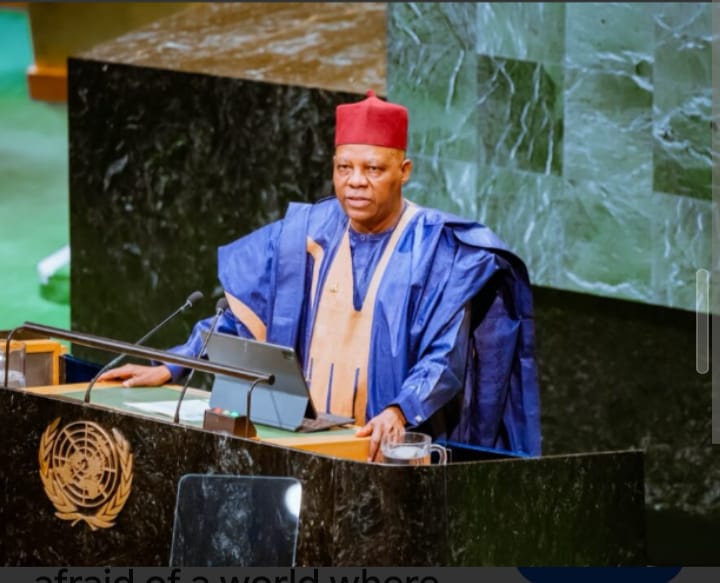
Vice President Kashim Shettima made the call while delivering Nigeria’s national statement on behalf of President Bola Ahmed Tinubu during the General Debate of the 81st UNGA in New York.
The General Assembly is being held under the theme, “Restoring Trust, Managing Transformation: A United Nations That Delivers for All.”
Nigeria urged member states to restore confidence in international institutions and reaffirmed its commitment to the UN Charter and its principles.
It stressed the importance of dialogue, mutual respect and collective responsibility in addressing global peace and security challenges.
A major focus of Nigeria’s address was the reform of the UN Security Council, with the country reiterating Africa’s longstanding demand for greater representation.
Nigeria restated its support for the Ezulwini Consensus and Sirte Declaration, which call for at least two permanent and five non-permanent African seats on the Security Council.
Shettima argued that reform was necessary to reflect current global realities and give Africa meaningful representation in decisions concerning international peace and security.
Nigeria also highlighted its contribution to international peacekeeping, recalling its involvement in Liberia, Sierra Leone, Darfur, Mali and The Gambia.
He reaffirmed Nigeria’s commitment to promoting peace, security and democratic governance through the Economic Community of West African States (ECOWAS), the African Union and Gulf of Guinea partnerships.
On the economy, Nigeria linked its foreign policy objectives to ongoing domestic reforms, saying sound macroeconomic management, stronger institutions, private-sector development and strategic public investment were central to sustainable development and the country’s contribution to global prosperity.
It also called for increased technology transfer, capacity building and climate finance to enable developing countries to pursue economic growth while meeting their climate commitments.
Nigeria reaffirmed its commitment to its Energy Transition Plan and the Paris Agreement, including its target of achieving net-zero emissions by 2060.
The country further drew attention to the opportunities offered by artificial intelligence and emerging technologies, citing investments in digital infrastructure, broadband connectivity, innovation ecosystems, research institutions and technology entrepreneurship.
It called for the responsible application of artificial intelligence in healthcare, education, agriculture, governance and economic productivity.
On development financing, Nigeria called for reforms to the international financial architecture and greater access to concessional financing and sustainable debt frameworks.
It also backed innovative financing through private capital, blended finance, South-South cooperation and strategic partnerships.
Nigeria described the African Continental Free Trade Area (AfCFTA) as crucial to expanding intra-African trade, strengthening regional value chains and promoting industrialisation, while moving the continent towards greater value addition and knowledge-driven growth.
On security, Nigeria called for stronger international cooperation against terrorism, organised crime, cyberattacks and illicit financial flows.
It urged countries to strengthen intelligence-sharing, build institutional capacity, disrupt the financing of violence and prevent the circulation of illicit weapons that fuel conflicts.
Drawing on its experience in confronting Boko Haram, ISWAP and other armed groups, Nigeria said lasting security must be supported by education, economic opportunities, accountable governance and protection of the rights and dignity of communities.
The country also called for urgent diplomatic efforts to address the conflicts in Sudan and other war-affected countries.
It urged parties to conflicts to protect civilians, facilitate humanitarian access and respect international humanitarian and human rights law.
Nigeria advocated greater emphasis on dialogue, reconciliation, peacebuilding and conflict prevention, stressing that military victories alone could not guarantee lasting peace.
Vice President Shettima also highlighted Africa’s youthful population, natural resources, expanding markets and capacity for innovation as opportunities that could make the continent an important driver of future global growth.
Nigeria called for developing countries to be recognised as essential partners in shaping global solutions and advancing shared prosperity.
Shettima pledged that Nigeria will continue choosing “cooperation over confrontation, dialogue over division, hope over fear, and partnership over isolation”.
He therefore called on UN member states to honour their obligations to one another and respond to current global realities with justice, wisdom and compassion.
Nigeria said a reformed, inclusive and effective United Nations was essential to building a peaceful, just and sustainable world for future generations.
He also described humanity as “the world’s oldest citizenship” and peace as “the inheritance owed to every child”.