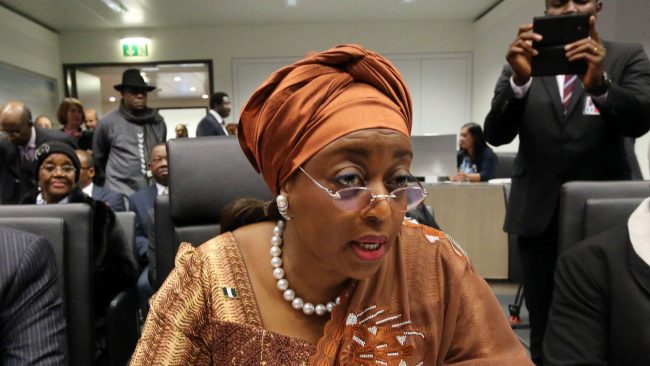
The Economic and Financial Crimes Commission (EFCC) has rejected former Minister of Petroleum Resources Diezani Alison-Madueke’s attempt to rely on her recent acquittal by a United Kingdom court in her ongoing legal battle over assets facing forfeiture in Nigeria.


The anti-graft agency urged the Federal High Court in Abuja to disregard the former minister’s attempt to introduce evidence of the UK proceedings, arguing that the case and her acquittal in Britain have no bearing on the issues before the Nigerian court.
The EFCC stated its position in a five-page further counter-affidavit filed before Justice Inyang Ekwo, in opposition to Diezani’s application seeking to place the UK court’s decision before the court. 
Diezani is challenging the EFCC’s move to auction or otherwise dispose of properties and personal effects allegedly linked to her.
The dispute intensified after the Southwark Crown Court in London discharged and acquitted the former minister on June 17, 2026, in a bribery case brought against her.
Following the UK judgment, Diezani sought permission to rely on the development in her Nigerian proceedings, arguing that the acquittal was a significant new fact that occurred while her case in Nigeria was still pending.
Her legal team maintained that the development was relevant to issues surrounding conviction, fair hearing, due process and the legality of depriving her of property rights.
However, the EFCC has strongly opposed that position.
In its response, the commission argued that the proceedings before the Southwark Crown Court were separate from the Nigerian case and had no legal connection to the issues requiring determination by the Federal High Court.
Oyakhilome Ekienabor, a litigation officer in the law firm of EFCC counsel, Mofesomo Oyetibo, SAN, described portions of Diezani’s additional affidavit as misleading, immaterial and irrelevant.
“The proceedings before the Southwark Crown Court, London, United Kingdom, and the purported acquittal of the applicant therein, are in respect of a proceeding that is not being prosecuted before any Nigerian court and have nothing to do with the substantive suit before this honourable court,” he stated.
The commission also challenged Diezani’s claim regarding the assets advertised for sale.
According to the EFCC, there was nothing in the public sale notice establishing that the properties listed belonged to the former minister.
It further argued that the forfeiture order relied upon by the commission was specifically limited to jewellery and did not extend to other categories of assets or properties.
“The order for forfeiture relates exclusively to items of jewelry and does not extend to any other category of assets or properties,” the commission submitted.
The EFCC also contended that Diezani’s legal team could not use supplementary filings to introduce new issues capable of expanding the scope of the substantive case.
It therefore asked Justice Ekwo to discountenance the additional affidavit and the attempt to introduce evidence relating to the UK acquittal.
But Diezani’s counsel, Prof. Mike Ozekhome, SAN, strongly defended the application.
In the 10-ground application, Ozekhome argued that the former minister’s suit was specifically challenging the EFCC’s public notice concerning the auction or sale of properties and personal effects allegedly affecting her proprietary rights.
He contended that the commission was seeking to impose serious proprietary consequences on Diezani without a conviction, fair hearing or strict compliance with the applicable forfeiture procedures.
Ozekhome noted that Diezani filed her amended originating motion on February 19, 2025, after obtaining the court’s leave two days earlier.
He argued that the June 17, 2026 decision of the Southwark Crown Court amounted to a subsequent material development because it occurred while the Nigerian proceedings were still pending.