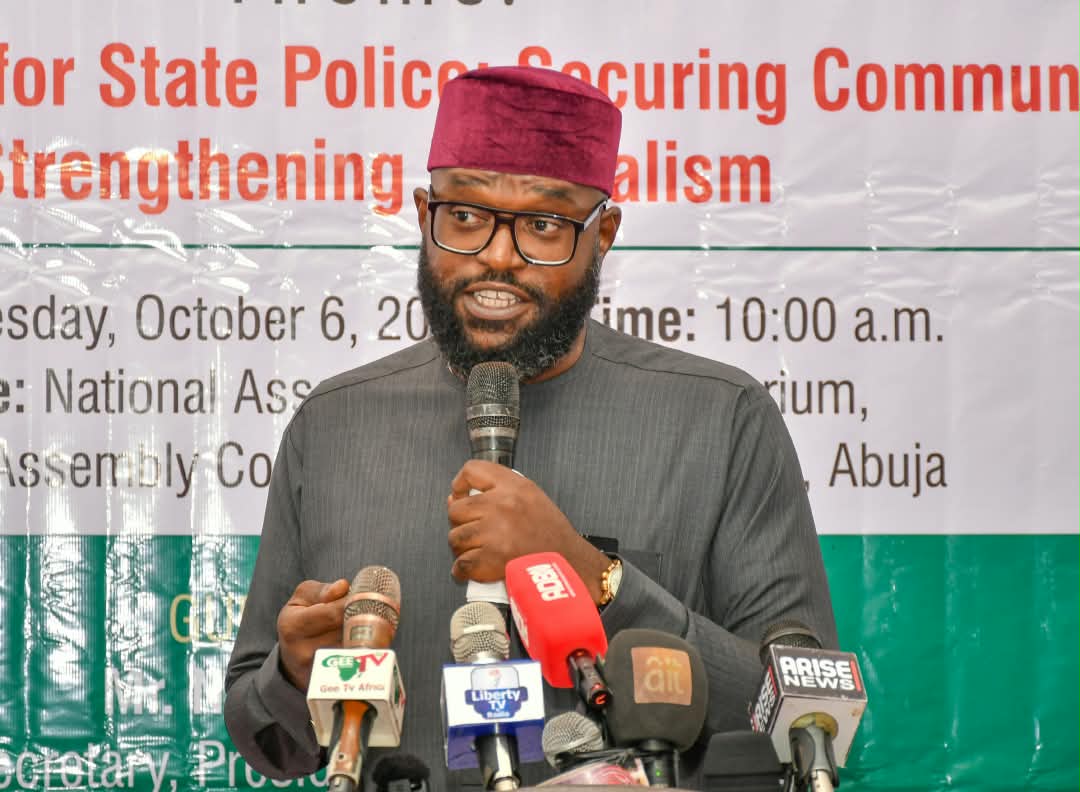
…says local policing must bring government closer to communities


By Gloria Ikibah
The Secretary of the Presidential Working Group on the National Policing Bill, Nnadubem Moghalu, has said that the proposed state police system must make security more responsive to local communities while preventing political abuse. 
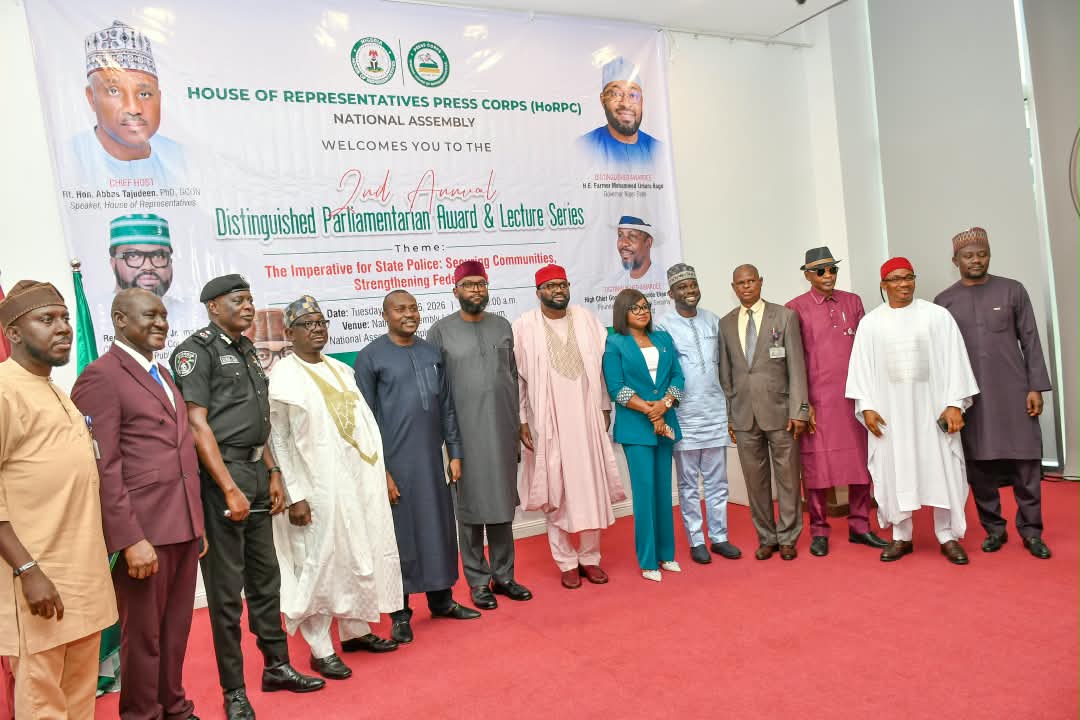
Moghalu, who spoke in Abuja on Tuesday at the 2nd Annual Distinguished Parliamentary Award and Lecture Series organised by the House of Representatives Press Corps, said state police can make responsibility for public safety more direct by connecting state governments with the communities they are expected to protect.
He, however, acknowledged concerns that state police could be exploited by political authorities, particularly governors.
Moghalu said Nigeria’s security needs varied from one community to another, making local knowledge an important part of effective policing.
He said: “State governments already face public demands to protect their communities. A workable federal policing system should connect responsibility with lawful authority and the capacity to act. State police offers an opportunity to make that connection more direct, while retaining the federal capacity necessary to address crimes and threats that cross state boundaries.
“Policing a dense commercial district requires different knowledge than policing a rural transport corridor. Effective prevention depends on understanding local circumstances, maintaining relationships and recognising changes before they become emergencies”.
He said the proposed system should also ensure that citizens can identify who was responsible when policing failed.
“There must also be a clear line of public responsibility. Citizens should be able to identify who is answerable for a failure and demand that it be corrected. Where responsibility is dispersed so widely that every institution can point somewhere else, the citizen is left carrying the consequences,” Moghalu said.
On concerns about political interference, he said the architects of state policing had to design institutions capable of withstanding abuse regardless of who occupied political office.
“Local knowledge, however, does not guarantee good conduct. Power can be abused close to home. A governor may put pressure on officers to treat a political opponent as an enemy of the state. There is also the danger that a local majority will seek to use the police against a minority.
“These are some of the concerns people have raised during our work. The people who raise these concerns are asking necessary questions, and any serious case for state police must answer them,” he said.
Moghalu said safeguards cannot depend merely on assurances from serving political office holders, arguing that the law must clearly define police powers and provide consequences for their misuse.
“Our institutions must be designed to work even when people we distrust hold power. Personal assurances from today’s officeholders cannot carry that responsibility. Therefore, the law must define authority clearly and make its misuse answerable,” he said.
He said the proposed constitutional change and the National Policing Bill were separate but connected processes.
According to him, the constitutional amendment will provide the basis for a dual policing structure, while the National Policing Bill would establish the operational framework for making such a system work.
“The amendment would create a constitutional basis for the dual policing model. The National Policing Bill is intended to provide the operational framework through which that constitutional model can work. State legislation and the practical work of building capable institutions must follow within the resulting legal framework,” he said.
Moghalu disclosed that four states Edo, Rivers, Osun and Oyo had approved the constitutional amendment bill at the time he delivered the lecture. He said 24 states were required for the constitutional process to reach the stipulated threshold.
He emphasised that constitutional approval alone would not produce functioning state police institutions.
“An alteration to the Constitution cannot, by itself, recruit and train an officer or equip a police station. It cannot create the administrative capacity to investigate a crime. Those tasks require preparation and resources, and they take time,” he said.
The presidential working group, he said, was therefore working on the legislation and other preparations ahead of the completion of the constitutional process.
Moghalu said the proposed policing reforms must not simply replicate existing weaknesses under a different structure.
“What I can state without reservation is the standard we must meet. First, if these reforms merely federalise the status quo, distributing familiar failures across more institutions, they will have failed,” he said.
He also stressed the importance of training, equipment, welfare and accountability for officers who would eventually operate under the new policing framework.
“Professional policing requires proper training and dependable support. An officer must be able to carry out a lawful duty with the equipment and institutional backing it requires. Welfare belongs in any serious discussion of performance. So does the expectation that misconduct will have consequences,” Moghalu said.
He said implementation would ultimately determine whether the proposed reforms delivered meaningful changes to policing.
“Most importantly, we must recognise that legislation begins a longer undertaking. Implementation will require sustained funding and administrative discipline. Courts and other justice institutions must be able to perform their own responsibilities,” he said.
Moghalu said Nigerians would ultimately assess the new policing arrangements by whether officers responded to reports, conducted competent investigations and dealt with complaints of abuse.
He said the National Policing Bill would be published once it had been transmitted to the National Assembly, allowing Nigerians to examine the complete proposal and make further observations.
“The plan is to publish the Bill on www.nationalpolicingbill.com when it is transmitted to the National Assembly and invite observations on the complete text,” he said.
He urged Nigerians to scrutinise the legislation, particularly provisions affecting police powers and accountability.
“When the Bill is published, examine it against the ordinary things you should be able to expect of your country. Ask whether its institutions can protect you when you need help, and whether you can hold them to account when they do wrong,” he said.
Moghalu said the ultimate test of the proposed policing system would be whether ordinary Nigerians could obtain police protection without political influence or financial demands.
“The Nigerian who needs the police at three in the morning should be able to get help without influence, without payment demanded as the price of protection, and without first becoming a national news story,” he said.