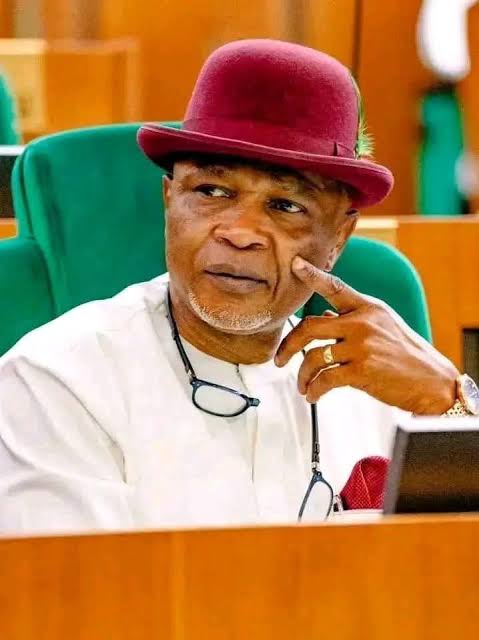
The political contest for the Rivers State Government House assumed a new dimension on Tuesday as the Rainbow Coalition unveiled its candidates for the 2027 general election, with the All Progressives Congress (APC) governorship candidate, Rep. Kingsley Ogundu Chinda, promising to replace the traditional “winner takes all” approach with a government of inclusion.


Chinda, a prominent federal lawmaker and one of the leading political figures in Rivers State, made the pledge before a mammoth gathering of supporters and political stakeholders at the coalition’s unveiling, declaring that victory at the polls would not translate into exclusion of those who backed the losing side.
His position is central to the political message of the Rainbow Coalition, an alliance bringing together political structures from about seven parties with the stated objective of pooling resources and support behind their candidates ahead of the 2027 elections. 
For Chinda, the coalition goes beyond an electoral arrangement. He presented it as a platform for rebuilding political cohesion in a state that has, in recent years, been deeply affected by intense political rivalry and divisions.
“If elected governor, it will no longer be winner takes all,” was the thrust of his message, as he pledged to run an administration that would accommodate divergent political interests and give every segment of the state a sense of belonging.
The declaration is significant given the high-stakes nature of Rivers politics, where control of the state has traditionally been tied to fierce contests for political influence, patronage and succession.
Chinda’s emergence as the APC governorship candidate has also added weight to the coalition’s strategy.
A seasoned federal legislator, he has built his political profile around years of representation and engagement with issues affecting Rivers people, particularly in the political space of the state’s oil-producing communities.
His supporters argue that his political journey, stretching from his early years as an undergraduate to his years in elective office, has been defined by consistency and advocacy for his people. His decision to make inclusiveness a central plank of his governorship campaign therefore appears designed to distinguish his political proposition from the adversarial politics that have characterised parts of Rivers’ recent history.
At the unveiling, Chinda said the coalition would work collectively to secure victory for President Bola Ahmed Tinubu, himself and other candidates contesting elective positions under the alliance.
He said the ultimate objective was to form a government of unity that would prioritise peace, development and inclusiveness, while rejecting political rancour, division and what he described as “zero-sum entitlement.”
The APC candidate also commended the Minister of the Federal Capital Territory, Nyesom Wike, for spearheading the Rainbow Coalition, describing it as a political arrangement capable of bringing together structures across party lines in pursuit of a common electoral objective.
The political significance of Wike’s role cannot be ignored. As a former Rivers governor and a major power broker in the state, his involvement gives the coalition considerable political weight, while Chinda’s candidacy provides the alliance with a candidate around whom its various interests can be consolidated.
Chinda consequently framed the coalition as an opportunity to move Rivers politics away from prolonged confrontation and towards cooperation.
He stressed that peace and unity were prerequisites for meaningful development, arguing that the state could not realise its economic and social potential without political stability and a shared sense of purpose.
The message also comes at a critical point in Rivers politics, where the 2027 governorship contest is expected to be closely fought. Beyond the conventional battle between political parties, the election is increasingly shaping up as a contest over competing political structures, alliances and personalities.
For Chinda, the Rainbow Coalition provides the vehicle to broaden the political base of his campaign while his promise of an inclusive administration seeks to reassure stakeholders who may otherwise fear marginalisation under a new government.
The real test, however, will come after the ballots are counted.
Whether the Rainbow Coalition can translate its broad political alliance into electoral victory—and whether Chinda can turn his promise of an inclusive government into reality if elected—will ultimately determine whether the “winner takes all” era he seeks to end becomes a defining political shift in Rivers State.