News
NCC hails Ministerial Initiative on Girls ICT Empowerment…Hosts 185 students on excursion
- /home/naijuinz/public_html/wp-content/plugins/mvp-social-buttons/mvp-social-buttons.php on line 27
https://naijablitznews.com/wp-content/uploads/2026/06/jfgk-2-1000x563.jpg&description=NCC hails Ministerial Initiative on Girls ICT Empowerment…Hosts 185 students on excursion', 'pinterestShare', 'width=750,height=350'); return false;" title="Pin This Post">
- Share
- Tweet /home/naijuinz/public_html/wp-content/plugins/mvp-social-buttons/mvp-social-buttons.php on line 72
https://naijablitznews.com/wp-content/uploads/2026/06/jfgk-2-1000x563.jpg&description=NCC hails Ministerial Initiative on Girls ICT Empowerment…Hosts 185 students on excursion', 'pinterestShare', 'width=750,height=350'); return false;" title="Pin This Post">
The Nigerian Communications Commission NCC, has commended the Hon. Minister of Communications, Innovation and Digital Economy, Dr. Bosun Tijani, for championing initiatives aimed at empowering the younger generation, especially the Ministerial Initiative on Girls ICT Empowerment, which aims to equip them with digital knowledge and skills, especially the Nigerian girls.

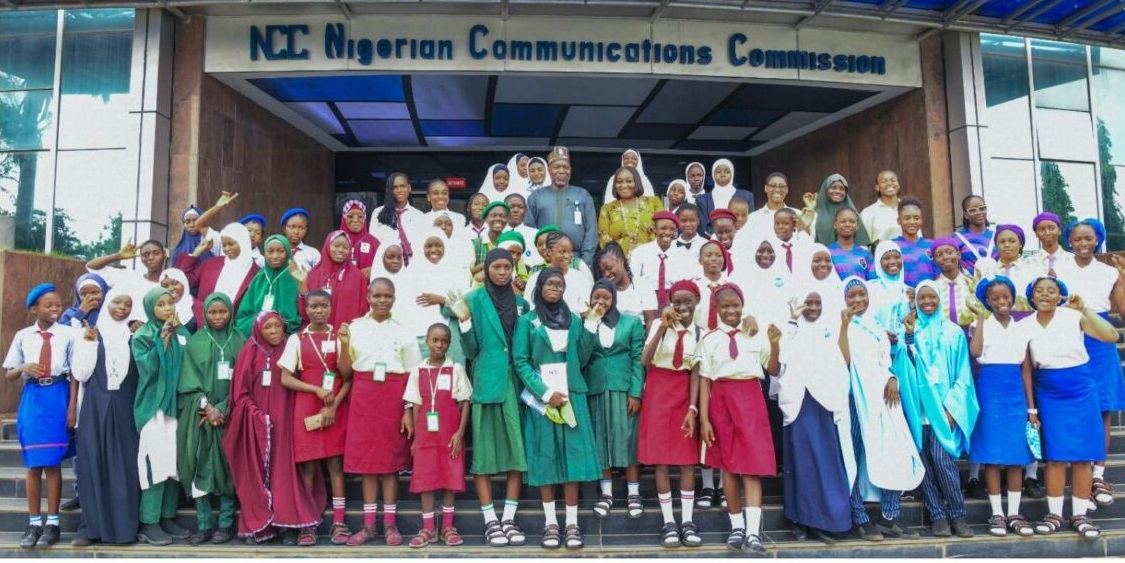
The Commission has also hosted a total of 185 students, who were on an excursion tour of industry facilities.
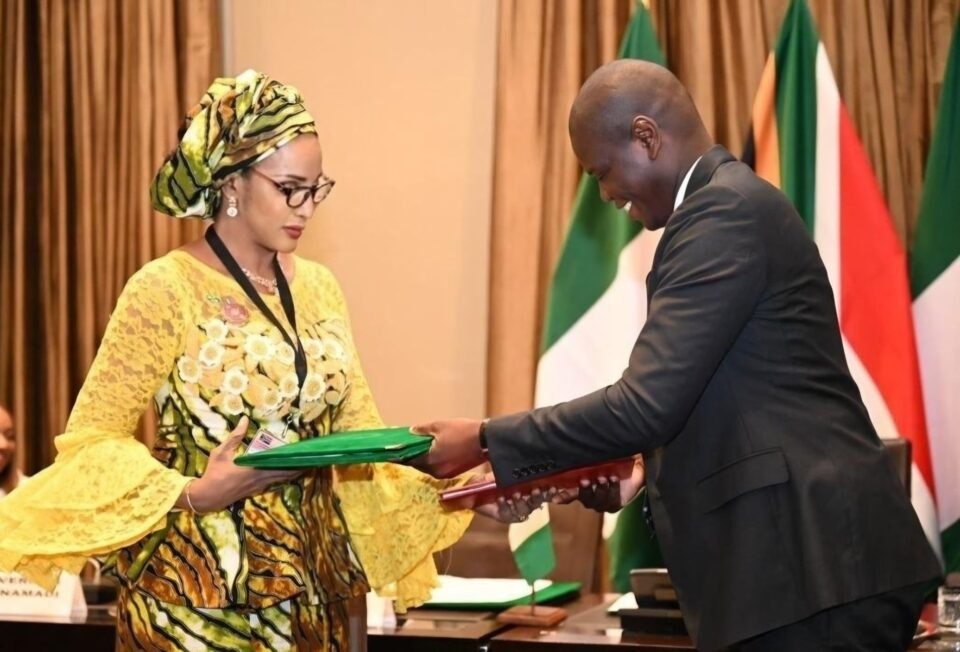
Executive Vice Chairman/CEO of the Commission, Dr. Aminu Maida, while speaking when he conducted the 185 contestants of the 2026 National Girls in ICT NG-ICT, Competition on a tour of the National Communication Museum domiciled at the Commission in Abuja, Thursday, said the initiative also aligns with the NCC’s digital literacy advocacy.

According to a statement signed by the Head, Public Affairs of the Commission, Nnenna Ukoh, disclosed that the contestants were selected by the Ministry across the country’s six geo-political zones for competition to promote digital inclusion and inspire greater participation of girls in Information and Communication Technology ICT, and other Science, Technology, Engineering and Mathematics STEM, disciplines.
The students’ visit to the Commission was part of activities organised by the Minister under the National Girls in ICT Programme, an initiative aimed at bridging the gender gap in the technology sector by equipping young girls with digital skills, mentorship opportunities and exposure to innovation.
The NCC-boss, who was represented by the Director, Research and Development Department, Babagana Digima, further noted that the museum tour was designed to create a link between the old and new generations in Nigeria’s telecommunications journey, helping young people appreciate the sector’s transformation from analogue systems to the current digital revolution.
During the study tour, NCC officials guided the students through exhibits and historical artefacts that document key milestones in the Nigeria’s telecommunications history and the evolution of the communications sector to date. He emphasised that understanding the industry’s history would inspire the participants to contribute meaningfully to the future of digital innovation in Nigeria.
The EVC noted that exposing young people to the history of technological advancement and innovation is essential to building a new generation of leaders for Nigeria’s growing digital economy.
“The whole idea behind this is that we are looking at the younger generation. We want to show them what communication is all about. This place is a museum meant to preserve the history of what has gone before and to keep the artefacts, ensuring that people see the evolution from the postal system to telegraphy, from analogue systems to the digital era.
“This is essentially what we are showing them in the shortest amount of time and, of course, to excite the curiosity of the young ones. When they see what happened in the past and how it has progressed into the future, they can also take it up from here and think about what it will look like going forward. That is the whole essence of having them here,” he said.
During the tour, the participants learned about generational trends in telecommunications development, dating back to 1886 when the colonial administration established first communication facilities primarily to support administrative functions. They were also taken through the history of the country’s early telegraph services, which linked Lagos to other parts of West Africa and Europe through submarine cable connections.
The tour highlighted the state of telecommunications at Independence in 1960, when the country had only 18,724 telephone lines serving an estimated population of about 40 million people. The students were also briefed on various development plans that followed Independence, the operations of the former Department of Posts and Telecommunications P&T, and Nigerian External Telecommunications NET, Limited, as well as the establishment of the Nigerian Telecommunications Limited NITEL, in 1985 to coordinate the provision of internal and external telecommunications services.
A major highlight of the visit was the display of rare historical artefacts preserved at the NCC Museum. Among the exhibits were a Post Office Counter dating back to 1852, Sorting Racks introduced to Lagos in 1852, the Grand “T” Key used at the Lagos Post Office in the nineteenth century, leather mail bags dating back to 1863, Drop Bag fittings from the late 20th Century, a 511A Letter Scale from the mid-20th Century, an Improved Dynamometer Scale from the 1920, Telegram machines, Teleprinter T100, Cordless PBX, Digital Card Phone and others.

News
SEDC Defends Record Before Senate, Says Less Than 10% of ₦140bn Budget Released
…highlight major projects, Programme,Regional Development Plans Amid Funding Challenges
By Gloria Ikibah
The South East Development Commission (SEDC) has reiterated its commitment to transparency, accountability and regional development following an oversight session with the Senate Committee on South East Development Commission at the National Assembly.
The interactive session, chaired by the Committee Chairman, Senator Orji Uzor Kalu, formed part of the National Assembly’s constitutional responsibility to oversee the activities of government agencies.
During the engagement, the Commission presented a detailed report of its activities since the inauguration of its Board in February 2025, covering its financial performance, institutional development, procurement processes, staffing, partnerships and ongoing programmes across the South-East.
The Commission also briefed lawmakers on its engagements with state governments, federal institutions, development finance organisations and other stakeholders involved in driving development across the region.
As part of its review, the Senate Committee requested additional documentation relating to certain aspects of the Commission’s operations and programme implementation.
Responding to the request, the Commission welcomed the move and sought a short extension to collate and submit the required materials.
Following discussions, the Committee adjourned proceedings to a later date pending receipt of the requested submissions, which the Commission is expected to provide on or before 23 June 2026.
SEDC used the opportunity to highlight progress recorded despite what it described as significant funding constraints.
According to the Commission, preparatory work has advanced on several major regional projects since the Board was inaugurated, including strategic infrastructure initiatives such as gas pipeline and railway projects designed to drive economic growth and regional integration.
The Commission also disclosed that it had established partnerships with a number of national and international institutions, including the United Nations Development Programme (UNDP), Afreximbank, Rural Electrification Agency, the Bank of Industry, Presidential Initiative on Compressed Natural Gas and Gas Aggregator Company of Nigeria.
It added that extensive consultations had been held with the governments of the five South-East states, federal ministries, development partners, academic institutions and private sector stakeholders to create a coordinated approach to regional development.
One of the major achievements highlighted during the session was the South East Vision 2050 stakeholder consultations, which brought together government officials, development experts, business leaders, academics and civil society groups to develop a long-term blueprint for the economic transformation of the region.
The Commission also spotlighted the successful rollout of the inaugural South East Venture Capital Programme (SEVCP), which it described as a flagship initiative aimed at promoting innovation, entrepreneurship and investment.
According to SEDC, 25 start-ups from across the South-East received equity investments through a transparent and competitive selection process under the programme.
The Commission said the initiative aligns with President Bola Ahmed Tinubu’s Renewed Hope Agenda and reflects efforts to strengthen entrepreneurship, private sector growth and investor confidence.
“Anchored within the South East Investment Company, the Programme represents a strategic effort to move beyond fragmented interventions towards a more structured and credible venture capital ecosystem for the South East, combining capital deployment with venture development, institutional partnerships, and pathways for attracting institutional capital into early-stage, high-growth enterprises across the region,” it stated.
However, the Commission expressed concern over the pace of funding releases, warning that implementation of critical projects could be affected if appropriated funds are not released promptly.
It disclosed that despite the Federal Government and National Assembly approving ₦140 billion for the Commission in the 2026 budget, less than 10 per cent of the allocation has so far been released.
The statement further read: “Of the N140 billion appropriated to the Commission in the 2026 budget, less than 10% has been released to date across all budget lines.”
SEDC stressed that accelerated releases are essential to enable the execution of key infrastructure, agricultural transformation, youth empowerment, economic development and regional security initiatives captured within its mandate.
“The scale of development required across the South East demands sustained funding, institutional coordination, and continued collaboration among all stakeholders,” the Commission noted.
Reaffirming its commitment to openness and accountability, the Commission pledged full cooperation with the National Assembly and all relevant oversight institutions.
“SEDC remains committed to full cooperation with the National Assembly and all relevant oversight institutions. The Commission views accountability, transparency, and constructive engagement as fundamental to the successful delivery of its mandate and will continue to provide all information required to support effective legislative oversight.
“The Commission remains focused on its responsibility to deliver meaningful and measurable impact for the people of the South East through disciplined planning, transparent governance, strategic partnerships, and the effective deployment of public resources. The Commission appreciates the continued support of the National Assembly and looks forward to sustained collaboration in advancing inclusive growth, shared prosperity, and long-term development across the region.”
News
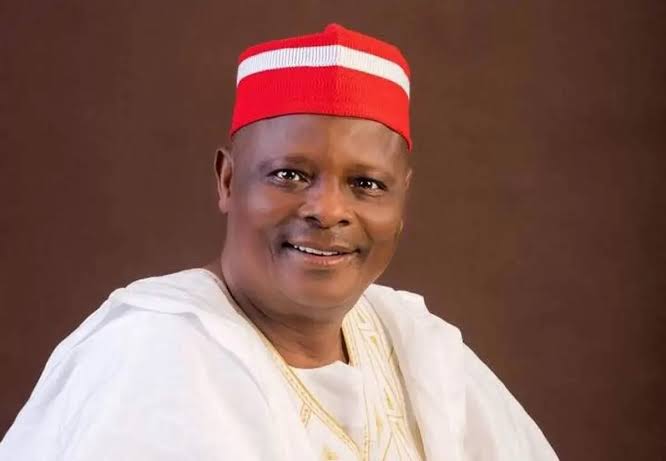
NDC leader, Dickson in closed door session peace talks to stop party crisis in Kano
The National Leader of the Nigeria Democratic Congress (NDC), Seriake Dickson, and other leaders of the NDC, on Monday, held a closed-door peace talks with aggrieved members of the party in Kano State.
Osa Director, the national spokesperson of the NDC, disclosed this in a statement on Tuesday.
Mr Director explained that the closed-door peace talks were part of efforts to resolve the primary election-related crisis between Kwankwasiya Movement and other NDC members in the North-western state.
Kwankwasiya Movement is a political support group founded by the NDC vice-presidential candidate and former Governor of Kano State, Rabiu Kwankwaso.
The national spokesperson said the meeting, which lasted for several hours, was “productive.”
Senator Dickson and the NDC leadership are mediating in the process in order to enhance inclusion and participation by every party member.
According to Oda Director the NDC leadership will not impose candidates in Kano State, and indeed across the nation as the party cherishes the virtues of internal democracy,” he said.
He stressed that the NDC has not released any official results of its 2027 primaries in any state.
He urged members to disregard any such list in circulation.
The cause of the crisis
It was gathered that some NDC members in North-west Nigeria recently alleged Mr Kwankwaso was plotting to facilitate the dominance of members of Kwankwasiya Movement in the region’s party structure while dropping other key party leaders.
The Vice-Chairman of the NDC in the North-west, Mohammed Serina, and the Chairman of the party in Kano State, Hussaini Mariga, made the allegations against Mr Kwankwaso in a petition recently submitted to the party’s national leadership.
The petition followed purported results of NDC’s primaries in North-west circulating on Facebook in which the majority of winners were linked to the Kwankwasiya Movement.
News
PDP logjam: INEC updates portal, names new treasurer, financial secretary
The Independent Electoral Commission, INEC, has removed the names of Ahmed Yayari and Daniel Woyengikuro from its portal as Peoples Democratic Party, PDP, National Treasurer and National Financial Secretary, respectively.
According to a check by DAILY POST shows that both names have also been replaced with Odeyemi Mackson Oladiran and Eyim Donatus Henry as the new executives.
Yayari and Woyengikuro who are part of the Makinde-backed Turaki faction while Odeyemi and Eyim are members of the FCT Minister Nyesom Wike’s faction, which is also the recognised faction of the PDP.
INEC had earlier recognised Wike’s faction by putting the names of Abdulrahman Mohammed as the National Chairman and Samuel Anyanwu as the National Secretary, but had left the names of Yayari and Woyengikuro as part of the executives.
With the recent update on its portal, all executives of the PDP on INEC’s portal are now aligned with FCT Minister Nyesom Wike.
-
News24 hours agoPRESIDENT TINUBU BEGINS PROJECT COMMISSIONING IN ABUJA ON TUESDAY
-
News17 hours agoOyo Police: How Family Aide Conspired in Kidnap of Ex-Minister’s Sister, Twin Sons
-
News16 hours agoINEC clears Maku, Ombugadu, 18 others for June 20 bye-elections
-
News24 hours agoJust in: Warri-Itakpe train derails, three passengers confirmed dead
-
News16 hours agoFinally, Amaechi emerges Atiku’s running mate after closed door meeting with him
-
News8 hours agoThe 30 Days of Projects Commissioning in the FCT starts today
-
News8 hours agoSad: Nigerian Labour Leader Dies At International Labour Conference In Geneva
-
News17 hours agoOhanaeze Ndigbo Bans Monarchical Titles In Edo