

Foreign
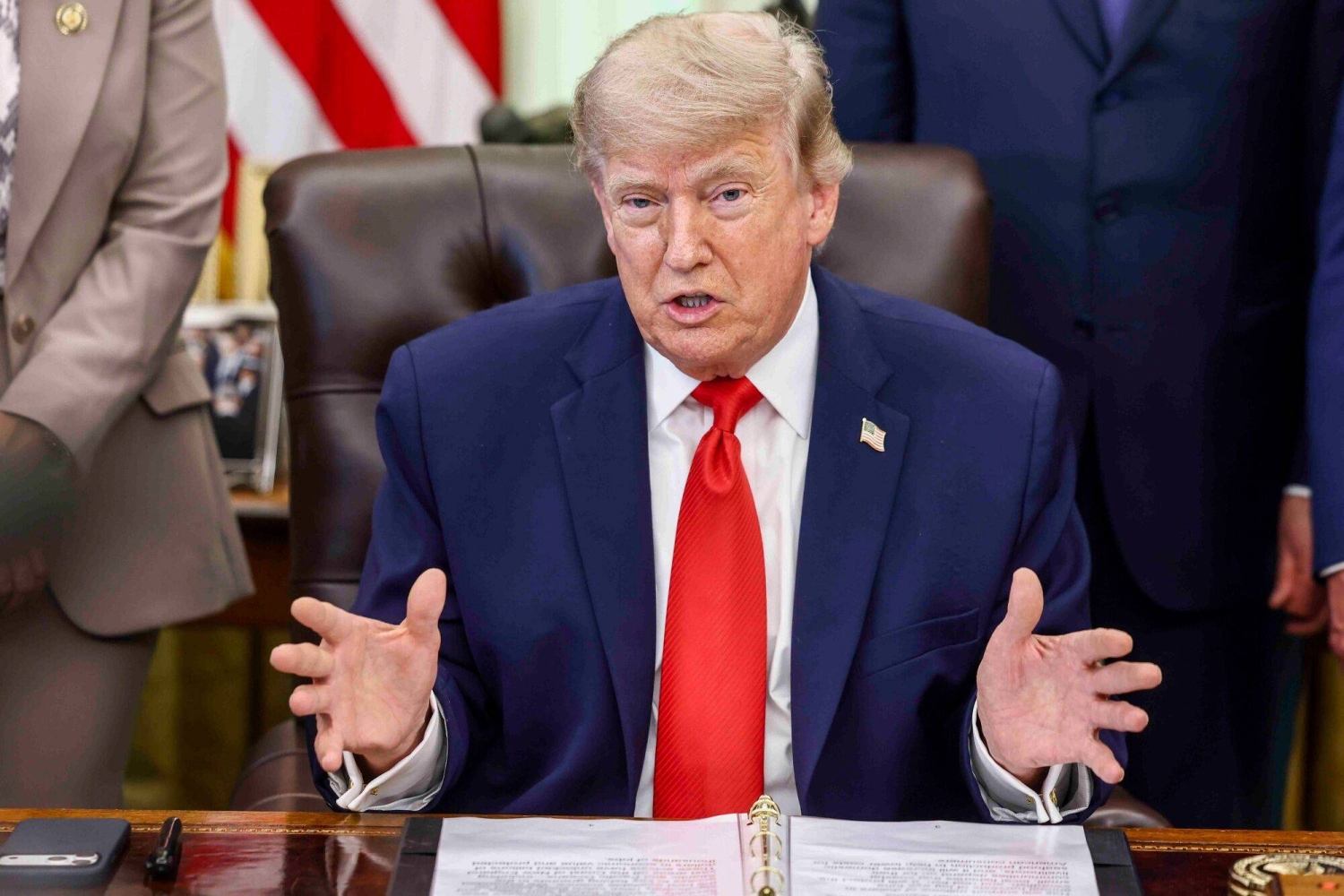
Hormuz to reopen on Sunday after US-Iran sign deal-Trump
- /home/naijuinz/public_html/wp-content/plugins/mvp-social-buttons/mvp-social-buttons.php on line 27
https://naijablitznews.com/wp-content/uploads/2026/06/545979-1000x600.jpg&description=Hormuz to reopen on Sunday after US-Iran sign deal-Trump', 'pinterestShare', 'width=750,height=350'); return false;" title="Pin This Post">
- Share
- Tweet /home/naijuinz/public_html/wp-content/plugins/mvp-social-buttons/mvp-social-buttons.php on line 72
https://naijablitznews.com/wp-content/uploads/2026/06/545979-1000x600.jpg&description=Hormuz to reopen on Sunday after US-Iran sign deal-Trump', 'pinterestShare', 'width=750,height=350'); return false;" title="Pin This Post">
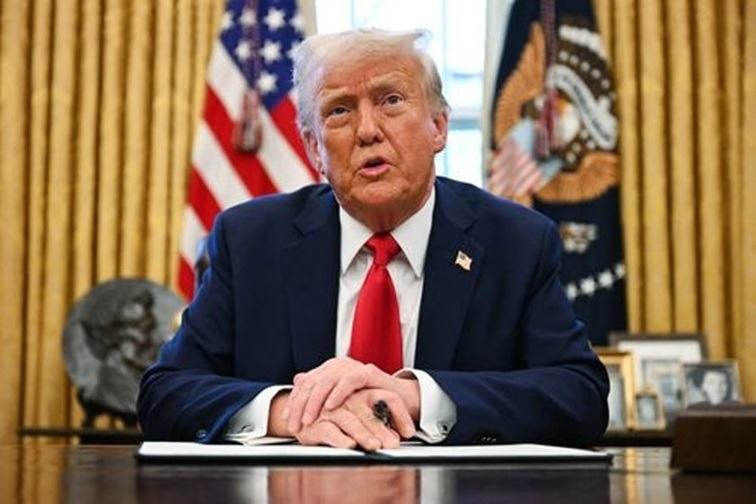
US President Donald Trump said that a deal with Iran to end the war in the Middle East could be signed on Sunday, and that the strategic Strait of Hormuz would be “open to all” immediately after.
Iran had offered a different timeline earlier in the day, but nonetheless signalled an agreement was in the offing, as both the warring parties and their mediators expressed increasing optimism that weeks of halting negotiations were drawing to a close.

The leader of key mediator Pakistan said a deal was closer “than ever before”.
The “finalisation” of this agreement is expected “within the next 24 hours”, Pakistani Prime Minister Shehbaz Sharif said Saturday on X, adding that it will be signed electronically, without going into further detail or specifying what this would involve.
He said “technical level talks” are expected to follow next week.
The momentum came in spite of fresh skirmishes in the Strait of Hormuz, which Iran has blockaded since early in the war, throwing global markets into turmoil.
“The Deal is scheduled to get signed tomorrow, and immediately after it is signed, the Hormuz Strait is OPEN TO ALL,” a post on Trump’s official Truth Social platform read on Saturday.
Since an April 8 truce paused the worst of the fighting, Trump has repeatedly insisted a deal was imminent, only for the wrangling to drag on.
Iranian foreign ministry spokesman Esmaeil Baqaei had said earlier on Saturday that the date of the signing was yet to be determined, but “it will not be tomorrow”.
However, he added: “The possibility of this happening in the coming days cannot be ruled out.”
The warring parties have nonetheless released conflicting information about the contents of the deal, as each seeks to show it emerged from the war with the upper hand.
Tehran has insisted it will maintain control over the Strait of Hormuz, a key maritime trade route for oil and gas shipments from the Gulf.
Since imposing its blockade, Iran has demanded that vessels obtain permission from its armed forces before transiting the waterway, and has established a new body to oversee it and collect tolls.
The US has responded with its own blockade of Iranian ports.
The US military’s Central Command said earlier Saturday Iran had “launched multiple one-way attack drones in an attempt to strike commercial ships transiting the Strait”.
It added that “US forces have downed all of them in recent hours”.
Iran’s Foreign Minister Abbas Araghchi, in an interview with state television on Friday, had said the deal on the table called for the lifting of the US naval blockade.
“The administration of Strait of Hormuz will no longer be the same as before,” he added, calling the waterway one of Iran’s “main instruments of deterrence”.
The US has repeatedly said Iran remaining in control of the strait would be unacceptable, and Trump’s post made no mention of tolls or other arrangements.
– ‘Nuclear dust’ –
Another key sticking point in the talks has been the fate of Iran’s nuclear programme, particularly its stockpile of highly enriched uranium — believed to have been buried by US strikes last year during a previous short-lived war.
Iran has long insisted its nuclear programme is peaceful and that it has a right to enrichment, but the United States, Israel and other Western governments suspect it of seeking a bomb.
Araghchi on Friday said the only way to deal with Iran’s enriched uranium “is to dilute it inside Iran”.
Trump, who has justified the war as necessary to prevent Iran from obtaining nuclear weapons, previously said the US would remove and destroy the uranium.
In Saturday’s post, he said: “When all is calm, we will go in and get the Nuclear Dust… and downblend and destroy it, whether in Iran, or the United States.”
“Hopefully, this process will all work out quickly, easily, and smoothly,” he added. “If it doesn’t, we have the ultimate alternative, hopefully never to be used again!”
Prime Minister Benjamin Netanyahu of Israel — which launched the war in tandem with the US in February — said Trump had promised him any agreement would include the removal of the enriched nuclear material.
In the streets of Tehran, there was scepticism that the latest agreement would cross the finish line.
“I don’t think there is any deal soon,” said Saeed Sadeghi, 49. “I don’t trust their word.”
Fars news agency shared a video from Iran’s northeastern city of Mashhad showing dozens protesting the deal outside a foreign ministry building on Saturday.
It showed women in black chadors chanting “death to dishonourable Araghchi, the infiltrator”, while waving red and black flags.
Foreign
US: How 17-year-old Boy Allegedly Killed Mother, Brother After ChatGPT Searches
A 17-year-old boy in Massachusetts, United States, allegedly killed his mother and 14-year-old brother after using ChatGPT to search for “theoretical ideas or fantasy stories regarding the killing of his family,” prosecutors said.
Arjun Aravind, 17, of Acton, a Boston suburb, was charged with two counts of murder over the deaths of his mother, Sudha Venkatesan, 45, and his brother, Siddharth Aravind, 14.
He was also charged with assault and battery for allegedly using “a dangerous weapon, a Laptop,” to attack the two victims, according to a criminal complaint filed in Concord.
Advertisement
Investigators said they found “a heavily damaged bloody laptop computer” at the family’s home, which they believed was used during the attack.
Police also found what appeared to be a knife.
“A bent utensil, possibly a knife with an orange handle, was also found in the area of the disturbance,” the complaint said.
What happened
Acton police officers went to the family’s home on Martha Lane at about 6:37 p.m. Tuesday for a welfare check.
Aravind’s tutor, who had a 4 p.m. appointment at the home, “was unable to make contact with residents upon arrival,” prosecutors said.
Shortly afterwards, Aravind’s father, who had left for work hours earlier, called police.
Officers then “found both victims dead inside,” Middlesex County District Attorney Marian Ryan said.
Siddharth was found on the first floor, while his mother was found in the basement.
The complaint said the boy was found “with massive trauma to the head” and “lying in a pool of blood.”
Venkatesan was found with “heavy trauma” to her head and face. She also had “a puncture rod to her stomach consistent with some object being used as a weapon,” according to the complaint.
“As officers cleared the residence, significant biological evidence was observed in and around the bodies,” the probable cause statement said.
ChatGPT searches before the killings
Prosecutors said Aravind had used ChatGPT hours before the killings to write about fictional characters killing their parents.
According to the complaint, he typed: “wait when Adrian kills parents I could see him luring one to convo in basement as they have always forced him to do but what excuse would he use to take their phone”
He also wrote: “maybe before killing mom Adrian coldly reveals,” according to the complaint.
Ryan said Aravind had recently shown what investigators described as concerning behaviour involving the internet and ChatGPT.
“The investigation has so far shown that Arjun had recently been demonstrating some concerning behavior, including using the internet and ChatGPT to make searches for theoretical ideas or fantasy stories regarding the killing of his family,” Ryan told reporters on Wednesday.
A representative for OpenAI, the developer of ChatGPT, could not immediately be reached for comment.
Ryan said the searches appeared to involve fictional stories and characters but were linked to threats involving Aravind’s family.
“He was engaged in the use of ChatGPT in creating fantasy stories, kind of the gothic novel kind of stories, asking questions, creating characters, asking what about this if this happened to that, and they seem to appear to relate to threats to his family,” Ryan said.
Family had reportedly hidden knives
According to the complaint, Aravind had been experiencing “behavioral issues” and had been involved in “concerning internet activities.”
The family had reportedly been hiding knives in the house to stop him from getting access to them.
Ryan said it was unclear which victim was killed first.
Siddharth had gone to a recreational facility at about 9 a.m. and returned home shortly after noon on the day of the killings.
“This is an unspeakable tragedy,” Ryan said. “It is an incredibly dark day. Obviously, an insurmountable tragedy for the dad in this case.”
After the killings, Aravind and his mother’s 2014 green Honda Accord were missing from the home.
An alarm was triggered at a parking lot about 13 miles away in Wayland early Wednesday.
Officers “recognized that license plate, and Arjun was inside that car,” Ryan said.
“He was taken into custody by police without incident,” she added.
Aravind was found asleep inside the vehicle. Police also found bedding and “large amounts of cereal and protein energy bars.”
According to the complaint, a person whose name was redacted from the court document had gone to a nearby supermarket at about 4 p.m. Tuesday and bought “an enormous” amount of cereal and energy bars.
“This employee reported this purchased was in excess of $2,000 and when questioned, he reported he had plans to sell the items,” the complaint said.
Previous contact with police
Police had previously dealt with the family after Aravind was reported missing in 2025.
Acton Police Chief Douglas Sturniolo said the incident was treated as a runaway case and involved no threats of violence.
Aravind’s lawyer, Debra DeWit, urged the public not to reach conclusions before the case is heard.
“My client is distraught and confused,” she said. “It’s a tragedy for everyone.”
Aravind pleaded not guilty on Thursday and was ordered to remain in custody without bail.
Foreign
Iran slams Trump’s threat to declare Hormuz US territory
Iran on Saturday fired back at US President Donald Trump’s claim that he would soon declare the Strait of Hormuz part of US territory, saying the crucial energy waterway it has blockaded “will remain Iranian”.
Trump has repeatedly insisted that the strait, which Tehran effectively closed at the start of the Middle East war in late February, is under US control despite traffic remaining throttled.
“The Strait of Hormuz has been Iranian, is Iranian, and will remain Iranian,” Iranian Deputy Foreign Minister Kazem Gharibabadi said on X.
“This strait will only be closed and opened under Iran’s command.”
Trump told a political rally in New York state on Friday that after the US defeats Iran, “pretty soon I’ll be declaring the Hormuz Strait a territory of the United States”.
“It’s true,” he added.
An unnamed White House official later clarified that Trump was joking, the Wall Street Journal reported.
Last week, a top Iranian official set out a list of conditions for reopening the strait, including an end to the “war and aggression against Iran and its allies in Lebanon, Palestine, Yemen, and Iraq”.
Mohammad Bagher Zolghadr also demanded the end of crippling sanctions, the release of frozen assets and compensation for wartime damage.
– Ongoing attacks –
As diplomacy stalls between the longtime foes, attacks in the Hormuz strait have continued, highlighting the continued risks to regional shipping.
The United Arab Emirates’ state-owned oil giant ADNOC said on Saturday that one of its vessels came under attack the night before.
Abu Dhabi’s foreign ministry later blamed Tehran, and said that Iran’s Revolutionary Guards were engaged in “acts of piracy” in the strait.
On Friday the Gulf nation blamed Iran for other attacks on two vessels linked to ADNOC as they passed through the waterway.
Such attacks led to the collapse of an April ceasefire between the United States and Iran.
As Iran chokes traffic in Hormuz, its Houthi allies in Yemen have also declared a parallel maritime blockade on Saudi ports in the Red Sea, the oil-exporting giant’s only other maritime route.
A June deal between Washington and Tehran — meant to serve as a jumping-off point for negotiations on a permanent settlement — had said Iran and Oman would hash out future arrangements for the Hormuz in discussion with other Gulf countries and “in line with the applicable international law”.
Before the war, the strait carried around a fifth of the world’s oil and LNG exports, and prices have repeatedly surged since the dispute over the waterway erupted, piling economic and political pressure on Washington.
Iran wants to control the strait and charge tolls, powers it did not exercise before the war and ones that the US fiercely opposes.
The closure of Hormuz has driven up prices for US voters, creating a political headache for Trump as November’s midterm elections near.
US Vice President JD Vance said this week that Washington’s top priority in the Iran war was keeping energy prices low for Americans, while preventing Tehran from acquiring a nuclear weapon ranked second.
Tehran signalled last week that it had agreed with Oman on a route for ships to transit the strait and were finalising arrangements to jointly manage the waterway.
The US has imposed its own retaliatory blockade of Iranian ports in an attempt to cripple its economy.
“We have the blockade. No ships get through unless we want them to,” Trump said to a cheering crowd of supporters on Friday.
AFP
Foreign
SAD! Professor’s lifeless body found in London apartment days after receiving sack letter
Who Was Jason Arday, the sociologist whose remarkable rise through academia made him one of Britain’s most prominent Black scholars, has died at the age of 41.
Arday was found unresponsive at an address in Battersea, south London, on Friday afternoon. Police said his death was unexpected but is not currently being treated as suspicious. His cause of death has not been made public, with a report expected to be prepared for the coroner.
His death came days after he was fired from Cambridge University and Jesus College raising dust that something must be amiss.
But before the controversy, Arday had built a career around an extraordinary personal and academic journey.
Despite those early challenges, he went on to pursue higher education, earn a doctorate and establish himself as a sociologist whose work focused on race, inequality, social mobility and education.
Arday’s family said in a statement that they were “in shock to have lost this amazing father, partner, brother, uncle and son”.
They added: “The campaign of misinformation was too much for Jason, who was a gentle man and who always wanted to see the best in everyone.”
Earlier on Friday, police officers were called to an address in Battersea by the London Ambulance Service.
In a statement, the Metropolitan Police said: “At this time his death is being treated as unexpected, but is not believed to be suspicious.”
Cambridge University vice-chancellor Prof Deborah Prentice said: “We are desperately saddened to hear this tragic news.”
“Our heartfelt sympathies go to Jason Arday’s family and friends at this incredibly difficult time,” she said.
Education Secretary Lucy Powell said she was “deeply shocked and saddened” to hear about the death and she urged people to “remember there are real people with loved ones involved”.
Arday, 41, had denied any plagiarism – but admitted errors in his work – and last week said the recent controversy about his work had led to “an unrelenting level of public scrutiny and personal attack”.
The row first erupted after another academic – self-defined “race realist” Nathan Cofnas, who was sacked from his Cambridge role in 2024 – said he found numerous instances of plagiarism in the professor’s work.
Arday said some errors in his early academic work arose because of his autism, as he relied on using mimicry to make sense of information.
Similar scrutiny would find similar errors in work by other academics, he said.
-
News15 hours agoSee Dollar to Naira exchange rate today, August 17, 2026
-
News18 hours agoAbuja Flooding: FCT Minister’s Aide Takes a Swipe at Adeyanju
-
News15 hours agoNDLEA destroys N301bn worth of cocaine, heroin, opioids, others in Lagos (Photos)
-
Politics15 hours agoEdo Assembly elects Yekini Idiaye Speaker As Agbebaku Resigns
-
News14 hours agoEdo new speaker reveals why speaker was flushed out
-
News14 hours agoOsun Poll: Davido’s Father Alleges APC Spent N60bn on Vote Buying
-
News13 hours agoNigerian lands in Accra Court for attempting to rob three Ghanaian banks
-
News12 hours agoAregbesola hails Adeleke’s victory says “Osun people have given their verdict”