

Connect with us

News

SAD! 164 killed, 1,000 Injured In Venezuela

Published

on

ADVERTISEMENT
Zoom Ad
ADVERTISEMENT
Zoom Ad


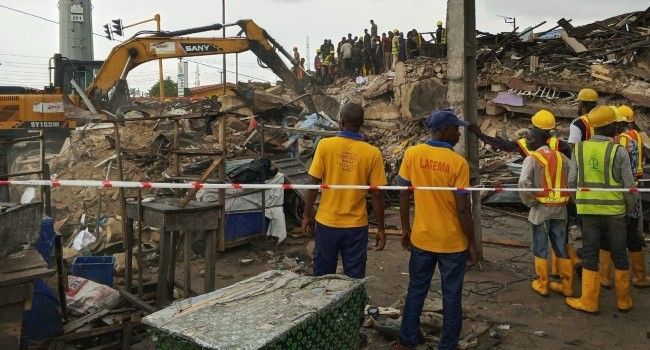
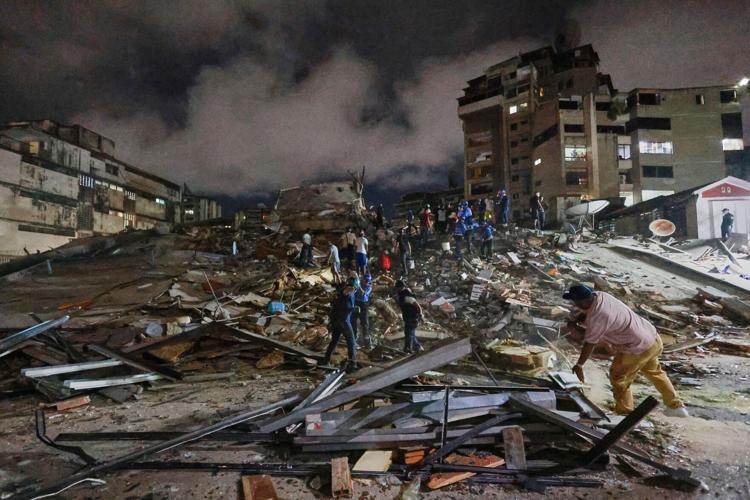
A twin earthquake that was Venezuela’s largest in over a century has killed at least 164 people and destroyed multiple buildings near the capital, where residents searched Thursday for missing relatives.

Venezuela’s strongest earthquake since 1900 sent rescuers and locals clambering in the dark over flattened apartments, hunting for survivors and extracting people from under the ruins.

France, Spain and the US offered to urgently send rescuers after the magnitude 7.2 and 7.5 quakes the United States Geological Survey (USGS) said struck areas west of the capital on Wednesday evening.

Advertisement

The toll has climbed quickly, with interim president Delcy Rodriguez reporting at least 164 dead and over 970 hurt and noting the state of La Guaira north of Caracas was hit hard.

“We have nothing, right now we have nothing, not even the strength or the courage to go in there, just imagine,” Larry Rojas, 49, told AFP, standing in front of a collapsed building where his family was trapped in the La Guaira city of Catia La Mar.

The coastal city was without electricity, and many residents spent the night in the streets or searching for their relatives, according to AFP reporters.

The 7.5-magnitude earthquake was Venezuela’s most powerful since October 29, 1900, when a 7.7-magnitude tremor struck offshore.

Advertisement

After Wednesday’s shock, some residential buildings showed large cracks and fallen walls, with dozens of others destroyed, according to AFP reporters.

“There are people alive in there and no-one is coming to save them,” said a woman waiting for news of her daughter, who was buried in a ruined 12-story building.

France said it would send 85 rescuers and Spain pledged 54 army searchers as nations including China, India, Brazil and the United States also offered help.

Washington was “immediately deploying search and rescue teams, medical resources, and humanitarian assistance to Venezuela,” US Secretary of State Marco Rubio said on Thursday.

Advertisement

Earthquake hits Iranian capital Tehran
The first quake, with an epicenter 21 kilometers (13 miles) west of the coastal town of Moron, occurred at 2204 GMT, USGS said. Within a minute, a 7.5-magnitude quake struck about 45 kilometers away.

“This earthquake was the second event in a doublet. This magnitude 7.5 mainshock was preceded by 39 seconds by a 7.2 foreshock,” USGS said.

Interior Minister Diosdado Cabello asked people to leave their homes, adding that gas supplies had been cut to several buildings as a precaution.

“We have some damaged structures and we don’t want any kind of accident involving gas to occur,” he said.

Advertisement

The Maiquetia International Airport, located near Caracas, was closed due to “serious damage” to its infrastructure, Rodriguez said, with social media posts showing its severely damaged facilities.

The quakes triggered panic in the capital and drove people into the streets, AFP journalists saw.

“The stairs came away, the whole wall cracked. Things fell from the ceiling. It was horrible,” said 54-year-old bank employee Odalis Escalona.

An AFP journalist saw a 22-story building completely destroyed in the capital’s Altamira neighborhood, where people cried out relatives’ names as volunteers climbed over the rubble.

Advertisement

“We need flashlights,” one of them said.

The tremors struck at a depth of 22 kilometers and 10 kilometers, respectively.

They prompted screams of panic at a shopping center in Caracas, an AFP journalist observed.

“It was unbelievable, I don’t even know how long it lasted,” said shopkeeper Heidi Romero, who was on the top floor when the quake struck.

Advertisement

“We went out through the emergency stairs; that’s how they got us out,” the 42-year-old told AFP.

Many more in the capital exited buildings and waited outside before returning to their offices and homes.

Carmen Guedez, 69, was in the same room as her bedridden sister when she felt the jolt.

“It kept getting stronger,” said the administrator, who lives in a hilly middle-class neighborhood above the capital. “I started to see the windows begin to move and then everything shook.”

Advertisement

She described how she “huddled together” with her sister and a neighbor, adding that “we couldn’t get out. The neighbors are still out on the street.”

The states of Trujillo, Carabobo, Miranda and La Guaira were the hardest hit, according to Cabello.

The quake was felt as far away as the Colombian capital of Bogota, where alarms sounded and some residents evacuated buildings as a precaution.

Freddy Tovar, coordinator of Colombia’s National Seismological Network, said they had received more than 200 reports of tremors nationwide.

Advertisement

“The conditions of this seismic event mean that some aftershocks may occur, which could also be widely felt across Colombian territory,” he said in a video posted on X.

The strongest tremors in earthquake-prone Venezuela’s recent history occurred in the northeast in 1997, killing 73 people, and in Caracas in 1967, when 236 people died.

AFP
Advertisement
Continue Reading
Advertisement

News

Wike Slams David Mark Over ADC Claims On FCT Roads Construction, Defends Tinubu’s Development Agenda

Published

on

ADVERTISEMENT
Zoom Ad
ADVERTISEMENT
Zoom Ad

Minister of the Federal Capital Territory (FCT), Barr. Nyesom Wike, on Thursday took a swipe at former Senate President David Mark over what he described as his poor infrastructure record while in office, arguing that the achievements of President Bola Tinubu’s administration in road infrastructure within three years had surpassed what was accomplished during Mark’s tenure in leadership positions.

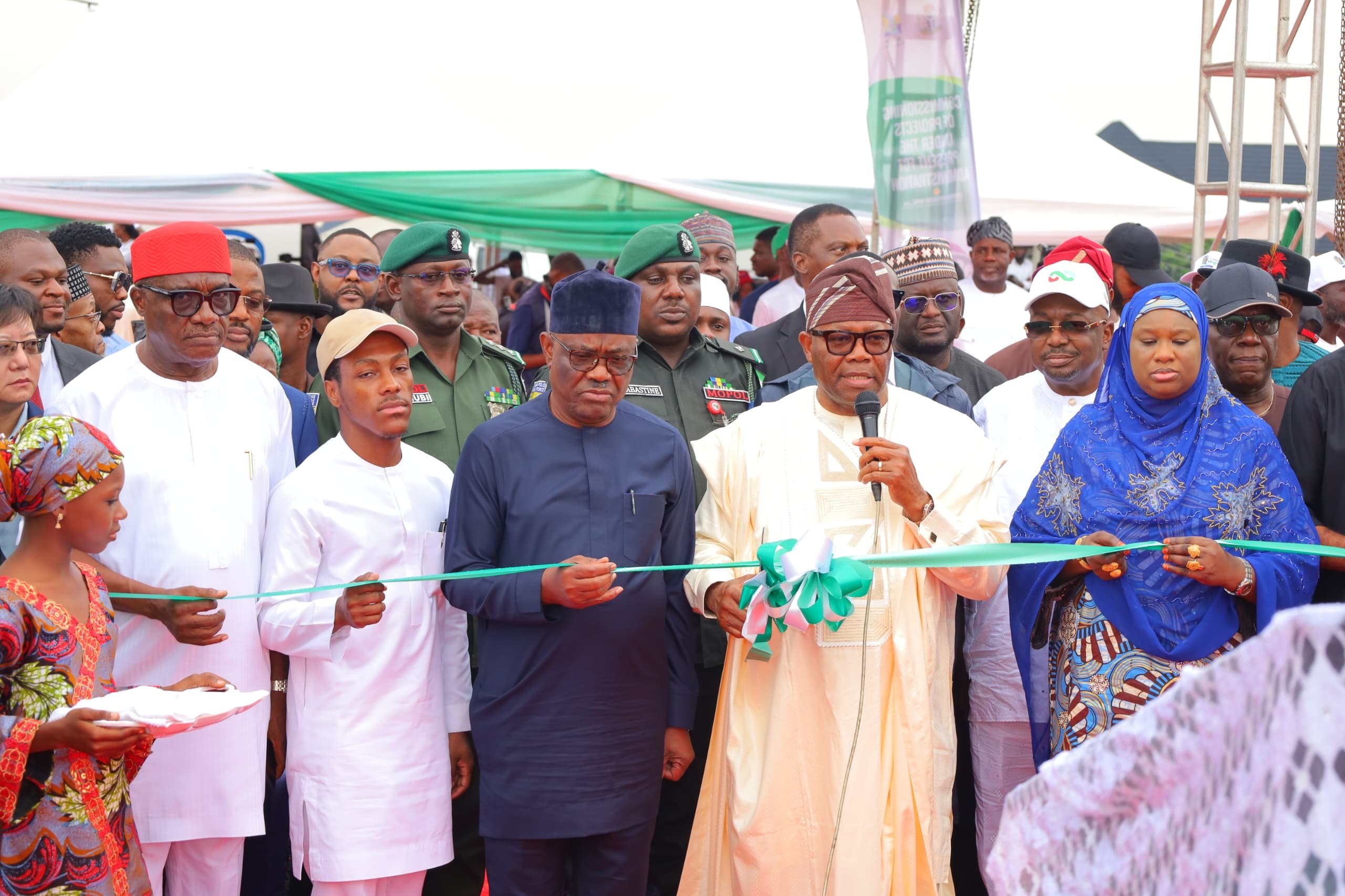
Wike spoke at the commissioning of the Interchange at Arterial Road N16–Ring Road II Junction linking Jahi and Gwarimpa districts in Abuja, where President Bola Ahmed Tinubu was represented by Senate President Godswill Akpabio.

The minister’s remarks came in response to recent criticisms from the African Democratic Congress (ADC), which he said had nonetheless acknowledged the administration’s achievements in road infrastructure.

“ADC has conceded that in terms of road infrastructure, Mr. President has done very, very well,” Wike said. “Without roads, you cannot go to hospital, you cannot go to school, and you cannot go to farm. Roads are the bedrock of development in any society.”

Advertisement

Turning his attention to David Mark, whom he identified as chairman of a faction of a ADC, Wike questioned the former Senate President’s record on infrastructure delivery during his eight years in office.

According to him, the Akwanga-Makurdi road remained in deplorable condition despite being awarded during Mark’s tenure as Senate President under a ruling party’s government.

“The poor people could not afford to travel to Makurdi because there was no road. But David Mark, as Senate President then was flying helicopters,” Wike said.

“Today, because of the intervention of this administration, people can drive freely to Makurdi and Otukpo. The same David Mark, who once relied on helicopters can now travel by road too.”

Advertisement

The minister argued that the Tinubu administration had demonstrated what could be achieved through political will and commitment to continuity in governance.

He noted that the Jahi-Gwarimpa interchange project, commissioned on Thursday, was awarded before the current administration took office but had received no mobilisation or significant progress until the present government intervened.

“One of the problems of development in Nigeria is that new administrations often abandon projects initiated by their predecessors.

“But President Tinubu has shown that government is a continuum. What matters is completing projects for the benefit of the people, regardless of who awarded them,” he said.

Advertisement

Wike disclosed that residents of the area had long doubted the project would ever be completed, describing its delivery as a significant milestone in the ongoing transformation of the Federal Capital Territory.

He also rejected claims that the administration’s development efforts were limited to road construction, citing investments in water infrastructure across satellite towns.

The minister recalled the recent commissioning of water projects in Karu and announced that a similar project in Bwari would be inaugurated on July 14.

“It is not correct to say we are only doing roads,” he said.

Advertisement

“In Karu, we commissioned water supply infrastructure, and by July 14 we will commission another major water project in Bwari. These are projects designed to improve the lives of ordinary people.”

Wike challenged critics to point to comparable investments in satellite towns during previous administrations, insisting that the Renewed Hope Agenda was delivering tangible benefits across the FCT.

Continue Reading

News

FG ready to review N70k Minimum Wage-Gbajabiamila reveals

Published

on

ADVERTISEMENT
Zoom Ad
ADVERTISEMENT
Zoom Ad


The presidency has officially confirmed that plans are underway to alter the current national minimum wage configuration because the current economic situation has made the baseline salary unsustainable.

Chief of Staff to the President, Femi Gbajabiamila, made this disclosure while speaking in Abuja on Thursday during an event organized by a group called Working People United.

According to the former Speaker of the House of Representatives, the present N70,000 threshold established under President Bola Tinubu’s administration in 2024 is no longer capable of meeting the practical economic demands faced by citizens across the nation.

Advertisement

Addressing the gathering, the president’s representative pointed out that the current fiscal environment necessitates a thorough re-evaluation of what constitutes a living baseline for Nigerian workers.

He noted that the “N70,000 wage, which was a milestone in 2024 must be honestly reassessed against today’s realities,” signaling a strong commitment from the executive arm to reopen discussions surrounding statutory labor compensation.

Gbajabiamila assured organized labor groups that the administration does not view workers as adversaries but rather as key contributors to the progress of the country.

He emphasized that the government plans to approach the upcoming negotiations with a high level of empathy and cooperation.

Advertisement

“I can confirm to you that when the time comes to begin the process of reviewing the national minimum wage, this administration will approach that endeavor not as an adversary of Labour, but as a partner,” he said.

He further re-iterated the commitment of the president to human capital development and fair treatment of the workforce.

“President Tinubu has said time and again that the custodians of the nation’s machinery deserve a fair and commensurate wage, and as you all well know by now, this is the president who means precisely what he says and does exactly what he means,” Gbajabiamila stated, defending the president’s record on labor issues.

While urging trade unions and workers to maintain a peaceful posture, the Chief of Staff maintained that sustainable national growth requires an ongoing collaboration rather than perpetual conflict.

Advertisement

He mentioned that “It must be said that good governance is not a performance stage by government for the benefit of a passive audience, it’s a partnership between those who govern and those who are governed.”

He also emphasized that the relationship between the ruling political class and the working population remains the most crucial foundation for industrial harmony.

“No where is that partnership more vital than the relationship between government and the working people of Nigeria,” he added.

Concluding his address, the former lawmaker appealed directly to union leaders to choose the path of dialogue over strikes and industrial actions, which often cripple the national economy.

Advertisement

“It is with this understanding in mind that I ask the leaders of organized labour and the members of working people united to remain what you have so often been at your finest, partners in progress rather than antagonist in perpetuity, let us choose to dialog over disruption, because as we have proved again and again, we achieve far more when we visit together than when we retreat, retreat to our separate corners,” Gbajabiamila remarked.

Continue Reading

News

We’re rebuilding Abuja, building trust, restoring hope in governance – Tinubu (Photos)

Published

on

ADVERTISEMENT
Zoom Ad
ADVERTISEMENT
Zoom Ad

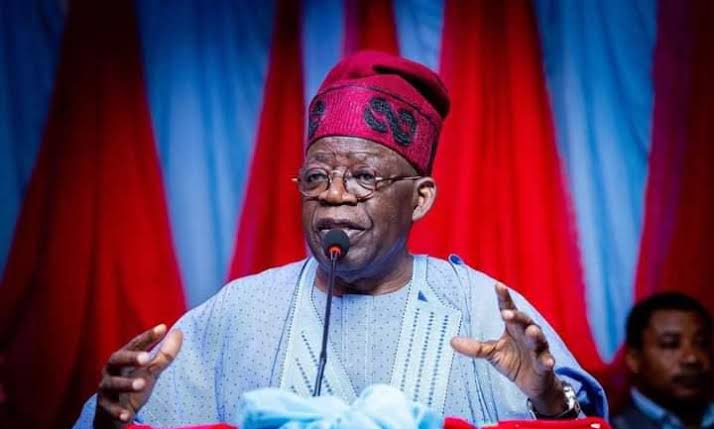
President Bola Tinubu has reiterated that his administration was rebuilding the Federal Capital Territory (FCT) to build trust and restore citizens hope and confidence in government.

Tinubu made the remarks in Abuja on Thursday, while inaugurating the newly constructed Interchange at the intersection between Arterial Road N16 with the Ring Road II, linking Jahi District to Gwarinpa District.

Represented by the Senate President, Senator Godswill Akpabio, the President noted that “Abuja is changing.”

He said: “One interchange at a time, one road at a time, we are rebuilding trust and restoring hope. Together, we will build a country where every citizen can move freely, live safely, and prosper.

Advertisement

“This intersection used to choke Abuja. Gridlock stretched from Maitama to Gishiri, from Jahi to Gwarimpa. Hours were lost, fuel was wasted and businesses were delayed.

“Today, that story ends. This interchange opens up critical districts of the FCT and connects them smoothly to the rest of the territory.”

Tinubu described infrastructure as the foundation of prosperity and roads as the arteries of a nation saying, “when we connect districts, we connect destinies.

“That is the logic of the Renewed Hope Agenda: build the roads, unlock the economy, and let Nigerians thrive. The Jahi/Gwarimpa Interchange is proof that Nigeria is not beyond redemption”.

Advertisement

The President commended FCT Minister, Nyesom Wike, for making Abuja work again, pointing out that from roads to bridges, from city centre to satellite towns, the minister is domesticating renewed hope across the FCT.

“Nigerians can see it, critics can see it and residents feel it in their daily lives. Well done,” he said.

In his remarks, Wike said that the project was awarded, a few days before Tinubu was sworn into office, with no mobilisation. But to show leadership, you made funds available to continue the project awarded by your predecessors.

“Mr President, you have shown that government is continuum. It doesn’t matter who awarded the project. What is important is to complete the project for the betterment and the development of society.

“This is what differentiated the current government and the previous administrations.

“Thank you Mr President for giving us the opportunity to be part of history in changing the narrative as far as the development of Abuja is concerned.”

Advertisement

Reacting to the claim by the African Democratic Congress, alleging that Tinubu government is building only roads while Nigerians are hungry, the minister described the assertion as misleading.

He recalled that just two days ago, Mr President inaugurated the Karu Water Supply Network, adding that another water network would be inaugurated in Bwari in July.

“Let me say that it is not correct that we are only doing roads. It is not correct,” he said.

He, nonetheless, thanked the ADC for acknowledging the road infrastructural stride in the FCT and other parts of the country.

On her part, FCT Minister of State, Dr Mariya Mahmoud said that beyond traffic management, the interchange serves as a critical link connecting communities, businesses, and opportunities across Abuja.

Mahmoud said that the completed interchange would significantly reduce travel time, improve access to commercial centres, facilitate the movement of people and goods, and support the growing demands of the FCT’s expanding population.

Earlier, Mr Richard Dauda, acting Executive Secretary, Federal Capital Development Authority, said that the project was awarded in May 2023 for the full-scope development of Arterial Road N16 from Ring Road II to Ring Road III with two interchanges.

Dauda said that one of the Interchanges was at the intersection between Arterial Road N16 and Ring Road II, which was being inaugurated.

Advertisement

“The Arterial Road N16 is being developed in stages, with the Phase I section completed, that is the Maitama section. The Katampe section, which is the Phase II section, was also completed up to Wole Soyinka Way (Arterial N20) and inaugurated.

“The Jahi District section is still under construction, while the Phase III section, which is the project we are in now, has attained significant progress with the completion of this interchange,” he said.

He said that the rest of the project up to Ring Road III, a total length of 7.25 kilometres in length, would be completed in due course.

Advertisement
Continue Reading

Trending

Copyright © 2024 Naija Blitz News