
Politics
Kwankwaso Blames Tinubu’s Fuel Subsidy Removal for Nigeria’s Economic Crisis




Rabiu Kwankwaso, presidential running mate of the Nigeria Democratic Congress (NDC), has blamed President Bola Tinubu’s economic policies, particularly the removal of fuel subsidy, for what he described as Nigeria’s current economic crisis.
Kwankwaso said the decision to remove the petrol subsidy immediately after Tinubu assumed office in 2023 was implemented without adequate measures to cushion its impact on Nigerians.
Speaking on Arise Television on Wednesday, the former New Nigeria Peoples Party (NNPP) presidential candidate said the government should have considered the potential consequences of the policy before implementing it.
“Bola Tinubu decided to remove the subsidy and the consequences we thought would happen certainly happened,” Kwankwaso said.
According to him, the subsidy was removed abruptly without sufficient consideration of the wider economic implications.
“He removed it immediately without looking at all the possible issues. That is how we found ourselves in this total mess economically,” he said.
Tinubu announced the removal of the petrol subsidy during his inauguration at Eagle Square in Abuja on May 29, 2023, ending the subsidy regime that had kept petrol prices artificially lower but had also imposed a significant cost on government finances.
The policy was followed by a sharp increase in petrol prices, with subsequent increases contributing to higher transportation and living costs across the country.
Kwankwaso maintained that Nigerians should be able to access petrol at a more affordable price, arguing that the government should take steps to reduce the burden of fuel costs on citizens.





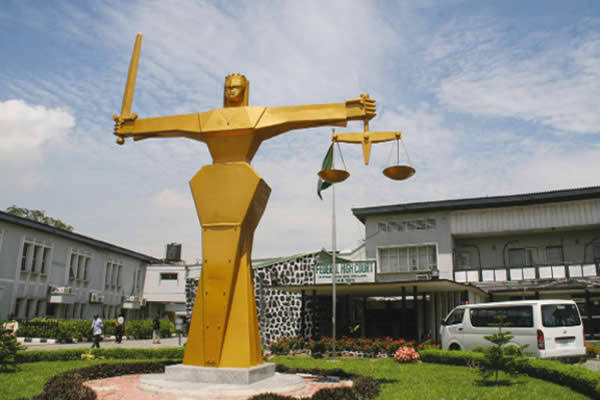
The Federal High Court in Abuja has nullified Abubakar Babazango’s nomination as the African Democratic Congress (ADC) candidate for the Yola North, Yola South and Girei Federal Constituency of Adamawa State in the 2027 general elections.
The court also ordered the Independent National Electoral Commission (INEC) to recognise Abubakar Bashir as the winner of the ADC primary election conducted for the constituency on May 21, 2026, and as the party’s candidate for the House of Representatives seat.
Justice Chigozie S. Onah delivered the judgment on September 17, 2026, in a suit filed by Bashir against the ADC, INEC and Babazango.
The dispute arose after Bashir emerged as the winner of the party’s primary but Babazango was subsequently submitted as the ADC candidate for the 2027 election.
According to the results cited in the court proceedings, Bashir won the primary with 33,931 votes, defeating six other aspirants.
Zayyad Tumba came second with 16,266 votes, while Yusuf Garba polled 14,611 votes. Abubakar Mohammed scored 10,035 votes, Abubakar Gabdo received 8,022 votes, and Abdulaziz Abubakar secured 4,501 votes.
Babazango polled 4,359 votes, placing seventh among the seven aspirants.
Bashir subsequently challenged the substitution of his name with that of Babazango, asking the court to recognise him as the rightful winner of the primary and ADC candidate for the constituency.
In its judgment, the court held that the process through which Babazango’s name was accepted and published as the winner was inconsistent with the ADC’s Constitution and guidelines.
Justice Onah specifically referred to Section 12 of the ADC Guidelines for the Conduct of Primary Elections, which provides for the substitution of a declared winner only in circumstances involving the winner’s death or withdrawal.
The court found that neither condition applied to Bashir.
Consequently, the court set aside Babazango’s declaration and nomination and restrained him from presenting himself as the ADC candidate for the constituency in the 2027 general elections.
The court further directed INEC to recognise Bashir as the winner of the May 21 primary and as the ADC candidate for the Yola North/Yola South/Girei Federal Constituency.
The court also ordered the ADC to recognise Bashir as its duly elected candidate and held that the party was required to comply with the Electoral Act 2026 and its own nomination guidelines.
Babazango had sought to retain his seat in the House of Representatives after defecting from the All Progressives Congress (APC) to the ADC.
Bashir had also asked the court for N25 million in litigation costs. The court declined the claim for solicitors’ fees but awarded N1 million in costs against the ADC and another N1 million against Babazango.
The African Democratic Congress (ADC) says it is a “national disgrace” for President Bola Tinubu to be vacationing in France while President Emmanuel Macron is in New York attending the United Nations General Assembly (UNGA).
Tinubu, who is currently on annual vacation in Europe, had delegated Vice-President Kashim Shettima to attend the global event.
This is the third consecutive time that Shettima would stand in for the president, a development that has triggered reactions, especially from opposition voices.
In a statement, Mallam Bolaji Abdullahi, National Publicity Secretary of the ADC, said, “The irony would be amusing if it were not a national disgrace. At a time when world leaders are advancing their countries’ interests at the United Nations General Assembly, Nigeria’s President is holed up in the French capital while his host has left to pursue his own country’s national interest.
“President Tinubu cannot be vacationing in Paris while President Macron is in New York representing France and expect Nigerians to accept that it is okay for their President to continue to hang around in a country after the host has left to attend to more important things. This is not merely poor optics. It is a national embarrassment.”
He described the continued absence of President Bola Ahmed Tinubu, while Vice-President Kashim Shettima is outside Nigeria, as a “dangerous disregard for the Constitution.”
The ADC spokesman said it was particularly troubling that the President and Vice-President were simultaneously absent while Nigerians confronted worsening insecurity, unemployment and an unbearable cost-of-living crisis.
Abdullahi called on the Presidency and the National Assembly to provide a direct answer to one question: “Who presently exercises the constitutional powers of the President of the Federal Republic of Nigeria, and under what provision of the Constitution?”
He said Section 145 of the Constitution requires the President, when proceeding on vacation for a period of up to 21 days, to transmit a written declaration to the President of the Senate and the Speaker of the House of Representatives, after which the Vice-President performs the functions of Acting President.
Abdullahi said, “President Tinubu left Nigeria on 30 August and has now been away for more than 21 days. We therefore demand to know whether the required declaration was transmitted by the President. If he did not, we would like to know why the National Assembly has ignored Section 145 of the Constitution.”
He also rejected the Presidency’s explanation that the President was on a “working vacation” or that the Secretary to the Government of the Federation, Senator George Akume, would represent President Tinubu at official events, dismissing it as “an absurdity that raises more questions than it answers.
“Representing the President at events and ceremonies does not confer constitutional powers. The Secretary to the Government of the Federation is a mere appointee of the President. He may attend events or deliver speeches on the President’s behalf, but he cannot exercise the constitutional powers of the President or Acting President,” he said.
“Representation is not governance. Attendance at official functions is not presidential authority. Nigeria cannot be governed through ceremonial proxies, telephone calls and press statements issued from foreign capitals.”
He added that the claim that the President has continued to direct national affairs from abroad only “compounds the absurdity”, saying that a so-called “working vacation” does not remove the President’s constitutional obligations under Section 145.
“There is no constitutional category known as a ‘working vacation’. Presidential authority cannot be transferred by convenience, protocol or press statement. Nigeria is a constitutional democracy, not a private enterprise to be managed remotely from a holiday destination.”
Politics
Kwankwaso Says He And Peter Obi Will Return Fuel Subsidy In ‘Our Own Way’, Accuses Atiku Of Playing Politics Over Promise

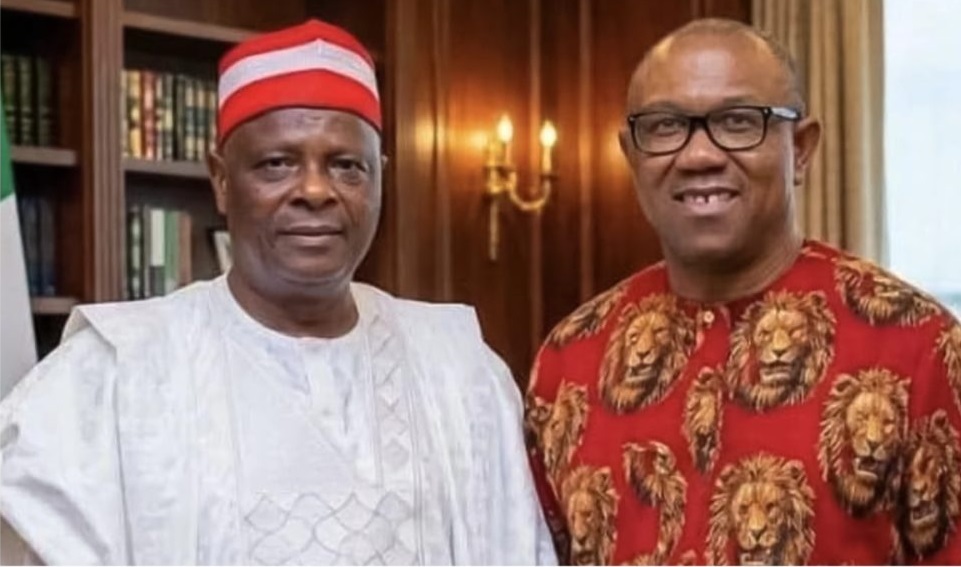
Former Kano State Governor and National Democratic Congress (NDC) vice-presidential candidate Rabiu Kwankwaso has criticised President Bola Tinubu’s decision to remove the petrol subsidy, saying the policy plunged Nigeria into what he described as a “total mess economically.”
Kwankwaso, who is the running mate to the NDC presidential candidate Peter Obi ahead of the 2027 general elections, said an NDC administration would restore fuel subsidy in a different form and take measures to reduce the price of petrol for Nigerians.
He made the remarks in an interview with ARISE correspondent Adesuwa Giwa-Osagie while discussing the economic consequences of the Tinubu administration’s policies and the NDC’s proposed alternative ahead of the 2027 elections.
The removal of the petrol subsidy, announced by President Tinubu in his inaugural address on May 29, 2023, has remained one of the most consequential and controversial economic policies of his administration, with its effects continuing to dominate political and economic debates in the country.
Kwankwaso said that during the 2023 presidential campaign, the three leading presidential candidates, Tinubu, Atiku Abubakar and Peter Obi, had all spoken about removing the subsidy, although he recalled that Atiku had also proposed selling the country’s four refineries.
“In 2023, during the campaigns, I remember the three of them, all of them said they will remove subsidy. In fact, before then, Atiku even added that he would sell all the four refineries to his friends,” Kwankwaso said.
He, however, singled out Tinubu for implementing the policy immediately after assuming office, arguing that the administration failed to adequately consider the possible consequences before removing the subsidy.
“Of course, among the three of them, Bola Tinubu decided to do or to remove the subsidy. And the consequences that we thought would happen certainly happened,” he said.
“And not only he decided to remove the subsidy, what he did was to remove it immediately. In fact, day one, without looking at all those possible issues that were associated to that.
“And that’s how we find ourselves in this total mess economically.”
According to Kwankwaso, the consequences of the policy have demonstrated that the decision was a mistake, although he said former Vice President Atiku Abubakar’s position on the issue during the campaign was politically motivated.
“Now, everybody realizes that it was a mistake,” he said.
“But you see, what Wazir Adamawa did was just to play politics. I don’t think he meant what he said.”
Kwankwaso also criticised Atiku for failing to explain how he intended to implement his proposed subsidy policy, arguing that political considerations influenced the positions taken by the candidates during the 2023 campaign.
“That is one. And secondly, really, he didn’t tell anybody how he’s going to do it,” he said.
“But he knew people now are desperate. If you just go out there and say, I’ll remove it. Even when you said many times that you would not remove it.
“Now we have seen the consequences or they saw the consequences. They didn’t see it before. I saw it.”
Asked whether it would be difficult for him to campaign in the Northwest, where many Nigerians have continued to demand the return of fuel subsidy, while explaining that the NDC would not simply restore the subsidy in its previous form, Kwankwaso rejected the suggestion.
“No, no, no. Look, we are bringing subsidy in our own way,” he said.
The former Kano governor explained that the government could reduce the cost of petrol by supporting the expansion of domestic refining capacity, including through the construction of government-owned refineries.
He pointed to the emergence of privately built refineries as evidence that more refining capacity could be developed within Nigeria.
“Of course, there are many ways. One, I can tell you now we have a refinery built by businessman. And I’m sure more refineries would be built,” Kwankwaso said.
“Now, if individuals in this country could build refineries, I see no reason why government under certain circumstances will not build a refinery or refineries to the extent that we achieve the minimum requirement.”
He said the ultimate objective of the NDC would be to ensure that Nigerians could purchase petrol at what he described as a reasonable price.
“What is the minimum requirement? The minimum requirement is for the people across the country to go to the filling stations and buy fuel at a reasonable price,” he said.
“We in the NDC will do whatever it takes really to put the price of oil down.”

BREAKING: Body of UNIZIK Pupil Swept Away by Awka Flood Recovered, Viral ‘Found Alive’ Claim Debunked

Fuel Under-Dispensing: PETROAN Orders Members To ‘Check’ Meters Nationwide

Kwankwaso Blames Tinubu’s Fuel Subsidy Removal for Nigeria’s Economic Crisis





-
 Economy16 hours ago
Dangote To Support Two Million Women With Refinery IPO Share Ownership – Aliko Dangote
-
 News16 hours ago
Primate Ayodele Blasts Bishops Again! Dismisses Their Defense, Insists Their Endorsement of Tinubu Is Selfish Not Spiritual
-
 News15 hours ago
Osun assembly endorses state police
-
 News16 hours ago
Ex-LASU VC: Public varsities must charge N1m tuition per student to sustain financial independence
-
 Sports16 hours ago
Sadio Mane Builds $20.4m Mango Processing Plant In Hometown
-

 Metro15 hours ago
Enugu: Man ‘kills’ girlfriend over HIV argument