
News
Physically challenged Nigerian faces deportation after living in

- /home/naijuinz/public_html/wp-content/plugins/mvp-social-buttons/mvp-social-buttons.php on line 27
https://naijablitznews.com/wp-content/uploads/2024/05/images-4-1.jpeg&description=Physically challenged Nigerian faces deportation after living in', 'pinterestShare', 'width=750,height=350'); return false;" title="Pin This Post">
- Share
- Tweet /home/naijuinz/public_html/wp-content/plugins/mvp-social-buttons/mvp-social-buttons.php on line 72
https://naijablitznews.com/wp-content/uploads/2024/05/images-4-1.jpeg&description=Physically challenged Nigerian faces deportation after living in', 'pinterestShare', 'width=750,height=350'); return false;" title="Pin This Post">


Physically challenged Nigerian faces deportation after living in
for 38 years
By Francesca Hangeior
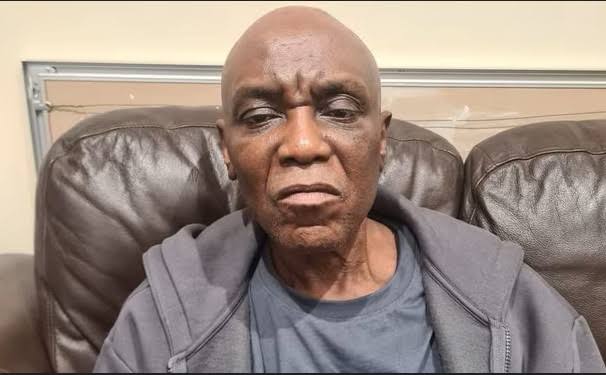
A disabled Nigerian man, who has resided in the UK for 38 years, is facing the prospect of being forcibly removed from the country by the Home Office, the Guardian UK reports.
Anthony Olubunmi George, now 61 years old, arrived in the UK at the age of 24 back in 1986, from Nigeria.
Since then, he has remained in the UK and, according to the Guardian, has a clean record with no criminal convictions.
In 2019, he experienced two strokes that had a significant impact on his ability to speak and move.
According to George, he no longer has any immediate relatives residing in Nigeria.
He is said to have faced numerous episodes of homelessness and admitted that he has lost track of the countless friends who have sheltered him over the years.
George said, “I don’t know how many different sofas I’ve slept on – too many to count. I don’t have my life, living the way I’m living now. My health problems since I had my stroke are my biggest worry. All I’m asking for is some kindness from the Home Office.”
George has submitted multiple applications for leave to remain in the UK, all of which have been denied by the Home Office, with the most recent rejection occurring on May 7, 2024.
In 2005, his previous solicitors submitted a falsified entry stamp in his passport which has since been reported to the police and the legal regulatory bodies.
According to George, he was completely unaware of the passport stamp until several years later, as he revealed to the Guardian.
According to his current lawyer, Naga Kandiah of MTC Solicitors, George’s difficulties can be attributed to his poor past legal representation.
In their latest rejection, officials from the Home Office stated that the situation was not deemed to be an exceptional circumstance.
Kandiah has filed an appeal challenging the most recent denial.
Kandiah said, “My client has been living in limbo for 38 years, with no family, has suffered two strokes and has no family left in Nigeria.
“His situation is not just because of Home Office policies but also because of poor representation by previous solicitors who failed to uphold professional integrity and ethical standards.”
A spokesperson for the Home Office told the Guardian that, “applications have to be considered on their merits in accordance with the immigration rules with the responsibility on applicants to demonstrate they meet these rules.”
News
2027: Wike rallies support for Tinubu In Obio-Akpor, Insists He’II resign as Minister should president lose FCT, Rivers(Photos)

The Minister of the Federal Capital Territory (FCT), Nyesom Wike, on Friday declared that his political alignment with President Bola Tinubu remains unshakable, rallying the political structure of Rivers State to consolidate support for the President.
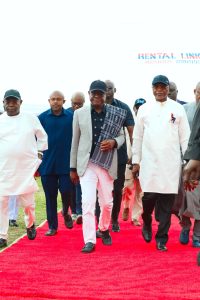
”My interest in Rivers State is for God to use me as a vessel to help our people. I am back here not for what I will get, but for what I will be to raise my people”, Wike declared during a strategic consultative meeting with stakeholders of the Akpor Kingdom in Obio-Akpor Local Government, Rivers State, Wike emphasized that politics is driven by the collective interest of the people rather than perpetual animosity.
He also reiterated his decision to resign his position as Minister should President Tinubu lose in Rivers State and the FCT.
The former governor of Rivers State maintained that expanding the political base is essential for delivering democratic dividends.
He said; “there is no permanent enemy in politics what we have is permanent collective interest.
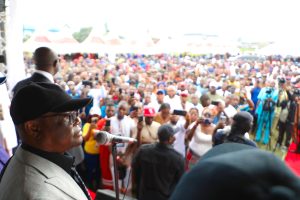
“It is all about the interest of our people. The more you are in number, the happier you become. Leadership is like a waste dustbin. If you cannot absorb things, both the good and the bad, then you cannot be a true leader.”
Reflecting on the political trajectory that led to his appointment as FCT Minister, Wike noted that working with President Tinubu was an extraordinary milestone that defied political convention.
He stressed that his return to grassroots mobilization in Rivers State is aimed at leveraging his position as a vessel to uplift the state and its people.
”You know how difficult, you know how impossible it looked, but he made it possible for us to produce the Minister of the Federal Capital Territory,” Wike told the gathering.
He charged political actors in the state not to be distracted by social media criticism regarding his open-door policy toward former detractors, asserting that true political strength lies in numerical superiority.
In a fiery charge to local leaders, Wike demanded an all-inclusive campaign structure spanning every stratum of society in Obio-Akpor Local Government Area.
He called on traditional rulers, clergy, and community leaders to unite behind a single political direction.
”Obio-Akpor as a whole, whether you are a politician, whether you are a traditional ruler, whether you are a pastor, or whether you are a native doctor, I need everybody now,” he declared.
Wike said further; “Because all of them will vote. For the purpose of voting and elections, we must bring everyone together. ”
Drawing from his political history as the first elected chairman in the history of Obio-Akpor Local Government to win a second term following its creation in 1989, Wike reminded incumbent council leaders that performance and human connection remain the ultimate yardsticks for re-election.
He stated; “I was not elected two times because I was just Chairman.
“I was elected because people felt the impact of governance and because I related with the people. Anywhere, whether for burial or thanksgiving, I was always identifying with them”.
Outlining the electoral roadmap, the FCT Minister highlighted Wards 15, 16, and 17 in Obio-Akpor Local Government as strategic strongholds capable of deciding electoral outcomes across the local council.
”We have over 200 units across three very important wards Ward 15, Ward 16, and Ward 17. These three wards can defeat ten wards in Obio-Akpor. They are three wards with a difference, and you must utilize them to make that difference,” he instructed.
Wike directed local leaders to immediately deploy unit coordinators and door-to-door canvassers across all polling units, urging them to mobilize their immediate families, in-laws, and neighbors to ensure a decisive victory.
Reiterating his loyalty to his constituency, Wike affirmed that he would remain the state’s “Chief Critic” and guide to ensure elected council officers stay accountable to the electorate.
Wike was accompanied by the Rivers State APC governorship candidate, Kingsley Chinda and other political leaders.
News
Echoes of Wike ‘na our own ‘ song takes over at ongoing Akpor town hall meeting in Obio/Akpor LGA today (Video)
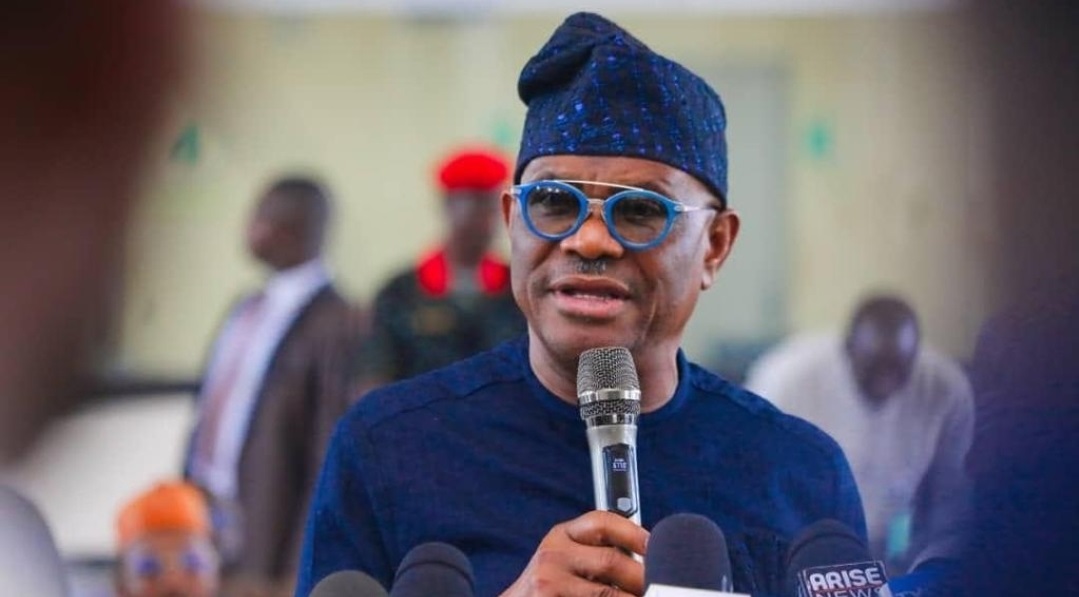
Echoes of Wike ‘na our own ‘song rent the air at ongoing Akpor town hall meeting at Obio/Akpor LGA in Rivers State today.
Watch clip below:
News
Watch moment, traditional rulers present kola to FCT minister Wike at ongoing town hall meeting in Akpor, Obio/Akpor LGA

A video clip showing traditional rulers presenting kola to FCT minister Nyesom Wike at Akpor in Obio/Akpor LGA in Rivers State has emerged.
Watch:

2027: Wike rallies support for Tinubu In Obio-Akpor, Insists He’II resign as Minister should president lose FCT, Rivers(Photos)

Echoes of Wike ‘na our own ‘ song takes over at ongoing Akpor town hall meeting in Obio/Akpor LGA today (Video)

Watch moment, traditional rulers present kola to FCT minister Wike at ongoing town hall meeting in Akpor, Obio/Akpor LGA



-

 Metro12 hours ago
Gunmen Abduct 20 Corps Members In Imo
-

 Foreign12 hours ago
UK government begins freeing 5,000 prisoners due to extreme prison overcrowding
-

 News12 hours ago
Nigeria Is Now the Worst Place To Be Born — Peter Obi
-

 News12 hours ago
If you elect me as your president in 2027, I will end election rigging in Nigeria — Atiku
-
 News12 hours ago
Nigeria at 66: ‘Tinubu made Yahoo Yahoo promise to Nigerians, he’s fake’ – Atiku
-

 News12 hours ago
Nigerian researcher Chika Onochie wins grant for male fertility study in Canada
You must be logged in to post a comment Login