
News
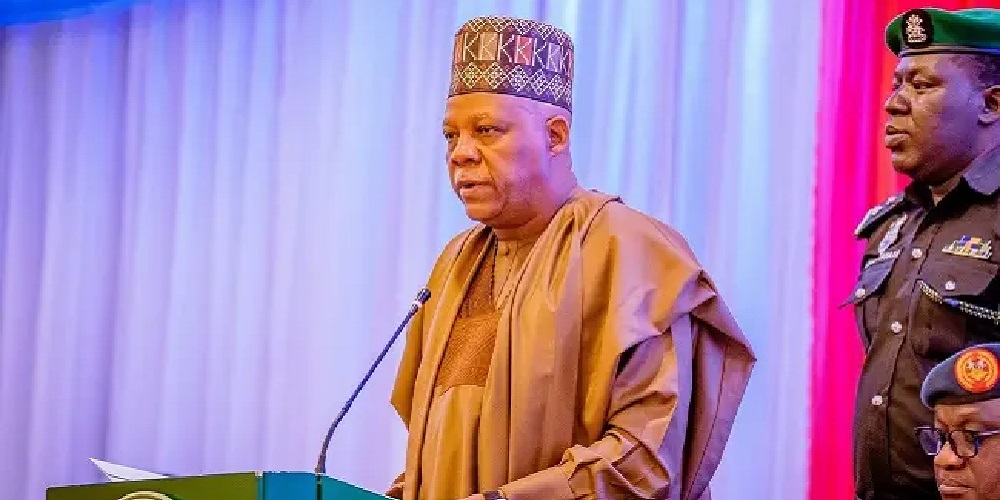
‘We’re committed to efficiency in tax collection’ – VP Shettima

- /home/naijuinz/public_html/wp-content/plugins/mvp-social-buttons/mvp-social-buttons.php on line 27
https://naijablitznews.com/wp-content/uploads/2024/02/Kashim-Shettima.jpg&description=‘We’re committed to efficiency in tax collection’ – VP Shettima', 'pinterestShare', 'width=750,height=350'); return false;" title="Pin This Post">
- Share
- Tweet /home/naijuinz/public_html/wp-content/plugins/mvp-social-buttons/mvp-social-buttons.php on line 72
https://naijablitznews.com/wp-content/uploads/2024/02/Kashim-Shettima.jpg&description=‘We’re committed to efficiency in tax collection’ – VP Shettima', 'pinterestShare', 'width=750,height=350'); return false;" title="Pin This Post">


Vice President Kashim Shettima has said the administration of President Bola Tinubu is focused on revamping the nation’s tax system rather than imposing a heavy burden on Nigerians.
According to him, the fundamental motive of the administration is not to increase the tax burden on Nigerians but to improve the efficiency of tax collection.
He explained this on Thursday when he received a delegation from the Chartered Institute of Taxation of Nigeria, CITN, at the Presidential Villa, Abuja.
Shettima noted that no Nigerian is pleased with the illegal tax collection happening across the entire country by non-state actors.
Soliciting CITN’s insights on attracting foreign direct investment through competitive company tax rates, Senator Shettima said: “The focus of the President Bola Ahmed Tinubu administration is not to increase the tax burden on Nigerians but to improve the efficiency of tax collection. That is our fundamental motive.
“As you go across every state, you get to at least five or six places where you have to pay all sorts of fictitious taxes that do not get to the pockets of the government.”
The Vice President stressed the importance of collaborating with the CITN to adopt global best practices in tax administration, pointing out that knowledge is not something to be bought but earned.
In his remarks, CITN President Samuel Agbeluyi commended the Federal Government’s efforts to address the needs of Nigerians, citing the recent suspension of the Cyber Security Levy as a prime example.
He applauded the administration’s initiatives, including unifying exchange rates, attracting foreign investment, establishing the Presidential Committee on Fiscal Policy and Tax Reforms, as well as deploying monetary policy measures to stabilise the naira, combat inflation, and recapitalise banks.
Agbeluyi outlined the CITN’s multi-pronged goals, chief among which is forging a strategic partnership with the government to ensure the smooth implementation of the fiscal policy committee’s recommendations.
He advocated the professionalisation of tax functions within government agencies, recognising exemplary tax professionals and taxpayers through national honours, and fostering a robust working relationship between the CITN and the Vice President’s office on fiscal matters.
News
Davido’s Friend ‘Tiny’ Ubiribo, Who Died After Penis Procedure, Was Wanted by NDLEA Over Drug Trafficking


Igho ‘Tiny’ Ubiribo, the British-Nigerian influencer and close associate of Afrobeats star David Adeleke, popularly known as Davido, who died following complications from a penis enlargement procedure in Thailand, had previously been declared wanted in Nigeria over alleged drug trafficking.
Ubiribo, who died in Bangkok on March 6, 2026, had been declared wanted alongside his wife, Danielle Simba Allen, an Anglo-Zimbabwean fashion entrepreneur, by the National Drug Law Enforcement Agency (NDLEA) in connection with an alleged international drug trafficking syndicate.
The couple was among individuals the anti-narcotics agency listed in 2023 as “celebrity couple wanted over seized illicit drugs.”
According to the NDLEA, Ubiribo, also known as Tiny, and Allen, known as Dani, were allegedly involved in recruiting teenage girls into the illicit drug trade while operating as alleged leaders of an international syndicate said to have links to Los Angeles, United States.
The agency had also declared Port Harcourt-based prophetess and founder of Christ Power Adoration Ministries, Faith Ugochi, wanted over the alleged activities.
The NDLEA said investigations linked Ubiribo and his wife to the alleged drug trafficking operation and that repeated attempts to secure their appearance for questioning had failed.
The agency alleged that two teenage girls, identified as Favour and Shalom, were recruited as sales representatives in the illicit drug trade by Ugochi, who allegedly used her church platform to recruit teenagers brought to her for assistance.
The girls were allegedly recruited on behalf of Ubiribo and Allen, whom the agency described as the owners of the operation.
The NDLEA further identified Edward Omatseye, also known as Montana, as the alleged coordinator of the syndicate’s activities in Nigeria, while Nnochiri Chidinma Promise was identified as a representative of Ben Cargo Ltd, which the agency said was responsible for shipping illicit consignments into Nigeria.
“Several attempts to get Prophetess Faith Ugochi, Igho Ubiribo and Danielle Simba Allen to submit themselves for questioning have proved abortive,” the agency said at the time.
Ubiribo and his wife remained at large for about three years, with the drug trafficking investigation unresolved.
His death was announced in London on March 6, prompting an outpouring of tributes from friends and associates, including Davido.
In an emotional tribute, Davido described Ubiribo as a man of “light, energy, courage, resilience” and a trusted ally, saying he could not bring himself to speak about him in the past tense.
However, details surrounding Ubiribo’s death emerged months later during a UK coroner’s inquest.
On September 5, coroner Jean Harkin ruled that the 43-year-old died from a pulmonary embolism caused by complications from a penis enlargement procedure he underwent while on holiday in Thailand.
Evidence presented at the inquest showed that Ubiribo had been injected with about 40 millilitres of hyaluronic acid and lidocaine at a Thai clinic in March.
UK pathologist John du Parcq said in his report that cellular material found in Ubiribo’s lungs matched the hyaluronic acid used in the penis filler injection.
According to the pathologist, the finding was consistent with a pulmonary embolism and also matched the results of the Thai autopsy.
Ubiribo’s death has therefore brought renewed attention to a man whose public profile was marked not only by his close association with one of Africa’s biggest music stars but also by an unresolved drug trafficking investigation in Nigeria.
At the time of his death, there was no indication that the NDLEA case against him had been concluded.

The Federal Government’s borrowing from domestic investors rose by 90.5 per cent year-on-year (YoY) to N24.7 trillion in the first eight months of 2026, compared with N12.98 trillion recorded in the corresponding period of 2025.
Findings by Financial Vanguard, based on public finance data from the Debt Management Office (DMO) and the Central Bank of Nigeria (CBN), also showed that credit to the government grew more than four times faster than credit to the private sector during the period.
The sharp increase in domestic borrowing came despite a significant rise in government revenue reported by key agencies, including the Nigerian Revenue Service, Nigeria Customs Service and Nigerian National Petroleum Company Limited (NNPCL).
The government has also benefited from savings associated with the removal of petrol subsidies and increased naira proceeds following the floating of the exchange rate.
However, public finance analysts have raised concerns over extra-budgetary spending and other fiscal exposures, which they say may be contributing to the government’s growing financing needs and prompting increased borrowing from both domestic and external sources.
Govt credit grows 4.5 times faster than private-sector credit
The latest CBN money and credit data showed that credit to the government rose by 43 per cent YoY, from N23.69 trillion in July 2025 to N33.92 trillion in July 2026.
By contrast, credit to the private sector increased by only 9.6 per cent, from N76.13 trillion to N83.43 trillion over the same period.
This means credit to the government grew about 4.5 times faster than credit to the private sector.
The surge in Federal Government borrowing was driven largely by increased issuance of Federal Government of Nigeria (FGN) bonds, FGN savings bonds and Nigerian Treasury Bills (NTBs).
Borrowing through FGN bonds rose by 145 per cent YoY to N7.78 trillion in the first eight months of 2026, from N3.18 trillion in the corresponding period of 2025.
Similarly, borrowing through NTBs increased by 78.6 per cent to N16.92 trillion, from N9.47 trillion, while borrowing through FGN savings bonds rose by 22 per cent to N40.56 billion, from N33.18 billion.
Why FG is borrowing more
Experts who spoke to Financial Vanguard attributed the sharp increase to the government’s larger financing requirements amid a significant fiscal deficit, rising expenditure and higher debt-service obligations.
They, however, warned that increased reliance on the domestic market could crowd businesses and households out of available credit.
The Chief Executive Officer of MDU Capital Ltd, Ayodeji Ebo, said the increase reflected “larger financing requirements arising from high debt-service costs, recurrent expenditure, infrastructure and security needs, and a fiscal deficit that remains significant despite improved revenue.”
According to Ebo, the government may also be relying more heavily on the domestic market to reduce its exposure to foreign-exchange risks.
He, however, cautioned that not all NTB issuance should be regarded as fresh borrowing, noting that part of the issuance represents refinancing or rollover of maturing obligations.
Chief Economist, United Capital Plc, Ayodele Akinwunmi, identified infrastructure spending and the need to bridge fiscal deficits as major drivers of the increased borrowing.
He said the impact of the borrowing should also be assessed in relation to the infrastructure being financed.
“Across the country, we have witnessed significant growth in infrastructure development, ranging from physical projects, such as roads and railways, to soft infrastructure, including education, healthcare and security.
“These advancements have contributed positively to the ease of doing business, creating a more enabling environment for economic activity,” Akinwunmi said.
He noted that Nigeria’s infrastructure financing gap remained substantial, making it difficult for the government to rely solely on annual budgetary allocat

Applicants who took part in the West African Examinations Council’s (WAEC) recruitment aptitude test have raised concerns over alleged technical difficulties that they said disrupted their attempts to complete the online examination.
Several applicants took to X to complain of difficulties accessing the test portal, repeated logouts, delays in loading questions and problems moving from one question to another during the exercise.
One applicant, posting under the name Matchmaking – Nightlife, described the experience as frustrating, alleging that the test was designed to last 40 minutes but that candidates were losing valuable time because the system repeatedly logged them out.
The applicant wrote that about 15 minutes had elapsed without a question being successfully answered, citing auto-logout, delayed logins and errors after clicking the button to proceed to the next question.
Another user, Jamokski, who said the video circulating online was recorded before the main examination room, also complained about the examination platform.
According to the applicant, moving from one question to another could take several minutes, while some questions reportedly moved automatically to the previous or next item without any input from the candidate.
Other applicants reported similar experiences.
One user, Kayode K. Lawal, said the aptitude test had glitches “everywhere”, listing problems with the login process, examination portal, timing and loading of subsequent questions.
He questioned the suitability of the system for student examinations, given the difficulties applicants were experiencing during the recruitment exercise.
Another applicant, who identified himself as Leahcim, said he was scheduled to take the test between 1pm and 1:40pm but could not gain access at the scheduled time.
“I was scheduled for 1pm-1:40pm, after so much trial I was allowed to access the website around 3pm. And I was able to finally login by 5:30pm,” the applicant wrote.
He said that after eventually gaining access, he struggled to complete only four questions because he was repeatedly logged out of the system.
An applicant identified as Kuti Of Mokwa also posted that after the test was rescheduled, he had managed to answer only two questions in 28 minutes.
The complaints have triggered criticism of WAEC on social media, with some applicants describing the experience as frustrating and questioning the reliability of the organisation’s technology.
However, the complaints should be viewed against the background of a genuine recruitment process.
WAEC maintains an official Job Application Management Portal for vacancies at its Nigeria National Office. The portal instructs applicants to review advertised vacancies, submit applications and monitor their application status through their dashboards.
By August, applicants who had progressed in the recruitment exercise began seeing messages on their dashboards informing them that they had been “advanced to the next stage of the application process” and asking them to confirm their availability for an aptitude test.
The portal update required applicants at that stage to provide or confirm details including their active email addresses, telephone numbers and states of residence for subsequent communication about the recruitment process.
WAEC itself also has an Aptitude Tests Department that provides computer-based and remote online testing services, including recruitment tests for organisations. Its published materials describe the remote testing system as an initiative intended to provide secure, flexible and convenient assessment while improving efficiency and reducing logistical challenges.
The latest complaints raise questions about whether the technology deployed for the recruitment exercise delivered the reliability expected from an organisation that administers high-stakes examinations.
As of the time of filing this report, WAEC had not publicly responded to the specific complaints reviewed by The Nigeria Education News or explained the reported login, auto-logout, timing and question-navigation problems.
The Nigeria Education News could not independently establish how many applicants were affected or whether the reported difficulties occurred across all test sessions.
WAEC applicants have therefore been advised to rely on the Council’s official recruitment portal for further instructions and updates rather than unverified information circulating on social media.

Davido’s Friend ‘Tiny’ Ubiribo, Who Died After Penis Procedure, Was Wanted by NDLEA Over Drug Trafficking

Businesses Feel Pressure as FG’s Domestic Borrowing Surges 90% to N24.7trn

WAEC Recruitment Test: Applicants Raise Alarm Over Login, Auto-Logout and Technical Glitches




-

 News22 hours ago
₦33.75bn cash transfer funds: Atiku promises to dig deep into missing money
-

 Foreign23 hours ago
Drug trafficking: Court sentences popular tv presenter, 11 others to death
-

 News23 hours ago
Herbal tea businessman behind cocaine shipments to Saudi Arabia nabbed in Lagos (Photos)
-
 News22 hours ago
Total darkness looming from today as parts of Abuja undergo maintenance -TCN
-

 News21 hours ago
Three casualties, 20 injured in Osun auto crash
-

 News17 hours ago
Awujale throne: Fusengbuwa ruling house insists it remains united, alleges sabotage
-

 News6 hours ago
“I’ll Crash Petrol, Cooking Gas, And Jet Fuel To ₦200 In 12 Months!” – SDP’s Adewole Adebayo Drops 2027 Presidential Bombshell
-

 News17 hours ago
2027 Presidency: No Candidate, Including Peter Obi, Can Fix Nigeria — Datti
Warning: Undefined variable $user_ID in /home/naijuinz/public_html/wp-content/themes/zox-news/comments.php on line 49
You must be logged in to post a comment Login