
News
Again! Court Forfeits Another $1.4m Linked To Ex-CBN Boss, Emefiele


- /home/naijuinz/public_html/wp-content/plugins/mvp-social-buttons/mvp-social-buttons.php on line 27
https://naijablitznews.com/wp-content/uploads/2024/05/Screenshot_20240529-144602.png&description=Again! Court Forfeits Another $1.4m Linked To Ex-CBN Boss, Emefiele', 'pinterestShare', 'width=750,height=350'); return false;" title="Pin This Post">
- Share
- Tweet /home/naijuinz/public_html/wp-content/plugins/mvp-social-buttons/mvp-social-buttons.php on line 72
https://naijablitznews.com/wp-content/uploads/2024/05/Screenshot_20240529-144602.png&description=Again! Court Forfeits Another $1.4m Linked To Ex-CBN Boss, Emefiele', 'pinterestShare', 'width=750,height=350'); return false;" title="Pin This Post">


By Kayode Sanni-Arewa
Justice Ayokunle Faji, of a Lagos Federal High Court, on Wednesday, ordered interim forfeiture of the sum of $1, 426, 175.14 million, linked to the former governor of the Central Bank of Nigeria (CBN) Godwin Ifeanyi Emefiele.
Apart from forfeiting the mentioned sum, Justice Faji also, ordered the EFCC to published the interim forfeiture order in a national newspaper, for anyone interested in the money sought to be forfeited to appear before the Court and show cause within 14 days, why the final order of forfeiture of the said sum should not be made in favour of the Federal Government of Nigeria.
Justice Faji, made the above orders, while granting an Exparte motion marked FHC/L/CS/232/2024, moved by Mrs. Bilikisu Buhari-Bala, lawyer to the Economic and Financial Crimes Commission (EFCC).
The money forfeited in the interim is said to be in Donatone Limited’s account number: 2000000500 domiciled in Titan Bank Limited.
In asking the court for the orders, Mrs. Buhari-Bala, told the court that the orders sought for are pursuant to Section 17 of the Advance Fee Fraud and other fraud-related Offences Act No. 14, 2006, and Section 44 (2)(B) of the 1999 Constitution of the Federal Republic of Nigeria.
She also informed the court the grounds for the orders are: “that this honourable court has the statutory powers under the provisions of section 17 of the Advance Fee Fraud and Other Related Offences Act, 2006 to grant the reliefs being sought.
“That the funds sought to be forfeited are reasonably suspected to be proceeds of unlawful activities.”
Mrs. Buhari-Bala also told the court that he motion Exparte is supported with an affidavit deposed to by one David Jayeoba, an investigator with the EFCC.
In the affidavit, the deponent stated that his commission received a credible and directed intelligence which led to the tracing of funds reasonably suspected to be proceeds of unlawful activities warehoused in the Donatone Limited (DL) Titan Trust Bank account, which funds are reasonably suspected to be part of proceeds of unlawful activities.
The deponent stated that the EFCC, whilst investigating the monumental fraud carried out by the erstwhile Centra Bank of Nigeria Governor, Mr Godwin Emefiele (GE) and his Cronies, discovered a huge amount of money warehoused and concealed in the account of Donatone Limited, domiciled in Titan Trust Bank.
He stated that investigation revealed that some of the brains behind the fraudulent concealment of funds reasonably suspected to have been proceeds of unlawful activities of the erstwhile Central Bank of Nigeria’s Governor, Mr Godwin Emefiele, are the natural persons behind Donatone Limited, Uzeobo Anthony and Adebanjo Olurotimi, who are directors Donatone Limited.
The deponent further stated the followings: “Between 2021 and 2022, when accessibility to Forex in Nigeria was difficult, several international entities operating in Nigeria had to resort to different means to source Forex.
“That Uzeobo Anthony and Adebanjo Olurotimi used the firm, to collect bribes and gratification on behalf of Godwin Emefiele, to get approval for accessing Forex. And that one of the entities (NP) paid a total sum of $26,552 million USD, into the account of firm domiciled in Titan Trust account number 2000000500.
“That the said credits came into the account of firm on November 9, 2021: $6,450,000; November 5, 2021: $6,050,000.00; December 16, 2021: $5,400,000.00; December 23, 2021: $652,000; January 31 2022; $3,000,000.00 and September 21, 2022: $5,000,000.00.
“The investigation traced the funds to having been fixed into interest-yielding accounts, dissipated and laundered through a foreign account in Mauritius, and transported back to Nigeria under disguise.
“That of the total sum of $26, 555, 000.00 US dollars received by firm, the balance standing in the said account as at today is the sum of $1, 426, 175.14 million USD.
“That it is the balance in the account that the applicant seeks to forfeit to the Federal Government of Nigeria, which has been traced to be the proceeds of unlawful activities of (GE) and his cronies. And that investigation further revealed that the international entities sourcing for forex were pressured into parting with huge funds to access forex during the period.
“That the signatories to the account warehousing the sum of $1, 426, 175.14 million USD, sought to be forfeited are at large and are making frantic efforts to dissipate the funds electronically. And that based on our investigation findings, the funds sought to be forfeited are proceeds of unlawful activities of (GE) and his cronies. And that it is in the interest of justice to grant this application.”
Justice Faji, after granted the orders, adjourned the matter to June 25, for hearing of the final forfeiture of the money.
It would be recall that Justice Yelim Bogoro had on May 25, 2024, ordered interim forfeiture of $4.7m, N830m, and some properties assets linked to Emefiele
The monies forfeited to the Federal Government in the interim were said to be warehoused in First Bank; Titan Bank and Zenith Bank, being operated by Omoile Anita Joy, Deep Blue Energy Service Limited, Exactquote Bureau De Change Ltd; Lipam Investment Services Limited, Tatler Services Limited, Rosajul Global Resources Ltd and TIL Communication Nigeria Ltd.
While the properties forfeited in the interim are: His properties forfeited to the Federal Government include 94 Units of an 11-floor building under Construction at 2, Otunba Elegushi 2nd Avenue (Formerly Club) Road, iKoyi, Lagos; AM Plaza, 11-floor office space, situate on 1E, Otunba Adedoyin Crescent, Lekki Peninsula Scheme 1, Lagos; Imore Industrial Park 1, Esa Street, Imoore Land purchased with (Deep Bive Industrial Town, Oriade LCDA, Amuwo Odofin LGA, Lagos, Mitrewood and Tatler Warehouse (Furniture Plant at Bogije) near Elemoro Lagos, Owolomi Village, ibeju-Lekki LGA, Lagos and two properties purchased from Chevron Nigeria, Closed PFA Fund, Block B. Lot twin completed property in Lakes Estate, Lekki, Lagos.

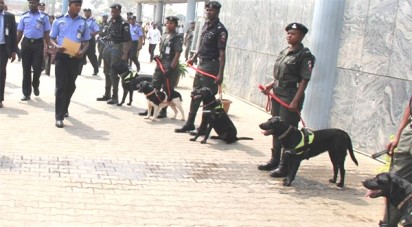
Ahead of today’s guber poll, the Police has deployed some of its security dogs to Osun state to ensure seurity is not breeched during and after the election.
The police dogs have been prepared to assist security personnel in detecting and confronting potential threats from violent criminals.
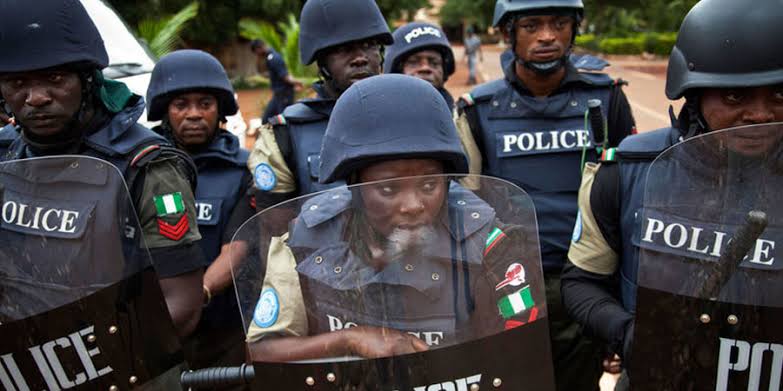
The Speaker of the Osun State House of Assembly, Hon. Adewale Egbedun, has reportedly been placed under house arrest, with unidentified security operatives in police uniforms surrounding his residence in Osun State.
According to reports, the security personnel arrived at the Speaker’s residence in more than 10 black Hilux vehicles and allegedly cordoned off the premises.
The Imole Campaign Council said it attempted to contact senior police officers and the Police Situation Room to obtain clarification on the development but was unable to reach them.
It also urged security agencies and political actors to ensure that the electoral process remains peaceful and free from intimidation, fear or interference.
The council called on residents and all stakeholders to remain calm, obey the law and await an official explanation from the relevant authorities.
As of the time of filing this report, there had been no official explanation from the police or other security agencies regarding the reported operation at the Speaker’s residence.

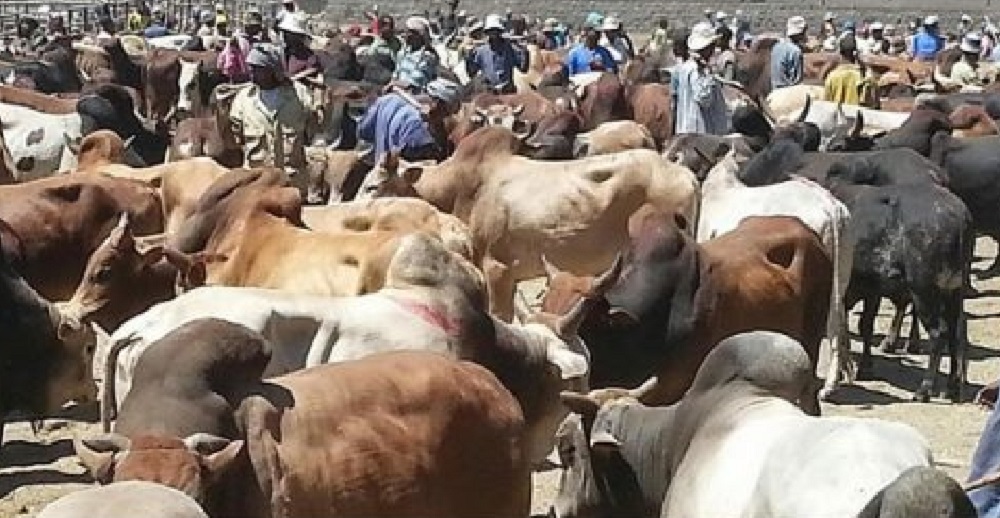
The Federal Government has earmarked about 33,000 hectares of land in the Federal Capital Territory (FCT) for livestock settlements as part of efforts to curb cattle movement within Abuja and shift livestock production to a more settled, commercially viable system.
Minister of Livestock Development, Idi Mukhtar Maiha, disclosed this on Friday in Abuja during a ministerial press briefing, fielding questions from journalists.
Maiha said the land, captured in the Abuja Master Plan and located outside the city centre, would provide designated areas where livestock could be raised under improved conditions without competing for space with residents in densely populated parts of the capital.
He said the initiative is part of the Federal Government’s broader livestock transformation programme, focusing on settled production, improved animal genetics, better husbandry practices, and the establishment of Livestock Development Centres across the country.
“The city is not designed to co-mingle livestock with people,” Maiha said.
He explained that livestock owners would still be free to conduct their businesses within the city, while their animals would be kept in designated production areas where adequate feed, water, veterinary services, and other facilities would be provided.
The minister said the Federal Government was already engaging the FCT Administration to rehabilitate existing livestock facilities, including the Cow Grazing Reserve, Karshi, Piko, and Kore.
He said improvements had commenced at the Cow Grazing Reserve, where three boreholes and a digital weather station had been provided to enhance livestock production and management.
Maiha added that discussions were ongoing with the FCT authorities to rehabilitate other facilities and integrate them into the government’s proposed settled livestock production system.
The minister said the government was determined to address the practice of moving livestock over long distances in search of pasture and water, describing the system as economically inefficient and detrimental to animal productivity.
According to him, animals that continuously trek long distances expend energy that should ordinarily contribute to weight gain, milk production and other productive purposes.
He described cattle subjected to such movements as “athletes”, stressing that the extensive production system was partly responsible for Nigeria’s low livestock productivity.
Maiha said animals were not roaming for the sake of movement but because the existing production system compelled livestock owners to search continuously for feed and water.
He said the government’s preferred model would keep animals within designated production areas where they could access feed, water, veterinary care, breeding services and other essential inputs.
The minister noted that the approach would not only increase meat and milk production but also reduce waste and some of the social and economic challenges associated with uncontrolled livestock movement.
Maiha also identified low genetic potential and poor animal husbandry practices as major constraints on Nigeria’s ability to meet growing demand for meat, milk and eggs.
He said indigenous livestock breeds were not necessarily inferior but had not undergone the systematic genetic improvement required to substantially increase their productivity.
According to him, some indigenous cattle require several years to reach marketable weight, whereas genetically improved breeds can achieve considerably higher weights in a shorter period.
He also highlighted the disparity in milk production, noting that many indigenous cows produce between 1.2 and two litres of milk daily, compared with significantly higher yields obtainable from improved dairy breeds.
“The rate of growth matters a lot. Serviceability matters a lot,” Maiha said.
He said genetic improvement, better feeding and modern animal husbandry would therefore be critical components of the Federal Government’s livestock development programme.
Maiha said the creation of the Federal Ministry of Livestock Development in July 2024 had begun to trigger institutional reforms at the state level.
Only three states, he said, had dedicated ministries or agencies responsible for livestock when the ministry was established, but the number has since increased to 20 states.
He said this development would strengthen collaboration between federal and state governments in implementing livestock policies and attracting investment into the sector.
The minister, however, cautioned that transforming a sector that had operated largely through traditional systems for decades would take time.
“It’s a gradual process,” he said, adding that the impact of the reforms should not be assessed solely on immediate outcomes.
Under the emerging framework, the Federal Government would provide policy direction, technical and animal health standards, traceability systems, data infrastructure, investor facilitation and regulatory coordination.
State governments would be expected to provide suitable land and local infrastructure, undertake community engagement and security coordination, and mobilise livestock producers.
Private investors and producer organisations would, in turn, finance and operate commercial activities across livestock value chains.
Maiha said the proposed Livestock Development Centres would serve as commercially oriented production clusters rather than government-owned farms.
The centres are expected to accommodate investments in breeding, feed and fodder production, cattle finishing, dairy production and chilling, sheep and goat fattening, poultry production, pig breeding, feedlots, modern abattoirs and meat processing.
Other opportunities include cold-chain facilities, logistics, biogas and organic fertiliser production, and hides, skins and leather processing.
He said states would be encouraged to develop livestock industries based on their comparative advantages, available feed and water resources, agro-ecological conditions, producer populations, and market demand, rather than adopting a uniform model.
For cattle and dairy production, investment opportunities would include irrigated fodder, hay and silage production, feedlots, breeding and artificial insemination, milk collection and chilling, abattoirs and meat packaging.
The poultry value chain would encompass hatcheries, breeder farms, feed mills, broiler and layer clusters, vaccination and laboratory services, egg grading and packaging, processing and cold-chain facilities.
Similar investment opportunities would be developed for sheep and goats, pigs and micro-livestock, including rabbits, grass cutters, snails and bees.
Maiha said the reforms were aligned with the National Livestock Growth Acceleration Strategy (NL-GAS), which seeks to raise the livestock sector’s contribution to the Nigerian economy from about $32 billion to at least $74 billion by 2035.
The minister said the reforms would also reduce the economic and security risks associated with transporting live animals over long distances from major livestock-producing areas to consumer markets.
He noted that although a significant proportion of the country’s livestock population is concentrated in the North, major markets are located elsewhere, resulting in animals travelling more than 1,000 kilometres.
Maiha said developing livestock production, processing and marketing infrastructure across states would reduce dependence on long-distance movement of live animals.
He said the combination of settled livestock production, improved genetics, adequate feed and water, animal health services, processing infrastructure and private-sector investment would enable Nigeria to produce more meat, milk and eggs while creating jobs and strengthening rural economies.
Meanwhile, the National Veterinary Research Institute (NVRI), Vom, presented awards to Maiha and the Permanent Secretary of the Ministry, Dr Chinyere Ijomah Akujobi, in recognition of their contributions to developing the livestock sector.
The Executive Director and Chief Executive Officer of NVRI, Dr Yakubu Gunya Dashe, presented the awards alongside institute officials.
The institute recognised Maiha for service delivery, while Akujobi was honoured for her leadership and supportive role in advancing the ministry’s mandate.
The recognition highlighted the importance of collaboration among government institutions, veterinary research organisations, livestock producers and private investors in building a modern and productive livestock industry.

Osun decides: Ahead today’s poll, police dogs deployed to combat thugs

Just in: Security operatives take over Osun Assembly Speaker residence

SAD! Professor’s lifeless body found in London apartment days after receiving sack letter




-

 News7 hours ago
US missionary kidnapped in Niger released after nine months in captivity
-

 News7 hours ago
Adeleke camp condemns release of APC Assembly candidate allegedly found with gun
-

 News7 hours ago
ASUU decries unpaid 2022 salaries, demands education review
-

 News7 hours ago
2027: Atiku asks court to disqualify Tinubu over names, certificate controversy
-

 News7 hours ago
Court remands ex-NBA chairman in DSS custody
-

 News7 hours ago
Osun 2026: Davido fires back at critics, says ‘I’ll be on ground before 7am’
-

 News18 hours ago
Osun 2026: Davido Raises Alarm Over Ebonyi REC’s Presence, Alleges Plot to Rig Election
-
 News7 hours ago
‘I Am Very Sorry’: Madugu Apologises To Nigerians After Super Falcons’ World Cup Miss
Warning: Undefined variable $user_ID in /home/naijuinz/public_html/wp-content/themes/zox-news/comments.php on line 49
You must be logged in to post a comment Login