Connect with us

News

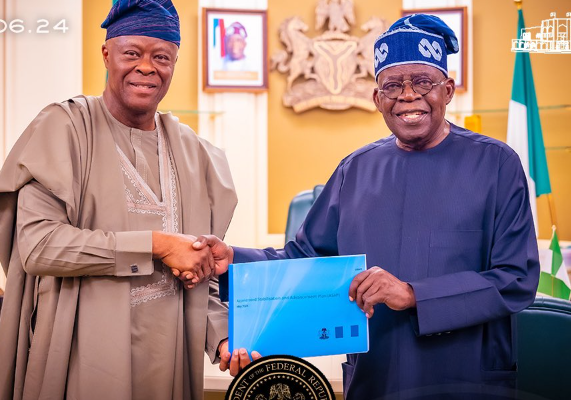
Minimum Wage: Finance Minister, Edun Beats Deadline Submits Template To Tinubu Today

Published

on

ADVERTISEMENT
Zoom Ad
ADVERTISEMENT
Zoom Ad

By Kayode Sanni-Arewa

The Federal Government and Organised Labour on Wednesday adjourned the minimum wage talks till Thursday (today) when the negotiation is expected to continue.

The Tripartite Committee on National Minimum Wage postponed the session in anticipation of the Minister of Finance, Wale Edun, submitting the salary template to President Bola Tinubu today.

Tinubu had on Tuesday directed the finance minister to present the cost implications for a new minimum wage within two days.

Advertisement

The President gave the order at a meeting with the government negotiation team led by the Secretary to the Government of the Federation, George Akume, at the presidential villa in Abuja.

Sources in the labour unions privy to the committee meeting said the parties decided to await the outcome of the presidential template before proceeding with further negotiations.

A source who attended the meeting said, “The meeting has been adjourned until Thursday. We showed understanding because we all know that the president gave the minister of finance 48 hours to come up with a minimum wage. So, we decided to give them the time. We will be meeting by 2 p.m.”

A top labour official who is a labour representative on the tripartite committee explained that the template was crucial to the minimum wage negotiation.

Advertisement

The source, who cannot be quoted because he was not authorised to disclose information to the media on the negotiation, expressed confidence that the talks would record good progress once the presidential template is presented to the parties.

The Minister of Information and National Orientation, Mohammed Idris, had hinted that the President wished to know the financial implications of the new minimum wage in 48 hours.

Briefing journalists on the presidential directive, the information minister said, “We were all there to look at all issues, and the President has directed the minister of finance to do the numbers and get back to him between today and tomorrow so that we can have figures ready for negotiation with labour.”

Idris assured of the president’s readiness to accept the committee’s resolutions, adding that “The president is determined to go with what the committee has said and he’s also looking at the welfare of Nigerians.

Advertisement

“Government is not against or opponent of labour discussions; the government is not an opponent of wage increase, but what is there is that government is always there to ensure a balance between what government pronouncement is and what the realities are on the ground.

“And therefore, we will work assiduously to ensure that whatever promises the government makes are promises that will be kept. That is the idea of this meeting.”

Furthermore, he said Tinubu directed the government representatives to work collectively with the organised private sector and the sub-nationals to achieve a new affordable wage award for Nigerians.

Idris explained, “The President has given a marching order that all those who have negotiated on behalf of the Federal Government and all those who are representatives of organised private sectors, the sub-nationals to come together to have a new wage that is affordable, sustainable and realistic for Nigerians.

Advertisement

“The wage is not just that of the Federal Government; as I mentioned earlier, the sub-nationals are involved, the organised private sector is involved; the Labour stepped out during that procedure. Now we have come back to the negotiation table.”

The minister assured that all hands would be on deck to present a new minimum wage for Nigerians in one week.

“All of us will work together assiduously within the next week to ensure that we have a new wage for Nigeria that is acceptable, sustainable and realistic,” Idris said.

Despite the intervention of the leadership of the National Assembly, labour embarked on a nationwide strike on Monday and Tuesday, crippling economic activities nationwide.

Advertisement

Banks, airports, public schools and courts were shut, forcing the Federal Government to convene an emergency meeting to find a way out of the impasse.

Following a meeting with the SGF, National Assembly leaders, and the National Security Adviser, Nuhu Ribadu, on Monday, the unions announced on Tuesday the suspension of industrial action for five days after President Tinubu agreed to pay a national minimum wage higher than N60,000. The tripartite committee pledged its readiness to convene daily until a new minimum wage is announced.

In an interview on Channels television, the President of the Trade Union Congress, Festus Osifo, said the unions would not insist on its N494,000 demand, indicating that the labour leaders were willing to accept a reasonable compromise.

Though the union leader refused to mention a specific amount, he said the new minimum wage must equal purchasing power to the value of N30,000 in 2019 and N18,000 in 2014.

Advertisement

Meanwhile, airlines lament the revenue loss incurred during the two-day strike declared by the labour unions.

The action forced airports to shut down, resulting in scores of cancelled flights and huge financial losses.

The Chief Operating Officer of United Nigeria Airlines, Osita Okonkwo, highlighted the severe impact of the strike on UNA’s operations.

He said, “For two days, we didn’t fly. Ours (revenue loss) runs into millions. We do about 24 flights every day, and for two days, we didn’t do 48 flights. I can tell you it runs into millions.

Advertisement

“Our passengers were continuously informed of the situation. Our call centre was busy 24/7. The fallout now is what do we do with passengers who want to continue with their businesses because they have lost two days and all want to travel tomorrow (today)?

“And then, we have passengers booked to travel tomorrow (today). We are trying to accommodate as many as we can. Where possible, we put in additional flights. But you know capacity, you can’t stress it too much. Most flights are full now because of what happened in the last two days. It is not like we are against the strike, but everybody is feeling the situation of the country.’’

Okonkwo canvassed that essential services should be exempted from strikes, lamenting the plight of stranded passengers.

“It is understandable what labour is doing. But essential services should be exempted from this type of strike. Hospitals, and air travel, because some people had connecting flights. Some were stranded in Asaba, and they were supposed to go to Europe,” he noted.

Advertisement

The Chief Operating Officer of Ibom Air, George Uriesi, also expressed concern over the financial losses recorded by the local airlines during the labour action.

“There was a massive loss of revenue. If you were going to take N100 of revenue a day, and you don’t fly at all, you will probably make N2 or N3. And then there’s more to it because we must accommodate all the people that didn’t fly. So, you may be unable to sell seats for a long time because you’re dealing with a backlog,” he explained.

The Assistant General Secretary of the Aviation Round Table, Olumide Ohunayo, emphasised the strike’s broader impact on the aviation industry.

“It’s not only the airlines. The aviation industry lost lots of money due to the strike. The airlines, airport terminals, concessionaires, taxi drivers, and others. In fact, the entire ecosystem lost millions of naira, even the charter flights.

Advertisement

“Some flights were cancelled. People are now forced to reschedule flights and see if they can get seats on a future date. And in getting those seats, ticket prices have jumped due to the rush to get seats.” he stated.

Pointing out the long-term economic effects on the aviation sector, the Chief Executive Officer of Centurion Security Limited, John Ojikutu, said, “The domestic airlines will lose some money, and that will affect the economy. The kind of money I’m talking about is not coming from local airlines because they contribute virtually nothing. If you compare the money they make from ticket sales to the money we make from foreign airlines, that is where the problem is.

“In the next two, three days, they would have cleared all those passengers, and we would now go back to our normal aviation problems, which are fuel and ticket fares,” he said.

Speaking on the long-drawn minimum wage negotiation, Debo Adeniran, the Executive Director of the Centre for Anti-Corruption and Open Leadership, urged the Federal Government and labour unions to finalise their talks quickly.

Advertisement

“The FG and the labour unions should not waste any more time beyond the 48 hours given to the finance minister. Everything is already concluded; they need to harmonise their positions based on their capacities to raise resources,” Adeniran stated.

Stressing the need for swift negotiations, he noted, “Labour unions and the FG should be realistic, which should not take an eternity to conclude. They should aim to finalise everything by the end of tomorrow (today).”

Adeniran also cautioned the labour unions against rushing to embark on strikes.

On his part, the Executive Director of the Civil Society Legislative Advocacy Centre, Auwal Rafsanjani, admonished the government to be honest and realistic during the negotiation.

Advertisement

“The Federal Government needs to be honest and realistic. They should be able to restore dignity in labour. Once the FG is realistic in presenting a minimum wage to Nigerians, there would not be any delay in the meeting with labour unions,” he concluded.
Continue Reading
Advertisement
Click to comment

Warning: Undefined variable $user_ID in /home/naijuinz/public_html/wp-content/themes/zox-news/comments.php on line 49

You must be logged in to post a comment Login

Leave a Reply

News

Osun decides: Ahead today’s poll, police dogs deployed to combat thugs

Published

on

ADVERTISEMENT
Zoom Ad
ADVERTISEMENT
Zoom Ad


Ahead of today’s guber poll, the Police has deployed some of its security dogs to Osun state to ensure seurity is not breeched during and after the election.

The police dogs have been prepared to assist security personnel in detecting and confronting potential threats from violent criminals.

Continue Reading

News

Just in: Security operatives take over Osun Assembly Speaker residence

Published

on

ADVERTISEMENT
Zoom Ad
ADVERTISEMENT
Zoom Ad


The Speaker of the Osun State House of Assembly, Hon. Adewale Egbedun, has reportedly been placed under house arrest, with unidentified security operatives in police uniforms surrounding his residence in Osun State.

According to reports, the security personnel arrived at the Speaker’s residence in more than 10 black Hilux vehicles and allegedly cordoned off the premises.

The Imole Campaign Council said it attempted to contact senior police officers and the Police Situation Room to obtain clarification on the development but was unable to reach them.

Advertisement

It also urged security agencies and political actors to ensure that the electoral process remains peaceful and free from intimidation, fear or interference.

The council called on residents and all stakeholders to remain calm, obey the law and await an official explanation from the relevant authorities.

As of the time of filing this report, there had been no official explanation from the police or other security agencies regarding the reported operation at the Speaker’s residence.

Advertisement
Continue Reading

News

FG reserves 33000 hectares for FCT livestock settlements

Published

on

By

ADVERTISEMENT
Zoom Ad
ADVERTISEMENT
Zoom Ad

The Federal Government has earmarked about 33,000 hectares of land in the Federal Capital Territory (FCT) for livestock settlements as part of efforts to curb cattle movement within Abuja and shift livestock production to a more settled, commercially viable system.

Minister of Livestock Development, Idi Mukhtar Maiha, disclosed this on Friday in Abuja during a ministerial press briefing, fielding questions from journalists.

Maiha said the land, captured in the Abuja Master Plan and located outside the city centre, would provide designated areas where livestock could be raised under improved conditions without competing for space with residents in densely populated parts of the capital.

He said the initiative is part of the Federal Government’s broader livestock transformation programme, focusing on settled production, improved animal genetics, better husbandry practices, and the establishment of Livestock Development Centres across the country.

Advertisement

“The city is not designed to co-mingle livestock with people,” Maiha said.

He explained that livestock owners would still be free to conduct their businesses within the city, while their animals would be kept in designated production areas where adequate feed, water, veterinary services, and other facilities would be provided.

The minister said the Federal Government was already engaging the FCT Administration to rehabilitate existing livestock facilities, including the Cow Grazing Reserve, Karshi, Piko, and Kore.

He said improvements had commenced at the Cow Grazing Reserve, where three boreholes and a digital weather station had been provided to enhance livestock production and management.

Advertisement

Maiha added that discussions were ongoing with the FCT authorities to rehabilitate other facilities and integrate them into the government’s proposed settled livestock production system.

The minister said the government was determined to address the practice of moving livestock over long distances in search of pasture and water, describing the system as economically inefficient and detrimental to animal productivity.

According to him, animals that continuously trek long distances expend energy that should ordinarily contribute to weight gain, milk production and other productive purposes.

He described cattle subjected to such movements as “athletes”, stressing that the extensive production system was partly responsible for Nigeria’s low livestock productivity.

Advertisement

Maiha said animals were not roaming for the sake of movement but because the existing production system compelled livestock owners to search continuously for feed and water.

He said the government’s preferred model would keep animals within designated production areas where they could access feed, water, veterinary care, breeding services and other essential inputs.

The minister noted that the approach would not only increase meat and milk production but also reduce waste and some of the social and economic challenges associated with uncontrolled livestock movement.

Maiha also identified low genetic potential and poor animal husbandry practices as major constraints on Nigeria’s ability to meet growing demand for meat, milk and eggs.

Advertisement

He said indigenous livestock breeds were not necessarily inferior but had not undergone the systematic genetic improvement required to substantially increase their productivity.

According to him, some indigenous cattle require several years to reach marketable weight, whereas genetically improved breeds can achieve considerably higher weights in a shorter period.

He also highlighted the disparity in milk production, noting that many indigenous cows produce between 1.2 and two litres of milk daily, compared with significantly higher yields obtainable from improved dairy breeds.

“The rate of growth matters a lot. Serviceability matters a lot,” Maiha said.

Advertisement

He said genetic improvement, better feeding and modern animal husbandry would therefore be critical components of the Federal Government’s livestock development programme.

Maiha said the creation of the Federal Ministry of Livestock Development in July 2024 had begun to trigger institutional reforms at the state level.

Only three states, he said, had dedicated ministries or agencies responsible for livestock when the ministry was established, but the number has since increased to 20 states.

He said this development would strengthen collaboration between federal and state governments in implementing livestock policies and attracting investment into the sector.

Advertisement

The minister, however, cautioned that transforming a sector that had operated largely through traditional systems for decades would take time.

“It’s a gradual process,” he said, adding that the impact of the reforms should not be assessed solely on immediate outcomes.

Under the emerging framework, the Federal Government would provide policy direction, technical and animal health standards, traceability systems, data infrastructure, investor facilitation and regulatory coordination.

State governments would be expected to provide suitable land and local infrastructure, undertake community engagement and security coordination, and mobilise livestock producers.

Advertisement

Private investors and producer organisations would, in turn, finance and operate commercial activities across livestock value chains.

Maiha said the proposed Livestock Development Centres would serve as commercially oriented production clusters rather than government-owned farms.

The centres are expected to accommodate investments in breeding, feed and fodder production, cattle finishing, dairy production and chilling, sheep and goat fattening, poultry production, pig breeding, feedlots, modern abattoirs and meat processing.

Other opportunities include cold-chain facilities, logistics, biogas and organic fertiliser production, and hides, skins and leather processing.

Advertisement

He said states would be encouraged to develop livestock industries based on their comparative advantages, available feed and water resources, agro-ecological conditions, producer populations, and market demand, rather than adopting a uniform model.

For cattle and dairy production, investment opportunities would include irrigated fodder, hay and silage production, feedlots, breeding and artificial insemination, milk collection and chilling, abattoirs and meat packaging.

The poultry value chain would encompass hatcheries, breeder farms, feed mills, broiler and layer clusters, vaccination and laboratory services, egg grading and packaging, processing and cold-chain facilities.

Similar investment opportunities would be developed for sheep and goats, pigs and micro-livestock, including rabbits, grass cutters, snails and bees.

Advertisement

Maiha said the reforms were aligned with the National Livestock Growth Acceleration Strategy (NL-GAS), which seeks to raise the livestock sector’s contribution to the Nigerian economy from about $32 billion to at least $74 billion by 2035.

The minister said the reforms would also reduce the economic and security risks associated with transporting live animals over long distances from major livestock-producing areas to consumer markets.

He noted that although a significant proportion of the country’s livestock population is concentrated in the North, major markets are located elsewhere, resulting in animals travelling more than 1,000 kilometres.

Maiha said developing livestock production, processing and marketing infrastructure across states would reduce dependence on long-distance movement of live animals.

Advertisement

He said the combination of settled livestock production, improved genetics, adequate feed and water, animal health services, processing infrastructure and private-sector investment would enable Nigeria to produce more meat, milk and eggs while creating jobs and strengthening rural economies.

Meanwhile, the National Veterinary Research Institute (NVRI), Vom, presented awards to Maiha and the Permanent Secretary of the Ministry, Dr Chinyere Ijomah Akujobi, in recognition of their contributions to developing the livestock sector.

The Executive Director and Chief Executive Officer of NVRI, Dr Yakubu Gunya Dashe, presented the awards alongside institute officials.

The institute recognised Maiha for service delivery, while Akujobi was honoured for her leadership and supportive role in advancing the ministry’s mandate.

Advertisement

The recognition highlighted the importance of collaboration among government institutions, veterinary research organisations, livestock producers and private investors in building a modern and productive livestock industry.

Continue Reading

Trending

Copyright © 2024 Naija Blitz News