Economy
75.5% of rural Nigerians now live below poverty line — World Bank
- /home/naijuinz/public_html/wp-content/plugins/mvp-social-buttons/mvp-social-buttons.php on line 27
https://naijablitznews.com/wp-content/uploads/2024/02/World-Bank.jpg&description=75.5% of rural Nigerians now live below poverty line — World Bank', 'pinterestShare', 'width=750,height=350'); return false;" title="Pin This Post">
- Share
- Tweet /home/naijuinz/public_html/wp-content/plugins/mvp-social-buttons/mvp-social-buttons.php on line 72
https://naijablitznews.com/wp-content/uploads/2024/02/World-Bank.jpg&description=75.5% of rural Nigerians now live below poverty line — World Bank', 'pinterestShare', 'width=750,height=350'); return false;" title="Pin This Post">
The World Bank has disclosed that a staggering 75.5 per cent of rural Nigerians are now living below the poverty line, reflecting deepening hardship in the country’s hinterlands.

This was revealed in the Bank’s April 2025 Poverty and Equity Brief for Nigeria, which paints a grim picture of worsening economic hardship, widening inequality, and persistent underdevelopment across much of the nation.
While poverty is widespread among urban populations, the report emphasised that the situation is significantly worse in rural areas, where economic stagnation, high inflation, and insecurity have exacerbated living conditions.

“Based on the most recent official household survey data from Nigeria’s National Bureau of Statistics, 30.9 per cent of Nigerians lived below the international extreme poverty line of $2.15 per person per day in 2018/19 before the COVID-19 pandemic,” the report stated.
The report also highlighted Nigeria’s enduring regional disparities. “Nigeria remains spatially unequal. The poverty rate in northern geopolitical zones was 46.5 per cent in 2018/19, compared with 13.5 per cent for southern ones. Inequality measured by the Gini index was estimated at 35.1 in 2018/19.
“Nigeria’s Prosperity Gap — the average factor by which individuals’ incomes must be multiplied to attain a prosperity standard of $25 per day for all — is estimated at 10.2, higher than most peers.”
Despite successive policy interventions, these figures underscore a persistent economic divide across the country.
The report’s demographic analysis found that children aged 0 to 14 years had a poverty rate of 72.5 per cent, reflecting the scale of deprivation among the youngest segment of the population.
Gender disparities were also observed, with 63.9 per cent of females and 63.1 per cent of males classified as poor under the $3.65 per day lower-middle-income threshold.
Education emerged as a significant determinant of poverty, with Nigerians lacking formal education experiencing a poverty rate of 79.5 per cent. This contrasts with 61.9 per cent for those with primary education and 50.0 per cent for secondary school graduates. Only 25.4 per cent of those with tertiary education were considered poor.
The report also drew attention to multidimensional poverty indicators, which further reflect widespread deprivation.
According to the World Bank, about 30.9 per cent of Nigerians live on less than $2.15 daily, 32.6 per cent lack access to limited-standard drinking water, 45.1 per cent do not have limited-standard sanitation, and 39.4 per cent have no electricity.
Education access remains a challenge, with 17.6 per cent of adults yet to complete primary education, and 9.0 per cent of households reporting at least one school-aged child not enrolled in school.
The report noted that even before the COVID-19 pandemic, efforts to reduce extreme poverty had largely stalled.
“Before COVID-19, extreme poverty reduction had almost stagnated, dropping by only half a percentage point annually since 2010. Living standards of the urban poor are hardly improving, and jobs that would allow households to escape poverty are lacking,” the report read.
Although the World Bank acknowledged recent economic reforms aimed at stabilising Nigeria’s macroeconomic outlook, it warned that persistently high inflation continues to undermine household purchasing power, particularly in urban areas where incomes have not kept pace with rising costs.
In light of the worsening situation, the Bank called for urgent policy action to shield vulnerable groups from inflationary shocks and to drive job creation through more productive economic activities.
Economy
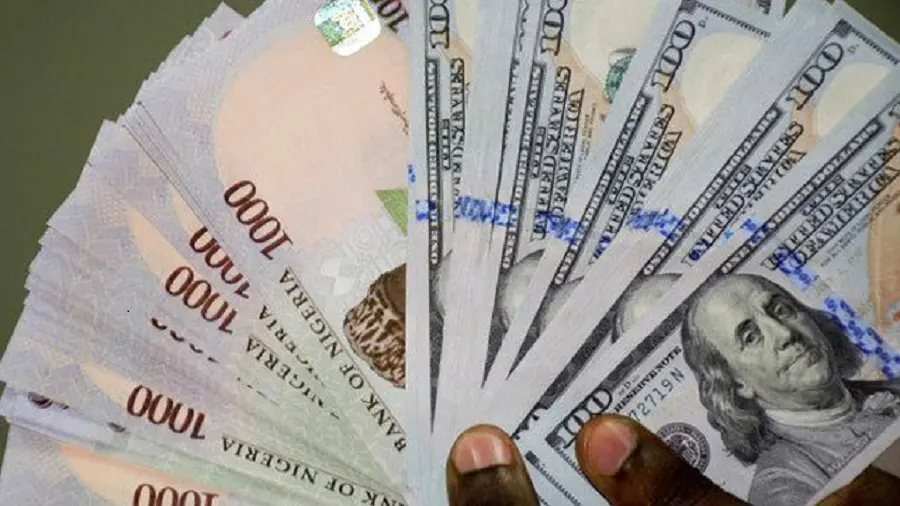
SEE Black Market Dollar To Naira Exchange Rate Today 24th June 2026
See Exchange Rate As Naira Gains 0.07%
The Black Market Dollar-to-Naira Exchange Rate for 24th June 2026 Can Be Accessed Below.
NOTE: The exchange rate changes hourly. It depends on the volume of dollars available and the Demand. This means…you can buy or sell 1 dollar at a certain rate, and the price can change (high or low) within hours.
The official naira black market exchange rate in Nigeria today, including the Black Market rates, Bureau De Change (BDC), and CBN rates.
Note that the exchange rate is subject to hourly fluctuations influenced by the supply and demand of dollars in the market.
What’s the dollar to naira black market today, 24th June 2026?
The exchange rate for a dollar to naira at Lagos Parallel Market (Black Market) players sell a dollar for ₦1395 and buy at ₦1385 on Wednesday, 24th June, 2026, according to sources at Bureau De Change (BDC).
Please note that the Central Bank of Nigeria (CBN) does not recognize the parallel market (black market), as it has directed individuals who want to engage in Forex to approach their respective banks.
Dollar to Naira Black Market Rate Today
Dollar to Naira (USD to NGN) Black Market Exchange Rate Today
Selling Rate ₦1395
Buying Rate ₦1385
Dollar to Naira CBN Rate Today
Dollar to Naira (USD to NGN) CBN Rate Today
Highest Rate ₦1375
Lowest Rate ₦1365
Economy
SEE Dollar to Naira exchange rate today, June 23, 2026
The Nigerian naira traded at relatively stable levels against the United States dollar on Tuesday, June 23, 2026, across both the official and parallel foreign exchange markets, as market participants continued to monitor liquidity conditions and foreign exchange demand.
Latest data from the Nigerian Foreign Exchange Market (NFEM) showed that the naira exchanged at approximately ₦1,366.41 per dollar at the official market. The NFEM rate, which is published by the Central Bank of Nigeria, represents the volume-weighted average exchange rate for the day.
The official exchange rate has remained within the ₦1,350-₦1,370 range in recent weeks, supported by improved liquidity and sustained foreign portfolio inflows into local assets.
In the parallel market, also known as the black market, the dollar traded at around ₦1,400 for buying and between ₦1,410 and ₦1,420 for selling, depending on location and dealer quotations.
The spread between the official and parallel market rates remained relatively narrow compared with previous years, reflecting ongoing reforms aimed at improving transparency and efficiency in Nigeria’s foreign exchange market.
Currency traders said demand for dollars from importers, travellers and businesses remained steady, although the naira has benefited from increased confidence in the foreign exchange market and improved dollar supply.
Analysts noted that exchange rates could continue to fluctuate in response to changes in foreign exchange inflows, global oil prices and domestic economic conditions.
As of the prevailing rates, $100 would exchange for about ₦136,641 at the official NFEM window, while the same amount could fetch between ₦141,000 and ₦142,000 in the parallel market.
Foreign exchange rates remain subject to intraday movements and may vary across banks, bureaux de change operators and other market participants.
Economy
FAAC: FG, States, LGCs share N2.3tn as May revenue
A total sum of N2.300 trillion, being the May 2026 Federation Account Revenue, has been shared between the federal government, states, and the local government councils.
In a statement on Wednesday by the spokesperson of the Office of the Accountant General of the Federation, Bawa Mokwa, the revenue was shared at the June 2026 Federation Account Allocation Committee FAAC meeting held in Abuja.
The N2.300 trillion total distributable revenue comprised distributable statutory revenue of N1.611 trillion and distributable Value Added Tax (VAT) revenue of N688.785 billion.
A communiqué issued by the Federation Account Allocation Committee (FAAC) indicated that the total gross revenue of N3.395 trillion was available in the month of May 2026. Total deduction for cost of collection was N123.546 billion, while total transfers and refunds were N971.610 billion.
According to the communiqué, gross statutory revenue of N2.651 trillion was received for the month of May 2026. This was higher than the sum of N2.378 trillion received in the preceding month by N273.623 billion.
Gross revenue of N743.668 billion was available from the Value Added Tax (VAT) in May 2026. This was lower than the N806.617 billion available in the month of April 2026 by N62.949 billion.
The communiqué stated that from the N2.300 trillion total distributable revenue, the federal government received a total sum of N818.680 billion, and the state governments received a total sum of N759.141 billion.
The local government council received N534.277 billion, while the sum of N188.132 billion (13% of mineral revenue) was shared with the benefiting state as derivation revenue.
On the N1.611 trillion distributable statutory revenue, the communiqué stated that the federal government received N749.801 billion and the state governments received N380.309 billion.
The local government councils received N293.202 billion, and the sum of N188.132 billion (13% of mineral revenue) was shared with the benefiting states as derivation revenue.
From the N688.785 billion distributable Value Added Tax (VAT) revenue, the federal government received N68.879 billion, the state governments received N378.832 billion, and the local government councils received N241.075 billion.
In May 2026, Companies Income Tax (CIT), CGT, SDT, Petroleum Profit Tax (PPT), Hydrocarbon Tax (HT), and Oil and Gas Royalty increased significantly, while Import Duty, Value Added Tax (VAT), Excise Duty, and CET Levies decreased considerably.
-
News22 hours agoSouthern Parkway Service Lanes to End Gridlock, Transform Abuja’s Southern Corridor, Tinubu Assures
-
Metro10 hours agoAlleged Drug Trafficking: Billionaire, Two Others Face Trial in Lagos
-
Foreign10 hours agoUS Targets Alleged ISIS Funding Network, Names Nigerian
-
News10 hours agoHajj: NAHCON concludes return of pilgrims’ airlifts
-
News10 hours agoBenin monarch to place a curse on kidnappers, armed robbers, fixes date
-
News2 hours agoDAY 11 of Projects Commissioning in the FCT: TInubu set to commission Kuje, Gwagwalada road today
-
Sports10 hours agoSuper Eagles: Chelle, NFF Reach New Contract
-
News2 hours agoDAY 11 of Projects Commissioning in the FCT

Warning: Undefined variable $user_ID in /home/naijuinz/public_html/wp-content/themes/zox-news/comments.php on line 49
You must be logged in to post a comment Login