
By Patricia Esami-Lubba | From Hong Kong
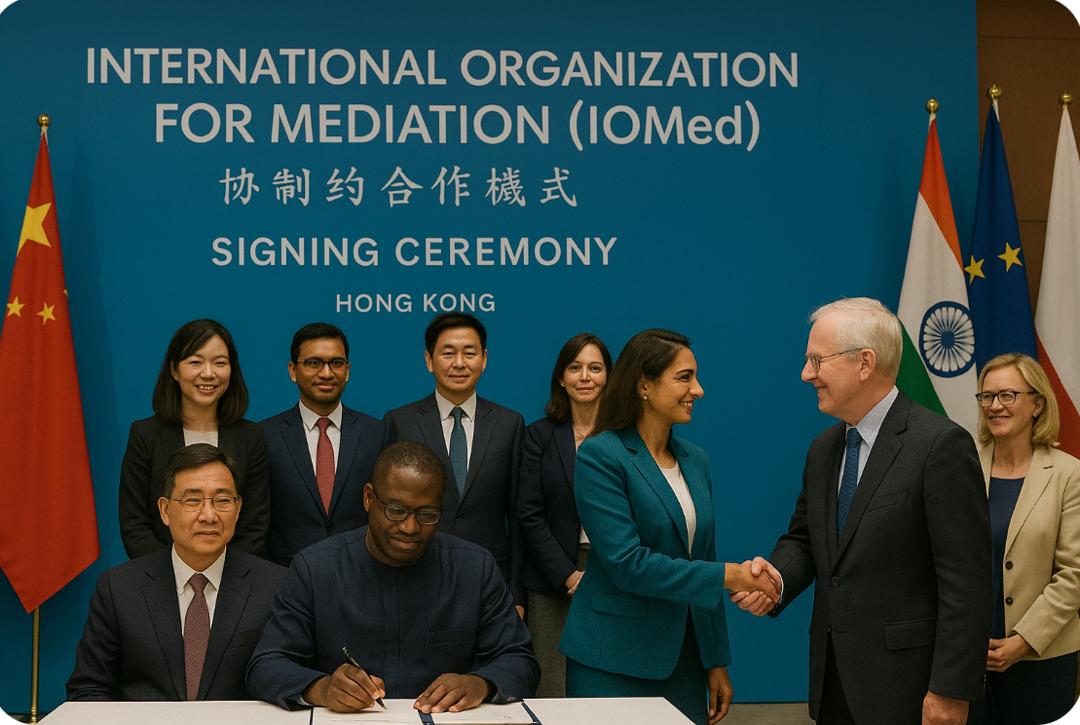
On the surface, the IOMed signing ceremony in Hong Kong looked like every other high-level diplomatic event with national flags, legal documents, strategic handshakes though scratched beneath the polished exterior, and a far more significant story emerges, one about the changing face of global justice and whose voice counts in moments of conflict.
The International Organization for Mediation (IOMed), formally launched on May 30th, 2025, is more than an institutional milestone, it is a response to a silent demand: the need for more inclusive, accessible, and culturally attuned mechanisms for peace.
Who gets to mediate peace
For decades, international dispute resolution has often leaned on structures born from a post-WWII world order, institutions with rigid hierarchies, expensive legal frameworks, and procedures often out of step with the realities faced by small or developing nations.
Enter IOMed
Unlike courts or arbitration panels with binding judgments and high thresholds for entry, IOMed presents itself as voluntary, cooperative, and deeply grounded in dialogue.
There are no winners or losers but only agreements shaped by mutual understanding.
In the words of one diplomat from Southeast Asia, “This is not just about diplomacy, it’s all about dignity, about giving smaller nations the chance to be heard without fear of legal or political muscle.”
Stories behind closed doors
At the convention, away from the cameras and ceremony, the mood was strikingly personal, several delegations shared off-the-record accounts of stalled border talks, unfair trade disputes, and legacy colonial boundaries that have lingered for generations, cases where formal litigation wasn’t an option, and silence became survival.
“IOMed offers hope where there’s been hesitation, and mediation doesn’t just resolve conflict; it preserves relationships” said one African Legal Adviser.
That nuance is powerful and potentially transformative for communities that suffer when state-level tensions go unresolved; border farmers cut off from their markets, students denied cross-border schooling, small traders taxed twice, or not at all.
A Global South turn
There’s another undercurrent to this story, the rise of the Global South as a diplomatic bloc. Of the 30+ nations represented, many were from Africa, Asia, the Caribbean, and Latin America. Together, they signaled that peace doesn’t have to be designed solely in Geneva, New York, or The Hague.
Some critics in the West have raised questions, majorly about the neutrality of an institution so heavily backed by China, but for many countries at the table, that concern is overshadowed by the fact that they finally have a seat at it.
As one Latin American ambassador put it: “We’ve been recipients of mediation for decades, it is time we become providers.”
Beyond geopolitics, what’s at stake?
For the ordinary citizen, all this might sound distant but it isn’t as the ripple effects of how nations resolve conflict shape real lives; peace deals that let refugees return home, trade agreements that stabilize food prices, maritime talks that preserve fishing rights.
If IOMed lives up to its promise, it could reduce the costs on human and financial burdens associated with prolonged legal disputes and geopolitical standoffs, it could also empower local traditions of peacemaking as much as to make diplomacy feel less like a privilege and more like a right.
And perhaps, most importantly, it could remind the world that power doesn’t always shout, but it sometimes, listens.
Patricia Esami-Lubba is a Nigerian journalist and diplomatic correspondent, reporting from Hong Kong on the launch of the International Organization for Mediation.