
Foreign
US threatens shipping firms with sanctions if they pay Iran tolls


- /home/naijuinz/public_html/wp-content/plugins/mvp-social-buttons/mvp-social-buttons.php on line 27
https://naijablitznews.com/wp-content/uploads/2026/03/Strait-of-Hormuz-1000x600.jpg&description=US threatens shipping firms with sanctions if they pay Iran tolls', 'pinterestShare', 'width=750,height=350'); return false;" title="Pin This Post">
- Share
- Tweet /home/naijuinz/public_html/wp-content/plugins/mvp-social-buttons/mvp-social-buttons.php on line 72
https://naijablitznews.com/wp-content/uploads/2026/03/Strait-of-Hormuz-1000x600.jpg&description=US threatens shipping firms with sanctions if they pay Iran tolls', 'pinterestShare', 'width=750,height=350'); return false;" title="Pin This Post">


The US has warned shipping companies they could face sanctions if they pay Iran for safe passage through the Strait of Hormuz.
An alert on Friday by the US Office of Foreign Assets Control (OFAC) warned US persons and companies were generally banned from paying Iranian government entities, and non-US persons may risk exposure to sanctions if they pay.
“Maritime industry participants involved with vessels calling at Iranian ports face significant sanctions risk under multiple sanctions authorities targeting Iran’s shipping sector and ports”, OFAC said.
Iran has severely limited traffic through the strait since the war began in February.
The US has also enforced a naval blockade on Iranian ports.
Iran has called the US interception of ships entering and leaving Iranian ports under the blockade “piracy”.
Tehran says it has collected tolls from ships in order to navigate freely through the strait, with Hamidreza Haji Bababei, deputy speaker of Iran’s Parliament, last week claiming the first toll revenue had been deposited with the country’s Central Bank.
No further detail was provided on the amount of the toll, the method of collection nor who paid it. The BBC could not independently verify this claim.
OFAC’s alert said payments could involve cash as well as “digital assets, offsets, informal swaps, or other in-kind payments,” including charitable donations and payments at Iranian embassies.
The agency warned that non-US persons who pay could also face civil and criminal enforcement liability if payments cause US persons, such as insurers and financial institutions, to violate sanctions.
OFAC said it “will continue to aggressively target Iran’s main revenue-generating sectors, in particular its petroleum and petrochemical sectors”.
The US Treasury also announced sanctions on three Iranian foreign currency exchange houses on Friday, saying they have converted oil revenue into more usable currencies.
Treasury Secretary Scott Bessent said his agency would “relentlessly target the regime’s ability to generate, move and repatriate funds, and pursue anyone enabling Tehran’s attempts to evade sanctions”.
After the US and Israel attacked Iran on 28 February, Iran has been targeting and striking ships passing through the Strait of Hormuz, including seizing two of them.
The US has also enforced a naval blockade since 13 April, stopping all ships from travelling to or from Iranian ports.
Trump had hoped the blockade would put pressure on Iran by targeting its revenue from the tolls and oil sales.
US Central Command (Centcom) said on Friday that 45 commercial ships have been told to turn around since the blockade began.
About 3,000 ships typically pass through the strait each month, but that number has dropped sharply to just a handful each day.
The strait is a crucial shipping channel for oil and other goods, including food, medicines, and technological supplies.
Map titled “US blockade of Iran’s Gulf coast” showing Iran’s southern coastline along the Persian Gulf, Strait of Hormuz and Gulf of Oman highlighted in red to indicate a blockade. Iranian territorial waters are shaded, with a caption stating, “No ships permitted to approach or leave Iranian coast.”
Ports and major jetties are marked with purple dots, including Kharg Island and Bandar Abbas. Surrounding seas are labelled, including the Arabian Sea, and a distance scale, source credit, and BBC logo are visible.
UNHCR, the UN refugee agency, said on Friday that the closure of key maritime routes has forced the use of longer and more expensive alternatives to transport aid.
Higher transport and fuel costs “disproportionately affect people in emergencies”, including refugees and displaced people, the agency said.
The cost of delivering aid to Sudan, entering its fourth year of war, has doubled in recent months, as rerouting shipments around the Cape of Good Hope in South Africa adds up to 25 days in delivery time.
The UN agency said it has adapted quickly by rerouting sea cargo and relying more on land corridors. But it warned that “if instability in the Middle East persists, rising costs, delays and limited transport capacity are likely to constrain humanitarian operations further.”
The US and Iran began a fragile ceasefire on 8 April. Since then, the two countries have held talks, but no long-term deal has been reached.
Iran gave mediators in Pakistan a proposal to end the war on Thursday night, according to Iran’s state-run IRNA news agency. However, US President Donald Trump has responded negatively to the proposal.
“They want to make a deal, I’m not excited, so we’ll see what happens,” Trump said on Friday.
He added: “Because they have no military left, essentially. I’m not sure if they ever get there.”
The president did not give details about the proposal or explain why he was not satisfied, but said: “They’re asking for things that I can’t agree to.”
He also voiced frustration with Iran’s leadership, saying: “It’s a very disjointed leadership. They all want to make a deal, but they’re all messed up.”
After Iran’s Supreme Leader Ali Khamenei was killed in US and Israeli strikes on the first day of the war, his son Mojtaba Khamenei succeeded him. However, decision-making seems less centralised than it was before the war.
On Thursday, Trump said he was briefed on options for Iran ranging from “blast the hell out of them and finish them forever” to “make a deal”.
The conflict began after the US and Israel carried out wide-ranging strikes on Iran in February. Iran responded by launching attacks on Israel and US-allied states in the Gulf.
The US and Israel said Iran was trying to develop a nuclear bomb, which Tehran has strongly denied. [BBC]

More than 150,000 passengers have been left stranded after a volcanic eruption forced Indonesian authorities to temporarily suspend operations at eight airports.
According to the report, Jakarta’s Soekarno-Hatta International Airport was the first to be closed on Sunday morning after ash from Anak Krakatau was detected in airspace near the airport.
Transport minister Dudy Purwagandhi said so far 712 flights have been affected and asked airlines to consider diverting some flights to other airports.
The volcano had started erupting late on Friday night, generating continuous seismic activity, lava fountains, and booming sounds across surrounding regions.
The transport ministry said the pause in operations mainly affected flights to and from Singapore, and other international routes including Doha, Sydney and Kuala Lumpur.
Purwagandhi said the decision to temporarily close more airports was made after tests found that volcanic ash had spread towards West Java.
He urged airlines to speed up processes for refunding tickets for passengers who have been affected by flight cancellations, and for airlines to provide timely information to those with upcoming flights to avoid overcrowding at airports.


An Egyptian court has sentenced popular television presenter, Sarah Khalifa and 11 others to death over their alleged involvement in the production and trafficking of narcotics.
Khalifa, 39, is a well-known television personality and the presenter of ‘Mission Impossible’, a programme that focuses on security and crime-related issues.
According to the state-linked Al-Ahram newspaper, a Cairo court found Khalifa and the 11 other defendants guilty of forming an organized criminal gang involved in procuring materials used to manufacture narcotics for trafficking.
The defendants were also convicted of possessing and carrying unlicensed firearms and ammunition.
The court reached the death sentence after seeking the religious opinion of Egypt’s Grand Mufti, as required by law in capital punishment cases.
However, the verdict is subject to appeal.
State-run Akhbar Al-Youm newspaper reported that the defendants were accused of producing synthetic drugs for trafficking after allegedly importing the materials needed for their manufacture from outside Egypt.
Authorities reportedly seized more than 750 kilogrammes of narcotics and raw materials during investigations into the case. They also discovered two apartments allegedly being used as drug laboratories, alongside unlicensed firearms and ammunition.
Khalifa, who also owns a plastic surgery clinic and a production company involved in organizing parties and events, was further sentenced to five years in prison with other defendants in a separate case involving the kidnapping and assault of a young man.
Egyptian law allows the death penalty for offences including premeditated murder, terrorism, certain rape cases and drug trafficking. Data from the Egyptian Commission for Rights and Freedoms showed that 541 death sentences were handed down in Egypt in 2025
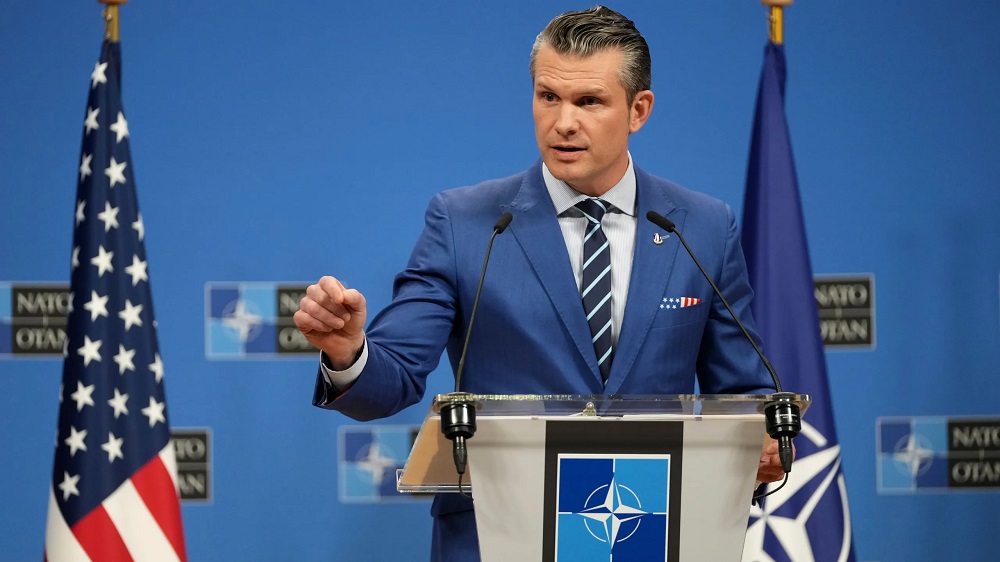
The United States has issued a fresh warning to Iran, threatening to destroy and sink Iranian oil tankers if Tehran launches further attacks against American naval vessels.
U.S. Secretary of War Pete Hegseth issued the warning on Saturday, September 5, 2026, shortly after American forces struck three Iranian oil tankers following what Washington described as ballistic-missile attacks by Iran’s Islamic Revolutionary Guard Corps (IRGC) against two U.S. Navy warships.
Hegseth, in a statement on X, said the United States would respond directly by targeting Iran’s oil fleet if American ships came under fire.
“It’s simple: if Iran shoots at U.S. ships, we will destroy (and sink) their oil tankers,” Hegseth said, adding that Iran only needed to refrain from attacking the U.S. Navy.
He further claimed that Iran’s oil tanker fleet was vulnerable because, according to him, Tehran lacked the naval and air capabilities necessary to protect the vessels.
“Iran’s oil tanker fleet is defenseless — Iran has no navy or air force. Our planes, ships & subs can strike them all,” Hegseth said, referring to areas under the U.S. Central Command and U.S. Indo-Pacific Command.
US strikes three Iranian tankers
The warning came after U.S. Central Command (CENTCOM) confirmed that American forces had struck three Iranian crude oil carriers.
CENTCOM said the action followed missile attacks by the IRGC against a U.S. aircraft carrier and a guided-missile destroyer. According to the command, both American warships successfully evaded the missiles and no U.S. personnel were injured.
The American military identified two of the vessels as M/T Downy, which was struck off Kharg Island, and M/T Stark 1, targeted near Jask.
Both vessels were described by CENTCOM as “permanently disabled.”
A third tanker, M/T Kylo, also known as Noxen, was attacked in the Gulf of Oman. CENTCOM said the crew was warned to abandon the vessel before it was destroyed.
The U.S. military said the tankers were connected to what it described as a multibillion-dollar “shadow network” allegedly used to finance Iran’s Revolutionary Guard and its regional allies.
US threatens wider action
The commander of U.S. Central Command, Admiral Brad Cooper, also warned that Washington would impose an even greater economic cost on Tehran if Iranian forces continued attacking American vessels.
“If you shoot at two of our ships, we will impose an even higher economic cost — taking out three of yours,” Cooper said.
He added that the United States would not hesitate to defend its forces and, if necessary, destroy Iran’s “limited and exposed oil fleet.”
The latest threats signal a potentially significant expansion of the maritime confrontation between Washington and Tehran, with Iranian oil shipments increasingly becoming a direct target of U.S. military pressure.
Iran condemns attacks
Iran has condemned the American strikes on its oil tankers, describing the attacks as illegal and warning that Washington and its allies would bear responsibility for the consequences of continued attacks.
Iranian authorities have also warned that further attacks on Iranian vessels could trigger retaliation against American interests in the region.
The escalation is particularly significant because it is unfolding around the Strait of Hormuz, one of the world’s most important energy shipping routes.
The waterway connects the Persian Gulf with the Gulf of Oman and is a critical route for global oil supplies. Continued attacks on commercial vessels could therefore have wider implications for international energy markets and global shipping.
With the United States now openly threatening to target Iran’s oil fleet in response to attacks on its Navy, the latest confrontation could mark a new and more dangerous phase in the ongoing U.S.-Iran conflict.

Davido’s Friend ‘Tiny’ Ubiribo, Who Died After Penis Procedure, Was Wanted by NDLEA Over Drug Trafficking

Businesses Feel Pressure as FG’s Domestic Borrowing Surges 90% to N24.7trn

WAEC Recruitment Test: Applicants Raise Alarm Over Login, Auto-Logout and Technical Glitches




-

 News24 hours ago
Three casualties, 20 injured in Osun auto crash
-

 News20 hours ago
Awujale throne: Fusengbuwa ruling house insists it remains united, alleges sabotage
-

 News8 hours ago
“I’ll Crash Petrol, Cooking Gas, And Jet Fuel To ₦200 In 12 Months!” – SDP’s Adewole Adebayo Drops 2027 Presidential Bombshell
-

 News20 hours ago
2027 Presidency: No Candidate, Including Peter Obi, Can Fix Nigeria — Datti
-

 News19 hours ago
Man Who Caught Wife Cheating With Robot Vacuum Camera Jailed for Privacy Breach
-

 News22 hours ago
Hartland Nigeria Completes 41 Projects, Reaffirms Commitment To Infrastructure Delivery
-

 Opinion21 hours ago
Death Be Not Proud: Publisher Dotun Oladipo and the Tolling Bell
-

 News18 hours ago
Lagos Police Probe Viral Clash Between Officers, Youths in Surulere