
Foreign
Navalny Buried In Moscow Amid Thousands Of Defiant Mourners

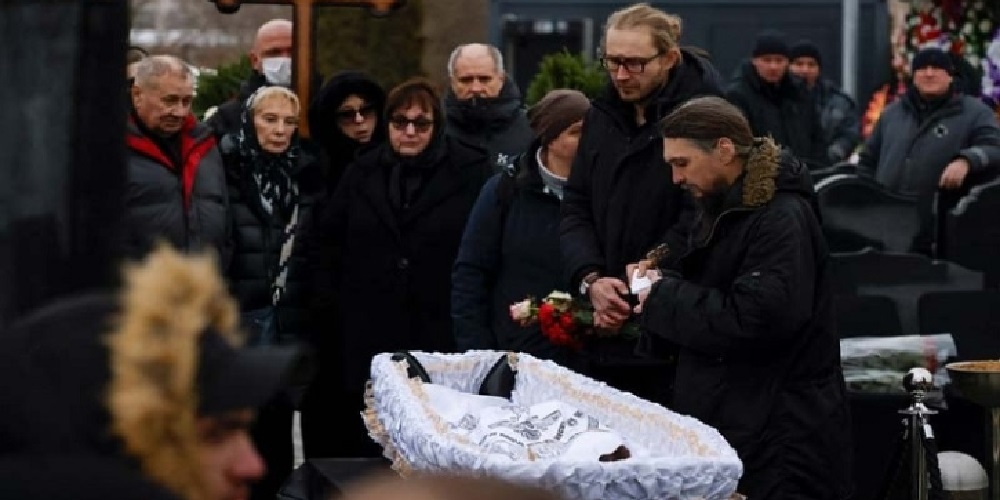
Russian opposition leader Alexei Navalny was laid to rest in Moscow on Friday, surrounded by crowds of defiant mourners who chanted his name and blamed authorities for his death in prison.
Outside the cemetery where he was buried, some supporters shouted in grief, while others yelled out slogans against the Kremlin and its offensive in Ukraine.
Despite a heavy police presence and official warnings, thousands of mourners paid their respects to the 47-year-old anti-corruption campaigner whose death in an Arctic prison was announced on February 16.
People come to a makeshift memorial for late Russian opposition leader Alexei Navalny organized outside the former Russian Embassy in Tbilisi to honour his memory on March 1, 2024. (Photo by Vano SHLAMOV / AFP)
Navalny’s death has been widely condemned by Western leaders and his allies have accused President Vladimir Putin of responsibility and of trying to prevent a dignified public burial.
The Kremlin, which has dismissed the accusations as “hysterical”, warned against “unauthorised” protests around the funeral.
Navalny’s body first lay in an open casket in a packed church in Maryino, southern Moscow, for a ceremony attended by his parents.
The coffin was closed immediately after the service, meaning many mourners who had wanted to file past were not able to pay their last respects at the Mother of God Quench My Sorrows church.
It was then transported to the Borisovo cemetery, near the banks of the Moskva River, where several large wreaths were arranged around the grave.
“We won’t forget you!”, “Forgive us!” some mourners shouted as the coffin arrived.
‘What are they afraid of?’
“No to war!” some chanted. Others yelled out: “Down with the power of murderers!” and “We will not forgive!”.
Many opponents blame Putin for the death of his top critic.
Police detained some six people in the capital and dozens elsewhere in Russia, according to the OVD-Info rights group.
“Any unauthorised gatherings will be in violation of the law and those who participate in them will be held responsible,” Kremlin spokesman Dmitry Peskov said, according to TASS news agency.
“What are they afraid of? Why so many cars?” one mourner, Anna Stepanova, told AFP outside the church.
“The people who came here, they are not scared. Alexei wasn’t either.”
German Chancellor Olaf Scholz praised the thousands who turned out as “courageous”.
The French, German and US ambassadors were seen among mourners outside the church, as were some of Russia’s last free independent politicians.
Music from “Terminator 2” — Navalny’s favourite film — was played as the coffin was lowered, his spokeswoman Kira Yarmysh said.
‘Nothing to say’
The dissident’s widow Yulia Navalnaya, who did not attend, paid tribute to her husband on social media.
“I don’t know how to live without you, but I will try my best to make you up there happy for me and proud of me. I don’t know if I’ll make it or not, but I’ll try,” she said.
“I love you forever. Rest in peace,” she wrote.
Navalnaya has also blamed Putin for her husband’s death.
Putin’s spokesman Peskov has criticised the accusations made by her and some Western leaders as “vulgar”.
As the funeral went ahead, Peskov said he had “nothing to say” to the family of the deceased.
Navalny shot to prominence through his anti-corruption campaigning, exposing what he said was rampant graft at the top of Putin’s administration.
Some mourners mentioned the huge influence Navalny had on their own activism.
“Because of him I began to get involved in politics… He was the first public person that I listened to,” said 26-year-old Denis, a volunteer at a charity.
Navalny was arrested in January 2021 when he returned to Russia after being treated in Germany for a poisoning attack.
“Alexei was tortured for three years,” Navalnaya told lawmakers in Brussels.
“He was starved in a tiny stone cell, cut off from the outside world and denied visits, phone calls, and then even letters.”
“And then they killed him. Even after that, they abused his body,” she said.
‘Ideas will live on’
His body was held for eight days before being returned to the family, which Navalny’s team believed to be a bid to cover up responsibility for his death.
His family and his team have also accused authorities of trying to prevent a dignified public burial, fearing it could turn into a flashpoint for dissent.
Navalny’s team said local investigators had threatened to bury him on the prison grounds if his mother did not agree to a “secret” funeral.
Once the body was released, allies struggled to find a place to hold a funeral ceremony and even hearse drivers.
A civil ceremony allowing the general public to pay their respects to the body — common in Russia — was not allowed.
Navalnaya has vowed to continue his life’s work and urged to “fight more desperately, more fiercely than before.”
In the crowd near the church, some seemed to agree.
“A person has died, but his ideas will live on thanks to those who have gathered here,” said Alyona, a 22-year-old archaeologist who came to pay her respects.
AFP



US President Donald Trump has defended the White House plan to receive a luxury jumbo jet from Qatar to be used as America’s Air Force One presidential plane.
“They’re giving us a gift,” Trump told reporters at the White House on Monday, adding that he would be “a stupid person” if he did not accept it.
In an earlier statement, a Qatari spokesman said it would be “inaccurate” to refer to the plane as a gift. He said the transfer of an aircraft for “temporary use” was under discussion between the two countries.
The news comes as Trump is set to visit Qatar this week as part of the first major foreign trip of his second term.
Speaking on Monday, Trump said that the US had helped the other country “a lot over the years in terms of security and safety” and that he had “a lot of respect for the leadership” of the country.
He went on to say it would be a “very nice gesture” if Qatar provided the US with a Boeing jet while his government continued to wait for two new ones to be provided directly by Boeing itself.
The potential value of the plane and its handling has raised legal and ethical questions among critics on the political left and right.
The US Constitution has a provision known as the Emoluments Clause, which restricts what gifts US presidents can accept from foreign governments. It was designed to prevent leaders from becoming beholden to foreign governments.
On social media, Democratic Senator Adam Schiff from California quoted a section of the US Constitution that said no elected official could accept “any present… of any kind whatever” from the leader of a foreign state without congressional approval.
Congressman Ritchie Torres, a New York Democrat, called on the Government Accountability Office to investigate, saying the plane could “constitute the most valuable gift ever conferred on a president by a foreign government”.
But there was criticism, too, from some of Trump’s staunchest supporters.
Daily Wire podcaster Ben Shapiro lambasted the plane deal on Monday as “skeezy”.
“Is this good for President Trump?” Shapiro said. “Is it good for his agenda? Is it good for draining the swamp and getting things done? The answer is no, it isn’t.”
Far-right influencer Laura Loomer also criticised the move. She posted to say she would “take a bullet” for the president, but that any decision to accept the jet would be “such a stain” on the administration.
White House Press Secretary Karoline Leavitt said on Sunday that “any gift given by a foreign government is always accepted in full compliance with all applicable laws. President Trump’s administration is committed to full transparency”.
The White House’s current fleet includes two Boeing 747-200B planes customised for presidential use with special communications equipment and features like a state room, office and conference room. The planes have been in use since 1990 and 1991.
Qatar is said to be offering a version of a Boeing 747-8, a much newer model that ABC News reports has been upgraded into a “flying palace”.
The plane, reported to be worth about $400m (£303m), would not be ready for use right away if provided to the US, as it would need to be retrofitted and cleared by security officials, sources told CBS, the BBC’s US partner.
Boeing has already been contracted to directly provide the White House with two 747-8s directly, but Trump complained earlier this year that the firm was behind schedule.
His team negotiated to receive these during his first term in office, though Boeing has cautioned that they will not be available for two or three more years.
Qatar – a country with which Trump has long had a positive relationship – has also previously given private jets as gifts to other countries, including Turkey.
This would not be the first Trump-related deal with Qatar. Last month, his company signed a deal to build a luxury golf resort there, marking its first foreign deal since the Republican returned to office in January.
According to CBS, the plane that Trump could acquire would be donated at the end of his term to his presidential library, which is a collection of artefacts related to a US leader’s time in office.
Air Force One planes usually carry over to other administrations. According to the National Archives, only the presidential library for Ronald Reagan has an Air Force One jet.
Trump, a businessman-turned-president, has been no stranger to conflict-of-interest accusations since taking office in 2017. During his first term, critics accused him of enriching himself in a number of ways, including through his hotel in Washington DC. A lawsuit followed, but was never concluded.
Commenting on the potential transfer of the plane, David Super, a law professor at Georgetown University, told the BBC: “It certainly stinks, but formally it’s a transfer to the [US] government, not the office holder.”
However, the jet could be viewed as an illegal personal gift to Trump if he is able to use it in his private life after leaving office, Prof Super added.
As for who could protest such a move – Congress could pass a resolution denouncing it, said Prof Super, albeit this would be unlikely given the Republican dominance on Capitol Hill, and it would not stop the actual transfer.

The world watched as white smoke rose from the Sistine Chapel, signaling the election of a new pope: Cardinal Robert Francis Prevost, now known as Pope Leo XIV. While the ceremonial elements of his ascension were rich in tradition, one symbolic gesture stood out—the choice of his papal name.
The decision to adopt a new name upon becoming pope is far more than a formality. It is a profound act rooted in centuries of Catholic history, carrying theological, historical, and pastoral significance. As the Church welcomes its new leader, attention turns to the name Leo XIV, and what it could mean for the future of global Catholicism.
Why Do Popes Change Their Names?
Though not mandated by Church law, changing one’s name upon papal election has become a long-standing tradition in the Roman Catholic Church. The practice began in 533 AD when Pope John II renounced his birth name, Mercurius, which had pagan roots.
Key reasons popes change their names:
Symbolic rebirth as the spiritual head of the Catholic Church
A chance to align with a legacy or emulate a previous pope or saint
To communicate the themes and direction of their papacy
Much like biblical figures—such as Saul becoming Paul or Simon renamed Peter—the new name represents a divine calling and transformation.
Historical Origins of Papal Name Changes
The first recorded instance of a papal name change, by Pope John II, set a precedent for future pontiffs. Over time, the tradition became entrenched as a way for popes to:
Distance themselves from controversial associations
Embrace names that resonate with spiritual reform
Adopt titles that offer reassurance during turbulent times
Fewer than 10 popes have retained their birth names. For instance, Pope Marcellus II in 1555 and Adrian VI in 1522 are rare examples who did not alter theirs.
The Significance of the Name “Leo XIV”
The newly elected pope’s decision to take the name Leo XIV is rich with meaning and draws directly from Pope Leo XIII, a pivotal figure in Church history.
Key Associations with the Name Leo:
Pope Leo I (Leo the Great): Strengthened papal authority and defended Rome from invaders
Pope Leo XIII: Known for championing social justice, workers’ rights, and engaging with the modern world through the 1891 encyclical Rerum Novarum
By aligning with this legacy, Pope Leo XIV signals an intention to:
Address global inequality and labor conditions
Tackle modern ethical dilemmas, such as artificial intelligence and climate change
Foster dialogue within the Church and across faiths
His name implies a strong, reform-driven leadership, rooted in both tradition and progress.
Who Is Pope Leo XIV?
Born Robert Francis Prevost in Chicago, USA, Pope Leo XIV is the first American pope in the history of the Catholic Church.
Background Highlights:
Born in 1955, former Augustinian priest
Served as Bishop of Chiclayo, Peru, where he advocated for indigenous rights and pastoral outreach
Most recently led the Vatican’s Dicastery for Bishops, overseeing global bishop appointments
His selection reflects a shift towards a more globally representative papacy, echoing the reach of Pope Francis, his immediate predecessor.
Are Any Papal Names Off-Limits?
While there is no official list of banned names, tradition discourages certain choices.
The name Peter II has never been used, out of reverence for Saint Peter, the first pope, and due to apocalyptic prophecies suggesting “Peter the Roman” will be the last pope.
Names associated with controversial historical figures, like Urban VIII (linked to the persecution of Galileo), are also typically avoided.
How the Name Is Announced
Following the conclave’s decision, the senior cardinal deacon appears on the central balcony of St. Peter’s Basilica to deliver the iconic Latin phrase:
“Habemus Papam – We have a pope!”
The full announcement includes:
The pope’s baptismal name, translated into Latin
His newly chosen papal name
The traditional final word: “Franciscum” (or the new name, in Latin)
In the case of Pope Leo XIV:
“Robert Francis Prevost” was presented in Latin as Robertum Franciscum
His papal name was announced as Leo Quartus Decimus
 Most Popular Papal Names in History
Some names carry more weight due to frequent use and historic success:
Papal Name Number of Popes
John 21
Gregory 16
Benedict 15
Leo 14 (with Leo XIV)
Innocent 13
The name Francis, chosen uniquely in 2013, marked the first usage in papal history, breaking a pattern that had lasted over 1,000 years.
What This Means for the Church
Pope Leo XIV is expected to prioritize:
Social justice and protection of the poor
Ethical debates around technology and artificial intelligence
Greater involvement of the Global South in Church leadership
Environmental stewardship and climate action
His papacy begins at a time of profound challenge and transformation for the Church, and his name hints at a bold, reformist agenda balanced by theological consistency.
Conclusion: A Name That Signals Direction
The name Leo XIV is more than a formality—it’s a powerful declaration of intention, alignment, and inspiration. As Pope Leo XIV steps into one of the world’s most influential spiritual roles, his choice pays homage to the Church’s past while casting a hopeful vision for its future.
From American roots to global responsibilities, his leadership may well define Catholicism’s engagement with the modern world for decades to come.

Pope Leo XIV celebrated his first Mass on Friday in the Sistine Chapel where he was elected less than 24 hours earlier, warning of the dangers caused by a lack of faith and hoping the Catholic Church could be a beacon lighting the world’s “dark nights”.
Leo, the former Cardinal Robert Prevost and the first U.S. pope, looked calm as he delivered the Mass in the famous, frescoed chapel with the same cardinals who chose him to be the 267th pontiff and the successor to Pope Francis.
Dressed in relatively simple white and gold vestments, Leo, who was born in Chicago but spent two decades as a missionary in Peru, said a few words in English before continuing his homily in fluent Italian.
In the homily, Leo, 69, painted a picture of the Church he would like to see, saying he would seek to serve as the “faithful administrator” for the Church as a whole.
The new pope, who leads 1.4 billion Catholics around the world, acknowledged that the Christian faith is sometimes “considered absurd” and the preserve of “the weak and unintelligent”.
“A lack of faith is often tragically accompanied by the loss of meaning in life, the neglect of mercy, appalling violations of human dignity, the crisis of the family and so many other wounds that afflict our society,” he said.
MAY 18 INAUGURATION
An inauguration Mass for Leo will be held in St. Peter’s Square on Sunday May 18, the Vatican said.
World and religious leaders are invited to the inauguration, which marks the formal launch of a papacy. Pope Francis’ inauguration in 2013 attracted a crowd estimated at 200,000 people.
The new pope will also leave senior Vatican officials in their roles for the time being, giving him time to decide before making definitive appointments, the Vatican said.
All Vatican senior officials, appointed for five-year terms, serve at the pleasure of the pope. A new pontiff usually rolls over existing mandates at least initially before deciding whether to change key positions.
The pope was elected at the end of a two-day conclave that was wrapped up on Thursday evening when white smoke billowed from the chimney on the Sistine Chapel.
Item 1 of 8 Pope Leo XIV conducts Mass in the Sistine Chapel at the Vatican, May 9, 2025. Vatican Media/Simone Risoluti Handout via REUTERS
Given the nature of the conclaves, when cardinals are shut away from the world and sworn to secrecy, little or nothing is likely to emerge – at least for now – about how Leo obtained the required two-thirds majority of the vote so swiftly.
The successor to Pope Francis, who died last month at the age of 88, inherits a number of major challenges, ranging from a budget shortfall to divisions over whether the Church should be more welcoming towards the LGBT community and divorcees, and should let women play a greater role in its affairs.
He will also have a packed agenda, with the Vatican celebrating a Holy Year that brings millions of additional tourists to Rome.
THE FIRST US POPE
Before Leo’s election, U.S. cardinals had largely been written off as papal contenders because of a widespread assumption that the global Church could not be run by a superpower pope.
However, he also holds Peruvian citizenship, meaning that he has deep knowledge of both the West and less developed nations.
U.S. President Donald Trump was quick to congratulate Leo. However, the new pope has a history of criticizing Trump and Vice President JD Vance’s policies, according to posts on the X account of Robert Prevost.
Leo worked for decades in the north of Peru, first as a missionary and later as Bishop of Chiclayo from 2015 to 2023. Catholics took to the streets of the small city in northwestern Peru, and church bells rang out to celebrate the election of a man who they embrace as one of their own.
One of the clues to what kind of a Church leader Leo will be was in his choice of name. The last pope with this name was Leo XIII, who led the Church from 1878-1903. He was known for his devoted focus to social justice issues.
Prevost became a cardinal only in 2023. He has given few media interviews and is known to have a shy personality.
Francis brought him to Rome two years ago to head the Vatican office in charge of choosing which priests should serve as Catholic bishops, meaning he has had a hand in selecting many of the world’s bishops.




-

 News19 hours ago
Just in: FG receives Wigwe’s helicopter crash report from NTSB
-

 Entertainment19 hours ago
SAD ! Popular Nollywood actress, Monalisa Stephen is dead
-

 News22 hours ago
SAD! Popular Broadcast Journalist Bukola Agbakaizu Slumps, Dies Before Afternoon Shift
-

 News19 hours ago
Just in: Tinubu’s son Seyi, Tops Controversial List As Lagos Guber Race Ignites Political Wahala
-
 News21 hours ago
PDP headache: Saraki’s Cttee signals there’s genuine intention to reconcile and resolve knotty issues -Hon Teejay Yusuf
-

 Economy22 hours ago
SEE Current Black Market Dollar (USD) To Naira (NGN) Exchange Rate
-

 Education15 hours ago
Just in: JAMB orders UTME resit for 387,000 candidates
-

 News4 hours ago
NNPCL failed to remit N500bn revenue in 2024 – World Bank