Connect with us

Foreign

Israel Launches Extensive Strikes In Lebanon In Retaliation Of Israeli Soldier Killed

Published

on

ADVERTISEMENT
Zoom Ad
ADVERTISEMENT
Zoom Ad

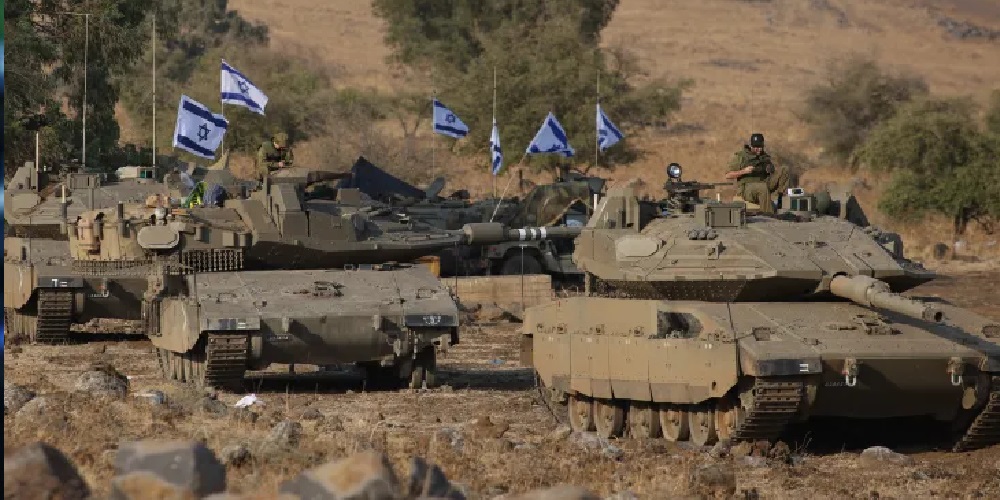
At least four people were reportedly killed in Israeli extensive air strikes in Lebanon after Hezbollah rocket fire killed a soldier in Israel.


A woman and two children were killed in the southern Lebanese town of Souaneh, state media and security sources said.

A man who Hezbollah identified as one of its fighters was killed in Aadchit.

Israel’s military said it hit Hezbollah infrastructure in response to a deadly rocket attack on its base in the northern Israeli town of Safed.

Advertisement

The Israeli Defence Force confirmed the attacks on their official X.com platform monitored by SOJ WORLDWIDE, it claimed,

“In response to ongoing rocket fire toward northern Israel, IDF fighter jets struck a series of Hezbollah terrorist targets.

The targets included military compounds, operational control rooms, and terrorist infrastructure. Several targets belonged to Hezbollah’s elite by Radwan Forces.” – IDF said.

Hezbollah fighters have exchanged fire with Israeli forces almost every day along the border since the start of the war between Israel and the Palestinian group Hamas in the Gaza Strip in October.

Advertisement

The clashes have raised fears of a wider regional conflict.

On Wednesday morning, sirens sounded across Northern Israel as barrages of rockets were fired towards the border communities of Netua and Manara, and the town of Safed, which is 14 km (9 miles) south of the frontier.

One Israeli soldier was killed and seven others were wounded after their base in Safed was hit by rockets, Israeli media and emergency services said. The soldier who died was later identified as Staff-Sergeant Omer Sarah Benjo.

A video showed that another rocket landed near the gate of Safed’s hospital.

Advertisement

Hezbollah later claimed it had attacked an “enemy position” in Safed “in support of the people and resistance of Gaza which is being subjected to brutal Zionist aggression with a US green light”.

In the afternoon, the Israel Defense Forces (IDF) announced that fighter jets had “struck a series of Hezbollah terror targets” in Souaneh, Aadchit, Jabal al-Braij, Kfar Houneh and Kfar Dunin in response to the rocket fire.

Hezbollah leader Hassan Nasrallah said it would only cease fire “when the aggression stops and there is a ceasefire in Gaza”

“Among the targets struck were military compounds, operational control rooms, and terror infrastructure,” it said, adding that several targets belonged to Hezbollah’s elite Radwan Force, whose well-trained members are considered the group’s special forces.

Advertisement

Lebanon’s state-run National News Agency (NNA) said a strike on a home in Souaneh killed a Syrian woman, Rawaa al-Mohammed, and her two sons, Hassan Mohsen, 13, and Amir Mohsen, two.

Video from the town showed residents inspecting the rubble of at least one destroyed building and the burned-out wreckage of a car.

NNA also reported that one man was killed and 10 other people were injured in Aadchit. It named the dead man as Hassan Ali Najm, a Hezbollah fighter whose death the group confirmed in a statement on Telegram.

“As we have made clear time and time again, Israel is not interested in a war on two fronts. But if provoked, we will respond forcefully,” Israeli government spokesperson Ilana Stein told Reuters news agency.

Advertisement

“The current reality, where tens of thousands of Israelis are displaced [in the north] and cannot return to their homes, is unbearable. They must be able to return home and live in peace and security.”

The IDF’s chief of staff, Lt Gen Herzi Halevi, meanwhile told the heads of northern municipalities: “There are great achievements striking Hezbollah in Lebanon, but we continue to operate – this is not the time to stop.

“We are intensifying the strikes all the time, and Hezbollah are paying an increasingly heavy price.”

On Tuesday, Hezbollah leader Hassan Nasrallah warned Israeli leaders in a speech that launching a war against the group would result in a “million evacuees” from northern Israel.

Advertisement

“To those who threaten us with a widening of the war: if you widen, we will too,” he said, adding that “those who think the resistance might be afraid are very mistaken”.

He also vowed that Hezbollah would only cease fire “when the aggression stops and there is a ceasefire in Gaza”.
Continue Reading
Advertisement

Foreign

‘We will not submit to lawless aggression’ – Iran tells UN

Published

on

By

ADVERTISEMENT
Zoom Ad
ADVERTISEMENT
Zoom Ad

Iran vowed at the United Nations on Monday that it would not submit to “lawless aggression”, and said its citizens were in “grave danger” from US and Israeli strikes.

At the UN Human Rights Council in Geneva, where countries were discussing the rights situation in Iran — notably following its deadly crackdown on protesters in recent months — Tehran said the focus instead should be on the Middle East war.

“The most urgent and fundamental human rights issue concerning Iran is the imminent threat to the lives of 90 million people whose lives are in immediate and grave danger under the shadow of reckless military aggression,” said Ali Bahreini, Iran’s ambassador to the UN in Geneva.

He called it “an aggression that is carried out by some of the most lawless and unscrupulous actors on the international stage”.

Bahreini said that if such “reckless militarism” was met with indifference, “Iran will most certainly not be the last country to suffer such treatment”.

On February 28, the US and Israel launched their war on Iran, that has seen the Islamic republic retaliate against multiple countries in the Middle East.

During a session on Iran’s record, Bahreini urged the UN’s top rights body to instead discuss the Iranian cultural heritage under “indiscriminate” attack and “the innocent children massacred at their school desks”.

Iran has accused the United States and Israel of conducting a deadly missile attack on a school in the southern city of Minab. Washington has said it is investigating the incident. AFP does not have access to the site.

The ambassador said more than 1,300 people had been killed in Iran and more than 7,000 injured since the US-Israeli strikes began.

“Under such circumstances, what exactly is Iran expected to do?” he asked, stating: “Iran is not a nation that submits to coercion, intimidation or lawless aggression.”

– ‘Wounded protesters arrested’ –

The six Gulf Cooperation Council countries, plus Jordan, condemned Iran’s attacks on their territories, saying they endangered regional security and civilian lives, and “cannot be justified under any pretext”.

The UN Human Rights Council was holding an interactive dialogue between nations and the council’s special rapporteur on rights in Iran and its fact-finding mission on the country.

Special rapporteur Mai Sato said Tehran’s deadly crackdown on the nationwide protests that began on December 28, in which “over 7,000 deaths have been reported by civil society”, followed a “pattern of persecution” that long predated the uprising.

“What was new and what has left a profound impression on me was the violation of medical neutrality,” she said.

“Hospitals were raided. Wounded protesters arrested from their beds. Medical professionals assaulted and arrested. A state directive instructing hospitals to provide information on injured protesters.

“The result was a healthcare system in which the injured feared seeking treatment more than the injuries themselves, and the act of saving life criminalised.”

She said that the US-Israeli strikes “remain unlawful, no matter the assumed or stated objectives of those strikes”.

She said her mandate exists for the people of Iran, and whether perpetrators are Iranian or foreign, “the people harmed are the same”.

The Independent International Fact-Finding Mission on Iran has said the war in the Middle East is likely to result in worsening institutionalised domestic repression of Iranian citizens.

Continue Reading

Foreign

Iran: You’re on your own for failing to consult us-NATO tells Trump

Published

on

By

ADVERTISEMENT
Zoom Ad
ADVERTISEMENT
Zoom Ad

German Chancellor Friedrich Merz, along with other European nations, has sought further information regarding US President Donald Trump’s strategy for the war in Iran and the anticipated duration of the conflict.

The inquiry comes as European leaders deliberate on whether to comply with the US President’s request to deploy warships to enhance security in the Persian Gulf.

As foreign ministers of the European Union convened to deliberate on Trump’s request, German Foreign Minister Johann Wadephul emphasized the need for the United States and Israel to clarify “when they believe the military objectives of their deployment have been achieved.”

“We require greater clarity on this matter,” Wadephul told reporters.

A spokesperson for Chancellor Merz, Stefan Kornelius, reiterated that “this is not NATO’s war. NATO is an alliance established to protect the alliance area.”

Kornelius noted that Berlin had “acknowledged” Trump’s statements but added: “The United States did not consult us prior to this conflict, and therefore we consider this issue to be outside the purview of NATO or the German government.”

Meanwhile, Estonian Foreign Minister Margus Tsahkna said US allies in Europe are eager to understand Trump’s “strategic objectives, what will the plan entail?”

Additionally, Polish Foreign Minister Radek Sikorski urged the Trump administration to follow the appropriate protocols.

“If a request is made through NATO, we will certainly, out of respect and solidarity for our American allies, consider it very carefully,” he said.

Continue Reading

Foreign

North Korea test-fires 10 missiles as South Korea, U.S. stage war games

Published

on

By

ADVERTISEMENT
Zoom Ad
ADVERTISEMENT
Zoom Ad

North Korea test-fired 10 short-range ballistic missiles into the Sea of Japan at the weekend, five days after South Korea and its U.S. allies kicked off their annual spring war games.

Seoul’s Joint Chiefs of Staff said they detected the launches at around 1:20 p.m.

“Our military maintains a firm readiness posture while closely sharing North Korean ballistic missile information with the U.S. and Japanese sides amid a heightened surveillance posture against additional launches,” Seoul’s Joint Chiefs said, per Yonhap News Agency, in a template statement.

The missiles splashed in the Sea of Japan, east of the peninsula.

For tests of ballistic missiles, Pyongyang follows common global protocols, firing them on a west-east trajectory so the Earth’s rotation grants them extra boost.

Experts say North Korea conducts test firings for two reasons. One is to gather technical data; one is to make political points.

Currently, North Korea is highly likely to be gathering data from live war. Since January, it has been firing tube and rocket artillery from Russia’s Kursk Oblast into Ukraine.

Saturday’s missile shoot followed angry rhetoric aimed at the annual “Freedom Shield” drills by Kim Yo-jong, the sister of North Korean leader Kim Jong-un. Pyongyang insists that the exercises, which Washington calls “defensive in nature,” are actually practice for an invasion.

Ms. Kim warned, in a statement in state media on Tuesday, the day following the drills’ commencement, that they could “lead to terrible consequences that are unimaginable.”

Her fortunes rose in February at the once-every-five-years Workers Party Congress, where she was promoted director of the party’s General Affairs Department.

Though the powerful Ms. Kim, who frequently pens bylined columns on inter-Korean relations, warned that Freedom Shield “will further destroy regional stability,” life in South Korea continues as usual.

The population has long been immunized to North Korean threats, and all three actions — the start of spring military drills by the two allies, followed by the North’s response in the form of barrages of rhetoric and missiles — had been predicted.

Events follow the same course virtually every year, though this spring, the drills take place against the backdrop of an ongoing Israeli-U.S. aerial campaign against Iran.

Indo-Pacific-based U.S. assets — missile interceptors in South Korea and U.S. Marines in Okinawa — are currently redeploying to the Middle East, where Iran’s will to fight remains unbroken.

The redeployments have raised quiet concerns about the U.S. ability to fight a two-front war, and come at a time when a major power shift is underway in the defense of the Korean Peninsula.

The all-domain drills encompass both computer simulations and “Warrior Shield” field exercises. Some 18,000 troops are engaged, with training running from March 9 through March 19.

While the “Allies drill-North Korea responds angrily” scenario was predictable, a new dynamic is animating the war games this year.

The Spring 2026 drills are being used to stress-test South Korea’s domestic capabilities, notably in sophisticated areas such as long-range strike, command and control, and intelligence, reconnaissance and surveillance.

The assessments, made by the U.S. side, are part of the planned conditions-based transfer of wartime operational control of South Korean troops from U.S. to South Korean command.

The Lee Jae-myung administration, which took office in summer 2025, has announced that it wants wartime “OPCON Transfer” to take place by the end of its term, 2030.

The concept has a long history, but current Seoul-Washington policy stances suggest it may, finally, happen.

OPCON transfer was first brokered by the liberal Roh Moo-hyun administration (2003-2008), which sought sovereign control of its own forces.

However, it was subsequently slow-walked by successive conservative administrations in Seoul, who feared it would greenlight reduced U.S. commitments to the peninsula.

As matters stand, Korean troops would fight under the orders of the Combined Forces Command, a joint structure led by an American four-star general, with a South Korean deputy.

Exactly how OPCON transfer — the exact conditions to be met have never been made fully public — would proceed, and what might happen to CFC if and when it does, is unclear. Whether U.S. troops would fight under Seoul’s wartime command is another concern that gives Korean conservatives the vapours.

Regardless, OPCON transfer’s stars are aligning on both sides of the Pacific.

In South Korea, the liberal Mr. Lee occupies the presidential Blue House, while his party comfortably controls the National Assembly. This leaves the conservative opposition largely impotent.

Meanwhile, the Trump administration is pressuring allies worldwide to increase defence spending and upgrade capabilities. It has made clear it wants Seoul to take an increasing share of the conventional defense burden, while sheltering Korea under the U.S. nuclear umbrella.

What is unknown is how far South Korea’s military is proceeding toward satisfying U.S.-set conditions.

“The main thing here is the conditions,” U.S. Forces Commanding General Xavier Brunson said during a webinar organized by the Korea Defense Veterans Association and the Korea-U.S. Alliance Foundation last December. “We cannot say we’re going to slide away from the conditions just so that we can get this done in time.”

Continue Reading

Trending

Copyright © 2024 Naija Blitz News