Connect with us

News

Reps Okay State Police Bill For Second Reading

Published

on

ADVERTISEMENT
Zoom Ad
ADVERTISEMENT
Zoom Ad
By Gloria Ikibah
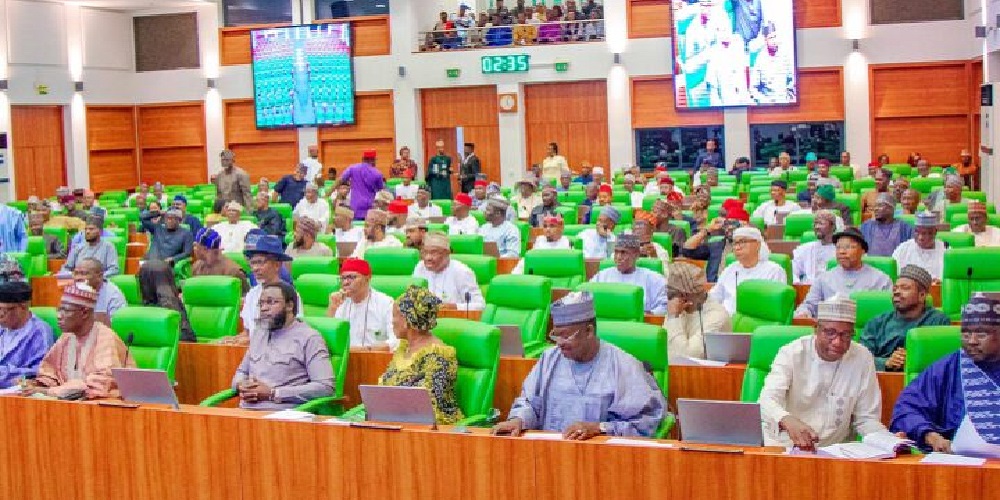
The House of Representatives has passed for second reading, “A bill for an to alter the provision of the constitution of the Federal Republic of Nigeria to provide for the establishment of State Police and for related matters. M
This is part of the efforts by the 10th National Assembly toward devolution of powers, which has gained momentum on the floor of the House.
Naijablitznews.com recalled that in the 7th and 8th Assembly the same bill seeking to establish State Police, was thrown out by the then legislature due to party interest by lawmakers; as many had feared that political opponents would use it in their favour.
The bill which is been reintroduce in the 10th Assembly is sponsored by Deputy Speaker, Rep. Benjamin Okezie Kalu, and 14 other lawmakers.
The proposed private members’ bill 18 clauses, seeking to alter Sections 34, 35, 39, 42, 84, 89, 129, 153, 197, 214, 215 and 216 of the 1999 Constitution (as amended), to  transfer Police from the Exclusive Legislative List to Concurrent Legislative List, with a view to effectively empower States to have State-controlled policing.
Leading the debate on general principles of the bill on Tuesday at plenary, Rep. Tolani Shagaya, representing IlotinWest/Asa Federal Constituency of Kwara state, decried that Nigeria, a federation of 36 States and Federal Capital Territory, with 774 LGAs, over 250 ethnic nationalities, more than 200 million citizens and a vast terrain spanning over 920,000 square kilometres, sadly still operates a single centralised police system that employs less than 400,000 police officers and men.
“There is no gainsaying that the nation’s security architecture is under immense pressure and always overwhelmed”, he lamented.
According to him, “The bill emerges as a necessary response to several calls for a decentralised and community-oriented approach to law enforcement. It seeks to navigate the complex landscape of security challenges by empowering our States with the means to address issues unique to their localities.
“This proposed alteration represents not just a legal adjustment to our grundnorm, but a visionary leap towards a safer, more secure, and harmonious Nigeria.”
Shagaya explained that the proposed bill seeks to introduce a comprehensive framework to ensure cohesion as well as accountability and uniform standards between the Federal Police and State Police.
“The provision of prescribed rigorous safeguards preventing unwarranted interference by the Federal Police in State Police Affairs, emphasising collaboration and intervention only under well-defined circumstances.
“The establishment of State Police Service Commissions as distinct from the Federal Police Service Commission with clearly defined roles and jurisdictions.
“A re-calibration of the National Police Council to include the Chairmen of the State Police Service Commissions, emphasising the collaborative and consultative nature of policing in our federal system.
“A recognition of the possible financial challenges which may be faced by States Police, by empowering the Federal Government to provide grants or aids subject to the approval of the National Assembly, thus ensuring adequate resources for effective policing, etc”, the lawmaker added.
Contributing to the debate, Rep. Ahmed Jaha, lawmaker representing Damboa/Gwoza/Chibok Federal Constituency of Borno State, described the bill as timely, eve as he argued that security is the responsibility of all the Citizens.
Rep. Jaha stated that with community policing and Nigerian police working in tandem, they will rid our communities of all forms of crime.
Alss speaking in favour of the bill, Chairman House Committee on Defence, Rep. Babajimi Benson, underscored the need to empower the Nigeria Police to license any State that expressed intent and furthermore meet the requirements set by the Police Service Commission.
Rep. Benson also noted that the Nigeria Police may renew the license or otherwise if such a State abused the licence.
He therefore expressed optimism that when put in place, State Police license would reduce unemployment and reduce the burden on recurrent expenditure from the Federal Government.
On his part, Rep. Awaji-Inombek Abiante, lawmaker representing Andoni-Opobo/Nkoro Federal Constituency of Rivers State, supported the bill, even as he lamented that Nigeria has had enough of insecurity.
Rep. Abiante said that establishing State Police is a sure way of guaranteeing security of lives and property amidst current security challenges.
The lawmaker also expressed optimism that the proposed bill when passed into law will cure the tragedy of military decree of 1966, he therefore underscored the need for deliberate efforts toward ensuring that the law is well drafted to meet the security needs of the country.
Rep. Ali Madaki, lawmaker representing Dala Federal Constituency of Kano State, who was a member of the 7th Assembly, confessed to be part of the death of State Police bill in the seventh Assembly, and revealed that the fear was to avert a situation where State Governors will use the State Police for political opponents.
Madaki admitted that the whole country was on fire, and that the bill when passed into law will enable each State to deploy the State Police in such a manner to address their peculiarities.
Rep. Marie Ebikake, lawmaker representing Brass/Nembe Federal Constituency of Bayelsa state, supporting the bill, urged lawmakers not to entertain any fears when the bill is passed because the benefits are  overwhelmingly outweighs the disadvantages.
She explained that so many States have security outfits, that could be strengthened and incorporated into the State Police
Also speaking, Rep. Sada Soli, representing Jibia/Kaita Federal Constituency of Katsina State, said that about 21 States including Benue, Taraba States are caught up in the socio-political, ethno-religious crises across the country.
He noted that some of the States clamouring for the establishment of State Police are not economically viable, but he however, acknowledged that State Police is a noble idea, though capital intensive.
Rep. Soli, cited a situation where a State Governor who denied a political opponent from landing at the airport, hence argued that such a Governor is capable of using the State Police for coercion of the opposition.
To this end, he urged the lawmakers to put all issues into perspective before enacting the law.
Rep. Ademorin Kuye, representing Shomolu Federal Constituency of Lagos State, argued that with 400,000 Policemen to 200 million Nigerians, Nigeria is under-policed.
He noted that deployment of a Police officer to a State that he is not familiar with will make him inefficient and ineffective in the course of discharging his duties.
Chief Whip of the House, Rep. Usman Kumo, said there was the need to address some of the grey areas and concerns raised during previous Assemblies.
Rep. Kumo who lamented over the incessant killings across the country, berated Federal Government for failing to provide funding for the ongoing recruitment exercise into the Nigerian Police.
He stressed that the current 400,000 Police workforce is inadequate, and argued that the long stay of military has put Nigerian Police which has the sole responsibility of providing internal security across the country in the background.
He said that there is nothing that stops the Federal Government from declaring state of emergency in the Nigerians police with a view to recruit adequate number of youths into the security agencies.
Also speaking, Rep. Benedict Itanabene, representing Okpe/Saoele/Uvwie Federal Constituency of Delta state called for the establishment of a distinct police structure for over 20 years.
He further noted that mere use of State Police sends wrong signal that Governors will be in control of the State Police.
He therefore urged the House to delete the word ‘State’ from the bill, and called for decentralization of the Federal Police by using Police Command.
In his intervention, the Deputy Speaker, Rep. Benjamin Kalu, who presided over the plenary urged the lawmakers to put the nation above personal or sentimental gains.
The House unanimously passed the bill and the presiding officer refered the bill to the Special Ad-hoc Committee on Constitution amendment for further legislative action.

Continue Reading
Advertisement

News

Stone Age lost Atlantis about 8,500 years discovered beneath the waters of Denmark

Published

on

ADVERTISEMENT
Zoom Ad
ADVERTISEMENT
Zoom Ad

By Ojomah Austin.


The mystery of Atlantis has created a city-sized gap in our grasp of history, with archaeologists searching the oceans for any trace of this submerged civilisation.

A prominent theory suggests that Atlantis never actually existed. Nevertheless, as we’re now aware, the notion of a coastal settlement being consumed by the ocean is entirely plausible.

Advertisement

Subsequently, archaeologists in Europe believed they’d discovered the missing piece of the puzzle. You wouldn’t necessarily expect Denmark to be the maritime location of an exotic lost metropolis from ancient times, yet this is precisely where archaeologists unearthed the most compelling proof of Atlantis, according to Global News.

“Europe’s Atlantis”, stretching back to the Stone Age, was discovered beneath the waters of Denmark’s Bay of Aarhus. Researchers unearthed numerous artefacts that paint a picture of a civilised community that inhabited the area nearly 8,500 years ago.

These included stone implements, arrowheads, animal remains, and even fragments of timber that appeared to be rudimentary tools.

Researchers plunged 26 feet beneath the surface of Denmark’s second-largest city, employing specialised suction apparatus, to retrieve the remains of Europe’s Atlantis.

Advertisement

The location dates back to the conclusion of the last Ice Age, when climbing sea levels submerged entire coastal communities, forcing Stone Age hunter-gatherer societies inland.

Because the artefacts have remained underwater for millennia, they are significantly better preserved than they would be inland. “What we actually tried to find out here is how life was at a coastal settlement 8,500 years ago,” archaeologist Peter Moe said.

He added: “Here, we actually have an old coastline. We have a settlement that was positioned directly at the coastline. What we actually try to find out here is how was life at a coastal settlement.

“It’s like a time capsule. When sea level rose, everything was preserved in an oxygen-free environment … time just stops. We find completely well-preserved wood. We find hazelnut. … Everything is well preserved.

Advertisement

“We can say very precisely when these trees died at the coastlines,” Moesgaard Museum dendrochronologist Jonas Ogdal Jensen, according to Fortune.


The specialist explained how this remarkable find has shed considerable light on how sea levels have shifted throughout history.

Stone Age lost Atlantis found is Denmark

He said: “It’s hard to answer exactly what it meant to people,” Moe Astrup said. “But it clearly had a huge impact in the long run because it completely changed the landscape.”

Researchers are keen to press ahead with investigations at a further site off the German coastline, with ambitions to examine locations in the notoriously unforgiving North Sea also in the pipeline.

Advertisement

Yet this is not the first occasion archaeologists have drawn comparisons between a site and Atlantis. Doggerland was a landmass that once extended between Britain, Denmark, and the Netherlands, linking the corners of Europe.

In 1931, evidence of this lost territory began to emerge after a Dutch fishing vessel retrieved artefacts from the seabed. A portrait of a hunter-gatherer community thousands of years old began to take shape. Yet, some 8,200 years ago, rising sea levels and a catastrophic tsunami ultimately swallowed this civilisation whole.

A colossal underwater landslide set off a chain of unstoppable natural disasters that plunged the landmass beneath the waves. Today, all that remains of this lost world lies buried under the North Sea.

Advertisement
Continue Reading

News

Amnesty International condemns attack on Abuja protesters as Sowore lands in hospital

Published

on

ADVERTISEMENT
Zoom Ad
ADVERTISEMENT
Zoom Ad

By Kayode Sanni-Arewa

Condemns his alleged “deliberate targeting”

Amnesty International has condemned what it described as a “reckless attack on peaceful protesters” during a Democracy Day demonstration in Abuja, where activist and African Action Congress 2027 presidential candidate, Omoyele Sowore, reportedly collapsed after security operatives allegedly fired teargas.

In a statement released on Friday, the rights organisation said Sowore was “subsequently taken to a hospital” following the incident at Unity Fountain, Abuja, and called for an immediate investigation into what it described as his “deliberate targeting.”

Advertisement

The Nigerian authorities are clearly using violence to crack down on human rights, including the rights to freedom of expression and peaceful assembly,” the statement said.

Amnesty International also warned that targeting activists for participating in peaceful demonstrations amounted to unlawful conduct and a breach of fundamental rights.

“Such targeting of activists solely for exercising freedom of assembly is unlawful and shows utter disregard for the rule of law,” it said.

The organisation further accused the authorities of failing to demonstrate commitment to constitutional and international human rights obligations, alleging a continued crackdown on civic freedoms under President Bola Tinubu’s administration.

Advertisement

Sowore’s collapse reportedly occurred during a protest in Abuja where security operatives allegedly dispersed demonstrators with teargas in front of the Force Headquarters.

Videos shared online showed him on the ground amid confusion as protesters attempted to assist him.

The protest was part of a nationwide mobilisation by a coalition of civic groups, labour activists, youth organisations and social movements, which had declared June 12 a day of mass action over insecurity, economic hardship and worsening living conditions. (Text, excluding headline:

(The PUNCH)

Advertisement
Continue Reading

News

Falana, Falz lead protest over kidnappings, hardship

Published

on

ADVERTISEMENT
Zoom Ad
ADVERTISEMENT
Zoom Ad

By Kayode Sanni-Arewa

Activist lawyer, Mr Femi Falana (SAN), his son – afrobeats singer, Mr Folarin Falana, popularly known as Falz, alongside civil society organisations, youth groups, among others, on Friday staged a protest in Lagos.

They demanded urgent action to address worsening insecurity and economic hardship in the country.

The protest came as Nigeria marked Democracy Day, set aside in remembrance of the June 12, 1993 presidential election, widely acclaimed to have been won by late Chief MKO Abiola.

Advertisement

The election, though regarded as the freest and fairest in the nation’s history, was annuled by the then military government.

Chanting, the protesters converged on the Ikeja Under Bridge, carrying placards with inscriptions such as “No Democracy Without Security,” End Bad Governance,” and “End Insecurity and Kidnapping.”

Others include, “End Hunger,” “Free All Captives Now,”End all anti-people policies now,”

The demonstration was aimed at drawing attention to rising insecurity, economic hardship and policies affecting ordinary Nigerians.

Advertisement

Speaking during the protest, Falana called for the immediate release of abducted pupils and teachers in Oyo State, expressing concern over their welfare in captivity.

According to him, the protest is not only about demanding the rescue of the abducted victims but also about highlighting broader issues of injustice, insecurity and poverty confronting Nigerians.

“We are protesting the kidnapping of our children in Oyo State. We are also protesting injustice in our country, a situation whereby innocent school children in Oyo and Borno states have been in the custody of criminals for several weeks now.

“We are also protesting injustice meted out to young people who are regularly arrested on the highways by the police.

Advertisement

“We are protesting hunger and poverty in the land, and we are calling on the government to address these challenges,” he said.

Falana, a human rights advocate, lamented the condition of the abducted children and teachers, and regretted the killing of one of the latter.

He called on the authorities to intensify efforts to secure the release of the remaining victims.

Also addressing the protesters, Falz bemoaned what he described as worsening insecurity and economic hardship across the country.

Advertisement

The entertainer and activist said Nigeria was grappling with increasing cases of kidnappings and killings, urging the government to do more in its responsibility of protecting the citizens.

“Everybody can see the worsening insecurity. It is becoming unbearable,” he said.

Falz cited recent abductions in different parts of the country, including the kidnapping of students and the abduction of a relative of a former minister in Oyo State.

“Every Nigerian life matters and must be protected at all costs,” he stated.

Advertisement

He said that the repeated abduction of students had heightened public frustration and anxiety.

Also speaking, human rights activist, Mr Olumide Ogunsanwo, popularly known as Seaking, called for stronger government action to tackle insecurity across the country.

He said Nigerians were demanding better governance and an end to the growing wave of killings, kidnappings and other violent crimes.

“We say no to insecurity. Insecurity has to end,” he said.

Advertisement

Ogunsanwo urged the Federal Government to intensify efforts against bandits, insisting that decisive action, rather than rhetoric, was needed to end the insecurity.

Security operatives maintained presence around the protest venue and monitored activities throughout the demonstration.

(NAN)

Advertisement
Continue Reading

Trending

Copyright © 2024 Naija Blitz News