Foreign
Wife of Haiti’s assassinated president indicted in his killing
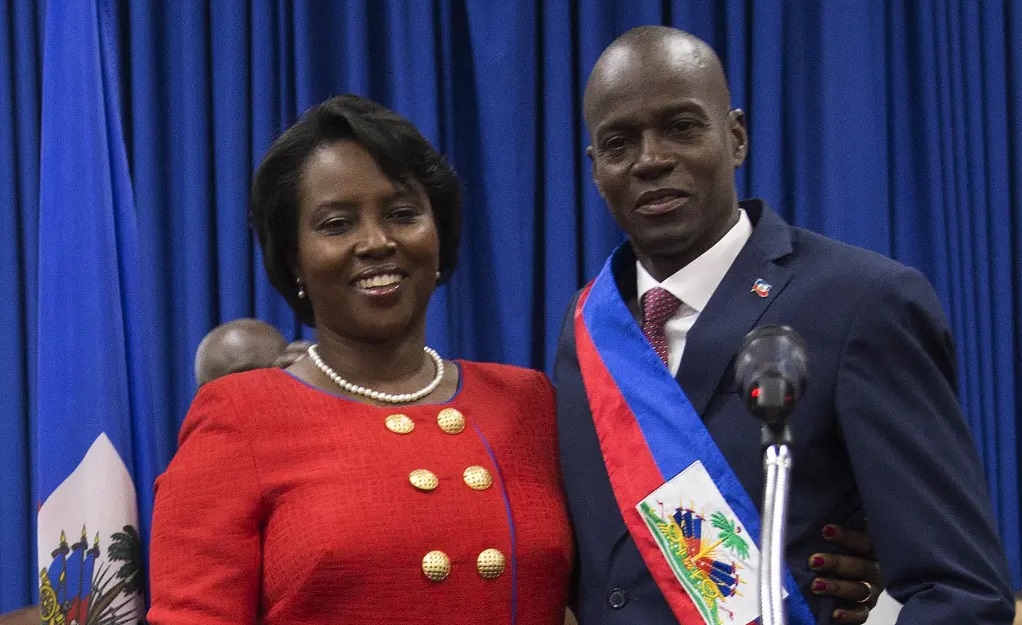
A judge in Haiti investigating the July 2021 assassination of President Jovenel Moïse indicted his widow, Martine Moïse, ex-prime minister Claude Joseph and the former chief of Haiti’s National Police, Léon Charles, among others in his killing.

Dozens of suspects were indicted in the 122-page report issued by Walther Wesser Voltaire, who is the fifth judge to lead the investigation after previous ones stepped down for various reasons, including fear of being killed.
Charles, who was police chief when Moïse was killed and now serves as Haiti’s permanent representative to the Organization of the American States, faces the most serious charges: murder; attempted murder; possession and illegal carrying of weapons; conspiracy against the internal security of the state; and criminal association.

Meanwhile, Joseph and Martine Moïse, who was injured in the attack, are accused of complicity and criminal association.
Joseph, the former prime minister, shared a statement with The Associated Press accusing Henry of “undermining” the investigation and benefitting from the president’s death.
“Henry … is weaponizing the Haitian justice system, prosecuting political opponents like me. It’s a classic coup d’état,” Joseph said. “They failed to kill me and Martine Moïse on July 7th 2021, now they are using the Haitian justice system to advance their Machiavellian agenda.”
Joseph again called on Henry to resign and noted that while he was still prime minister, he invited the FBI to help local authorities investigate the killing and wrote the U.N. and OAS for help.
“I won’t stop my fight. Justice must be served,” he said.
In his report, the judge noted that the former secretary general of the National Palace, Lyonel Valbrun, told authorities that he received “strong pressure” from Martine Moïse to put the president’s office at the disposal of Joseph because he needed it to “organize a council of ministers.”
Valbrun also said that two days before her husband was killed, Martine Moïse visited the National Palace and spent nearly five hours, from 10 p.m. to 3 a.m., removing “a bunch of things.”
He said that two days after Jovenel Moïse was slain, Martine Moïse called to tell him that, “Jovenel didn’t do anything for us. You have to open the office. The president told Ti Klod to create a council of ministers; he will hold elections in three months so I can become president, now we will have power.”
While the document did not identify Ti Klod, the former prime minister, Claude Joseph, is known by that name.
The judge also stated in his report that Martine Moïse “suggested” she took refuge under the marital bed to protect herself from the attackers, but he noted that authorities at the scene found that not “even a giant rat…whose size measures between 35 and 45 centimeters” could fit under the bed.
The judge said the former first lady’s statements were “so tainted with contradictions that they leave something to be desired and discredit her.”
Others who face charges including murder are Christian Emmanuel Sanon, a Haitian-American pastor who visualized himself as Haiti’s next president and said he thought Moïse was only going to be arrested; Joseph Vincent, a Haitian-American and former informant for the U.S. Drug Enforcement Administration; Dimitri Hérard, presidential security chief; John Joël Joseph, a former Haitian senator; and Windelle Coq, a Haitian judge whom authorities say is a fugitive.
Sanon, Vincent, and Joseph were extradited to the U.S., where a total of 11 suspects face federal charges in the slaying of Haiti’s president. At least three of them already have been sentenced.
Meanwhile, more than 40 suspects are languishing in prison in Haiti awaiting trial, although it was not immediately clear how quickly one would be held following Monday’s indictments. Among them are 20 former Colombian soldiers.
Milena Carmona, wife of Jheyner Alberto Carmona Flórez, told The Associated Press that he is innocent.
“What’s happening is that this crime is a conspiracy of great magnitudes in which powerful people are behind the scenes running everything, and that’s why they’re not given freedom,” she said of the former soldiers.
U.S. prosecutors have described it as a plot hatched in both Haiti and Florida to hire mercenaries to kidnap or kill Moïse, who was 53 when he was slain at his private home near the Haitian capital of Port-au-Prince.
The attack began late July 6 and ended July 7, according to witnesses.
Martine Moïse and others who were interrogated said they heard heavy gunfire starting around 1 a.m. that lasted between 30 to to 45 minutes before armed men burst into the bedroom of the presidential couple.
Moïse said she was lying on the ground when she heard the attackers yell, “That’s not it! That’s not it! That’s not it!”
She said the suspects made a video call to identify the exact location of what they were searching as they killed the president. She added that she was face down when the suspects tilted her head and tugged on one of her toes “to ensure that she wasn’t alive.”
Once they left, Moïse said she dragged herself on the ground and whispered to her husband that she was going to try and go to the hospital.
“That’s when she noticed that the president was dead and that his left eye had been removed from the socket,” the report stated.
Moïse said a group of about 30 to 50 police officers were supposed to guard the presidential residence, but the judge noted that only a handful of officers were present that night.
One officer told the judge that he heard explosions and a voice through a megaphone saying, “Do not shoot! It’s a DEA operation! US Army! We know how many officers are inside. Exit with two hands lowered.”
Another officer said the head of security of the first lady found her “in critical condition” surrounded by her two children. He said he also saw an undetermined number of people coming out of the president’s residence “with briefcases and several envelopes in their possession.”
The report quotes Inspector General André Vladimir Paraison saying that the president called him at 1:46 a.m. and told him, “Paraison! Man, hurry up! I’m in trouble! Come quickly and save my life.” He said he encountered heavily armed men and couldn’t access the residence immediately.
Officers at the scene said they found cars, windows, and doors at the president’s private home riddled with bullet holes, along with surveillance cameras cut off and a broken lock on the double-wooden door leading to the presidential bedroom.
The judge said some police officers at the residence were disarmed and handcuffed, while others “had time to throw themselves down a ravine” for safety. In addition, the police officer overseeing presidential security was accused of receiving $80,000 to bribe certain officers “to remain inactive” during the assassination, according to the report.
The judge noted how “none of the police providing security to the head of state was in danger. Unfortunately, the head of state was assassinated with ease.”

Foreign
North Korea test-fires 10 missiles as South Korea, U.S. stage war games
North Korea test-fired 10 short-range ballistic missiles into the Sea of Japan at the weekend, five days after South Korea and its U.S. allies kicked off their annual spring war games.
Seoul’s Joint Chiefs of Staff said they detected the launches at around 1:20 p.m.
“Our military maintains a firm readiness posture while closely sharing North Korean ballistic missile information with the U.S. and Japanese sides amid a heightened surveillance posture against additional launches,” Seoul’s Joint Chiefs said, per Yonhap News Agency, in a template statement.
The missiles splashed in the Sea of Japan, east of the peninsula.
For tests of ballistic missiles, Pyongyang follows common global protocols, firing them on a west-east trajectory so the Earth’s rotation grants them extra boost.
Experts say North Korea conducts test firings for two reasons. One is to gather technical data; one is to make political points.
Currently, North Korea is highly likely to be gathering data from live war. Since January, it has been firing tube and rocket artillery from Russia’s Kursk Oblast into Ukraine.
Saturday’s missile shoot followed angry rhetoric aimed at the annual “Freedom Shield” drills by Kim Yo-jong, the sister of North Korean leader Kim Jong-un. Pyongyang insists that the exercises, which Washington calls “defensive in nature,” are actually practice for an invasion.
Ms. Kim warned, in a statement in state media on Tuesday, the day following the drills’ commencement, that they could “lead to terrible consequences that are unimaginable.”
Her fortunes rose in February at the once-every-five-years Workers Party Congress, where she was promoted director of the party’s General Affairs Department.
Though the powerful Ms. Kim, who frequently pens bylined columns on inter-Korean relations, warned that Freedom Shield “will further destroy regional stability,” life in South Korea continues as usual.
The population has long been immunized to North Korean threats, and all three actions — the start of spring military drills by the two allies, followed by the North’s response in the form of barrages of rhetoric and missiles — had been predicted.
Events follow the same course virtually every year, though this spring, the drills take place against the backdrop of an ongoing Israeli-U.S. aerial campaign against Iran.
Indo-Pacific-based U.S. assets — missile interceptors in South Korea and U.S. Marines in Okinawa — are currently redeploying to the Middle East, where Iran’s will to fight remains unbroken.
The redeployments have raised quiet concerns about the U.S. ability to fight a two-front war, and come at a time when a major power shift is underway in the defense of the Korean Peninsula.
The all-domain drills encompass both computer simulations and “Warrior Shield” field exercises. Some 18,000 troops are engaged, with training running from March 9 through March 19.
While the “Allies drill-North Korea responds angrily” scenario was predictable, a new dynamic is animating the war games this year.
The Spring 2026 drills are being used to stress-test South Korea’s domestic capabilities, notably in sophisticated areas such as long-range strike, command and control, and intelligence, reconnaissance and surveillance.
The assessments, made by the U.S. side, are part of the planned conditions-based transfer of wartime operational control of South Korean troops from U.S. to South Korean command.
The Lee Jae-myung administration, which took office in summer 2025, has announced that it wants wartime “OPCON Transfer” to take place by the end of its term, 2030.
The concept has a long history, but current Seoul-Washington policy stances suggest it may, finally, happen.
OPCON transfer was first brokered by the liberal Roh Moo-hyun administration (2003-2008), which sought sovereign control of its own forces.
However, it was subsequently slow-walked by successive conservative administrations in Seoul, who feared it would greenlight reduced U.S. commitments to the peninsula.
As matters stand, Korean troops would fight under the orders of the Combined Forces Command, a joint structure led by an American four-star general, with a South Korean deputy.
Exactly how OPCON transfer — the exact conditions to be met have never been made fully public — would proceed, and what might happen to CFC if and when it does, is unclear. Whether U.S. troops would fight under Seoul’s wartime command is another concern that gives Korean conservatives the vapours.
Regardless, OPCON transfer’s stars are aligning on both sides of the Pacific.
In South Korea, the liberal Mr. Lee occupies the presidential Blue House, while his party comfortably controls the National Assembly. This leaves the conservative opposition largely impotent.
Meanwhile, the Trump administration is pressuring allies worldwide to increase defence spending and upgrade capabilities. It has made clear it wants Seoul to take an increasing share of the conventional defense burden, while sheltering Korea under the U.S. nuclear umbrella.
What is unknown is how far South Korea’s military is proceeding toward satisfying U.S.-set conditions.
“The main thing here is the conditions,” U.S. Forces Commanding General Xavier Brunson said during a webinar organized by the Korea Defense Veterans Association and the Korea-U.S. Alliance Foundation last December. “We cannot say we’re going to slide away from the conditions just so that we can get this done in time.”
Foreign
Iran’s Revolutionary Guards Launch Missile Strike On US Forces At Saudi Base
Iran’s Revolutionary Guards said late on Saturday they had launched a missile salvo at US forces stationed at a major base in Saudi Arabia’s Al-Kharj.
The Guards said the Prince Sultan Air Base was being used to equip “F-35 and F-16 fighter jets and is the storage place for fuel tankers”.
While there has been no immediate confirmation of the attack from Saudi Arabia, the kingdom’s defence ministry said earlier it intercepted six ballistic missiles headed towards Al-Kharj.
Saudi Arabia has previously said it has intercepted missiles and drones launched at the base during the ongoing Middle East war.
Riyadh is a close ally of the United States and hosts a large number of its troops. It has repeatedly been attacked by Iran, including strikes on its massive oil industry, but has so far not deployed its military against the Islamic republic.
Saudi authorities have previously condemned Iran’s attacks on its Gulf neighbours as “reprehensible”.
AFP
Foreign
Trump urges UK and other nations to send warships to Strait of Hormuz
Donald Trump has urged the UK and other nations to send warships to the Strait of Hormuz to help secure the key shipping route out of the Middle East.
The US president said he hoped China, France, Japan and South Korea would also send ships to the passage, where a number of tankers are said to have been attacked since the US and Israel mounted their war against Iran a fortnight ago.
Responding to Trump’s comments, the UK Ministry of Defence said it was discussing “a range of options to ensure the security of shipping in the region” with allies.
Tehran has said it will keep blocking the strait – the world’s busiest oil shipping channel through which about 20% of world oil supplies usually pass.
Its effective closure, as well as strikes on shipping and energy infrastructure since the war started, has led to a huge rise in global oil prices.
Trump wrote on his Truth Social platform on Saturday that “many countries” would be sending warships in conjunction with the US to help keep the strait “open and safe”.
He claimed “100% of Iran’s military capability” had already been destroyed, but that Tehran could still “send a drone or two, drop a mine, or deliver a close-range missile somewhere along, or in, this waterway”.
“Hopefully China, France, Japan, South Korea, the UK, and others, that are affected by this artificial constraint will send ships to the area so that the Hormuz Strait will no longer be a threat by a nation that has been totally decapitated.”
He added: “In the meantime, the United States will be bombing the hell out of the shoreline, and continually shooting Iranian Boats and Ships out of the water. One way or the other, we will soon get the Hormuz Strait OPEN, SAFE, and FREE!”
Trump repeated his appeal in a post later on Saturday – extending it to all “the Countries of the World that receive Oil through the Hormuz Strait” – and said the US would provide “a lot” of support to those who participated.
The president has separately threatened to target Iran’s vital oil infrastructure on Kharg Island if its leadership were to “interfere” with ships seeking to pass through the Strait of Hormuz.
He said the US had “obliterated” military targets on the small island off Iran’s coast on Friday, calling it “one of the most powerful bombing raids in the history of the Middle East”.
Iran’s military said oil and energy infrastructure belonging to firms working with the US would “immediately be destroyed” should the island’s oil infrastructure be attacked.
Tehran has been stepping up such attacks on energy targets in the Gulf, which have become a key element of its response to US and Israeli strikes. It warned on Thursday that any tanker bound for the US, Israel or its partners was a legitimate target.
The UK Maritime Trade Operations (UKMTO) said in its latest update on 12 March that 16 ships were reported to have been attacked in and around the strait since the war began on 28 February.
Currently, not even the US Navy is escorting tankers through the narrow shipping lane.
Trump’s message came a week after he said the US did not need the UK to send aircraft carriers to the region and accused Prime Minister Sir Keir Starmer of seeking to “join wars after we’ve already won”.
He also told the BBC’s US partner CBS that he “couldn’t care less” whether allies could do more to assist with the war, adding: “It’s a little bit late to be sending ships, right? A little bit late.”
He had already criticised Sir Keir for not joining the initial strikes on Iran and refusing at first to allow the US to use UK bases for its joint offensive with Israel – calling him “no Winston Churchill”.
The prime minister later approved “defensive” US action on Iranian missile sites from RAF Fairford in Gloucestershire and Diego Garcia in the Indian Ocean, saying Iran’s response had become a threat to Britain.
The UK’s first and only warship set to be present in the region – the Type 45 destroyer HMS Dragon – departed for Cyprus on Tuesday, where it will bolster RAF Akrotiri after it was hit by drone strikes.
The Royal Navy used to keep minesweepers based in Bahrain, but no longer has that capability after it withdrew HMS Middleton.
Ministers have insisted the UK built up an RAF presence in the region before the conflict, with the aim of protecting British military personnel.
Liberal Democrat leader Sir Ed Davey said on Saturday that Sir Keir must “rule out deploying British ships just because Trump tells him to”.
“Last week, Trump said he didn’t need Britain’s help because he’d already won this war. So we mustn’t let him push the UK around now. Any decision on the deployment of our armed forces should be made in the UK’s national interest and subject to a vote in Parliament.”
France’s President Emmanuel Macron has previously said he was willing to send warships to the Gulf as “purely an escort mission” – but only once the most “intense phase of the conflict” had ended.
-
News23 hours ago2027: Gov of Bauchi reportedly planning to abandon PDP for APC this week
-
News20 hours agoMidnight fire engulfs Jos main market destroying ten shops
-
News23 hours agoUK-bound 74-year-old grandad arrested at Abuja airport with 11kg cocaine in balloons+Photos
-
News23 hours agoWatch how NDLEA operatives politely educate grandpa nabbed with cocaine (Video)
-
News6 hours agoUK releases programme for President Tinubu’s State visit
-
News22 hours agoNPA wins Champions Newspaper’s “Outstanding Agency of the Year Award 2025”
-
News16 hours agoRep Dasuki dumps PDP, joins ADC
-
News22 hours agoJournalists are professionals deserving Respect- IGP Disu