Connect with us

News

Akpabio, Lawan, Ndume Throw Nigerian Senate Into Rowdy Session Over N23Trillion Ways & Means Funds Approved By 9th Assembly

Published

on

ADVERTISEMENT
Zoom Ad
ADVERTISEMENT
Zoom Ad

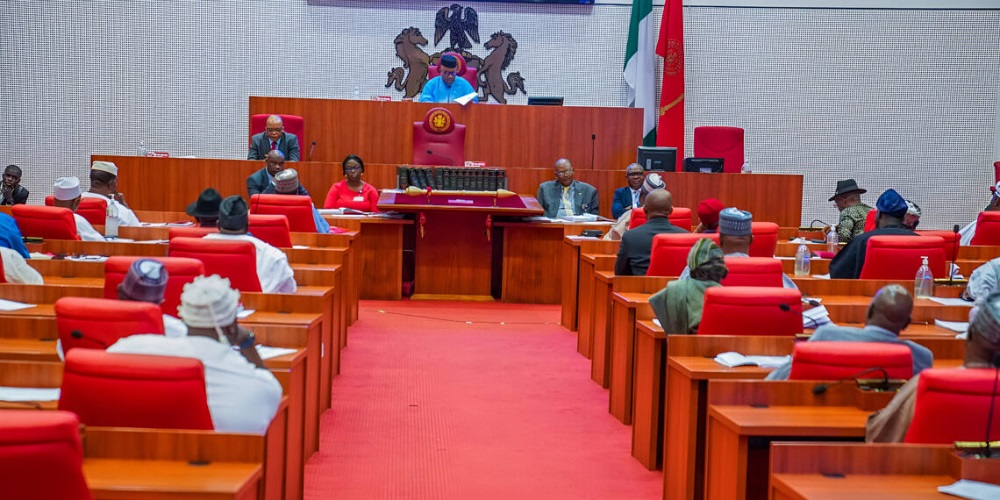
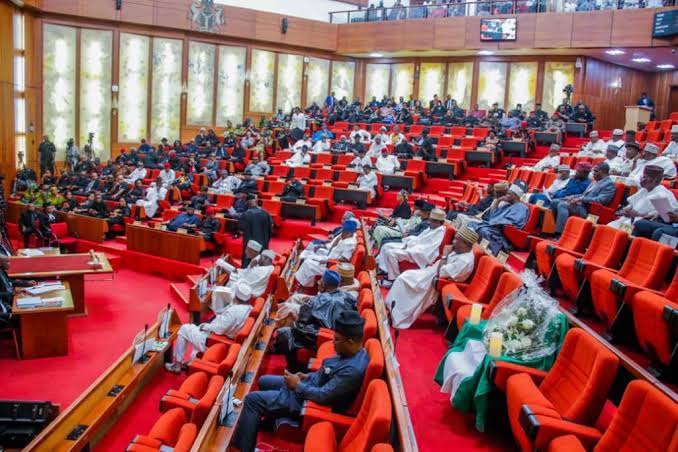
The Nigerian Senate was thrown into a rowdy session on Wednesday by the Senate President, Senator Godswill Akpabio, immediate past Senate President, Senator Ahmed Lawan and Senate Chief Whip, Senator Ali Ndume.


There was a mild drama in the Red Chamber as the Senate leaders disagreed over the N23 trillion Ways & Means funds approved by the 9th Assembly under the leadership of former Senate President, Lawan.

Addressing the Senate on the report of the Senate Committee set up to probe the Ways & Means funds approved by the 9th Assembly for former President Muhammadu Buhari’s administration, Akpabio said what the Senate did under the leadership of Lawan had thrown Nigeria into a more economic mess.

Directly asking Lawan to speak on the issue, Akpabio said, “We are saying what you did at that time has put the nation in more mess economically. Therefore, because of the current economic situation we have found ourselves, there is the need for us to look at the details to know whether they were rightly spent.”

Advertisement

Lawan said there is nothing that the National Assembly that makes laws cannot look into and review.

He said that if there were expenditures wrongly done in contradiction to the provision of the constitution, the National Assembly could look at the expenditures and if sanctions were needed for unlawful actions or unauthorised expenditures, the National Assembly would provide the sanctions.

The former Senate President argued: “What the 9th National Assembly approved or rectified in terms of Ways & Means was not N29 trillion or N30 trillion, it was N22 trillion. But there was N819 billion to attend to, deal with and address very serious infrastructure dilapidations that we had across the country.

“If we have a Ways & Means that is N30 trillion today, that means something happened between then and now, and it is for the National Assembly to find out what happened.”

Advertisement

Lawan insisted that nobody in the chamber should suggest that the Assembly should not look into what they feel is in the public interest, “but what Nigerians want today is food and security”.

“This (Ways & Means issue) belongs to the medium or long-term action that we need to take. How are we going to provide food for Nigerians and protect their lives?

“Let us not put the cart before the horse. Let’s consider it necessary to look at what happened in the past, but we in the present and the present is so unpleasant and we have to act very swiftly,” he said.

Responding to Lawan’s submission, Akpabio said, “Even though the Ways & Means were part of the things that put us where we are today, we are saying that expenses that were not explained, that we don’t have details about put us in the indebtedness that we are seeing today.”

Advertisement

Akpabio noted that it has affected the ability of the government to provide essential needs and services to Nigerians and that the National Assembly needs to look into it.

He however agreed that Nigerians are currently faced with a food crisis and they need to act immediately to put food on the table of Nigerians.

Akpabio said, “What we got to N30 trillion was because of the interest element. They brought that before this current Senate, that the interest has accrued to the N23 trillion that was passed by the 9th Senate and that they needed additional N7 trillion which was the interest. We passed the interest and that is what was added to make it N30 trillion.”

Speaking further, Akpabio confronted the Senate Chief Whip, Ndume, that he was part of the 9th Senate that approved the Ways & Means, but Ndume quickly denied being involved in its approval.

Advertisement

Ndume said, “I was not there; check the record. You cannot approve illegality. What they did was illegal. The Senate doesn’t have the right, let it be on record.”

Ndume’s denial of being part of lawmakers who approved the Ways & Means in the 9th Senate threw the session into rowdiness as some of the lawmakers insisted that Ndume was involved.

Ndume argued that the Senate only has the right of approval but doesn’t have the right to rectify when money has been spent.

“We don’t have the right to rectify, we only have the right to approve,” he said.

Advertisement

He further said that the 9th Senate only approved N819 billion and that the details of other funds that had been spent should be provided.

He said, “It has never been provided till date. This committee should find out what happened to the money. People must be held responsible and they should come and explain to this Senate what they did with the money. Now is the time that people are looking for their money everywhere, where is that money?”

Akpabio sarcastically said, “I want you to know that Senator Ndume cannot remember being there when the thing happened.”

The Senate President said that what the Senators from the 9th Senate were saying was that the total amount of N30 trillion was brought before them for approval, however, they left a caveat that they could approve the funds but they needed details and that till date, the details had not been provided.

Advertisement

On his part, Senator Mustapha Habib representing Jigawa South West Senatorial District said that in addition to the Ways & Means, there were loans given to state governments and the manufacturing sector, some of which had not been returned.

“We have a colossal amount of money given to the banks and this amount ran into trillions of Naira. We need to really interrogate this. DisCos (Electricity dictribution companies) were also given money by the CBN (Central Bank of Nigeria). This money needs to be returned to CBN,” he said.
Continue Reading
Advertisement

News

10 survived as building collapses in Lagos

Published

on

ADVERTISEMENT
Zoom Ad
ADVERTISEMENT
Zoom Ad

Ten people have been rescued with varying degrees of injuries following the collapse of a building in the Alakija area of the Amuwo-Odofin Local Government Area (LGA) of Lagos State.

The Lagos State Fire and Rescue Service said the building, which collapsed on Thursday, is a residential structure located at Old Ojo Road, by Alakija Bus Stop, off Lagos-Badagry Expressway, Satellite Town, Lagos.

“The incident involves the collapse of a storey building, an existing residential structure occupied by multiple residents at the time of the incident,” the Lagos State Fire and Rescue Service Controller General, Margaret Adeseye, said in a statement on Thursday.

“As of the time of this report, 10 persons have been rescued alive with varying degrees of injuries and have been handed over to medical personnel for necessary treatment.”

Advertisement

According to her, the service received a distress call at 11:37 am regarding a building collapse incident, and immediately, emergency responders from the Ijegun-Egba Fire Station were mobilised and arrived at the scene at 11:49 am.

Continue Reading

News

Soldiers Reject Fresh Move To Deploy ‘Repentant’ Terrorists In Military Operations, Fear Sabotage, Intelligence Leaks

Published

on

ADVERTISEMENT
Zoom Ad
ADVERTISEMENT
Zoom Ad

Nigerian soldiers battling Boko Haram insurgents in the North-East have accused the Borno State government of issuing a fresh directive compelling them to work alongside ‘repentant’ terrorists who were recently reintegrated into society under the state’s controversial deradicalisation programme.

The development, according to serving military personnel who spoke to SaharaReporters, has triggered unease within frontline formations, with many soldiers expressing fears that the arrangement could expose military operations to renewed sabotage and intelligence leaks.

Sources told the media that some of the former Boko Haram fighters who publicly pledged loyalty to the Nigerian state during recent reintegration exercises have now been mobilised and attached to local security groups that support military operations against insurgents across parts of Borno State.

The soldiers alleged that the move was part of efforts by the state government to justify its rehabilitation and reintegration programme, which has come under criticism from members of the public, including victims of insurgency and some security personnel.

Advertisement

According to the sources, military authorities and troops on the ground remain sceptical about the sincerity of several former insurgents despite undergoing rehabilitation programmes.

“The government wants to prove that the reintegration programme is working, so some of these ‘repentant’ Boko Haram members are being attached to security groups that work with troops in operations,” one soldier told SaharaReporters.

“But many of us are uncomfortable with the arrangement because there have been cases in the past where information leaked and operations were compromised. Trust is a major issue.”

Another source said soldiers have deliberately kept some of the former insurgents at separate locations within military facilities because of fears that they could still maintain links with active terrorist cells operating in the region.

Advertisement

“We don’t trust them completely. There have been too many incidents in the past. That is why they are often given separate accommodation. Yet now there is pressure for us to work closely with them during our missions,” the source said.

“You can see how these Boko Haram fighters have been killing our ogas (commanders). That should tell you there is a leak in information about their movements. Yet the government is asking us to trust these people and work with them. It won’t work,” the source said.

The soldiers argued that instead of compelling troops to collaborate with former Boko Haram fighters, the Nigerian government should focus on providing better equipment, intelligence support and welfare packages for personnel risking their lives in the fight against terrorism.

According to them, the latest directive has generated anxiety among troops who fear that operational details could once again find their way to insurgent groups still active in parts of Borno and neighbouring states.

Advertisement

The concerns come barely two weeks after the Borno State government reintegrated 720 ‘repentant’ insurgents, alongside 992 spouses and 2,050 children, into various communities under its “Borno Model” deradicalisation and rehabilitation programme.

The beneficiaries were among former insurgents who surrendered to security forces and subsequently underwent rehabilitation at the Hajj Camp in Maiduguri before being formally returned to society.

Speaking during the reintegration ceremony, the Special Adviser to Governor Babagana Zulum on Security and member of the state’s Deradicalisation, Rehabilitation and Reintegration Committee, retired Brigadier General Abdullahi Ishaq, described the programme as a critical component of Borno’s non-kinetic strategy against insurgency.

He said the initiative, which began in July 2021, was founded on forgiveness, rehabilitation and community acceptance of former insurgents willing to renounce violence.

Advertisement

According to Ishaq, more than 350,000 individuals have reportedly left insurgent camps and surrendered since the programme commenced, while a total of 9,680 persons have been reintegrated through nine batches.

The official maintained that those processed through the programme underwent vocational training, religious and behavioural reorientation, counselling and skills acquisition before being returned to their communities.

However, the programme has remained controversial, with critics questioning whether former insurgents can be fully trusted and whether adequate safeguards exist to prevent them from returning to extremist activities.

The latest concerns raised by soldiers suggest that those reservations persist even among security personnel directly engaged in counter-insurgency operations across the North-East.

Advertisement

Efforts to obtain a reaction from the Nigerian Army were unsuccessful as of the time of filing this report.

Several calls placed to the Director of Army Public Relations, Colonel Appolonia Anele, went unanswered. A text message seeking the Army’s response to the allegations was also sent to her and successfully delivered, but she had not responded at the time of filing.

Sahara Reporters

Advertisement
Continue Reading

News

SAD! 164 killed, 1,000 Injured In Venezuela

Published

on

ADVERTISEMENT
Zoom Ad
ADVERTISEMENT
Zoom Ad


A twin earthquake that was Venezuela’s largest in over a century has killed at least 164 people and destroyed multiple buildings near the capital, where residents searched Thursday for missing relatives.

Venezuela’s strongest earthquake since 1900 sent rescuers and locals clambering in the dark over flattened apartments, hunting for survivors and extracting people from under the ruins.

France, Spain and the US offered to urgently send rescuers after the magnitude 7.2 and 7.5 quakes the United States Geological Survey (USGS) said struck areas west of the capital on Wednesday evening.

Advertisement

The toll has climbed quickly, with interim president Delcy Rodriguez reporting at least 164 dead and over 970 hurt and noting the state of La Guaira north of Caracas was hit hard.

“We have nothing, right now we have nothing, not even the strength or the courage to go in there, just imagine,” Larry Rojas, 49, told AFP, standing in front of a collapsed building where his family was trapped in the La Guaira city of Catia La Mar.

The coastal city was without electricity, and many residents spent the night in the streets or searching for their relatives, according to AFP reporters.

The 7.5-magnitude earthquake was Venezuela’s most powerful since October 29, 1900, when a 7.7-magnitude tremor struck offshore.

Advertisement

After Wednesday’s shock, some residential buildings showed large cracks and fallen walls, with dozens of others destroyed, according to AFP reporters.

“There are people alive in there and no-one is coming to save them,” said a woman waiting for news of her daughter, who was buried in a ruined 12-story building.

France said it would send 85 rescuers and Spain pledged 54 army searchers as nations including China, India, Brazil and the United States also offered help.

Washington was “immediately deploying search and rescue teams, medical resources, and humanitarian assistance to Venezuela,” US Secretary of State Marco Rubio said on Thursday.

Advertisement

Earthquake hits Iranian capital Tehran
The first quake, with an epicenter 21 kilometers (13 miles) west of the coastal town of Moron, occurred at 2204 GMT, USGS said. Within a minute, a 7.5-magnitude quake struck about 45 kilometers away.

“This earthquake was the second event in a doublet. This magnitude 7.5 mainshock was preceded by 39 seconds by a 7.2 foreshock,” USGS said.

Interior Minister Diosdado Cabello asked people to leave their homes, adding that gas supplies had been cut to several buildings as a precaution.

“We have some damaged structures and we don’t want any kind of accident involving gas to occur,” he said.

Advertisement

The Maiquetia International Airport, located near Caracas, was closed due to “serious damage” to its infrastructure, Rodriguez said, with social media posts showing its severely damaged facilities.

The quakes triggered panic in the capital and drove people into the streets, AFP journalists saw.

“The stairs came away, the whole wall cracked. Things fell from the ceiling. It was horrible,” said 54-year-old bank employee Odalis Escalona.

An AFP journalist saw a 22-story building completely destroyed in the capital’s Altamira neighborhood, where people cried out relatives’ names as volunteers climbed over the rubble.

Advertisement

“We need flashlights,” one of them said.

The tremors struck at a depth of 22 kilometers and 10 kilometers, respectively.

They prompted screams of panic at a shopping center in Caracas, an AFP journalist observed.

“It was unbelievable, I don’t even know how long it lasted,” said shopkeeper Heidi Romero, who was on the top floor when the quake struck.

Advertisement

“We went out through the emergency stairs; that’s how they got us out,” the 42-year-old told AFP.

Many more in the capital exited buildings and waited outside before returning to their offices and homes.

Carmen Guedez, 69, was in the same room as her bedridden sister when she felt the jolt.

“It kept getting stronger,” said the administrator, who lives in a hilly middle-class neighborhood above the capital. “I started to see the windows begin to move and then everything shook.”

Advertisement

She described how she “huddled together” with her sister and a neighbor, adding that “we couldn’t get out. The neighbors are still out on the street.”

The states of Trujillo, Carabobo, Miranda and La Guaira were the hardest hit, according to Cabello.

The quake was felt as far away as the Colombian capital of Bogota, where alarms sounded and some residents evacuated buildings as a precaution.

Freddy Tovar, coordinator of Colombia’s National Seismological Network, said they had received more than 200 reports of tremors nationwide.

Advertisement

“The conditions of this seismic event mean that some aftershocks may occur, which could also be widely felt across Colombian territory,” he said in a video posted on X.

The strongest tremors in earthquake-prone Venezuela’s recent history occurred in the northeast in 1997, killing 73 people, and in Caracas in 1967, when 236 people died.

AFP

Advertisement
Continue Reading

Trending

Copyright © 2024 Naija Blitz News