Connect with us

News

Enough of blame game, FG didn’t give states N30b each — Makinde

Published

on

ADVERTISEMENT
Zoom Ad
ADVERTISEMENT
Zoom Ad

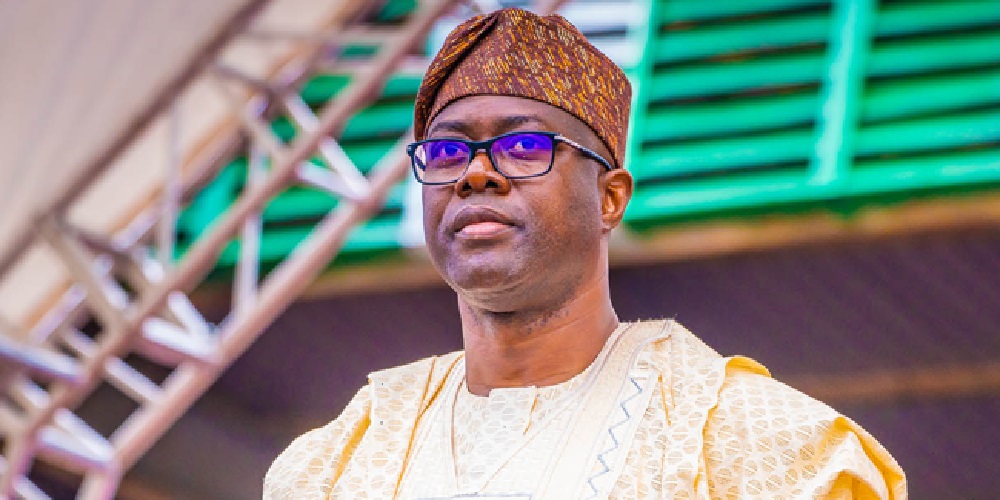
Oyo State governor and Vice Chairman of the Nigerian Governors’ Forum, ‘Seyi Makinde, has declared that there is no truth in the claim by the President of the Senate, Godswill Akpabio, that states of the federation got additional N30 billion each outside of their statutory revenue allocations, to address food insecurity in their states.


The governor stated this on Thursday, noting that Oyo State has not got any N30 billion from the FIRS or the Federal Government and that his government has been and will always be open and transparent to the people of the state.

Makinde, who added that he has been doing everything to cushion the effect of the economic hardship on the people, warned that leaders should instill confidence and hope in the citizenry in this trying time rather than playing blame game.

Makinde stated this in Iseyin, where he commissioned the newly-renovated multi-billion Naira Iseyin Central Mosque facilitated by legal icon, Ahmed Raji, SAN, hailing the religious harmony in Oyo State as being exemplary.

Advertisement

He added that apart from Oyo State not getting N30 billion from any agency or department of the Federal Government, he could say the same for his colleague-governors as vice chairman of the Nigerian Governors’ Forum (NGF).

Governor Makinde decried Akpabio’s reliance on unverified reports, clarifying that it was impossible for states to get funds from the Federal Inland Revenue Service (FIRS), since all revenues go into the Federation Account and belongs to the Federal Government, states and the local governments.

According to Makinde, the only fund that Oyo State got from the Federal Government outside of statutory allocation was N2 billion out of the N5 billion promised to all states in the wake of the removal of fuel subsidy, adding that the Federal Government had even been asking for the refund of the N2 billion.

Makinde added that his government has been doing its best to mitigate the hardship on residents of the state, having been first to announce and implement measures to cushion the effect of the hardship through the Sustainable Action for Economic Recovery (SafER).

Advertisement

He said: “This is a very difficult period in our nation’s history because all of us are aware of what we are going through economically. But for us as an administration, I can say we are the first in Nigeria to announce and implement measures on the 9th of June 2023, to cushion the effect of this policy through SAfER.

“We have been doing our bit. And the reason I came here is for us to talk to ourselves and intensify prayers. So, this is one of the edifices through which we can reach God, though we have done our bit.

“We have health insurance for our own people, we gave farm inputs to our farmers but, at this stage, we need to cry to God.

“For the workers, we have been paying a wage award; N25,000 for workers and N15,000 for pensioners, and we have paid for close to six months.

Advertisement

“Only last week, I announced an extension for another six months so that we can have the time to conclude the discussion on minimum wage.

“Well, we know there is much to be done and we will continue to do everything within our power to support our people through this hard time.

“This is not the time to play politics, as we have real issues that deserve real solutions. But yesterday, I saw the video and read in the news where the Senate President, Sen. Godswill Akpabio, made a statement, though he said it was unverified report, stating that the state governments received additional N30 billion from the Federal Inland Revenue Service, FIRS, outside of our statutory allocation, in the last few months, to address food security.

“Please, listen to me loud and clear. I can speak for Oyo State and can also speak for any of my colleagues. This is because, as the Vice Chairman of Nigeria Governors’ Forum, I know when things are happening.

Advertisement

“If I want to play politics, I will keep quiet and let this slide, but I am not going to let this slide. FIRS cannot give money to any state. It is not possible. All revenues accruing to the country goes into the federation account and it is distributed to all tiers of government.

The FG does not give states money. The money in the federation belongs to all of us; it does not only belong to the Federal Government.

“So, if the Senate President, who is the number three citizen in this country, could be quoting an unverified report, people are looking at us as leaders. This is the period that we are supposed to give confidence to our people. It is not the period to start playing politics or to start looking for scapegoats.

“We need to engage with our people. If our policies are not working, we need to listen to the people and amend. So, if the Number Three Citizen had nothing but unverified report, why did he need to say it? Does his statement give confidence to the people or solve the problem of hunger and anger in the land?

Advertisement

“Let me say it clearly: as for Oyo State and for most of my colleagues, there is nothing like N30 billion being given to states for food security and I stand to be challenged.

“Yes, the Federal Government promised the states N5 billion and out of that, it only gave N2 billion and they are even asking that the N2 billion should be refunded right now.

“It is the responsibility of the Federal Government to manage the fiscal situation in Nigeria and manage the inflationary trend we have in the country right now.

“We have been transparent about everything we are doing here and this is the time for us to stay together as a nation to solve the problems we are facing. It is not the time to engage in blame games and propaganda. Hunger and anger are real and, as leaders, we must address them.”

Advertisement

While commending Raji, SAN on the success of the mosque renovation, which he noted is a befitting place to worship Allah, Makinde hailed the religious harmony in Oyo State as evidence in the presence of representatives of the Christian Association of Nigeria (CAN) at the event, warning those hell-bent on causing disharmony to steer clear of the state.

Also speaking, the Sultan of Sokoto, Alhaji Sa’ad Abubakar, appreciated Makinde for attending the event and for speaking passionately as expected of leaders, saying the Oyo State governor is on the right track.

He said: “We appreciate the governor for being with us here today.

“I appreciate him for speaking in a passionate tone and that is how a leader should speak to his people to let them know he cares for them.

Advertisement

“Seyi, don’t worry, we are with you and will keep on praying for you. We will keep on supporting you because you are on the right track.”

The Sultan also hailed Raji for being a humanitarian supporting Muslims and non-Muslims.

Earlier, the facilitator of the Iseyin Central Mosque renovation project, Barr. Raji, SAN, appreciated the governor for his presence, urging citizens of the country to continue to pray for its leaders and to pray to God to lessen the burden of the people.

The event had in attendance the Sultan of Sokoto; National Assembly members and top government functionaries from Oyo State as well as Oke Ogun Traditional Council members.
Advertisement
Continue Reading
Advertisement

News

Experts Urge ECOWAS Lawmakers to See Electricity as an Economic Game-Changer

Published

on

ADVERTISEMENT
Zoom Ad
ADVERTISEMENT
Zoom Ad

By Gloria Ikibah

Energy experts have urged ECOWAS lawmakers to rethink electricity access as more than a basic social service, arguing that reliable power remains one of the most powerful tools for transforming rural economies, creating jobs and accelerating sustainable development across West Africa.

The call was made during the ongoing delocalised meeting of the ECOWAS Parliament’s Joint Committee on Energy and Mines, Agriculture, Environment and Natural Resources, and Infrastructure, where stakeholders are examining strategies for expanding energy access and strengthening rural livelihoods throughout the region.

Presenting a paper titled “The Impact of Energy Access on Rural Economies: Agro-Processing and Livelihoods”, Hary Andriantavy of the African Association for Rural Electrification (CLUB-ER) said access to electricity should be regarded as a cornerstone of economic and social development rather than merely a means of illuminating homes.

Advertisement

According to him, reliable energy has far-reaching effects on productivity, education, healthcare delivery and the overall quality of life in rural communities.

“Energy access has impacts across four key areas: economic development and productive use of energy, basic social services such as health and education, quality of life and social inclusion, and environmental sustainability,” he said.

Andriantavy explained that global development institutions increasingly recognise electricity as a critical factor in achieving broader economic and social goals.

He noted that Sustainable Energy for All (SEforALL) considers universal access to energy indispensable for attaining the Sustainable Development Goals, warning that inadequate electricity continues to limit healthcare services, educational opportunities and economic advancement in many developing regions.

Advertisement

The energy expert also highlighted findings by the Global Energy Alliance for People and Planet (GEAPP), which underscore the role of energy in supporting millions of jobs and livelihoods while facilitating a fair transition to low-carbon development.

He further referenced Mission 300, an initiative targeting electricity access for 300 million Africans by 2030, describing it as a clear example of how energy can transform lives by enabling access to information, improving healthcare services through vaccine preservation and creating large-scale employment opportunities.

According to Andriantavy, the Rockefeller Foundation has identified lack of electricity as one of the strongest indicators of extreme poverty, while greater energy access serves as a pathway to economic empowerment, digital inclusion and expanded opportunities for women.

He also cited recommendations from Climate Parliament, which advocates integrating energy access policies with broader poverty reduction and green transition strategies.

Advertisement

The expert stressed that productive uses of electricity, including agro-processing, grain milling, welding services and clean cooking technologies, can significantly improve rural incomes and reduce economic disparities.

Drawing from practical experiences across the region, Andriantavy highlighted successful renewable energy projects in Mali, Benin and Togo, where mini-grid systems and renewable energy-powered economic zones have stimulated local businesses and enhanced living standards.

Projects such as the Electrified Activity Zones initiative implemented by the French non-governmental organisation GERES in Mali, alongside community-based mini-grid schemes in Benin and Togo, have generated measurable benefits, including higher business revenues, increased agricultural value addition, job creation and improved financial inclusion.

According to him, the projects have also strengthened public services, improved living conditions and helped retain skilled workers in rural communities that often struggle with migration to urban centres.

Advertisement

Turning to the role of legislators, Andriantavy urged parliamentarians throughout the ECOWAS sub-region to create favourable conditions for investment in renewable energy through policy reforms, financing support and stronger institutional frameworks.

He called for the establishment of dedicated national renewable energy funds, increased public investment in the sector and targeted tax incentives, including the removal of value-added taxes on solar and hydroelectric equipment to make off-grid electricity solutions more affordable.

The expert also advocated legal frameworks that encourage decentralised mini-grids, clean energy technologies and productive-use energy applications, while ensuring that energy policies remain inclusive and accessible to vulnerable populations.
9
Beyond legislation, he emphasised the importance of parliamentary oversight in ensuring accountability and effective implementation of energy programmes.

He urged lawmakers to use their budgetary powers to strengthen monitoring systems, demand transparency in public spending and support evidence-based policymaking that delivers measurable benefits to communities.

Advertisement

Participants at the meeting broadly agreed that expanding access to affordable and reliable energy remains central to unlocking the economic potential of rural communities and achieving long-term sustainable development across West Africa.

Continue Reading

News

Minority Caucus Sounds Alarm Over Insecurity, Judiciary and 2027 Politics

Published

on

ADVERTISEMENT
Zoom Ad
ADVERTISEMENT
Zoom Ad

…accuse government of prioritising re-election politics over national security

…warn that Nigeria is approaching a dangerous crossroads

…To Nigerians:  Do not despair. 2027 will not be decided in Aso Rock or by compromised courts – Caucus

By Gloria Ikibah

Advertisement

The Minority Caucus of the House of Representatives has launched a blistering attack on the Federal Government, accusing it of failing to address worsening insecurity, presiding over judicial confusion and pursuing what it described as a coordinated effort to weaken opposition parties ahead of the 2027 general election.

Speaking at a world press conference held at the National Assembly Complex in Abuja on Wednesday, Minority Leader of the House, Rep. Fred Agbedi, painted a grim picture of the nation’s condition, alleging that governance had taken a back seat to political calculations.

Agbedi said: “Nigeria is bleeding. Nigeria is confused. And Nigeria is being deliberately pushed to the brink by a government that has elevated 2027 electioneering above the lives and welfare of citizens.

“We convene this press conference today with a heavy heart but with unshaken resolve to speak truth to power because silence in the face of tyranny is complicity.”

Advertisement

The caucus listed a number of concerns with regards to kidnappings, killings, worsening insecurity, economic hardship, political intimate among other.

General Rabe’s Death a National Tragedy
The caucus condemned the killing of retired Major General Rabe Abubakar while in captivity, describing the incident as evidence of the deepening security crisis confronting the country.

Agbedi argued that the death of a senior military officer in such circumstances raises troubling questions about the effectiveness of the nation’s security architecture.

He said the tragedy reflected the growing vulnerability of citizens across the country.

Advertisement

“The House of Representatives Minority Caucus condemns in the strongest terms the horrendous murder of retired Major General Rabe Abubakar while in terrorist captivity in Katsina. And the subsequent release of his wife under questionable circumstances.

“That a General of the Nigerian Army, who once commanded troops and defended this nation, could be kidnapped alongside his wife and later declared dead under unclear circumstances is a grave indictment of a failed state. It is a national embarrassment. It tells the world that in today’s Nigeria, neither rank, service, nor sacrifice guarantees safety.
“What is particularly irksome is that before General Rabe’s murder, two other Generals and commanding officers had been slain in battle without the repercussion of their sad demise visited on anyone or group.

“While we mourn General Rabe, we ask: If a General is not safe within the borders of our nation, then who truly is?

“Not even our respected traditional rulers and monarchs, who have now become easy targets of vicious bandits who kidnap and kill them at will. Our security is in the mud. Yet, the political class is busy rehearsing new political dance steps, seemingly unbothered”, he said.

Advertisement

Offering condolences to the late officer’s family and the Nigerian Army, Agbedi insisted that sympathy alone will not solve the country’s security challenges.

He claimed that previous gains made against insurgent groups had been lost and questioned the government’s current strategy.

“To General Rabe’s family, the Nigerian Army, and to all patriots who still believe in this country, we extend our deepest condolences. But condolences will not bring him back; neither does it restore confidence in the citizenry. Action will.

“President Bola Ahmed Tinubu must, therefore, live up to the title and position of Commander-in-Chief by working out a pragmatic pathway out of this enduring quagmire.

Advertisement

“At a period in our nation’s long-drawn battle with these insurgents, victory was close by, especially with the presence of mercenaries in the frontlines.

“Today, no one is sure what the strategy, if any, is.

“So, until the Administration defines a clear vision and pursues it with purpose, bandits continue to encircle the entire country, moving from Niger to Kwara, Oyo et cetera, without as much as a push back.

“General Rabe’s death must, therefore, evoke an urgent battle cry, which proclaims: Never again!”, he declared.

Advertisement

Concern Over Schoolchildren Still in Captivity
The caucus also expressed concern over schoolchildren and teachers reportedly still being held by kidnappers in Oyo State.

The Minority Leader accused the government of failing to adequately confront mass abductions, and therefore called for urgent action to secure the release of those still in captivity.

“As we speak, school children and their teachers abducted in Oyo State remain in captivity. Their crime? Going to school in Nigeria. Can we pause for a moment and imagine the gory conditions of those innocent children – and others still in captivity in other parts of the country – in the cold hands of bloodthirsty beasts.

“This is, indeed, the new normal under this administration: mass abductions without consequences, terrorists dictating terms, and a government that issues statements instead of results.

Advertisement

“We demand an immediate, coordinated, no-ransom rescue operation. Each hour these children spend with terrorists is an hour stolen from Nigeria’s future”, he stated.

Opposition Raises Alarm Over Court Rulings
The Minority Caucus also criticised recent judicial developments relating to the deregistration of political parties, describing them as politically motivated.

According to Agbedi, the ruling risked creating uncertainty within the political system.

He further alleged that the decision formed part of a broader effort to weaken opposition forces ahead of the next general election.

Advertisement

“Earlier this week, in a move that reeks of political mischief, a Federal High Court presided over by Justice Peter Lifu ordered the Independent National Electoral Commission,INEC to de-register five opposition political parties.

“This judgment, coming only months to the country’s general elections and after a subsisting Appeal Court decision on the same matter, is not intended to serve justice. Instead, it appears to be a deliberate ploy to engender judicial chaos weaponized to destabilize the polity. For us as a Caucus, this is rascality taken too far, and a danger to participatory democracy.

“Let us be clear: We consider Justice Lifu’s judgment as a calculated attempt to muscle legitimate opposition out of the race for the 2027 Presidency”, he said.

The Minority Leader questioned the basis upon which the ruling was delivered despite submissions made by the electoral commission.

Advertisement

He queried that opposition parties had continued to face obstacles in their preparations for 2027, and questioned the political links of those behind the litigation.

“Indeed, we remain at odds in fathoming whose justice Justice Lifu is serving, in overlooking INEC’s submission made during the pendency of the case, to the effect that the affected parties had satisfied the requirements of the law by winning elective positions in previous elections.

“Wittingly or unwittingly, by design or not, this latest judicial gambit only adds to the growing list of hurdles which our country’s political parties have had to confront in order to be able to present candidates for the 2027 general elections.”

“We wonder, for instance, whether it is by mere happenstance that the convener and alter ego of the plaintiffs in this matter is someone holed up in the sanctuary of the presidential villa as aide to President Tinubu’s chief of staff”, he queried.

Advertisement

While welcoming the intervention of the Court of Appeal, he urged vigilance against future attempts to undermine democratic competition.

“Whilst we thank the Appeal Court for halting the judicial overreach by Justice Lifu, we urge every proponent of political pluralism to remain alert to future attempts at undermining our nation’s democracy.

“We cannot stand aloof and watch Nigerians being kidnapped and killed daily, while the system is busy manufacturing political confusion”, he stated.

Hardship and Governance Under Scrutiny
The Minority Caucus also blamed the government for worsening economic hardship and declining living conditions.

Advertisement

Agbedi argued that political activities had overshadowed governance, reminding government officials of their constitutional responsibility.

“From Sokoto to Enugu, from Borno to Lagos, the story is the same: hunger, killings, kidnappings, collapse of the naira, collapse of hope.

“Yet what preoccupies the ruling party and the Presidency is 2027. Endorsement rallies. Defections. Re-election strategies. Town hall meetings to discuss tenure security.

“The life of every Nigerian matters. Politics must take the back seat when the nation bleeds. We must secure Nigeria first.

Advertisement

“Government exists primarily for the security and welfare of the people. Section 14(2)(b) of the 1999 Constitution is not a suggestion. It is a mandate”, Agbedi argued.

Minority Caucus Lists Demands
The caucus therefore called for a comprehensive overhaul of the nation’s security framework, an immediate operation to rescue abducted schoolchildren, a transparent investigation into the death of General Rabe, intervention by the Chief Justice of Nigeria in the controversy surrounding party deregistration, and a six-month national security and economic recovery plan.

The caucus vowed that the opposition will continue to challenge government policies and defend democratic principles.

“The attempt to kill opposition parties through judicial ambush, to ignore mass killings while chasing second term, and to normalize the abduction of children is a declaration of war against Nigerians.

Advertisement

“We, the Minority Caucus of the House of Representatives, will not be silent. We will not be intimidated. We will use every legislative instrument to hold this government accountable.

“To Nigerians: Do not despair. 2027 will not be decided in Aso Rock or by compromised courts. It will be decided by you, the people.

“The opposition parties will stand with you. The opposition will not be muscled out. Nigeria will be rescued”, he said.

The press conference comes amid heightened political activity and growing national debate over security, governance and preparations for the 2027 general election.

Advertisement

This is the first assignment for the new minority leadership been lead by Rep. Fred Agbedi, and the caucus said it will brief the media on happenings.

Continue Reading

News

PIGD Lauds Mutfwang’s Bold Push To Make Plateau Livestock Hub

Published

on

ADVERTISEMENT
Zoom Ad
ADVERTISEMENT
Zoom Ad


The Plateau Initiative for Growth and Development, PIGD, has commended Governor Caleb Manasseh Mutfwang for what it described as a visionary and economically strategic intervention in the livestock sector through the groundbreaking of a 500-cattle-per-day ultra-modern abattoir at Pwomol Village, Heipang, and a Veterinary Teaching Hospital in Barkin Ladi Local Government Area.
In a statement issued by its National Coordinator, Nengak David, the group said the projects mark a defining moment in the administration’s effort to reposition Plateau State from a producer of raw agricultural commodities to a major agro-industrial and livestock processing hub. PIGD said the intervention, supported by the Livestock Productivity and Resilience Support, L-PRES, Programme, speaks directly to the state’s comparative advantage in livestock, animal health services, meat processing, cold-chain development and export opportunities.

According to David, Governor Mutfwang has again demonstrated that governance is not about rhetoric but about building structures that can create jobs, expand revenue, improve food safety and open new economic frontiers for farmers, herders, butchers, transporters, processors, youths and investors across the livestock value chain.
“The groundbreaking of a 500-cattle-per-day ultra-modern abattoir and a Veterinary Teaching Hospital is not an ordinary project. It is a statement of intent. It shows that Governor Mutfwang understands that Plateau cannot continue to sit on huge agricultural and livestock potential without converting it into wealth, jobs and sustainable prosperity for the people,” the statement said.

PIGD noted that the ultra-modern abattoir, described as the largest facility of its kind in the region, would replace crude and unhygienic slaughter practices with a modern, automated and globally competitive meat processing system capable of strengthening public health, expanding market access and attracting private investment.

Advertisement

The group also praised the governor’s vision for the Heipang Special Agro-Processing Zone, saying the initiative would stimulate feed production, cold-room services, meat packaging, leather processing, transportation, veterinary services and other related businesses.
David said the Veterinary Teaching Hospital would further deepen Plateau’s reputation as a centre of excellence in animal health, research and livestock development, while also supporting training, disease control and improved productivity in the sector.

“This is the kind of intervention that creates a real economy. It is the kind of development that touches communities, creates dignity for labour and gives young people a reason to believe that their future can be built at home,” PIGD said.

The group urged the host communities to continue supporting the contractors and government agencies handling the projects to ensure timely completion within the projected period.
PIGD also called on investors, development partners and livestock stakeholders to take advantage of the Mutfwang administration’s renewed focus on agro-processing, saying Plateau is now being positioned as one of Nigeria’s most promising destinations for livestock investment, meat processing and agricultural value addition.
It added that the governor’s intervention was another evidence of an administration quietly but steadily laying the foundation for long-term economic transformation across Plateau State.

Advertisement
Continue Reading

Trending

Copyright © 2024 Naija Blitz News