News
SEE List of merged MDAs, scrapped agencies of govt
- /home/naijuinz/public_html/wp-content/plugins/mvp-social-buttons/mvp-social-buttons.php on line 27
https://naijablitznews.com/wp-content/uploads/2024/02/Bola-Tinubu.jpg&description=SEE List of merged MDAs, scrapped agencies of govt', 'pinterestShare', 'width=750,height=350'); return false;" title="Pin This Post">
- Share
- Tweet /home/naijuinz/public_html/wp-content/plugins/mvp-social-buttons/mvp-social-buttons.php on line 72
https://naijablitznews.com/wp-content/uploads/2024/02/Bola-Tinubu.jpg&description=SEE List of merged MDAs, scrapped agencies of govt', 'pinterestShare', 'width=750,height=350'); return false;" title="Pin This Post">
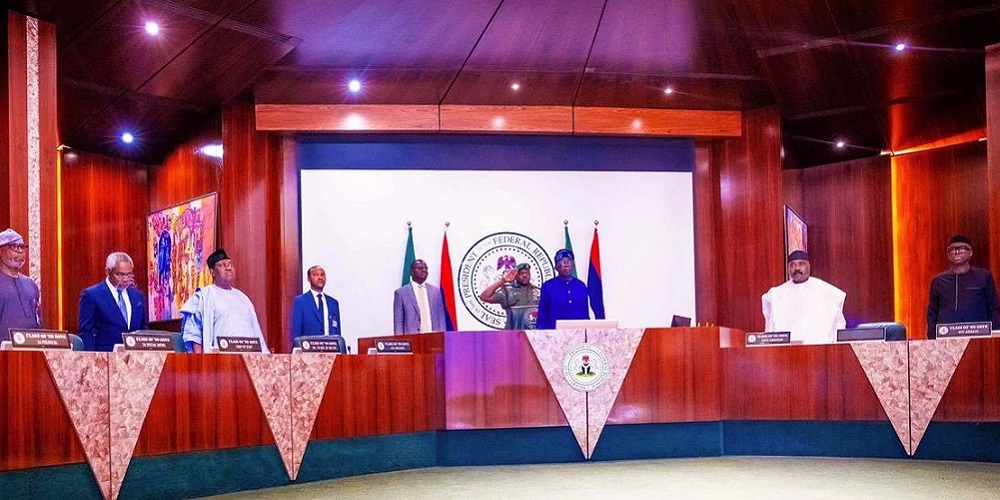
The Federal Executive Council (FEC) has approved the merging, scrapping and subsuming of some Ministries, Departments and Agencies (MDAs) of Federal Government in line with its policy of reducing cost of governance.


Hajiya Hadiza Bala-Usman, Special Adviser to the President on Policy Coordination, unveiled some of the merged, subsumed and scrapped MDAs at the end of the FEC meeting on Monday, February 26, 2024.

She said the decision was based on the Steve Oronsaye Report on civil service reforms inaugurated under former President Goodluck Jonathan in 2014.
With the new arrangement, the Nigerian Army University in Borno State will be merged with the Nigerian Defence Academy (NDA). The university will now functions as a faculty within the Academy.
Similarly, the Air Force Institute of Technology will also be merged with the Nigerian Defence Academy to function as the faculty of Nigerian Defence Academy.
Also, the Infrastructure Concession and Regulatory Commission is to be merged with Bureau of Public Enterprise and be rechristened as `Public Enterprises and Infrastructural Concession Commission.
The Federal Radio Corporation of Nigeria is to be merged with the Voice of Nigeria while the National Commission for Museum and Monuments is to be merged with the National Gallery of Acts.
She said the National Theatre is to be merged with National Troupe of Nigeria while the National Meteorological Development Centre is to be merged with the National Meteorological Training Institute.
National Agency for Control of HIV/AIDS (NACA) is to be merged with the Centre for Disease Control in the Federal Ministry of Health while National Emergency Management Agency (NEMA) is to be merge with the National Commission for Refugee Migration and Internally Displaced Persons.
The Directorate of Technical Cooperation in Africa will be merged with the Directorate of Technical Aid and to function as a Department in the Ministry of Foreign Affairs.
Nigerian Investment Promotion Commission is to be merged with Nigerian Export Promotion Council while the National Agency for Science and Technology and Science and Engineering Infrastructure is to be merged with National Centre for Agricultural Mechanisation and the Project Development Institute.
The Special Adviser further said that the National Biotechnology Development Agency will be merged with the National Centre for Genetic Resource and Biotechnology.
She said the National Institute for Leather Science Technology will be merged with the National Institute for Chemical Technology while the Nomadic Education Commission will be merged with the National Commission for Mass Literacy, Adult Education and Non-formal Education.
On the agencies to be subsumed, Bala-Usman said the Service Compact with Nigeria (SERVICOM) will be subsumed to function as a department under the Bureau of Public Service Reform.
She said the Border Communities Development Agency will be subsumed to function as a department under the National Boundary Commission.
National Salaries, Income and Wages Commission is to be subsumed under Revenue Mobilisation and Fiscal Commission. The National Assembly will need to amend the constitution as RMAFC was established by the Constitution.
The Institute for Peace and Conflict Resolution is to be subsumed under the Institute for International Affairs.
The Public Complaints Commission is to be subsumed under the National Human Rights Commission while the Nigerian Institute for Trypanosomiasis to be subsumed into the Institute for Veterinary Research.
The National Medicine Development Agency will be subsumed under the National Institute for Pharmaceutical Research and Development while the National Intelligence Agency Pension Commission to be subsumed under the Nigerian Pension Commission.
On the agencies to be relocated, the Presidential aide said the Niger Delta Power Holding Company to be relocated to the Ministry of Power while the National Agricultural Land Development Agency (NALDA) to be relocated to the Federal Ministry of Agriculture and Food Security.
Federal Ministry of Science to supervise a new agency that combines NCAM, NASENI, and PRODA
The National Blood Service Commission will be converted into an agency and relocated to the Federal Ministry of Health while the Nigerian Diaspora Commission is to be converted into an agency and to be relocated to the Federal Ministry of Finance.
Pension Transitional Arrangement Directorate (PTAD) to be scrapped and functions to be taken over by Federal Ministry of Finance.
Bala-Usman said the President had constituted a committee that would work within 12 weeks, to ensure that necessary restructuring and legislative amendments needed to ensure full actualisation of these approvals were granted.
The committee comprises Secretary to the Government of the Federation, Head of the Civil Service, Attorney General and Justice Minister, Budget and Planning Minister, DG Bureau of Public Service Reform, Special Adviser to the President on Policy Coordination, Special assistant to the president on National Assembly. The Cabinet Affairs Office will serve as the secretariat.
News
FG orders varsities to suspend drug offenders
The Federal Government has directed universities and other tertiary institutions across the country to temporarily suspend students who repeatedly test positive for drugs, as part of new measures aimed at tackling substance abuse in schools.
The directive is contained in the National Implementation Guidelines Against Drugs and Substance Use in Schools in Nigeria (Tertiary Institutions), which outlines procedures for mandatory drug testing, counselling, treatment and rehabilitation for students.
It was obtained by our correspondent in Abuja on Tuesday.
Under the guidelines, students who test positive after undergoing three stages of drug screening and intervention could be removed from the school environment pending rehabilitation.
“Students found to be positive in the second testing stage shall be made to undergo a third stage of testing, and if found to be positive again, such a student shall be temporarily suspended from the school environment to take treatment from a professional and undergo rehabilitation,” the policy stated.
It also directed all tertiary institutions to conduct mandatory drug integrity tests for newly admitted students in collaboration with approved health facilities.
According to the document, the objective is to identify students who may require help while promoting safer and healthier learning environments across campuses.
“The aim is to identify students who may need help, promote a safe and healthy school environment,” the guidelines stated.
The government stated that the testing process would commence with an initial assessment designed to determine the health status of students.
“The first test is to ascertain the health status of every student. Persons found to be positive to drugs shall undergo the initial intervention and treatment, which shall include counselling,” the document added.
Students who fail the first test would undergo counselling and treatment before being subjected to a second screening.
Those who test positive again would be referred to professionals for further medical attention and rehabilitation.
The guidelines also mandated periodic drug testing for returning students at least once every academic session.
In addition to sanctions for students, institutions were directed to establish disciplinary committees headed by student affairs officers to oversee compliance and enforcement.
The document further warned that students who refuse rehabilitation procedures could also be separated from the school environment until they are considered stable.
“Any student who refuses to abide by the treatment/rehabilitation procedures shall be temporarily separated from the school environment until he/she is found to be stable,” the guidelines stated.
The policy extends beyond students to include shop owners and vendors operating within campuses.
The government warned that vendors linked to drug-related activities could lose their operating licences and be reported to law enforcement agencies, including the National Drug Law Enforcement Agency.
The new measures come amid growing concerns over rising cases of substance abuse among young Nigerians, particularly within tertiary institutions.
Data from the United Nations Office on Drugs and Crime and previous national drug use surveys have consistently shown increasing rates of drug consumption among Nigerian youths, with substances such as cannabis, codeine, tramadol, and other psychoactive drugs commonly abused.
Authorities and education stakeholders have repeatedly raised concerns that drug abuse is contributing to cultism, violent behaviour, declining academic performance, mental health challenges and insecurity on campuses.
In recent years, the Federal Government and the NDLEA have intensified advocacy campaigns in schools, warning that substance abuse among students has become a major public health and security concern.
The latest guidelines signal a tougher regulatory approach, combining counselling and rehabilitation with disciplinary measures aimed at discouraging drug use within tertiary institutions.
News
Uganda’s Museveni Sworn In for Seventh Term After Controversial Election Victory
Ugandan President Yoweri Museveni has officially been sworn in for a seventh consecutive term after securing victory in the country’s disputed January elections, extending his nearly four-decade rule.
Tight security was observed across Kampala ahead of the inauguration ceremony, with armoured vehicles and security operatives deployed around key areas. Authorities said the measures were put in place to maintain order during the event.
Museveni, 81, was declared winner of the presidential election with more than 70 percent of the vote and is expected to remain in office until 2031. His main challenger, Bobi Wine, rejected the outcome, alleging widespread electoral malpractice including ballot stuffing. Electoral officials denied the accusations and maintained that the poll was credible.
Bobi Wine, whose real name is Robert Kyagulanyi Ssentamu, later fled Uganda, claiming he feared for his safety and accusing the government of targeting opposition figures.
Museveni first took power in 1986 after leading a rebel movement and has since remained one of Africa’s longest-serving leaders. Analysts believe this latest term could potentially be his last, although he has not publicly indicated any plans to step down.
Attention has also turned to Museveni’s son, Muhoozi Kainerugaba, who is widely seen as a possible successor. However, the military chief has faced criticism over controversial social media posts directed at opposition politicians.
News
Nigerian Military Airstrike ‘Killed at Least 100 Civilians’ — Amnesty International
At least 100 civilians were killed in a Nigerian military airstrike on a crowded market in Tumfa, Zurmi Local Government Area of Zamfara State, northwest Nigeria, Amnesty International said on Tuesday.
The strike hit the remote market on Sunday, May 10, 2026, with many victims reportedly being women and girls.
This is now the second deadly airstrike on a crowded market in northern Nigeria within the past one month, following a similar incident in April that reportedly killed more than 100 people.
Amnesty International has called on Nigerian authorities to immediately open an independent and thorough investigation into the incident.
-
News11 hours agoBREAKING: Popular Nollywood actor, Alex Ekubo is dead
-
News16 hours agoFG in Talks With World Bank For Fresh $1.25bn Loan
-
News10 hours agoElectricity Costs May go up Again as NERC Defends Tariff Review Plan
-
Economy17 hours agoSee Black Market Dollar To Naira Exchange Rate Today 12th May 2026
-
News17 hours agoOsun In Panic Mode As Gov Adeleke Summons Emergency Security Meeting Over Fresh Attacks
-
News11 hours agoNASS Reviews Data Protection Law To Tackle Rising Cyber Risks
-
News17 hours agoPhoto News: Minister of State for Foreign Affairs engagement at the UN
-
News11 hours agoKwankwaso reveals NDC, ADC may work together to attain victory in 2027