Foreign
Israel Forces Fire On Gazans Rushing For Food Aid
- /home/naijuinz/public_html/wp-content/plugins/mvp-social-buttons/mvp-social-buttons.php on line 27
https://naijablitznews.com/wp-content/uploads/2024/03/Gazans-Rushing-For-Food-Aid.jpg&description=Israel Forces Fire On Gazans Rushing For Food Aid', 'pinterestShare', 'width=750,height=350'); return false;" title="Pin This Post">
- Share
- Tweet /home/naijuinz/public_html/wp-content/plugins/mvp-social-buttons/mvp-social-buttons.php on line 72
https://naijablitznews.com/wp-content/uploads/2024/03/Gazans-Rushing-For-Food-Aid.jpg&description=Israel Forces Fire On Gazans Rushing For Food Aid', 'pinterestShare', 'width=750,height=350'); return false;" title="Pin This Post">
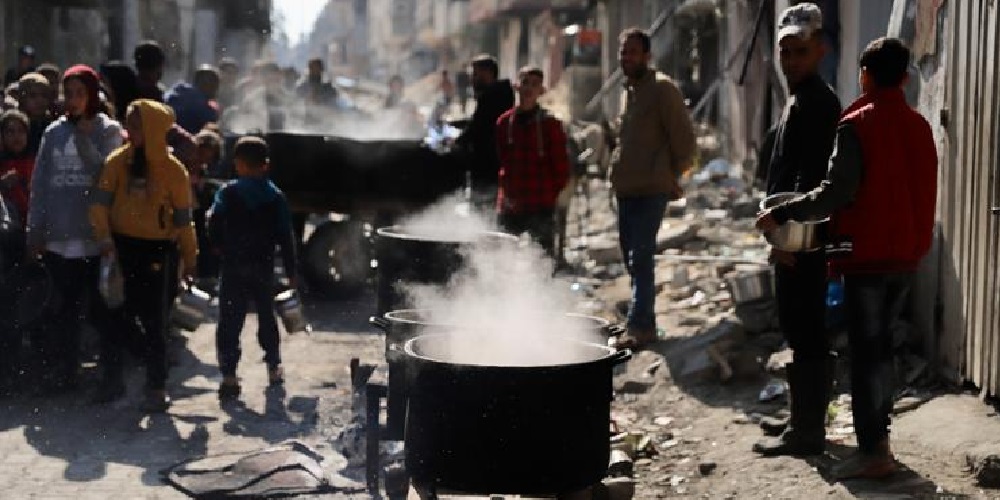
Israeli forces in war-torn Gaza opened fire on Palestinians scrambling for food aid in a chaotic melee on Thursday that the health ministry in the Hamas-run territory said killed more than 100 people.

The Israeli military said a “stampede” occurred when thousands of desperate Gazans surrounded a convoy of 38 aid trucks, leading to dozens of deaths and injuries, including some who were run over by the lorries.
An Israeli source acknowledged troops had opened fire on the crowd, believing it “posed a threat”.

The Gaza health ministry condemned what it called a “massacre” in Gaza City in which 112 people were killed and more than 750 others wounded.
The incident adds to a Palestinian death toll from the war which the ministry earlier Thursday said had topped 30,000, and dampens hopes a truce deal between Israel and Hamas militants could be just days away.
There were conflicting reports on what exactly unfolded in the hours before dawn.
A witness in Gaza City, declining to be named for safety reasons, said violence unfolded when thousands of people rushed towards aid trucks at the city’s western Nabulsi roundabout, and soldiers fired at the crowd “as people came too close” to tanks.
Israeli army spokesman Daniel Hagari said the military had fired “a few warning shots” to try to disperse a crowd that had ambushed the aid trucks.
When the crowd got too big, he said the convoy tried to retreat and “the unfortunate incident resulted in dozens of Gazans killed and injured”.
Aerial images released by the Israeli army showed what it said were scores of Gazans surrounding aid trucks in Gaza City.
Ali Awad Ashqir, who said he had gone to get some food for his starving family, told AFP he had been waiting for two hours when trucks began to arrive.
“The moment they arrived, the occupation army fired artillery shells and guns,” he said.
The army spokesman Hagari later denied Israeli forces carried out any shelling or strikes at the time.
‘Another day from hell’
US President Joe Biden said Washington was checking “two competing versions” of the incident, while a State Department spokesman said the United States had been in touch with Israel and was “pressing for answers” on what happened.
The shooting incident would complicate efforts to broker a truce, Biden said, later admitting that any deal was unlikely to happen by Monday — the timeline that he had predicted earlier this week.
The US president spoke with Qatari and Egyptian leaders in separate phone calls, the White House said, saying he discussed both the ceasefire and the “tragic and alarming” aid incident.
The UN Security Council will hold a closed-door emergency meeting on the incident on Thursday afternoon.
Saudi Arabia strongly condemned what it called the “targeting” of unarmed civilians, while Kuwait and the UAE also issued condemnations.
Qatar warned that Israel’s “disregard for Palestinian blood… (will) pave the way for an expanding cycle of violence”.
Italy called for an immediate ceasefire in Gaza to facilitate more humanitarian aid.
Looting of aid trucks has previously occurred in northern Gaza, where desperate residents have taken to eating animal fodder and even leaves to try to stave off starvation, as aid groups warn of looming famine after nearly five months of war.
The chief of the United Nations agency for Palestinian refugees, UNRWA, said that no UN agency had been involved in Thursday’s aid delivery, and called it “another day from hell”.
Truce hopes
The war began on October 7 with an unprecedented Hamas attack on southern Israel that resulted in the deaths of around 1,160 people, mostly civilians, Israeli figures show.
Militants also took about 250 hostages, 130 of whom remain in Gaza, including 31 Israel says are presumed dead.
Israel’s retaliatory military campaign has killed 30,035 people, according to the Hamas-run Gaza’s health ministry.
Israel’s military says 242 soldiers have died in Gaza since ground operations began in late October.
Washington, a key ally of Israel, has been pushing for a reduction in civilian casualties and a ceasefire.
It has been working with mediators from Egypt and Qatar to seek a six-week pause in the war.
Negotiators had hoped a truce could begin by around March 10 or 11 when the Muslim holy month of Ramadan begins, depending on the lunar calendar.
The proposals reportedly include the release of some Israeli hostages held in Gaza by militants in exchange for hundreds of Palestinians held in Israeli prisons.
Short of the complete withdrawal Hamas has called for, a source from the group said the deal might see Israeli forces leave “cities and populated areas”, allowing the return of some displaced Palestinians and humanitarian relief.
Fears of famine
The World Food Programme has said Israel has blocked access for aid deliveries — which Israeli officials have denied — and warned that if nothing changes, “a famine is imminent in northern Gaza”.
As fighting continued in Gaza, Muhammad Yassin, 35, battled to find flour in Zeitun.
“We have not eaten a loaf of bread for two months,” he said. “Our children are starving.”
In the south, nearly 1.5 million people trying to flee the fighting are now packed into Rafah city, also short of food, as Israel threatens to send in troops against Hamas fighters.
Israeli Prime Minister Benjamin Netanyahu has come under increasing pressure to bring the remaining hostages home.
A group of 150 Israelis have started a four-day march from Reim, near the Gaza border, to Jerusalem, calling for the government to reach a deal.
Violence has also surged in the occupied West Bank, where two Israelis were killed on Thursday.
AFP
Foreign
Trump to suspend US gas tax as Iran war raises prices
US President Donald Trump said on Monday that he plans to suspend a federal gasoline tax as consumers deal with surging energy prices in the wake of the Iran war.
Responding to a reporter’s question at the White House, Trump said he would be taking the step, with the suspension to remain in place “till it’s appropriate.”
“It’s a small percentage, but you know it’s still money,” he said.
US federal taxes on gasoline amount to 18.4 cents per gallon on gasoline and 24.4 cents per gallon for diesel, according to the US Energy Information Administration (EIA).
Suspending the tax would require an act of Congress, where Trump’s Republican party holds a razor-thin majority in both houses.
Trump ally Senator Josh Hawley said he would introduce legislation to do so on Monday. In the House, Republican Anna Paulina Luna made a similar pledge to introduce a bill “this week.”
US fuel prices have skyrocketed since Trump launched the war on Iran, with gasoline and diesel both up about 50 percent since late February.
Iran’s retaliatory action has included virtually closing the key Strait of Hormuz, through which about a fifth of the world’s oil and natural gas passes.
On Monday, the average price of a gallon of regular gasoline in the United States was $4.52, with diesel at $5.64, according to the AAA motor club.
Suspending the federal fuel tax would bring those prices down by about four percent.
State taxes on fuel, which average 32.61 cents per gallon for gasoline and 34.76 cents for diesel according to the EIA, would be unaffected by the move.
AFP
Foreign
Iran responds to US peace proposal as drones hit Gulf
Iran responded to Washington’s latest peace proposal on Sunday, after drones threatened several Gulf region targets and Tehran warned it would not hold back from retaliating against any new US strikes.
The long-awaited answer came as Israeli Prime Minister Benjamin Netanyahu — whose forces launched the war on Iran in tandem with the US on February 28 — insisted the conflict wasn’t over until Iran’s enriched uranium was removed and its nuclear facilities dismantled.
But Tehran maintained its defiant line, even as behind-the-scenes diplomacy towards a deal continued.
“We will never bow down to the enemy, and if there is talk of dialogue or negotiation, it does not mean surrender or retreat,” Iranian President Masoud Pezeshkian said on X Sunday.
According to state broadcaster IRIB, Tehran’s response to the US plan, passed to Pakistani mediators, focuses on ending the war “on all fronts, especially Lebanon” — where Israel has kept up its fight with Iran-backed Hezbollah — as well as on “ensuring shipping security”.
It offered little in the way of detail, though the US proposal had reportedly focused on extending the truce in the Gulf to allow for talks on a final settlement of the conflict and on Iran’s contested nuclear programme.
Netanyahu said on Sunday that Iran’s stockpile of enriched uranium must be removed before the US-Israeli war against Iran could be considered finished.
“It’s not over, because there’s still nuclear material — enriched uranium — that has to be taken out of Iran. There’s still enrichment sites that have to be dismantled,” Netanyahu told CBS’s “60 Minutes”.
– No Hormuz ‘interference’ –
Iran imposed a blockade on the vital Strait of Hormuz early in the war, sending global oil prices soaring and rattling financial markets.
It has since set up a payment mechanism to extract tolls from shipping crossing the strait, but US officials have stressed it would be “unacceptable” for Tehran to control an international waterway and the route for a fifth of the world’s oil.
The US Navy, meanwhile, is blockading Iran’s ports, at times disabling or diverting ships heading to and from them.
Britain and France are leading efforts to create an international coalition to secure the strait after a peace deal is secured, with both countries sending vessels to the region in advance.
But Iran insisted on Sunday that they would meet “a decisive and immediate response” should they deploy their ships to the strait.
“Only the Islamic Republic of Iran can establish security in this strait and it will not allow any country to interfere in such matters,” Deputy Foreign Minister Kazem Gharibabadi posted on X.
French President Emmanuel Macron later insisted that his country had “never envisaged” a naval deployment in the Strait of Hormuz, but rather a security mission “coordinated with Iran”.
Qatari Prime Minister Sheikh Mohammed bin Abdulrahman Al Thani, meanwhile, “stressed that freedom of navigation is a firmly established principle that is not open to compromise, and that closing the Strait of Hormuz or using it as a pressure card only serves to deepen the crisis”.
– ‘Restraint over’ –
Fresh drone attacks in the Gulf on Sunday were the latest to rattle the ceasefire after a string of flare-ups in recent days.
The United Arab Emirates said its “air defence systems successfully engaged two UAVs launched from Iran” in what would be, if confirmed, only the second strike on a Gulf country since the start of the month-old truce.
Iran’s neighbour Kuwait reported an attempted attack as well.
“At dawn today, the armed forces detected a number of hostile drones in Kuwaiti airspace, which were dealt with in accordance with established procedures,” the military posted.
And Qatar’s defence ministry said a freighter arriving in its waters from Abu Dhabi was hit by a drone off the port of Mesaieed.
The United Kingdom Maritime Trade Operations centre said the bulk carrier reported being struck by an unknown projectile.
“There was a small fire that has been extinguished, there are no casualties. There is no reported environmental impact,” it said.
There was no immediate claim of responsibility, but Iran’s Fars news agency reported that “the bulk carrier that was struck near the coast of Qatar was sailing under a US flag and belonged to the United States”.
In a social media post on Sunday, the spokesman for the Iranian parliament’s national security commission warned the United States: “Our restraint is over as of today.”
“Any attack on our vessels will trigger a strong and decisive Iranian response against American ships and bases,” Ebrahim Rezaei said.
Iran’s Revolutionary Guards had threatened the day before to target US interests in the Middle East if its tankers came under fire — as they did on Friday when a US fighter jet fired on and disabled two Iran-flagged vessels in the Gulf of Oman.
Tehran’s military chief Ali Abdollahi also met the country’s supreme leader Mojtaba Khamenei and received “new directives and guidance for the continuation of operations to confront the enemy”, according to Iranian state television.
AFP
Foreign
Georgia Mayor Fires Entire Police Force For Upsetting His Wife
The mayor of a small Georgia town has fired his entire police force for upsetting his wife.
Cohutta Mayor Ron Shinnick shut down the Cohutta Police Department and fired all 10 of its employees earlier this week after officers allegedly made “inappropriate comments” about his spouse on Facebook, WDEF reported.
“The PD has been dissolved, and all personnel have been terminated,” read a brutal sign on the department’s door first thing Wednesday.
“They’ll get a paycheck. We’re not that way, and I appreciate their service, okay? It is time for a change,” Shinnick said bluntly when asked about the controversy.
According to the New York Post, tensions boiled over late last month after several officers filed formal complaints alleging that the town’s former clerk, Pam Shinnick who is also the mayor’s wife continued working for the town despite being fired.
She was terminated last year for apparently creating a “hostile work environment” in the town of less than 1,000 people — but allegedly still had access to personal and classified information.
In the wake of the formal complaints, the mayor held a joint press conference with Police Chief Greg Fowler and town attorney Brian Rayburn to say they’d managed to resolve the dispute through “open dialogue and good-faith mediation.”
But roughly a week later, the cops were all fired anyway.
“This all comes to personal vendetta from the mayor and I wholeheartedly believe that,” said one of the axed officers, Sgt. Jeremy May, adding that they’d been assured their jobs weren’t in jeopardy for lodging complaints about the mayor’s wife.
“Official response from the town attorney: Nobody’s jobs are in jeopardy,” May said. “Here we are, less than a week later, nobody has a job.”
“We took a stand for transparency, and in result, every one of them has lost their jobs,” he added.
The mayor, for his part, blamed the conflict on “inappropriate comments” posted on Facebook by the officers.
For now, the fired officers have been ordered to return all department equipment.
The Whitfield County Sheriff’s Office is set to take over policing for the small town.
-
News11 hours agoBREAKING: Popular Nollywood actor, Alex Ekubo is dead
-
Economy24 hours agoCBN warns non-interest banks over rising risks
-
News15 hours agoFG in Talks With World Bank For Fresh $1.25bn Loan
-
News24 hours agoINEC To Mobilise Over 1.4m Corps Members For 2027 Elections
-
Foreign24 hours agoTrump to suspend US gas tax as Iran war raises prices
-
News10 hours agoElectricity Costs May go up Again as NERC Defends Tariff Review Plan
-
Economy17 hours agoSee Black Market Dollar To Naira Exchange Rate Today 12th May 2026
-
News17 hours agoOsun In Panic Mode As Gov Adeleke Summons Emergency Security Meeting Over Fresh Attacks