By Tunde Olusunle
Saturday June 22, 2024 will mark the 19th anniversary of the departure of Michael Athokhamien Omnibus Imoudu, the legendary, veteran Nigerian labour leader. Born in 1902, *Pa Imoudu* as he is popularly remembered and revered, exceeded the full century mark in age, living up to 102 years. As far back as 1931 when he was just 29, Imoudu got involved in labour union activities as a member of the *Railway Workers Union,* (RWU), at the time. He became President of the union in 1939, and spearheaded the advocacy for higher wages, de-casualisation and improved working conditions. Renowned for his radicalism, Imoudu instigated several confrontations between workers and employers all in the quest for better deals for workers. He became Vice President of the African Civil Servants Technical Workers Union, (ACSTWU) in 1941 and was at the fore of the advocacy for a *Cost of Living Allowance,* (COLA), to mitigate post-World War II inflation.
He was serially queried for denouncing the preferential treatment accorded European officials above African personnel between 1941 and 1943, and summarily dismissed early January 1943. He was thereafter detained for dissent and released in 1945. For the period between 1947 and 1958, Imoudu was a frontliner of various labour unions. He was President of the Trade Union Congress of Nigeria, (TUCN). Conflicts devolving from the teething organisation culminated in his suspension in 1960, upon his return from the Union of Soviet Socialist Republics, (USSR) and China. For his pioneering role in trade unionism in Nigeria, the former National Institute for Labour Studies, (NILS), located in Ilorin, the Kwara State capital, was renamed *Michael Imoudu National Institute for Labour Studies,* (MINILS), in his honour. 
The colourful Second Republic Senate leader and legendary politician, Abubakar Olusola Saraki is credited with facilitating the siting of the institution in the Kwara State capital. Former President Usman Shehu Shagari laid its foundation stone in May 1983. MINILS received tremendous support during the governorship regimes of Bukola Saraki, son of the older Saraki, and Abdulfatah Ahmed his successor. Both former Kwara State chief executives, undertook the construction of befitting operational and residential facilities in the institute as part of their corporate social responsibility, (CSR), to a federal establishment headquartered in their “area of responsibility,” (AOR), to adopt a military terminology. If you entered the premises of MINILS those good old days, it breathed life and flaunted environmental aesthetics.
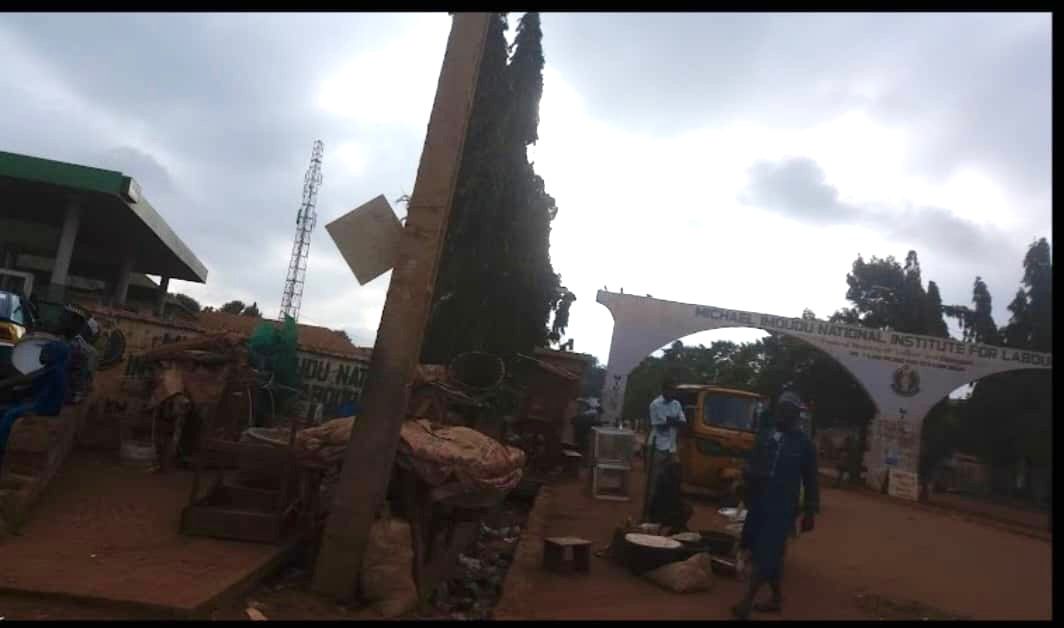
If Pa Imoudu were to pay a visit today, to MINILS for any reason this season of his remembrance, however, he will be grossly appalled and disoriented by the subsisting state of the institute. MINILS by the way, is supposed to be a pioneering establishment in West Africa, dedicated to capacity building for workers, employees and government officials. As you veer off the Ajasse-Ipo to Ilorin road onto the stretch which leads into the institute, your sensibilities are pitilessly assaulted by rot and disorder which stand guard on both sides of that short stretch. Kiosks, stalls, shops, decrepit buildings, rusted roofs, a cacophony of nondescript structures, constitute themselves into a riotous *mammy market,* an expression and concept popularised by our brothers at arms. It refers to those watering holes which spawn and squirm, at the backends of military barracks, which satiate their patrons with liquid and culinary varieties.
The entrance gate is totally uninspiring. It just sits there dumb and disconnected. As you advance into the acreage of the institute, you discover that the tarred driveway very much like the portion you encountered beginning from your detour off the major road, can do with some conscientious resurfacing. The greenery within the premises have not been challenged by the mouths of sharpened cutlasses in a long while, nor the humming, slashing anger of the lawnmower. Paint coatings on the perimeter fence have been peeled off either by reason of substandard work previously done, or the convergence of the rage of the elements. Patches of spyrogyra have contributed to the disfigurement of the hedge in places. A ghostly quiet pervades the air, away from the measured boisterousness of a thriving institute.
There is palpable lack of motivation for the generality of the workers, the pervading air also a disincentive for potential trainees. The collective muteness of the physical structures within the institution echoes and reverberates. The *Ollie Anderson Block* long named after an American benefactor of MINILS is the administrative building. It offers no spark or sparkle like the other structures, all collectively sleeping and slumbering. Power outages are the rule rather than the exception and you wonder why the leadership of the establishment wouldn’t avail its workers and course participants alternative energy sources so they can contribute their bits. The hostels in the institute which are supposed to be sources of internally generated revenue, (IGR), are dirty, decrepit, unkempt, utterly dysfunctional. The beds are broken, the beddings unfit for swine. The last batch of participants on a programme put together by the institute, had to rely on water fetched for them in buckets and heaved to their rooms. Such is the level of rot in today’s MINILS.
Issa Obalowu Aremu, a trade unionist and labour leader himself has been the director-general of the institute for about three years now. He was vice president of the Nigerian Labour Congress, (NLC), when Adams Oshiomhole was president, between 1999 and 2007, which coincided with the years Olusegun Obasanjo was President. Aremu initially attended the Ahmadu Bello University, (ABU), Zaria. Unfortunately, he was expelled from the institution in his final year because of activism. Respected scholars and social scientists, Claude Ake and Ikenna Ezimiro rescued Aremu’s educational trajectory by getting him into the University of Port Harcourt, where he graduated in 1985 with a second class upper degree. He obtained a masters in labour and development from the *Institute of Social Studies,* (ISS) in The Hague and was a labour delegate to the National Conference of 2014. He has also been privileged to attend the elite National Institute for Policy and Strategic Studies, (NIPSS), domiciled in Jos, Plateau State.
Unfortunately, these glossy credentials have not been manifest in Aremu’s administration of MINILS thus far. Aremu, who in years as comrade would rail at the wastefulness of bourgeois leaders, today reportedly drives around in Kwara State with a convoy of three or four cars. Not even the prevailing national economic crunch emblematised among others by spiralling fuel costs has mitigated this penchant for unnecessary exhibitionism. He is said to have a detachment of security details from the Department of State Services, (DSS) and the Nigerian police, escorting him around and about.
On his trips to Kaduna where he has been primarily domiciled for most of his working life, or Abuja, he is received at the airport by two official vehicles complete with armed escorts. They typically depart Ilorin ahead of his flights. The Vice Chancellor of the University of Ilorin in the same city, Wahab Olasupo Egbewole, a professor and Senior Advocate of Nigeria, (SAN), who oversees a student community in excess of 50,000 students moves around innocuously in the same Ilorin. This city by the way is relatively peaceful, posting low crime indicators compared to many others.
If stories and innuendos are to be credited some believability, there is this insinuation that there seem to be no demarcation between the official and the personal in MINILS under Aremu. The institute for instance groans for lack of operational vehicles to run its affairs. Yet some of its healthier motorised assets are said to be in the custody of his family members in various locations across the country. The names of Aremu’s relatives who are non-staffers in MINILS, have been alleged to feature on the list of his delegations on foreign trips, their tickets and estacodes fully paid by the institution. Fiscal frugality is said to be nonexistent in the dictionary of Issa Aremu.
Staff training for job function capacity building, which were usually undergone both externally and internally are reported in the past tense. He was recently pressed by in-house unions to address staffers on issues around capacity training, which he is said to have of completely ignoring in his three years in office. He responded by reluctantly convening a general staff meeting to which, very oddly, he invited the press. He presented an inconclusive compendium containing things he claimed to have achieved in office thus far. He chronicled and appropriated virtually all the legacies of preceding administrations. Aremu listed the *George Meany Computer Centre,* two power generators, and a hostel block, where he set up a non-functional clinic, as his personal achievements. Long-serving civil servants in MINILS, note with deep nostalgia the pluri-dimensional innovations emplaced in the organisation under the watch of former chief executives like Jacob Jeminiwa, John Olanrewaju, Saliu Ishaq Alabi, among achievers.
The institute is also hamstrung in convening tune-up programmes for external participants because of the quantum dilapidation of its facilities and unavailability of funds. This is as Aremu is reported to love the big life. He is said to fancy being adulated as “His Excellency, Comrade Issa Obalowu Aremu, mni, Director-General and Chief Executive of Michael Imoudu National Institute for Labour Studies.” Having contested for the governorship of Kwara State on the platform of Labour Party, (LP), in 2018, he has since coveted and adopted that fanciful referent. He also never fails to remind his audiences in the institute that having been deputy as a unionist to former governor Oshiomhole during his years in labour activism, he also qualifies to be referenced as a quasi-governor! He reportedly never fails to remind his officials how lucky they are to have a man with his accomplishments as helmsman.
The condition of the Michael Imoudu National Institute for Labour Studies, (MINILS) today is a national embarrassment. The institute constitutes colossal disrespect, monumental insult to the name and legacies of Michael Athokhamien Omnibus Imoudu, the iconic Pa Imoudu. Supervising Minister of Labour and Employment, Nkeiruka Onyeagocha needs to take immediate interest in the institute before it is wholly run aground. A physical visit to the institute for on-the-spot assessment will avail her better insights into the prostrate condition of the establishment. This will help in the articulation of a road map for the institute’s comprehensive makeover. Such timely remediation will please the spirits of those who conceived of the institute and that of Pa Imoudu, to no end.
*Tunde Olusunle, PhD, is a Fellow of the Association of Nigerian Authors, (FANA)*