Connect with us

News

103-year-old Tanzania woman waited years to meet her white boyfriend

Published

on

ADVERTISEMENT
Zoom Ad
ADVERTISEMENT
Zoom Ad

By Francesca Hangeior.

 

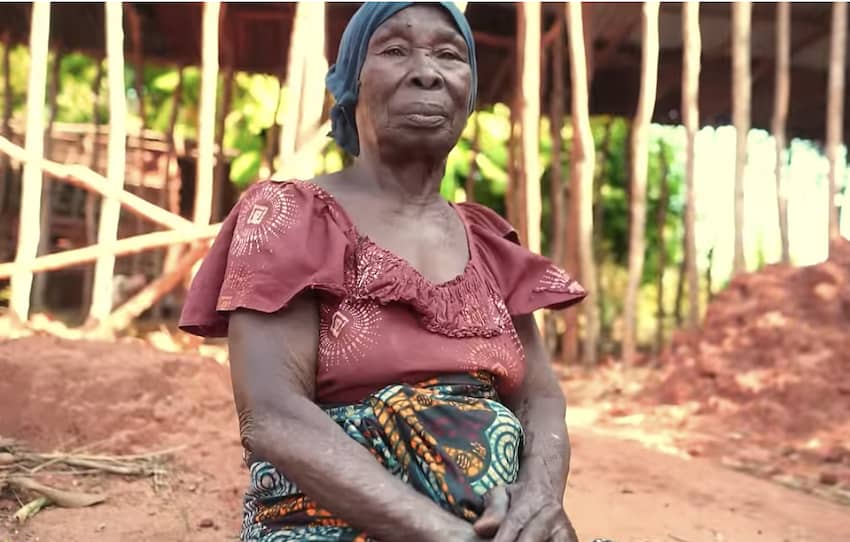
A 103-year-old Tanzanian woman identified as Mariam Hussein has narrated the lifelong story of love and patience detailing her deep affection for a white boyfriend named John, whom she failed to meet again after he left.

Hussein, who spoke with Afrimax’s English anchor, Simon Greenwood, in Swahili (translated to English) recently said she was convinced that her European boyfriend would find her soon so they could rekindle their love, but she ended up single and celibate all her life.

According to her, John was a young man full of adventure and kindness who had come to Tanzania seeking adventure.

Advertisement

“I met John, a young white man from Europe who had come to Tanzanian in search of adventure and purpose. I helped him navigate and settle comfortably into his new environment. Over time, our friendship blossomed into something more, to be honest, he was unlike anyone I have ever met his manners, stories, and kindness all fascinated me he respected my culture and showed genuine interest in my life and aspirations we spent countless hours envisioning a future filled with love and happiness I believed he was truly unique and indeed he was.

“Our relationship blossomed and I found myself falling deeply in love every moment we spent together made my feelings for him grow stronger, I could see that he loved me too, his eyes sparkled with genuine affection whenever he looked at me and his actions always showed his care and commitment.

“I love him back wholeheartedly and unconditionally because, for the first time in my life, it was all about love in its purest form we shared dreams, hopes and secrets together, building an unbreakable bond I also hoped that John would be the one to change my destiny I dreamt that he may take me away from the life of struggle I had always known and experienced with him I envisioned a future filled with endless possibilities free from the hardship that had defined my past he gave me hope that together we could build a new life full of love and happiness,” the woman said.

The woman, who has never married nor had children, stressed that her hopes were dashed when John abruptly received an urgent call to return to his village without bidding her farewell or explaining.

Advertisement

Devastated by his sudden disappearance, Hussein spent years searching for him, believing that he would someday return to fulfil their dreams.

“I was devastated I couldn’t believe he had disappeared initially. I considered the possibility of it being a prank or a test of my patience. I searched high and low for John desperately hoping for an explanation but he was nowhere to be found days turned into weeks, weeks turned into months and still there was no trace of him months turned into years and yet I clung to believe that John would eventually return.

“I refused to accept the idea that he may not come back anytime soon despite the wonderful moments we had shared, I remained a virgin in our culture, it was expected that preserve her purity until marriage having sex before a marriage was considered a taboo so I made it my priority to maintain my purity…,” she noted.

The 103-year-old woman further asserted that she had always believed that one day she would be married to John and her patience would be rewarded.

Advertisement

“This cultural belief was deeply ingrained in me and I took my commitment to take it seriously even though I loved John deeply and we had an incredible bond. I remained steadfast in upholding this cultural value.

“I believed that one day, we would be married and my patience would be rewarded … however as years went by the hopes of his returns began to fade leaving me feeling both betrayed and alone nevertheless, I remained resolute in my promise to myself and my culture,” she said.


Continue Reading
Advertisement
Click to comment

Warning: Undefined variable $user_ID in /home/naijuinz/public_html/wp-content/themes/zox-news/comments.php on line 49

You must be logged in to post a comment Login

Leave a Reply

News

Cholera Outbreak: Plateau Records 5 Deaths, 11 Confirmed Cases

Published

on

By

ADVERTISEMENT
Zoom Ad
ADVERTISEMENT
Zoom Ad

Plateau State commissioner for Health, Dr Nicholas Baamlong, has revealed that the state recorded 11 confirmed cases of cholera, five deaths and 53 suspected cases.

Baamlong, who disclosed this to journalists yesterday in Jos, said the confirmed and suspected cases were reported in Pushit, Mangu 1 and Mangu 2 communities in Mangu local government area (LGA).

According to him, the state Ministry of Health is intensifying public health interventions to contain the outbreak, prevent further spread and reduce its impact on affected communities.

He explained that the state had taken decisive actions to control the outbreak and protect its citizens via the deployment of additional Response Teams (RRTs) to the affected wards, scaling up of treatment centres and isolation capacity and the emergency procurement of Rapid Diagnostic Tests Kits, intravenous fluids and essential drugs.

Advertisement

The Commissioner further said that the ministry had activated an Incident Management System (IMS), for a comprehensive and multi sectorial response to the outbreak.

“The activation of the IMS ensures a coordinated, efficient, and accountable response structure in line with national and international emergency response frameworks,” he said.

Baamlong explained that cholera was an acute diarrhoeal disease caused by consuming food or water contaminated with the bacterium Vibrio cholerae.

He urged residents of Mangu LGA and neighbouring communities to remain vigilant and take preventive measures, including drinking safe water, maintaining proper hand hygiene, avoiding open defecation, and ensuring proper waste disposal.

Advertisement

He also advised residents to promply report suspected cases of cholera to the nearest healthcare facility for immediate attention.

While reaffirming the state government’s commitment to safeguarding the health and well-being of residents, Baamlong called on development partners and other stakeholders to support ongoing response efforts.(NAN)

Continue Reading

News

South Africa says 2,745 foreigners sent home in a week

Published

on

By

ADVERTISEMENT
Zoom Ad
ADVERTISEMENT
Zoom Ad

South Africa has repatriated 2,745 foreigners in the week after President Cyril Ramaphosa vowed tougher action against illegal immigration, the country’s home affairs minister said on Sunday.

One of Africa’s largest economies, South Africa has long attracted migrant workers from across the continent, both legally and illegally.

But saddled with an unemployment rate above 30 percent, it has experienced recurring spurts of anti-immigrant unrest, including fresh violence in recent weeks.

Mobs of South Africans carrying sticks, whips and shields have marched through parts of the country ordering foreigners with no residency papers to leave by June 30.

Advertisement

Growing security fears after businesses were looted and foreigners targeted have prompted citizens of Nigeria, Malawi, Ghana, Zimbabwe and Mozambique to accept voluntary repatriation organised by their governments.

“As of last night, the number we can report is 2,745 repatriations that have come in this period since the president spoke,” Home Affairs Minister Leon Schreiber told reporters.

“It is a moving target,” he said.

The government said most of those repatriated were in the country illegally.

Advertisement

They include Malawian nationals, about 7,000 of whom have been sheltering in an open field in the eastern port city of Durban, according to an inter-ministerial migration committee set up after the president’s address.

Eight buses commissioned by the Malawian government began moving its citizens on Sunday, with South Africa providing 10 additional buses to speed up deportations, the committee said.

Some 560 people, including about 200 children, took the journey on Sunday, Malawi Consul General Max Biwi said.

Among those boarding the first buses, some carried babies on their backs and small bags of belongings.

Advertisement

“I’m relieved we are finally leaving. It’s better than living in fear here,” said Fortunate Chilenje from Blantyre, Malawi’s commercial capital.

The 25-year-old had lived in South Africa for three years, she told AFP, adding that threats to leave had followed her even at the camp, one of the largest to emerge since the unrest began.

The government said on Sunday it did not operate refugee camps and had no intention of establishing them, even on a temporary basis.

Another passenger, Laina Nala from Mangochi in southern Malawi, said she simply wanted to be dropped as close to her home as possible, rather than continuing on to Blantyre.

Advertisement

“Blantyre is too far and expensive from there,” she said.

For Hassan Hasha, 27, a debt linked to his journey to South Africa still hung over his head.

He said he had barely stayed in South Africa for weeks before the anti-foreigner sentiment flared, but added: “I have resigned myself to going home”.

Last week, Ramaphosa acknowledged public concerns over illegal immigration but warned that the authorities would not tolerate anyone taking the law into their own hands.

Advertisement

Tensions escalated after two Mozambicans were killed following a May 29 march against illegal migrants in the Western Cape town of Mossel Bay. Mozambican authorities put the toll at five.

There are more than three million foreigners living in South Africa, or 5.1 percent of the population, according to the statistics agency.

Continue Reading

News

FCT residents decry rising cost of tomatoes

Published

on

By

ADVERTISEMENT
Zoom Ad
ADVERTISEMENT
Zoom Ad

Many residents of the Federal Capital Territory (FCT) have expressed concern over the  continued increase in the price of tomatoes.

The residents told the News Agency of Nigeria (NAN) on Sunday in Abuja that the situation was making things difficult for both traders and residents.

A market survey conducted by NAN in some markets in the FCT showed a sharp rise in tomato prices in recent weeks.

A vegetable seller at the Suleija market, Malam Isah Ado, said they were facing challenges in their business due to the surge in tomato prices.

Advertisement

Ado said a big basket of tomatoes, which sold for between N85,000 and N90,000 a few weeks ago, currently sells for between N150,000 and N170,000.

He attributed the rise in price to seasonal scarcity, post-harvest loses and high cost of transportation from farms to markets.

A tomato seller at Garki New Market, Ms Philomena Bassey, lamented that the cost of transporting produce from the producing states to the markets had continued to increase.

“Customers think we are ripping them off and making a lot of profit from our sales, but that is not the case.

Advertisement

” We buy these tomatoes sometimes cheaply from the farms where they are produced, but by the time they get to Abuja, the price will have gone up.

“So, we have to factor in all  of these factors, which makes the cost of the product increase,” she said.

A small-scale trader  popularly known as Mummy Juli, who resides in Kubwa village, said tomatoes were very scarce in the market these days.

” The scarcity has made tomatoes very expensive to buy, thus forcing us to also adjust our prices.

Advertisement

“I used to share a basket of tomatoes with three other traders, but now I have to share with five colleagues because of the increased price in the market,” she said.

She told NAN that a small bucket of tomatoes she usually sells for between N4,000 and N4,500 now sells for between N8,000 and N10,000.

“Due to the hike in price, I  can no longer sell a portion of tomatoes for less than N1,000 as against N100.

” This has led to reduced sales in my business because the majority of my customers are very low-income earners who buy in small quantities.

Advertisement

“As the situation is right now, there is nothing I can do; I have to keep managing and hope for the best,” she said.

Mrs Angella Ikenna, a mother of two, shopping at the Dutse Market, said the rising cost of tomatoes was taking a toll on her family’s feeding expenses.

“I used to buy the tomatoes I need for a week, but due to their price, I now buy only what I need for a day or two,” she said.

Similarly, Mr Moses Sunday, a nurse, lamented that the rising cost of tomatoes was compounding the country’s economic situation.

Advertisement

Mrs Badia Muhammad, a resident of Dei-Dei, said the rise in tomato prices was affecting many households.

“We use tomatoes almost in every meal, but due to the sharp  rise, we can no longer afford to buy them as we used to and have to opt for cheaper alternatives.

“We appeal to the government to address the issues affecting the supply of tomatoes and implement measures that will enhance production.

Advertisement
Continue Reading

Trending

Copyright © 2024 Naija Blitz News