Connect with us

News

Kano Assembly reverses dissolution of three emirates, downgrades emirs

Published

on

ADVERTISEMENT
Zoom Ad
ADVERTISEMENT
Zoom Ad

By Francesca Hangeior.

 

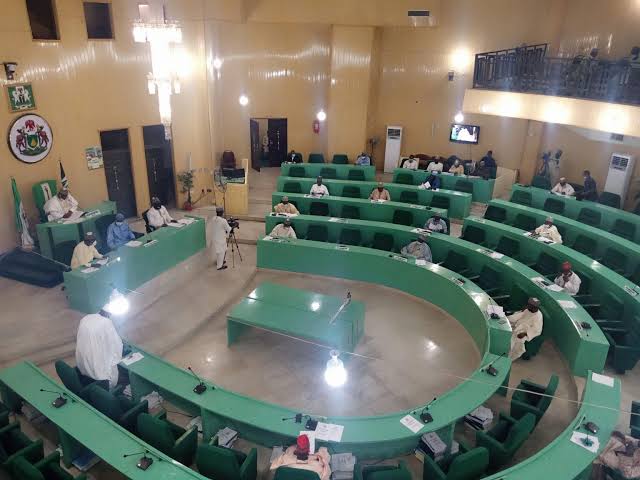
The Kano House of Assembly on Tuesday passed a bill to reverse the dissolution of three emirates in the state but also downgrading their emirs from first-class to second-class status.

In May, the lawmakers amended the emirate council law of the state to scrap the emirates of Gaya, Rano, Karaye and Bichi and restoring Kano as the only emirate in the state.

Advertisement

The development, which saw the removal of all the five sitting emirs and the reinstatement of Lamido Sanusi as the emir of Kano, led to an ongoing crisis in the state and battles in the law courts.

On Tuesday, the lawmakers maintained the scrapping of Bichi emirate and restored the emirate of Gaya, Karaye and Rano but downgraded their emirs and reduced the number of local government areas under their domain.

This is significant as the constitution allocates five per cent of federal allocations to local governments to the traditional institutions in the areas.

The lawmakers said they took the first reading of the bill before embarking on a recess on 23 May, although this was not reported in the media.

Advertisement

The Speaker of the House, Jibril Falgore, presided over the plenary on Tuesday.

After the second and third reading of the bill, the deputy speaker, Muhammad Bello, moved for the adoption and passage of the bill.

The lawmakers approved the downgrading of the scrapped emirates to second-class emirates.

Advertisement
Continue Reading
Advertisement
Click to comment

Warning: Undefined variable $user_ID in /home/naijuinz/public_html/wp-content/themes/zox-news/comments.php on line 49

You must be logged in to post a comment Login

Leave a Reply

News

Presidency, National Assembly Renew Alliance on Reforms as Abbas Defends 10th NASS Record

Published

on

ADVERTISEMENT
Zoom Ad
ADVERTISEMENT
Zoom Ad

By Gloria Ikibah

The Presidency has reaffirmed its commitment to working closely with the National Assembly to advance security, economic recovery and good governance, insisting that cooperation between both arms of government is essential to delivering the Renewed Hope Agenda.

The assurance came on Tuesday as the House of Representatives opened its National Assembly Open Week in Abuja, an initiative aimed at showcasing the work of parliament and strengthening public engagement under the theme, “Three Years of the 10th National Assembly: Advancing Transparency, Inclusion and Reform.”

Representing President Bola Tinubu, the Chief of Staff, Rt. Hon. Femi Gbajabiamila, said Nigerians expect government institutions to work together in the national interest, while stressing that the Open Week should serve as more than a ceremonial event.

Advertisement

He said: “An Open Week must be more than the ceremonial opening of the gates of Parliament. It should be an invitation to scrutiny, dialogue and partnership.

“Citizens should be able to follow how laws are made, understand how public resources are appropriated and see how legislative oversight protects the national interest.

“Equally, the legislature must continue to hear from young Nigerians, women, persons with disabilities, civil society, the private sector, professional bodies and communities across the federation.”

Gbajabiamila praised the leadership of the National Assembly, led by Senate President  Godswill Akpabio and Speaker of the House, Tajudeen Abbas, for reforms undertaken since the inauguration of the 10th Assembly.

Advertisement

He emphasised that collaboration between the Executive and Legislature strengthens, rather than weakens, democracy.

“While the Executive and the Legislature are separate arms of government, they share one ultimate mandate which is to improve the lives of the Nigerian people. Constructive cooperation does not diminish legislative independence, nor does robust debate amount to institutional conflict. Our democracy is strengthened when both arms engage with mutual respect, constitutional fidelity and a clear focus on results.

“As we reflect on the first three years of the 10th Assembly, I encourage us to look beyond the record of activities to the measure of impact: laws that solve real problems; budgets that translate into visible development; oversight that improves performance; and representation that renews citizens’ confidence in government.

“The Presidency remains committed to a productive relationship with the National Assembly in pursuit of security, economic renewal, social justice and shared prosperity under the Renewed Hope Agenda. Nigerians expect their institutions to work together.

Advertisement

“I congratulate the 10th National Assembly and all partners who have made this Open Week possible. May this gathering deepen public trust, strengthen democratic accountability and remind us all that public office is, above all, a public trust”, he added.

In his keynote address, Speaker Abbas Tajudeen defended the performance of the House over the past three years, revealing that lawmakers had processed 2,747 bills, with 363 passed by the National Assembly and 72 already signed into law by President Tinubu.

He said the figures represented the most productive legislative record since the return to democratic rule in 1999.

He said: “These were not lines upon a page but measurable and lasting change. Those figures represent the highest for any Assembly since 1999.”

Advertisement

According to the Speaker, one of the landmark laws guarantees interest-free student loans, while others have overhauled revenue administration and created regional development commissions.

“One of those laws now offers young people interest-free student loans, so that no Nigerian student is turned away from a lecture hall for want of means.

“Another has reformed how the nation raises and shares its revenue. Others have created commissions to carry development into every region of the Federation.

“The landmark statutes are only part of our work: more than 800 citizens have petitioned this House, and we have already brought hundreds of those matters to resolution. That, in my estimation, is this House at its most faithful.

Advertisement

“Where we have served the nation well, the Scorecard records it. Where we have fallen short, it records that also. At our inauguration in 2023, we asked to be measured against our own promises, and we meant it”, Abbas added,

The Speaker described the Open Week as an opportunity for direct engagement between parliament and the public.

“This week was designed not as a lecture but as a national conversation, and at every table, a place has been reserved for the citizen.”
The Speaker also defended the Assembly’s support for the Tinubu administration’s economic reforms, saying parliament had provided the legal framework required to implement key policies.

“President Bola Tinubu asked us to accept a difficult but necessary course of reforms. They reached into the very foundations of our economy, into how it is financed, how our currency is valued, and how our common revenue is shared and invested in our people.

Advertisement

“Every policy of the Executive still had to become law, to pass through appropriation, and to withstand legislative scrutiny. That is the indispensable work this House has performed.

“We laid the legal foundation for the tax reforms that will render our revenue fairer for generations to come.

“We enacted budgets directing resources toward infrastructure, toward power, and toward the human capital upon which all else depends.

“We gave statutory force to the reform of student financing. The President furnished the vision; the National Assembly furnished the laws that render the vision enforceable. That is the true measure of legislative support, and it is worth far more than applause”, he stated.

Advertisement

On security, Abbas maintained that progress was being made despite continuing challenges.

“Nothing tests a government, or a parliament, so severely as the safety of the citizen.

“Let me speak plainly: our security forces are gaining ground, and we will not rest until every Nigerian is safe.”

The Speaker also dismissed claims that the National Assembly merely rubber-stamps Executive proposals.

Advertisement

“Some assume, in good faith, that when a President signs a Bill quickly, then the legislature is a rubber-stamp. That is not how the work is done.

“Swift assent is usually the reward of months of committee work, completed long before the cameras arrive.

“Even the Congress of the United States has, in urgent moments, passed sweeping legislation in a single day, and no serious observer called it surrender.

“Speed built on hard preparation is the mark of a Parliament that is working, not one that has stopped thinking.”
He urged Nigerians to become more involved in the legislative process.
“My appeal to the citizen who observes us today is therefore a simple one: draw closer. Acquaint yourself with the true workings of your Parliament.

Advertisement

“Read a Bill before you pass judgement upon it. Submit your memoranda when we call for them. We take your submissions seriously and consider your input in amending laws”, he added.

Senate President Godswill Akpabio said the National Assembly remained focused on supporting government through legislation and budget approvals that improve the economy.

“I also insist that any sort of finance or those running our economy also take care of our contractors across the board so that money will be released to the society for things to function”, he said.

He also praised President Tinubu’s relationship with the legislature.

Advertisement

“He has visited us more times than any president. Whether it is June 12th or whether it is time of budget, he comes here in person and always very excited.

Executive Director of the Policy and Legal Advocacy Centre (PLAC), Clement Nwankwo, acknowledged the Assembly’s progress in areas including constitutional amendment, electoral reform and citizen engagement, but challenged lawmakers to strengthen oversight of the Executive.

“The Legislature is at its strongest not when it agrees with the Executive, but when it faithfully discharges its constitutional duty to scrutinise executive action, protect public resources and ensure that government remains accountable to the people”, he said.

Nwankwo urged lawmakers to conclude the constitutional review process, strengthen Nigeria’s electoral laws, pass the Special Seats Bill for Women, deepen transparency and ensure oversight delivers measurable benefits for citizens.

Advertisement

Former Speaker Aminu Masari commended the Open Week initiative, describing it as evidence that the House was living up to its reputation as the “People’s House.”

Emeritus Archbishop of the Catholic Archdiocese of Abuja, John Cardinal Onaiyekan, reminded lawmakers that their legitimacy comes from the electorate and urged them to place the interests of Nigerians above every other consideration.

Executive Secretary of the National Assembly Library, Hon. Henry Nwawuba, said the Open Week reflects parliament’s commitment to openness and accountability, while noting that it coincides with the second anniversary of the National Assembly Library, established by President Tinubu to preserve Nigeria’s legislative history and improve public access to parliamentary information.

Advertisement
Continue Reading

News

Reps Reopen State Police Debate, Drop Earlier Bill for Tinubu’s Executive Proposal

Published

on

ADVERTISEMENT
Zoom Ad
ADVERTISEMENT
Zoom Ad

By Gloria Ikibah

The House of Representatives on Tuesday rescinded its earlier resolution on the proposed constitutional amendment to establish state police, paving the way for fresh consideration of an Executive Bill transmitted by President Bola Tinubu.

Lawmakers unanimously voted to withdraw the earlier version of the legislation before immediately giving the President’s proposal a second reading, signalling a fresh phase in the long-running effort to create a constitutional framework for state policing.

The decision followed the adoption of a motion moved by the Chairman of the House Committee on Rules and Business, Rep. Francis Waive (APC, Delta), during plenary.

Advertisement

Waive said the motion was brought pursuant to Order Nine, Rule 6 of the Standing Orders of the House of Representatives.

He reminded members that the House had, on Thursday, 11 June 2026, approved amendments to several sections of the Constitution relating to the establishment of State Police Services.

According to him, the affected provisions include Sections 34, 35, 39, 42, 84, 89, 129, 153, 197, Chapter VI Part III, Sections 214, 215 and 216, as well as the Second and Third Schedules to the Constitution.

Waive also recalled that on 9 July, the House constituted a 12-member Conference Committee to harmonise its position with that of the Senate on the proposed legislation.

Advertisement

He, however, said fresh developments had made it necessary for lawmakers to revisit the bill.

He said: “New facts have emerged regarding the provisions of the Bill, which necessitate a critical review and reconsideration of its clauses to align with national security structure.

“Cognizant of the need to rescind the decision of the House on the passage of the bill and the constitution of the Conference Committee on the Establishment of State Police Services.”

When Speaker Abbas Tajudeen put the motion to a voice vote, members unanimously supported the proposal, effectively withdrawing the House’s earlier decision on the bill.

Advertisement

Shortly afterwards, the House considered an Executive Bill transmitted by President Bola Tinubu seeking to amend the Constitution to establish a constitutional framework for State Police Services.

The proposed legislation passed second reading after a letter from the President was read on the floor by the Speaker.

In the letter, Tinubu said the Executive Bill builds on the extensive legislative work already carried out by the House while introducing additional safeguards to strengthen the proposed policing framework.

According to the President, the amendments are designed to ensure that the creation of a dual policing system can respond more effectively to Nigeria’s changing security landscape.

Advertisement

“The proposed legislation is a critical component of our administration’s strategy to reorganise Nigeria’s security architecture to better protect our citizens, and I am confident that the House of Representatives will act quickly to consider and pass this bill.

“While I look forward to expeditious consideration of this submission by the House of Representatives, please accept, Rt. Honourable Speaker, the assurances of my consideration and best regards”, Tinubu stated.

Continue Reading

News

NSITF presents 78 beneficiaries with prostheses

Published

on

ADVERTISEMENT
Zoom Ad
ADVERTISEMENT
Zoom Ad

By Kayode Sanni-Arewa

The Nigeria Social Insurance Trust Fund (NSITF) has presented prostheses for different degrees of injuries to 78 beneficiaries in continuation of its Prosthesis Provision Exercise.

Managing Director, Barrister Oluwaseun Faleye, at the formal presentation of the final report on the current phase of the exercise in Abuja, said “the cooperation and commitment demonstrated by the prosthesis providers, beneficiaries, employers, and the monitoring team greatly contributed to the successful completion of this intervention.

“The providers also demonstrated flexibility by accommodating special clinical needs, including the provision of a hip disarticulation prosthesis where necessary”.

Advertisement

Represented by the Executive Director (Operations), Mojisola Alli Macaulay, the MD explained that following the commencement of the prosthesis provision exercise in April 2026, the Claims & Compensation Department of NSITF monitored the implementation of the programme from inception through to its successful completion.

In his words, “Sequel to the interim report submitted previously, I am pleased to report that the prosthesis provision exercise has now been successfully concluded. All identified beneficiaries under the approved programme have been assessed, fitted with the appropriate prostheses, trained on their use, and discharged after satisfactory evaluation.”

According to him, “Where beneficiaries could not participate due to reasons such as inability to establish contact, refusal to attend after notification, or death, they were replaced from the supplementary list to ensure the successful completion of the exercise”.

The various categories of prostheses successfully provided include: Above-knee prosthesis: Total beneficiaries 8, all 8 beneficiaries satisfactorily discharged; Hip Disarticulation Prosthesis: Total beneficiary 1 (provided for a beneficiary whose assessment indicated a hip disarticulation rather than an above-knee amputation), 1 beneficiary satisfactorily discharged

Advertisement

Below knee prosthesis:  Total beneficiaries 11 (All 11 beneficiaries satisfactorily discharged), Below elbow prosthesis:  Total beneficiaries 12 (All 12 beneficiaries satisfactorily discharged); Above elbow prosthesis: Total beneficiaries 5 (All 5 beneficiaries satisfactorily discharged), Trans-humeral prosthesis: Total beneficiary 1 (1 beneficiary satisfactorily discharged).

Silicon partial hand prosthesis: Total beneficiaries 40 (All 40 beneficiaries satisfactorily discharged), Total beneficiaries scheduled for prosthesis provision 78, Total beneficiaries duly discharged 78.

Also speaking at the event, the General Manager (Claims and Compensation), Nkiru Ede-Ogunnaike, noted that throughout the exercise, beneficiaries underwent assessment, measurement, prosthetic fabrication, fitting, gait and functional training, evaluation, and final discharge.

“The prostheses were successfully fitted, and beneficiaries expressed satisfaction with the services rendered. Discharge letters stating completion and warranty with the beneficiaries’ satisfaction forms have been duly completed and filed in their respective dossiers.

Advertisement

“In conclusion, the prosthesis provision programme achieved its intended objectives and has been completed successfully. The exercise has significantly improved the mobility, functionality, and quality of life of the beneficiaries while fulfilling the Fund’s mandate of providing appropriate rehabilitation support to eligible employees who sustained work-related disabilities”.

Speaking on behalf of all the beneficiaries, Solomon Sunday, a staff of Zodoson Industries in Abia State, praised NSITF for giving them their lives back.

He stated that most of them were depressed and frustrated with life after their accident before NSITF came into the scene to redeem their lives with prostheses which have given them  the opportunity to live normal once again.

In his words:” we are deeply grateful to the fund and appreciate NSITF for all they have done for us and have been doing, you can see how excited and happy l am as a young man who can look forward to a bright future and the fund has given me opportunity to acquire new skill to earn a living.  Honestly, we are deeply grateful and thank God for using NSITF to change our stories.”

Advertisement
Continue Reading

Trending

Copyright © 2024 Naija Blitz News