
News
Send Your Kid To School or get jailed – Gombe govt cautions parents


- /home/naijuinz/public_html/wp-content/plugins/mvp-social-buttons/mvp-social-buttons.php on line 27
https://naijablitznews.com/wp-content/uploads/2025/09/Screenshot_20250922-184935.jpg&description=Send Your Kid To School or get jailed – Gombe govt cautions parents', 'pinterestShare', 'width=750,height=350'); return false;" title="Pin This Post">
- Share
- Tweet /home/naijuinz/public_html/wp-content/plugins/mvp-social-buttons/mvp-social-buttons.php on line 72
https://naijablitznews.com/wp-content/uploads/2025/09/Screenshot_20250922-184935.jpg&description=Send Your Kid To School or get jailed – Gombe govt cautions parents', 'pinterestShare', 'width=750,height=350'); return false;" title="Pin This Post">


By Kayode Sanni-Arewa
The Gombe State government says it would send parents and guardians to jail for not sending their children to schools.
Babaji Babadidi, Chairman, Gombe State Universal Basic Education Board, SUBEB, said this on Monday at the inauguration of the 2025/2026 School Enrolment Campaign at Amada in Akko Local Government Area of the state.
He said that defaulting parents could face a two-month jail term under Section 19(2) of the SUBEB Amendment Law 2021.
Babadidi said the measure was necessary to ensure that every child has access to quality basic education.
“Every parent should ensure that his child or ward attends and completes primary, junior and senior secondary education.
“Any parent, who contravene Section 19(2) of the law commits an offence and is liable, upon conviction, to pay a fine or serve a one-month prison sentence.
“Subsequent convictions also attract a substantial fine or imprisonment for a term of two months,” he said.
Babadidi said prior to this enrolment campaign, the state government adopted a carrot approach by providing free education.
“However, if we fail to meet our target of enrolling 400,000 students into primary schools this session, we will revert to the stick approach by enforcing the law.”
The Commissioner for Education, Prof. Aishatu Maigari, said the state has over 700,000 out-of-school children.
According to Maigari, the North-East region accounts for 15 per cent of Nigeria’s 18.2 million out-of-school children.
“We cannot sit and fold our arms while our children remain out-of-school. We will ensure every child is enrolled. Every child will receive quality education, and also learn a trade, which does not necessarily mean working for the government.
“An educated person can become an employer of labour through skills and entrepreneurship acquired in school,” she said.


● _Company engages Board of Trustees, traditional rulers in Akwa-Ibom on Ibom Field operations on PPL 236_

L-R: Head, Human Resources Unit, Emadeb Energy, Mrs Uduak Ugbodaga, Managing Director, Emadeb E&P, Dr Segun Ogunsanya, Chief Executive Officer, Emadeb Energy Group, Mr Debo Olujimi, Paramount Ruler of Eastern Obolo Local Government, HRM, Chief Harry John Etetor, Chairman, Board of Trustees of Emadeb-Eastern Obolo-Ibeno Host Communities Development Trust, Mr Dominic Ekpe, and Legal Adviser, Emadeb Energy Group, Mr Jerry Achonwa during the Emadeb management team’s visit to Akwa-Ibom, Monday
Uyo, Akwa Ibom State | 23 June 2026 – Emadeb Exploration and Production Limited, a subsidiary of Emadeb Energy Group, has reaffirmed its commitment to fulfilling all obligations to the Emadeb-Eastern Obolo-Ibeno Host Communities Development Trust in line with the Petroleum Industry Act, 2021, as it advances stakeholder engagement on its Ibom Field operations on PPL 236.
The assurance was given on Monday in Uyo by the Chief Executive Officer of Emadeb Energy Group, Mr Debo Olujimi, and the Managing Director of Emadeb E&P, Dr Segun Ogunsanya, during an inaugural engagement with members of the Board of Trustees of the Host Communities Development Trust.
The seven-member Board of Trustees, chaired by Mr Dominic Ekpe, was inaugurated in April 2026 pursuant to the provisions of the Petroleum Industry Act. The meeting marked Emadeb E&P’s first formal engagement with the Trust since its establishment.
Speaking during the session, Mr Olujimi said Emadeb E&P would conduct its operations responsibly and in the best interest of the host communities of Eastern Obolo and Ibeno, Akwa Ibom State, and the Federal Republic of Nigeria.
He pledged that the company would engage the Trust with integrity, transparency and an open mind, and sought the Board’s cooperation in strengthening the Trust’s administrative structures as the company finalises the requirements of its operational licence.
“We know that what we have come to do in Eastern Obolo and Ibeno communities is for the betterment of these communities, Akwa Ibom State and Nigeria,” Mr Olujimi said. “I want you to rest assured that Emadeb E&P will do the needful. Deep offshore exploration is a highly technical and capital-intensive endeavour, and by God’s grace we have successfully completed that phase. It is now time to work together in line with the plans we had already emplaced. We are all fully on board.”

Fourth from left: CEO of Emadeb Energy Group, Mr Debo Olujimi, in a group photograph with his management team and members of the Board of Trustees of Emadeb-Eastern Obolo-Ibeno Host Communities Development Trust at the end of their engagement in Uyo, Monday
Emadeb E&P reiterated that the Host Communities Development Trust remains central to its community relations strategy and said it would continue to work closely with the Board of Trustees and host communities to ensure sustainable development and shared prosperity.
The Chairman of the Board of Trustees, Mr Dominic Ekpe, expressed appreciation to the Chief Executive Officer of Emadeb Energy Group for prioritising the engagement. He requested the company’s support for the Trust’s operational take-off, including the provision of administrative infrastructure and requisite funding.
As part of the stakeholder engagement, the Emadeb E&P delegation also paid separate courtesy visits to His Royal Majesty, Chief Harry John Etetor, Paramount Ruler of Eastern Obolo Local Government Area, and His Royal Majesty, Owong Amb. Prof. Effiong Bassey Archianga, Akwaha Owong Ibeno, Paramount Ruler of Ibeno Local Government Area.
Mr Olujimi assured both traditional institutions that Emadeb E&P would remain responsive to its corporate social responsibility commitments and would discharge every obligation stipulated under the Petroleum Industry Act for host communities. The monarchs commended the delegation for the visit and offered prayers for the success and safety of the company’s operations in their domains.
■ About Emadeb Exploration and Production Limited
Emadeb Exploration and Production Limited is the upstream subsidiary of Emadeb Energy Group, focused on the exploration and development of oil and gas assets in Nigeria. The company holds interests in PPL 236, a shallow-water marginal field located about 30 kilometres offshore in a water depth of roughly 20 metres, and is committed to responsible operations, environmental stewardship, and value creation for host communities and stakeholders.
■ For media inquiries
Emadeb Energy Group
+234 803 189 3290
News
Sokoto High Court slams death sentence on 3 men, including foreign national for terrorism , arms trafficking


Justice Muhammad Bello of a High Court sitting in Sokoto State has sentenced three men, including a foreign national, to death by hanging, following their conviction on charges bordering on terrorrism and arms proliferation.
The convicts identified as Yusuf Muhammad (alias Sallau), a Nigerien; Jabbi Alhaji Yalle; and Kabiru Muhammad, were apprehended on June 13th, 2025, by the Department of State Services (DSS) Counter Terrorism Unit in connection with cross-border criminal activities bordering on arms trafficking and terrorrism.
Delivering judgment in the case marked SS/45c/2026, Justice Bello found all three defendants guilty as charged and sentenced them to death by hanging. The court also ordered the forfeiture of all monetary exhibits recovered from the convicts to the Federal Government.
“The conviction is the latest in a series of successful prosecutions by the DSS in its sustained operations against terrorism and organised cross-border criminal networks across Nigeria,” Justice Bello said

The bandit leader linked to the abduction and eventual death of retired Major General Rabe Abubakar has reportedly gone into hiding, amid claims circulating on social media that a rival bandit kingpin, Ado Aleru, has declared him wanted.
The bandit leader, identified as Kachalla Muhammadu (also known as Kachalla Muhammadu Fulani), is a notorious bandit leader indigenous to Matazu Local Government Area of Katsina State, and has been the prime suspect in the May 30 abduction of Gen. Rabe Abubakar (rtd), a former Director of Defence Information and ex-spokesperson of the Nigerian Army.
It was gathered that Kachalla had previously been involved in a government-backed peace arrangement with armed groups operating in the North-West before the abduction.
The retired general was kidnapped alongside his wife, Hajiya Amina Abubakar, around the Matazu area of Katsina State while the couple were travelling to a wedding. Their vehicle was ambushed along the Marabar Musawa–Kafinsoli Road near Zakin Baure village, with their driver sustaining gunshot wounds in the attack.
Investigations by security agencies suggested the attack was not random. Preliminary findings indicated the abductors had deliberately targeted the general and his wife, tracking their movements from Kaduna before striking.
In the days that followed, Kachalla reportedly reached out to the family through an audio recording that later went viral. He demanded the release of three detained members of his gang and the return of livestock allegedly seized during a security operation in Jikamshi, appealing to the state government and local council leaders to meet his conditions.
He also confirmed reneging on a promise to free the general’s wife. Kachalla said he had planned to release Hajiya Amina but changed his mind because of the heavy security presence in the area, adding that he did not want security agencies to take credit for her release.
The bandit leader did not hide his readiness for violence either. He warned that he would have killed the general had his own parents been among those detained by security operatives, insisting that even a deployment of 1,000 soldiers would not help the government locate his camp.
Despite weeks of negotiation, Gen. Rabe did not survive captivity. The retired general died while in bandits’ custody, with the Katsina State Government attributing his death to complications from diabetes and hypertension rather than direct violence.
President Bola Tinubu reacted to the development, with his office expressing condolences to the family and the Armed Forces while reiterating that government would not bow to kidnappers’ demands.
There was, however, some relief for the family. Hajiya Amina Rabe Abubakar, who was abducted alongside her husband, was successfully rescued by security operatives.
Weeks later, troops intensified the manhunt for Kachalla’s gang. Soldiers of the 17 Brigade Strike Group and Quick Response Force, backed by the 8 Division Special Forces, raided a terrorist hideout in Fafu Village along the Matazu–Musawa axis under Operation CLEAN SWEEP III, engaging the bandits in a gun battle that forced them to flee and abandon their camp. Four other victims who had been held alongside the general and his wife since April 14 were rescued in that operation. The Army said troops remain on Kachalla’s trail.
Social media posts have since claimed that bandit kingpin Ado Aleru a Zamfara-based bandit leader who holds the title Sarkin Fulani and was himself once declared wanted by Nigeria’s Defence Headquarters with a bounty on his head has now declared Kachalla wanted, forcing him underground.

Emadeb E&P Reaffirms Commitment to Host Communities Development Trust Under PIA Framework

Sokoto High Court slams death sentence on 3 men, including foreign national for terrorism , arms trafficking

Bandit Kingpin Ado Aleru Declares fellow Bandit Leader who k!lled Gen Rabe Wanted




-

 Foreign16 hours ago
US Targets Alleged ISIS Funding Network, Names Nigerian
-

 Metro16 hours ago
Alleged Drug Trafficking: Billionaire, Two Others Face Trial in Lagos
-

 News9 hours ago
DAY 11 of Projects Commissioning in the FCT: TInubu set to commission Kuje, Gwagwalada road today
-
 News8 hours ago
BREAKING: El-Rufai arrives in court under heavy security for trial over alleged financial crimes
-

 Sports16 hours ago
Super Eagles: Chelle, NFF Reach New Contract
-

 News16 hours ago
Benin monarch to place a curse on kidnappers, armed robbers, fixes date
-
 News9 hours ago
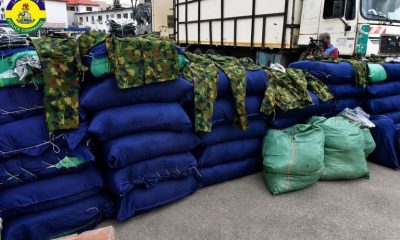
Photos: Police Block Truck Conveying 47 Sacks Of Camouflage & Drugs In Lagos
-

 News16 hours ago
Hajj: NAHCON concludes return of pilgrims’ airlifts