
News
Zamfara Civil Service reshuffled after memo leakage showing financing of terrorism, banditry



By Ojomah Austin.
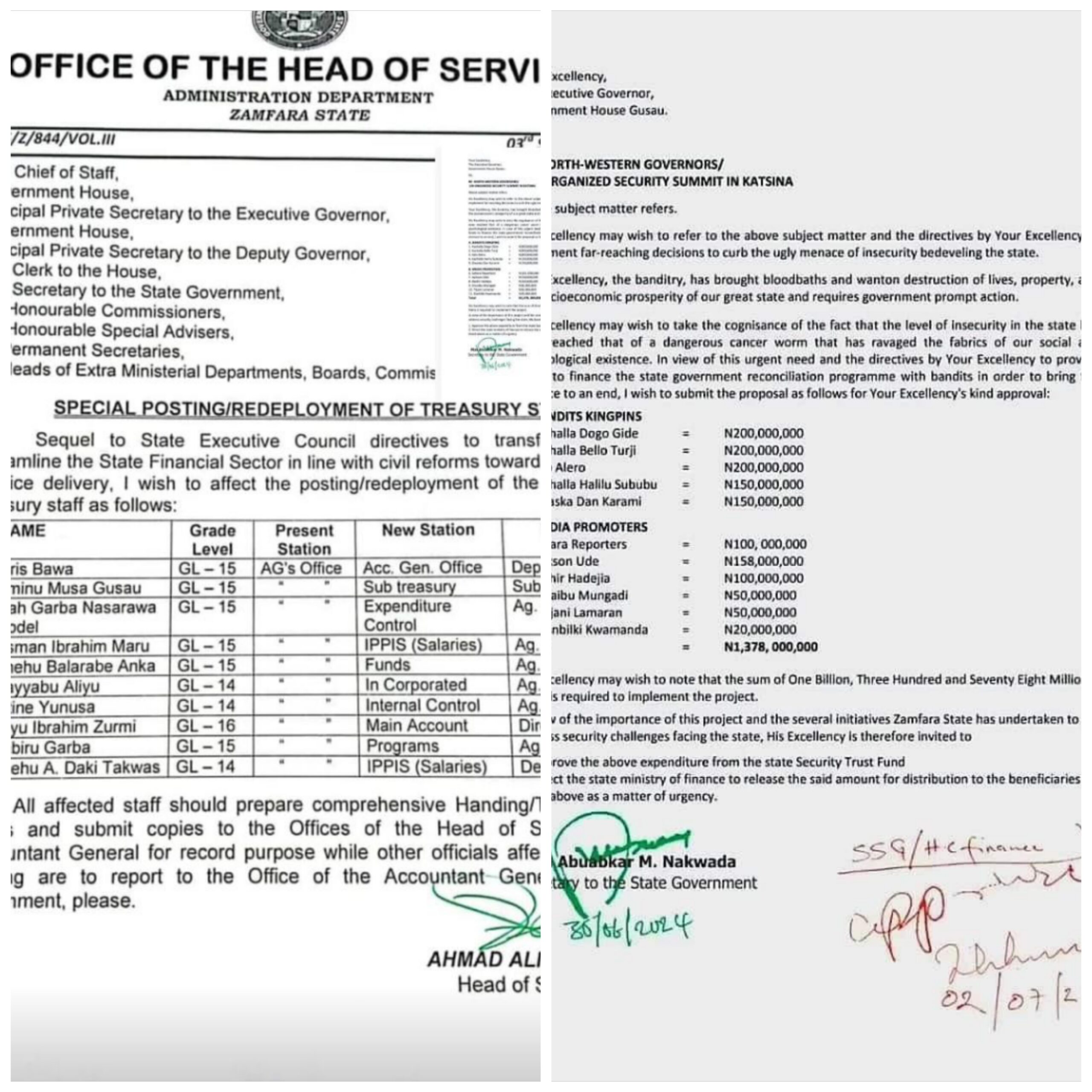
Zamfara State has been thrust into a maelstrom of political upheaval following the emergence of a leaked memorandum purportedly implicating senior government officials, including the Governor, in the financing of terrorism and banditry. This bombshell revelation has ignited widespread indignation and outrage, both domestically and internationally. The fallout from this explosive expose has led to an unprecedented and abrupt reshuffling of key civil servants across the state, in a move that has sent shockwaves through the bureaucracy.
Sources within the Zamfara State Government House have revealed that the Governor was visibly incensed upon learning of the leaked memo, which allegedly detailed financial transactions facilitating banditry and further entangling high-ranking government officials in the scandal.
At the epicenter of the Governor’s anger was reportedly the Commissioner of Finance, who, as the overseer of the state’s financial management, is responsible for orchestrating the movement of accounting staff within the bureaucracy.
*A Strategic Move or A Defensive Maneuver?*
In an attempt to mitigate the fallout from the public embarrassment and intense backlash from international human rights organizations, Governor Dauda Lawal swiftly initiated a comprehensive reorganization of civil servants within the state bureaucracy, specifically focusing on the treasury department. This strategic move was formally communicated through a subsequent memo, meticulously outlining the extensive reshuffling of civil servants.
According to credible sources, the Governor’s office, in an unconventional and unexpected maneuver, sidestepped the Commissioner for Finance and instead entrusted the Head of Service, Ahmad Aliyu Liman, with the sensitive task of orchestrating the “special” redeployment of treasury staff.
This unusual deviation from established protocol has raised eyebrows, sparking speculation about the motivations behind this decision and the extent of the Governor’s involvement in the treasury department’s affairs.
The follow-up memo obtained by our investigative team, with the reference number HOS/Z/844/VOL.III, outlines the redeployment of various senior treasury staff, including directors and deputy directors in key financial departments.
Here are some of the notable redeployments:
-Idris Bawa (GL-15): Moved from the Accountant General’s Office to a new post in the same office.
Aminu Musa Gusau (GL-15): Shifted from the Sub-Treasury to become the Deputy Accountant General.
Isah Garba Nasarawa Godel (GL-15): Appointed Acting Director of Expenditure Control.
Shehu Balarabe Anka (GL-15): Moved to the IPPIS (Salaries) department as Acting Director of Funds.
The comprehensive reshuffling affected over a dozen senior civil servants, many of whom held critical positions in the state’s financial management and control systems. Sources inside the government claim that these postings are part of a broader move to sanitize the state’s financial sector in line with civil service reforms. However, the sudden nature of the redeployment raises questions about its true intent.
*An Act of Reform or Damage Control?*
Interestingly, the Commissioner of Finance, typically entrusted with overseeing the assignment of accounting staff within the state bureaucracy, was conspicuously bypassed in this reshuffling exercise. According to well-placed sources, this decision stemmed from a profound lack of confidence in his office, coupled with deep-seated concerns that sensitive documents may continue to surface in the media.
The strategic redeployment of key financial personnel coincides with escalating suspicions that the Governor’s office is endeavoring to conceal the damning allegations outlined in the initial leaked memo.
While the government asserts that these personnel changes constitute part of comprehensive financial sector reforms, critics vehemently argue that the Governor’s true intention is to insulate himself from intensified scrutiny. The timing of this reshuffling has also raised significant concerns. If, as the Governor’s office maintains, the initial allegations of financial support to bandit leaders were entirely fabricated, it beggars the question: why the apparent haste to reassign key staff and prevent further leaks?
The emergence of the leaked documents has galvanized international and local organizations to demand a thorough, impartial investigation into the state’s financial dealings.
*Zamfara’s Dark Web of Terrorism Links?*
Zamfara State’s troubles have intensified with the surfacing of fresh allegations linking Governor Dauda Lawal to Farouq Abdulmutallab, the infamous perpetrator of the 2009 ”ailed terrorist attack. Although the specifics of this purported link remain unsubstantiated, the mere mention of Abdulmutallab’s name in conjunction with Zamfara’s escalating crisis has significantly exacerbated suspicions of the Governor’s involvement in terrorism financing.
Local leaders and astute political observers are gravely concerned that should these allegations be validated, Zamfara, already a volatile hotbed of banditry and insecurity, may descend into even greater instability.
The confluence of events – the leak of sensitive documents, the ensuing reshuffling of key personnel, and the Governor’s alleged ties to global terrorism – raises profoundly disturbing questions about the quality of governance and security apparatus in the state. The potential implications of these allegations are far-reaching, threatening to undermine the fragile stability of the region and perpetuate an environment conducive to terrorist activities.
*Political Fallout and the way Ahead*
To date, the Governor’s office has remained conspicuously silent, failing to issue an official statement addressing the leaked memo or the recent reshuffling, beyond the dubious assertion that these measures constitute part of broader “civil service reforms.”
Nevertheless, pressure continues to intensify from diverse quarters, with numerous voices demanding the Governor’s immediate resignation and a comprehensive, impartial investigation into the financial transactions of the Zamfara State Government. The strategic redeployment of key treasury personnel may temporarily appease certain elements within the government, but it will do little to dispel the pervasive specter of alleged corruption and complicity in terrorist activities now hanging over the state administration.
As the situation continues to unfold, attention remains fixed on Zamfara State, with all eyes watching for developments.
The true intentions behind the government’s actions, whether genuine reform or an intricate cover-up will likely become increasingly transparent as investigations progress, shedding light on the veracity of the allegations.
*The Unanswered Questions*
The question remains: if the initial memo alleging the Governor’s collusion with bandit leaders was indeed fabricated and tampered with, why the abrupt shift in focus towards preventing government document leaks, implicitly acknowledging the veracity of the prior accusations?
The swift reshuffling of civil servants and the deliberate bypassing of the Commissioner of Finance in this process betray a state of palpable panic and desperation, suggesting a frantic endeavor to reassert control and contain potential damage. This sudden and drastic action raises more questions than answers, casting doubt on the Governor’s professed innocence and fueling speculation about his actual involvement in the allegations.
The haste with which the Governor’s office has moved to reorganize key personnel and sidestep established protocols implies a profound sense of vulnerability, underscoring the likelihood that the initial memo struck closer to truth than initially acknowledged.
The Governor of Zamfara stands at a precarious juncture, faced with a daunting decision that will determine the fate of his administration and the state’s role in combating terrorism. The recent reshuffling, ostensibly presented as a facet of civil service reform, appears to be a strategic maneuver aimed at mitigating the fallout from the damning allegations contained in the leaked memo.
As clamors for accountability intensify, both domestically and internationally, the leadership of Zamfara State teeters on the brink of collapse, its credibility severely compromised. The citizens of Zamfara have lost faith in Governor Dauda Lawal’s ability to ensure their safety and security, which now seems an elusive dream on the verge of extinction.
The state’s pleas for help have become a desperate cry, borne out of frustration and despair. The people’s aspirations for a leader who would usher in an era of peace and stability, freeing them from the scourge of insecurity, have been cruelly dashed.
The lingering questions remain: Will terrorism ever be eradicated in Zamfara State? Will a worthy leader emerge to rescue its people from this abyss of fear and uncertainty?












Alhaji Ibrahim Galadima, a former Chairman of the Nigeria Football Association (NFA), died on Saturday after a prolonged illness.
His death was confirmed by former Secretary-General of the NFA, Sani Ahmed Toro.
Galadima was a prominent figure in Nigerian sports administration, having led the NFA before it was restructured into the Nigeria Football Federation (NFF).
He also served as Chairman of the Kano State Sports Council between 1981 and 1983.
Born in 1951 in Fagge, Kano, Galadima had a long-standing career in sports governance.
He was a member of the National Sports Commission and was elected Vice President of the Nigeria Olympic Committee in 1985, a position he held until 1987.
He was later reappointed as Chairman of the Kano State Sports Council and continued to play key roles at both state and national levels.
Galadima also served on the Presidential Monitoring Committee on the development of sports facilities for the 1995 FIFA World Youth Championship, which was initially scheduled to be hosted in Nigeria but later relocated due to health-related challenges.
In addition, he was a member of the Confederation of African Football (CAF) Youth Championship Organising Committee.
In 2002, he was elected Chairman of the then Nigeria Football Association, further cementing his legacy as one of the country’s influential sports administrators.
Burial arrangements will be announced later according to family sources.

Tragedy struck the Panshanu Hill stretch of the Bauchi-Jos federal highway on Friday evening as a horrific multi-vehicle collision claimed the lives of eleven persons, leaving thirty-two others with life-threatening injuries.
The victims, including women and children, were reportedly burnt beyond recognition when the vehicles involved in the crash erupted into a massive fireball upon impact.
According to a crash report released by the RS12.14
Toro Unit Command of the Federal Road Safety Corps
(FRSC), the accident occurred at approximately 6:40
PM. FRSC personnel, who arrived at the scene within ten minutes of the report, battled to rescue survivors from the mangled, smoking wreckage.
The crash involved a white MAN mini-tanker, identified as part of the Nigerian Police fleet, and a white FIAT J5 Boxer commercial bus with registration number KTU624XY.
Preliminary investigations by the FRSC identified
“dangerous driving” and the use of “worn-out tyres” as the probable causes of the carnage. The impact, which occurred on a single, unpaved carriageway, sent both vehicles off the road and triggered an immediate inferno.
A breakdown of the casualties paints a heart-wrenching picture of the disaster. Out of the 43 persons involved in the accident, 11 fatalities were recorded, comprising one male adult, three male children, five female adults, and two female children.
The 32 injured survivors, including five male children, 19 female adults, seven female children, and one male adult, were rushed to a nearby general hospital for emergency treatment.
The Bauchi State Command of the FRSC has reiterated its warning to motorists to avoid overspeeding and ensure their vehicles are in roadworthy condition, especially when navigating the treacherous bends of the Panshanu Hill.

The 2026 UTME, which began on April 16, is expected to continue until April 22 across examination centres nationwide.
The Joint Admissions and Matriculation Board on Friday announced that it had released the results of 632,788 candidates who sat for the first day of the 2026 Unified Tertiary Matriculation Examination (UTME).
A statement by the JAMB spokesperson Fabian Benjamin noted that the results of candidates who sat the 2026 UTME on Thursday, 16 April 2026, have been released and are now available for viewing.
To check their results, he advised candidates to send UTMERESULT via SMS to 55019 or 66019, using the same phone number (SIM) used during registration.
He, however, said that at this stage, candidates may view their results only; printing is not yet available.
The 2026 UTME, which began on April 16, is expected to continue until April 22 across examination centres nationwide.
How To Print Your Official Result Slip
The result slip carries the candidate’s passport photograph, full scores, and details required for admission processing.
It will be made available for printing on JAMB’s e-Facility portal at efacility.jamb.gov.ng and attracts a fee of N1,500.
Once activated, candidates should follow the steps below.
– Visit efacility.jamb.gov.ng.
– Log in with your registered email address and password.
– On your dashboard, click Print Result Slip.
– Click Continue with Payment and pay the N1,500 fee.
– Select 2026 as the examination year and enter your JAMB registration number.
– Download and print the result slip.
Check Your Score Via SMS
– Make sure you have at least N50 airtime on the phone number linked to your JAMB registration.
– Send UTMERESULT to 55019.
– Your score will be delivered to you via SMS.
Other Tips
– If you have forgotten your password or email address, use the Forgot Password option on the portal or visit a JAMB office with your registration details.
– Keep multiple printed copies of your result slip, as institutions typically request it during screening and admission.
– Use only JAMB’s official websites — efacility.jamb.gov.ng or portal.jamb.gov.ng to avoid scams.
JAMB Cautioned Against Manipulation
Candidates were strongly cautioned against manipulating the SMS received from the official platform (55019/66019) to fabricate or alter scores with the intent to mislead others, including parents.
“Such actions constitute a serious criminal offence. The Board treats such misconduct with the utmost gravity.”
“Currently, two candidates and one parent are in custody for engaging in result falsification using AI and other electronic means. Any candidate found culpable will face the full consequences of the law”, JAMB warned.
The examination is ongoing, and results will continue to be released as they become available.

Sad! Ex-NFF Chairman is dead

AFCON Fallout: Senegalese fans released after serving 3 months jail terms in Morocco

11 die, 32 injured in Bauchi tanker crash


-

 Politics21 hours ago
2027: Why Tinubu should be afraid — ADC
-
 Economy21 hours ago
Monetary Shake-Up! CBN Unveils New Interest Rate Benchmark
-

 News21 hours ago
Court Fixes Ruling Date In High-Profile Godwin Emefiele Trial
-

 Metro21 hours ago
Police Inspector joins robbery gang, shot dead during operation
-
 News22 hours ago
Security Operatives Arrest Seven Suspects Linked To Benue Abduction
-

 News21 hours ago
Aliko Dangote always tells me to save my money – Davido
-
 News21 hours ago
Awujale Stool: Police Again Summon Kingmakers Over Alleged Bribery in Selection Process
-

 News22 hours ago
JAMB Releases First Batch of 2026 UTME Results, Warns Against Score Manipulation
You must be logged in to post a comment Login