News
Cooking gas price jumps to N1,500/kg
- /home/naijuinz/public_html/wp-content/plugins/mvp-social-buttons/mvp-social-buttons.php on line 27
https://naijablitznews.com/wp-content/uploads/2024/02/cooking-gas-cylinders.jpg&description=Cooking gas price jumps to N1,500/kg', 'pinterestShare', 'width=750,height=350'); return false;" title="Pin This Post">
- Share
- Tweet /home/naijuinz/public_html/wp-content/plugins/mvp-social-buttons/mvp-social-buttons.php on line 72
https://naijablitznews.com/wp-content/uploads/2024/02/cooking-gas-cylinders.jpg&description=Cooking gas price jumps to N1,500/kg', 'pinterestShare', 'width=750,height=350'); return false;" title="Pin This Post">
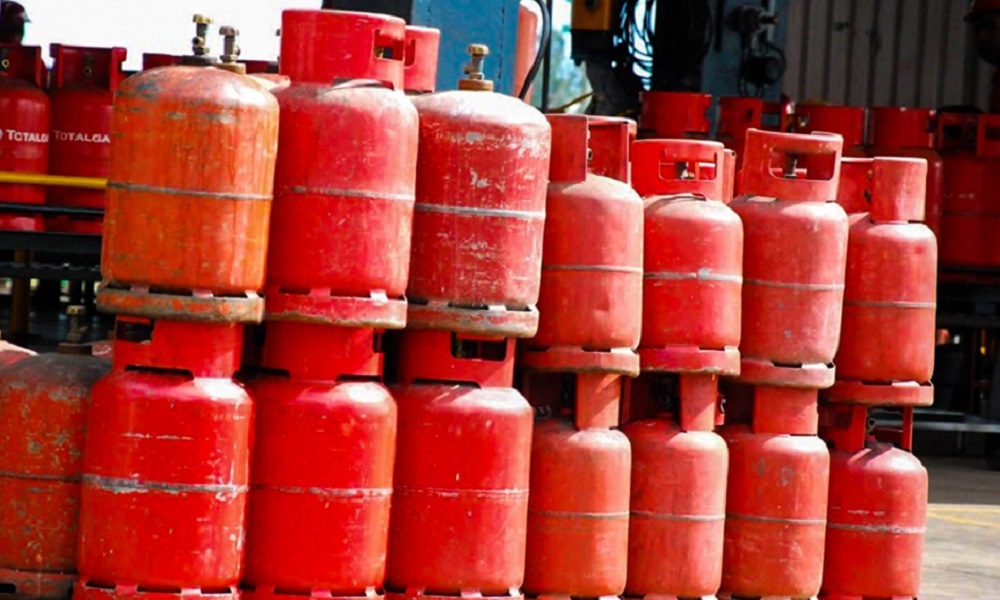
As Nigerians struggle with the high cost of petrol, the price of Liquefied Petroleum Gas, also known as cooking gas, has also increased to N1,500/kg.

But the Managing Director/Chief Executive Officer of NIPCO Plc, Suresh Kumar, said the Dangote refinery and other domestic refineries would bring down the price of cooking gas, expressing concerns that over 60 per cent of cooking gas consumed in Nigeria is being imported.
Checks by our correspondent confirmed that the prices of cooking gas peaked at N1,500/kg in some retail outlets in Ogun and Lagos States as of Sunday.

In Abuja, the average price for refilling a 12.5kg cylinder of cooking gas has increased by 41.6 per cent to N17,000 in different areas.
The PUNCH reports that the same commodity sold for N12,000 in July and N11,735 in January 2024.
This sharp price rise reflects ongoing trends in the market and may have implications for consumers, many of whom rely on LPG for their daily cooking needs.
In August, the Minister of State for Petroleum Resources (Gas), Ekperikpe Ekpo, promised to ensure a reduction in the rising cost of a kilogram of cooking gas.
Ekpo noted that he would invite the regulators and the gas producers to find ways to bring down the cost.
However, a new market survey conducted by our correspondent on Sunday revealed that the price has not decreased; instead, it has risen even further.
An analysis showed that the product currently sells for N17,000 in Lokogoma area of the FCT, an increase of 41.6 per cent from N12,000 vendors sold to customers three months ago. This means one kilogram of gas was sold for N1,400.
In Kubwa, the product was sold between N16,200 and N16,500 from N12,000 previously charged. But in the outskirt area of Bwari, Kurudu and Jikwoyi, the product sold for N1,300.
Some major distributors still sell the product between N1,300 and N1,400 depending on the location.
The Commissioner for Environment in Ogun State, Ola Oresanya, once told one of our correspondents that many might resort to charcoal for cooking if the price of LPG continues to rise.
However, speaking at the just-concluded National Conference of the Nigerian Association of Liquefied Petroleum Gas Marketers 2024, held in Lagos, Kumar, revealed that local production of LPG remains inadequate, urging the Federal Government to encourage Chevron to convert more of its propane output into propane.
“Currently, less than 40 per cent of the 1.5 million metric tonnes consumed domestically is produced locally. This is why the government must encourage companies like Chevron to convert more of their propane output into butane, which is more suitable for domestic use,” he explained.
Responding to questions about the rising cost of LPG amid a blend of local and imported supply, the managing director expressed optimism that prices would decline as domestic production improves, especially as the local refineries source crude oil locally.
“With the Dangote refinery and other refineries now sourcing crude oil in local currency, the volume of LPG produced locally is expected to increase, which will, in turn, drive down the price of the commodity,” the MD explained.
He added, “There is hope that the reliance on imported LPG will decrease, which will positively influence the prices at which the product is sold domestically. Greater local production will make LPG more affordable since it reduces exposure to foreign exchange fluctuations and international pricing dynamics.”
According to him, boosting local production would attract further investments in pipelines, storage, and bottling facilities, as well as expand retail outlets and LPG depots across Nigeria.
“Our latest assessments show that the existing downstream infrastructure is capable of handling up to 5 million MT annually. This means we are ready to accommodate increased production from both associated and non-associated gas fields within the country,” the MD said.
He urged the government to introduce incentives to encourage investments in gas processing.
According to him, NIPCO, which has been operational since 2004, initially entered the industry as a marketer of white products (petroleum fuels).
He, however, emphasised that the company’s long-term vision has always been to become a leader in the marketing and distribution of LPG.
Kumar said, “Our strategy was driven by the fact that Nigeria has over 200 trillion cubic feet of gas reserves. We believe that the country’s gas consumption must be optimised through the promotion of both LPG for domestic use and CNG for the industrial and transportation sector.”
He further emphasised the company’s investments in infrastructure, noting that NIPCO has expanded its LPG operations significantly over the years.
“In 2008, we invested in an LPG facility in Apapa with a capacity of 5,000 metric tonnes. Today, that same facility has grown to over 20,000 metric tonnes, thanks to strategic partnerships with our subsidiaries.
“We have also deployed LPG tankers and established multiple stations across Nigeria to ensure easy access to cooking gas for households nationwide,” Kumar revealed.
He further explained that while LPG is essential for homes, CNG will play a key role in powering industries and transforming the transportation sector.
The managing director added, “At the time NIPCO entered the market, Nigeria’s domestic LPG consumption was around 50,000 metric tonnes annually,” he stated.
“However, the past 16 to 17 years have been a remarkable journey. Today, the market has grown from 50,000 MT to approximately 1.5 million MT per year.”
Despite the growth, Kumar pointed out that significant potential remains untapped, saying less than 60 per cent of Nigeria’s 200 million population has embraced the use of LPG.
“Our vision is to harness these opportunities and grow the country’s LPG consumption from 1.5 million MT to levels more appropriate for a population of over 200 million people.
“We must work with the Nigerian Midstream and Downstream Petroleum Regulatory Authority and other stakeholders to end gas flaring in the country. Substantial investments are needed to capture and process flared gas to increase domestic supply beyond the current 1.5 million MT to at least 5 million MT annually,” he stressed.
The NIPCO boss acknowledged that demand for LPG in Nigeria has been relatively stagnant due to the high cost of the product.
“The current high prices have limited consumption growth, but this situation is only temporary. With more players entering the gas processing sector, we anticipate a market correction soon,” he stated, believing that the market would stabilise in the long run.
He urged the Federal Government to support local refineries, including the Dangote Refinery, to boost domestic gas production.
“It is crucial for the government to back these refineries in their efforts to significantly increase LPG output. This will drive down retail prices and make the product more accessible to Nigerians,” he posited.
Credit: PUNCH

News
2025 Capital Budget Gets New Lease of Life as Reps Push Deadline to September
By Gloria Ikibah
The House of Representatives has approved a three-month extension of the implementation period for the capital component of the 2025 Appropriation Act, shifting the deadline from June 30 to September 30, 2026.
The decision was taken during an emergency sitting held on Monday, as lawmakers moved swiftly to ensure the continued execution of capital projects captured in the national budget.
The legislation, which seeks to amend the Appropriation (Repeal and Enactment) Act, 2025, was designed to provide additional time for Ministries, Departments and Agencies to complete ongoing projects and fully utilise funds earmarked for capital expenditure.
In an unusually rapid legislative process, the bill passed through its first, second and third readings during the same plenary session after members suspended the relevant provisions of the House Standing Orders to facilitate its consideration.
Leading debate on the general principle of the bill, House Leader, Rep. Julius Ihonvbere, said the extension was necessary as several capital projects captured in the 2025 budget had not been fully implemented.
He emphasised that the amendment was not intended to alter any provision of the budget but merely to extend its lifespan by three months to allow ongoing projects to be completed.
He said: “It is very straightforward. Because some aspects of the capital appropriation will not be fully implemented, if we do not extend the life of this particular law, it will have a very grave impact on the growth and development of the national economy.
“The purpose essentially is to extend the lifespan. We are not touching any part of the law. It is simply extending the lifespan from June 30, 2026 to September 30, 2026. I urge my colleagues to approve this so that we can continue with the work of developing and growing our economy and country”.
Presiding over the session, Speaker of the House, Rep. Abbas Tajudeen, acknowledged that the records provided by the Chairman House Committee on Appropriations and other relevant agencies revealed that implementation of the capital budget was yet to be completed.
“As you are aware, the 2025 budget was extended to June 30. From the records we received from the Chairman, Appropriations, and other relevant quarters, it is yet to be fully implemented. It is therefore in the best interest of this country and the National Assembly for us to extend the budget to September 30 to enable the Federal Government fulfil its obligations under the 2025 budget,” the Speaker said.
Following the adoption of the bill at second reading, the House dissolved into the Committee of Supply where it had the clause by clause consideration of the bill, and approved the three clauses, explanatory memorandum and long title of the bill.
The committee subsequently reported back to plenary, where lawmakers adopted its recommendations and suspended House rules to allow the bill to be read a third time and passed the same day.
The accelerated passage reflects growing concern over the pace of implementation of key infrastructure and development projects, many of which require additional time to reach completion.
With the approval, government agencies now have until the end of September to execute projects funded under the capital component of the 2025 budget, a move expected to prevent disruptions to ongoing works and improve budget performance.
The extension is also aimed at ensuring that resources already allocated for development projects are effectively utilised before the capital budget expires.
With the passage of the amendment, federal ministries, departments and agencies now have an additional three months to implement capital projects and utilize funds appropriated under the 2025 budget.
Meanwhile, the House also announced changes in the leadership of some standing committees.
The appointments are as follows:
• Rep. Ali Madaki – Chairman House Committee on Special Duties
• Rep. Ali Isa J.C. – Chairman House Committee on Shipping Services,
• Rep. Pascal Agbodike – Chairman House Committee on Small and Medium Enterprises Development Agency of Nigeria (SMEDAN),
• Rep. Kelechi Nwogu – Chairman House Committee on Hydrological Services
The Speaker urged the newly appointed committee chairmen to assume their responsibilities immediately and bring their legislative experience to bear in advancing the work of the House.
News
Day 4 of projects commissioning as President TInubu set to commission newly constructed Court of Appeal Building
President Tinubu will commission the newly constructed Court of Appeal (Abuja Division) Building today, 15/6/26 as FCT projects commissioning enters Day 4.
#FCTProjects2026
#RenewedHopeFCT
News
Cholera Outbreak: Plateau Records 5 Deaths, 11 Confirmed Cases
Plateau State commissioner for Health, Dr Nicholas Baamlong, has revealed that the state recorded 11 confirmed cases of cholera, five deaths and 53 suspected cases.
Baamlong, who disclosed this to journalists yesterday in Jos, said the confirmed and suspected cases were reported in Pushit, Mangu 1 and Mangu 2 communities in Mangu local government area (LGA).
According to him, the state Ministry of Health is intensifying public health interventions to contain the outbreak, prevent further spread and reduce its impact on affected communities.
He explained that the state had taken decisive actions to control the outbreak and protect its citizens via the deployment of additional Response Teams (RRTs) to the affected wards, scaling up of treatment centres and isolation capacity and the emergency procurement of Rapid Diagnostic Tests Kits, intravenous fluids and essential drugs.
The Commissioner further said that the ministry had activated an Incident Management System (IMS), for a comprehensive and multi sectorial response to the outbreak.
“The activation of the IMS ensures a coordinated, efficient, and accountable response structure in line with national and international emergency response frameworks,” he said.
Baamlong explained that cholera was an acute diarrhoeal disease caused by consuming food or water contaminated with the bacterium Vibrio cholerae.
He urged residents of Mangu LGA and neighbouring communities to remain vigilant and take preventive measures, including drinking safe water, maintaining proper hand hygiene, avoiding open defecation, and ensuring proper waste disposal.
He also advised residents to promply report suspected cases of cholera to the nearest healthcare facility for immediate attention.
While reaffirming the state government’s commitment to safeguarding the health and well-being of residents, Baamlong called on development partners and other stakeholders to support ongoing response efforts.(NAN)
-
Foreign23 hours agoHormuz to reopen on Sunday after US-Iran sign deal-Trump
-
Crime23 hours agoNDLEA nabs businessman with 6.10kg cocaine starched in shirts, towels from Brazil+Photos
-
Sports23 hours agoPSG’s Barcola hands over transfer request as Aresenal, Liverpool show interest
-
Sports18 hours agoReal Madrid complete a Shocking Signing of Chelsea Superstar
-
Politics23 hours agoNew Delta Vision not a political project, but generational movement, Delta State’s ADC candidate Unuafe clarifies
-
News22 hours agoECOWAS Parliament Convenes High-Level Dakar Summit to Drive Renewable Energy Push in Rural West Africa
-
News21 hours agoDeputy Speaker Pushes for Home-Grown Defence Industry, Stronger Financial Crackdown on Insecurity
-
Opinion21 hours agoChinese Miners Are Not the Architects of Nigeria’s Banditry A Response to Farooq A. Kperogi’s “How Chinese Miners Fuel Nigeria’s Terrorist Banditry”

Warning: Undefined variable $user_ID in /home/naijuinz/public_html/wp-content/themes/zox-news/comments.php on line 49
You must be logged in to post a comment Login