
Economy
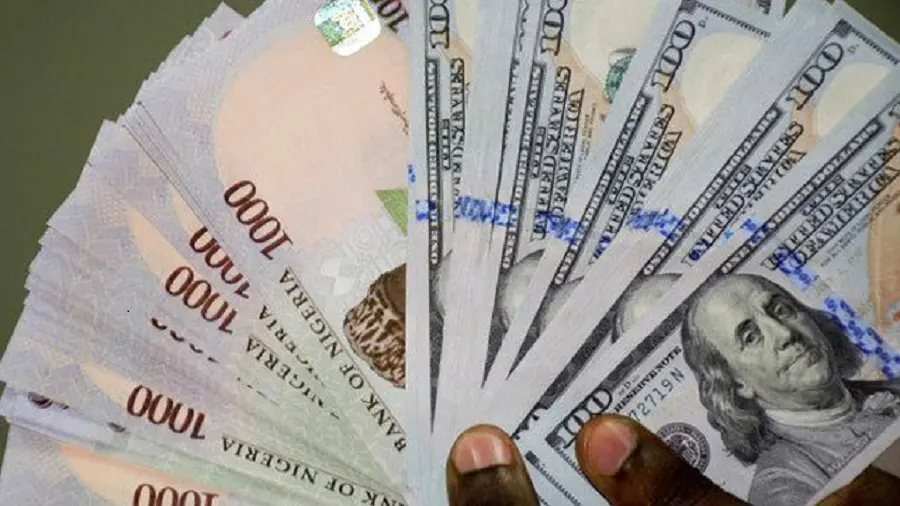
SEE Black Market Dollar To Naira Exchange Rate Today 13th January 2025

- /home/naijuinz/public_html/wp-content/plugins/mvp-social-buttons/mvp-social-buttons.php on line 27
https://naijablitznews.com/wp-content/uploads/2024/04/Naira.webp&description=SEE Black Market Dollar To Naira Exchange Rate Today 13th January 2025', 'pinterestShare', 'width=750,height=350'); return false;" title="Pin This Post">
- Share
- Tweet /home/naijuinz/public_html/wp-content/plugins/mvp-social-buttons/mvp-social-buttons.php on line 72
https://naijablitznews.com/wp-content/uploads/2024/04/Naira.webp&description=SEE Black Market Dollar To Naira Exchange Rate Today 13th January 2025', 'pinterestShare', 'width=750,height=350'); return false;" title="Pin This Post">


The Dollar to Naira exchange rate remains a critical indicator of Nigeria’s economic landscape, reflecting persistent challenges in the country’s foreign exchange market.
As of January 13, 2025, here is the latest update on the official exchange rate and the black market rate, alongside an analysis of current market trends.
Current Exchange Rates
Official Exchange Rate (CBN)
₦1,542/$1 – This is the Central Bank of Nigeria’s (CBN) rate used for official transactions through authorized channels.
Black Market (Parallel Market) Rate
Buying: ₦1,647/$1
Selling: ₦1,656/$1
The black market rate continues to reflect the realities of supply and demand outside the formal financial system.
Market Analysis and Trends
The gap between the official rate and the parallel market rate underscores ongoing pressures in the forex market. Despite the CBN’s policies to stabilize the naira, the demand for dollars in the black market remains high, driven by limited supply and speculative activities.
Key Factors Affecting the Dollar to Naira Exchange Rate
Limited Dollar Supply: Restricted access to forex through official channels pushes many businesses and individuals to the black market.
Import Dependency: Nigeria’s reliance on imports creates a consistent demand for dollars.
Inflationary Pressures: Rising inflation erodes the naira’s purchasing power, increasing demand for the more stable U.S. dollar.
Speculation: Traders hoard dollars in anticipation of higher rates, fueling further volatility.
CBN Policies and Interventions
The CBN has implemented several measures to stabilize the naira, including:
Forex Restrictions: Limiting access to dollars for non-essential imports to conserve reserves.
Promoting Export Earnings: Encouraging non-oil exports to generate forex inflows.
Diaspora Remittance Incentives: Streamlining remittance channels to boost dollar supply.
Despite these efforts, the significant disparity between the official and parallel market rates persists, pointing to structural challenges within the economy.
Economic Impact
The high Dollar to Naira exchange rate in the black market has far-reaching consequences:
Rising Costs: Importers pay a premium for dollars, leading to higher consumer prices.
Volatility in Investments: Uncertainty over exchange rates complicates business planning and investment decisions.
Debt Burden: Dollar-denominated debts become more expensive to service as the naira weakens.
Outlook for the Naira
Experts predict that the Dollar to Naira exchange rate will remain volatile unless Nigeria boosts its forex reserves, reduces dependency on imports, and strengthens non-oil export revenues. Long-term stability will require structural reforms and targeted economic policies.
Dollar to Naira Rate at a Glance
Exchange Rate
Value (₦)
CBN Official Rate
1,542
Black Market Buying Rate
1,647
Black Market Selling Rate
1,656
Conclusion
The Dollar to Naira exchange rate today, January 13, 2025, highlights the challenges facing Nigeria’s forex market. While the CBN rate offers a regulated framework, the black market continues to reflect market-driven dynamics. Staying informed is essential for businesses and individuals navigating this complex economic environment.










The United Kingdom has introduced new restrictions on a chemical commonly used in some gel nail polishes amid concerns over its potential impact on fertility and reproductive health.
The restriction targets trimethylbenzoyl diphenylphosphine oxide, commonly known as TPO, a photoinitiator that enables gel polish to harden when exposed to UV light and helps improve its durability and colour retention.
Under the new rules, which took effect on Saturday across England, Wales and Scotland, manufacturers are no longer permitted to place new TPO-containing cosmetic products on the UK market.
However, beauty salons have been given until February 14, 2027, to stop using existing products containing the chemical, meaning customers could still encounter TPO-based gel polishes during the transition period.
The move follows concerns arising from animal studies that have linked TPO exposure to possible reproductive and fertility problems. The European Union introduced a similar prohibition in September 2025.
The restrictions have nevertheless attracted debate within the cosmetics industry. The Cosmetic, Toiletry and Perfumery Association has maintained that the concentration of TPO used in nail products is significantly lower than levels associated with harmful effects.
The UK decision is therefore expected to intensify discussions within the beauty industry over whether precautionary restrictions should take priority where potential reproductive risks remain under investigation.

Investors in the Nigerian stock market recorded a cumulative loss of N5.45 trillion as the equities market extended its bearish run to an eighth consecutive session at the close of trading session on Thursday night, August 20..
Equities listed on the Nigerian Exchange Limited, NGX, have continued to experience significant declines since Tuesday, August 11, 2026 but last week, investors on the NGX lost N3.8 trillion in four consecutive bearish sessions.
From Monday to Thursday this week, stocks on the NGX have lost a total of N1.65 trillion meaning that the combined losses recorded over the last eight trading sessions amounted to N5.45 trillion, wiping out previous gains in the market.
The market extended its bearish run on Thursday as investors lost N440 billion, driven by continued profit-taking in large- and mid-cap stocks.
Market capitalisation declined by 0.30 per cent, or N440 billion, from N155.417 trillion at the opening of trading to N154.977 trillion at the close.

The Naira yesterday depreciated to N1,405 per dollar in the parallel market from N1,400 per dollar on Wednesday.
But the naira appreciated to N1,347.5 per dollar in the Nigerian Foreign Exchange Market, NFEM.
Data from the Central Bank of Nigeria, CBN, showed that the indicative exchange rate for the naira fell to N1,347.5 per dollar from N1,351 per dollar on Wednesday, indicating N3.5 appreciation for the naira.
Consequently, the margin between the parallel and official markets widened to N57.5 per dollar from N49 per dollar on Wednesday.
The interbank turnover at NFEM rose by 0.22 percent to N371.8 million yesterday from N370.98 million the previous day.

Fresh twist as Coordinator of fake agency releases appointment letter bearing OSGF letterhead

Navy, Army smash illegal refineries, arrest three in Imo, Rivers raids

How fake agency secured SGF office, built nationwide network – ICPC




-

 News21 hours ago
101-year-old great grandma nabbed as NDLEA intercepts cocaine in fufu (Photos)
-

 News20 hours ago
Unleashing unusual loyalty: Edo APC chairman, Tenebe, reportedly threatens to ‘kpai’ critics over FB post on Gov Okpebholo
-

 Sports20 hours ago
FIFA releases 2027 Women’s World Cup playoff fixtures-See List
-

 News15 hours ago
Iranian hackers ‘shut down British power plant for four days’
-

 News20 hours ago
CCTV Captures Armed Robbery Suspects at Benin City Hair Shop, Luxury Wigs Worth Millions Stolen
-

 News17 hours ago
BALLOT BOX NIGERIA TV REALITY SHOW: Nigeria’s Biggest Democratic Reality Television
-
 News15 hours ago
BREAKING: 200 members dump APC, join ADC in Niger
-

 News21 hours ago
2027: Akwa Ibom APC/PDP, Others, Collapse Structures For Tinubu, Akpabio and Eno
Warning: Undefined variable $user_ID in /home/naijuinz/public_html/wp-content/themes/zox-news/comments.php on line 49
You must be logged in to post a comment Login