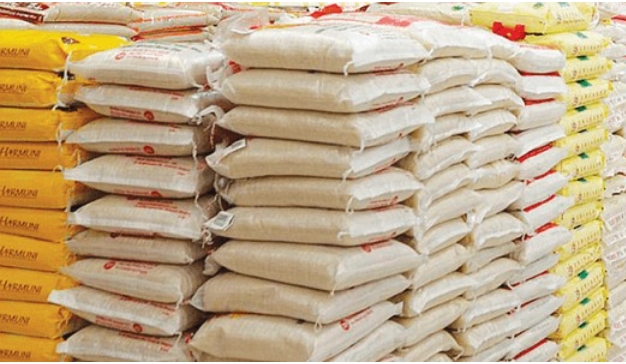
The Central Bank of Nigeria, CBN, and Rice Farmers Association of Nigeria made history on January 18, 2022, when they co-launched the Rice Pyramids on the premises of Abuja Chamber of Commerce and Industry, strategically located on Airport Road, Abuja, Nigeria’s capital city


It was a celebration of success in the production of rice, Nigeria’s number one staple food. Rice production had been specifically targeted by the CBN, then under the leadership of Mr. Godwin Emefiele, through the Anchor Borrowers Programme, ABP, an initiative through which the CBN expressed determination to assist Nigerians grow their food, rather than spending scarce foreign exchange (FX) on the importation of food items that can be produced in the country.
As the then CBN governor put it, the rice pyramids were a demonstration of “the courage and persuasion of our farmers and the conviction that it is still possible to do great things in our country.” 
The CBN also rallied rice millers, under the umbrella of Rice Processors Association of Nigeria, RIPAN, which saw many people massively investing in rice mills across the country. The result was that there was not only abundant production of rice paddy by the farmers, there also were massive rice mills across the nation to off-take, mill and supply to the market highly processed, nutritious rice in the country.
“That is what strongly motivated the rice showboat in Abuja,” as one commentator put it.
The Rice Pyramid celebration happened exactly three years ago. The Anchor Borrowers Programme catalysed the rural economy by building a sustainable framework for financing small-holder farmers in Nigeria.
It developed an ecosystem among all nodes of the agricultural value chain, with linkages optimized through synergy among all stakeholders.
CBN data showed that as at the end of December 2021, the ABP had financed 4.489 million farmers that cultivated 5.300 million hectares across 21 commodities through 23 participating financial institutions in the 36 states of the federation and the FCT.
The success of the CBN initiative was evident in the crash of imported rice. Thailand alone exported 1.3 million metric tons of rice to Nigeria in 2014.
The ABP was launched in 2015 to curtail these imports. The outcome of the programme was instant and by 2016, rice imports from Thailand had fallen to only 58,000 metric tons.
As at the end of 2021, Thailand exported only 2,160 metric tons to Nigeria, thereby saving the nation foreign exchange and helping preserve jobs in Nigeria.
National rice output ramped up from about 5.4 million metric tons in 2015 to over 9 million metric tons in 2021.
This was made possible by the massive public and private investments as the number of integrated rice mills grew astronomically from six in 2015 to over 50 in 2021.
A 50-kg bag of rice was sold at an average price of about N8,500 in 2015, rose to about N26,000 in 2020 and by November 2021, it had risen to an average of N32,000.
As at December 2023, a 50-kg bag of rice sold at an average of N47,000 but 2024 closed with the same bag selling for between N95 and N105,000.
What went wrong?
Effects of policy somersaults, insecurity and naira devaluation
It is obvious that upon inauguration, President Bola Tinubu recognised challenges posed by the skyrocketing food prices. That was why early in his administration, he declared emergency on food security in July 2023.
One year after, it was clear that the declaration of emergency on food security did not yield the desired results and food inflation remained on the upward trajectory.
Hunger became more widespread across the country and this led the Federal Government to announce another initiative to tackle the problem.
In July 2024, the government approved a 150-day duty-free window to allow importation of maize, husked brown rice, and wheat as part of measures to combat rising food inflation across the country.
The initiative was based on the implementation of the Presidential Accelerated and Stabilisation Advancement Plan.
In addition to these measures, government’s food security strategy included establishment of a guaranteed minimum price, GMP, for key agricultural products, aimed at stabilizing prices and supporting local farmers.
Another component of the strategy is a focus on boosting agricultural productivity among smallholder farmers in preparation for the 2024/2025 planting season, as well as promoting the production of fortified foods to address micro-nutrient deficiencies among Nigerians.
However, despite the optimistic outlook presented by these policies, the effectiveness of the measures in curbing food inflation has been questioned.
While some experts argue that the tariff moratorium and related policies could help reduce food prices, others have raised concerns about the potential negative impact on local agricultural producers.
Critics argue that by making imported food cheaper, local farmers could face increased competition, thereby reducing their market share and profitability during the duty-free period.
One of the most vocal critics of the government’s reliance on food imports is Dr. Akinwumi Adesina, President of the African Development Bank, AfDB.
Dr. Adesina warned that Nigeria’s increasing dependency on food imports could undermine the country’s agricultural policies and threaten long-term economic stability.
He advocated a greater focus on improving domestic food production, reducing reliance on imports, and ensuring that agricultural policies are aligned with the goal of achieving long-term food security.
Rising food inflation in Nigeria
The issue of food inflation in Nigeria has been a persistent challenge, exacerbating the already difficult economic conditions faced by millions of Nigerians.
According to the most recent Consumer Price Index, CPI, report from the National Bureau of Statistics, NBS, food inflation in Nigeria reached a staggering 39.93 per cent in November 2024, a significant increase from 32.84 per cent recorded in the same period the previous year.
This sharp rise in food prices has placed a heavy burden on households, with many Nigerians struggling to afford basic food items.
The NBS report highlights that prices for staple foods, such as yam, rice, maize, and palm oil, have surged, contributing to the overall increase in food inflation.
Other essential food items, including guinea corn, millet, and meat, have also experienced notable price hikes, further exacerbating the cost-of-living crisis in the country.
In fact, in 19 states, including the capital city, Abuja, food inflation rates have surpassed 40 per cent, significantly impacting the purchasing power of millions of Nigerians.
The zero-tariff food import initiative was not effectively implemented. It was planned to end in December, 2024. However, there had been no clear reports of those given approval to undertake the importation of the rice, maize and other items captured in the initiative.
The Minister of Finance and Coordinating Minister of the Economy, Mr. Wale Edun, at the presidential policy implementation briefing and citizens’ engagement in December last year, revealed that about 50,000 tons of wheat and rice had been imported under the initiative. Another 32,000 tons of husk rice was reportedly brought into the country from Thailand. The rice arrived in Lagos, facilitated by DUCAT Logistics Company, which played a key role in ensuring the successful delivery.
DUCAT confirmed that the rice was part of this initiative, designed to increase food availability and reduce the pressure on local food prices.
Adrian Beciri, the CEO of DUCAT, said: “Nigeria has been working tirelessly to identify and implement solutions that will expand and strengthen its food supply chain, making food more accessible to the population.”
The total volume of the affected items to be imported and those involved remain unclear. What is clear is that about three years ago, Nigeria proudly announced it was nearing becoming not only self-sufficient in rice production but also close to becoming an exporter of the commodity.
But today, the story has changed; Nigeria is now importing rice.
Good-spirited members of the Nigerian public are asking questions on what happened that Nigeria would showcase high rice productivity, boasting it was approaching being a net-exporter of rice only three years ago and now importing rice?
Nigeria’s rice production, availability, and affordability Stakeholders in the rice value-chain have expressed their views on what could be done to change the narrative and for rice to be on the plates of Nigerians at a relatively cheaper price
Insecurity, high exchange rates bedevil rice production, affordability — Millers
The National President, Rice Millers Association of Nigeria, Peter Dama, while giving an overview of current rice production, put paddy production in 2024 at about 8.1 million metric tons.
He identified insecurity and high exchange rates as key factors militating against players in the rice sub-sector.
He said: “According to various sources of data on rice production in 2024, Nigeria’s paddy rice production is estimated at about 8.1 million metric tons, which is a slight decline from previous years, such as 2021, when production was at its peak, resulting in 8.4 million metric tons as contained in the report of the Food and Agriculture Organisation, FAO, in 2023.”
Speaking further, he maintained that Nigeria’s potential to produce rice for her citizens is high, based on available land and human resources and that the country could achieve higher yield as there is an estimated cultivable area of about 4.9 million hectares. Only about 1.7 million hectares have been used for rice farming.
On the current availability of rice in the market, he said: “Based on sources, the demand for rice in 2023 was pegged at 6.5 million metric tons but current local production meets only 57 per cent of the national demand.
It is estimated that due to the increase in population, the annual demand for rice in Nigeria by 2024 might have increased to about 10 million metric tons per annum.
“Issues affecting the cost of rice; huge gap between demand and supply can drive up the prices, and more demand chasing fewer supply results in high pricing and inflation.
“High cost of inputs and labour caused the increase in the cost of production which must be transferred to pricing, escalating the sales price of domestically produced rice.
“Nigeria’s current currency floating that resulted in hyper devaluation was a key cause of price escalation as inputs imported now are too expensive, thereby affecting the prices of locally produced goods, especially food produce.”
He also highlighted factors hindering rice production to include “insecurity due to ongoing violence which disrupts farming activities and rising cost of inputs, especially fertilisers.
“Climate change that comes with unpredictable rain, flooding, and elongated drought during rainy season production; fluctuating government policies on agricultural financing; lack of irrigation facilities, which can enhance yield, due to production under controlled environment and water management.
“Rice supply in Nigeria is not adequate. Based on several factors, Nigeria has not been able to meet its rice supply sufficiency through its domestic production.
“Key issues are low yield, poor mechanization, inadequate and inaccessibility of inputs by farmers, lack of adequate financing, insecurity, poor irrigation facilities, and others.
“It has been revealed through a survey that Nigeria has over 10 million metric tons of installed rice milling capacity, made up of about 83 integrated large-scale mills with total milling capacity of 6 million metric tons per annum, and over 100,000 units of small and medium enterprise mills.
“Unfortunately, due to the above listed constraints, the mills are operating at less than 45 per cent for large scale and less than 50 per cent for SMEs mills, mainly due to non-sustainable supply of raw material (paddy rice).”
However, he made some basic recommendations as panacea to the rice situation, saying there was need for “holistic review of the production system in Nigeria, with huge government developmental and private sector investments in irrigation infrastructure.
“Enhancing security in agricultural zones; implementing subsidy programmes for inputs (fertiliser) and mechanization facilities, especially land preparation and irrigation facilities; market regulation on prices to prevent exploitation during periods of scarcity.
“Deliberate promotion of climate-smart agricultural production innovations; research for high-yielding resilient seeds, renewable energy-powered irrigation, and others.”
Limiting factors slow down govt’s effort towards husked rice importation — AFAN
In an interview, the National President, All Farmers Association, Arc. Kabir Ibrahim, said there are limiting factors that had slowed down government’s effort towards importation of husked rice, hence rice was not adequately available for Nigerians.
Ibrahim said: “Nigerian rice is fairly available but costly due to cost of production, distribution and corruption. It is definitely not adequately available, if truth be told.
“The cost and availability of paddy to the millers is responsible for the seeming scarcity which is predicated on the activities of the so-called prime anchors involved between 2016 and 2021.
“The demand for rice is very high in Nigeria because Nigerians have inadvertently made it the most important staple, as such it appears grossly inadequate for our population.
“The production of rice is restricted mostly to areas with a lot of water and where some irrigation activities take place. Therefore, it is really inadequate for our large population.
“The high cost of rice is attributable to production cost, processing cost, distribution/transportation costs and unscrupulous trading.
“Government, by opening the importation of food items, including husked rice, attempted to bring down food inflation but due to many reasons, it has not been successful largely because the importers had weak financial muscle and those who had capacity and licences were simply rookies or money launderers.
“Some bureaucratic bottlenecks also slowed down the whole process as seen by the blame game in the social media between the Customs and Ministry of Finance.
“The best way out is to incentivise real producers and farmers to produce massively and prevent smuggling decisively.
“Production can be optimized by automation and sustainable investments, by giving cheap and readily accessible credit to duly identified producers and farmers alike.
“Above all, a rice policy to ensure institutional reforms, covering production, processing, storage, distribution, marketing and consumption, must be transparently promulgated.”
Time for regional approach to rice self-sufficiency in Nigeria — EA Daniels Farm
Speaking with deep concern as a rice farmer and Chief Executive Officer of EA Daniels Farm, Engr. Daniel Ijeh, said national policies often failed to leverage regional advantages as states and local governments were not really keying into rice production, in partnership with the private sector.
Ijeh said: “Rice, a staple food in most Nigerian households, has become a source of concern due to its skyrocketing price. The primary cause of this price surge is the persistent low supply of locally produced rice, which has failed to meet growing demand.
“For years, discussions around achieving self-sufficiency in rice production have centered on a national approach.
“However, this strategy has yielded little success. It is time to shift the conversation toward a regional or state-focused approach to self-sufficiency in rice production.
“Nigeria’s diverse ecological zones offer unique opportunities for rice cultivation, but national policies often fail to leverage these regional advantages. States like Delta, with abundant rainfall and fertile lands, remain underutilised for rice farming.
“Similarly, local governments which are closer to the grassroots have not been adequately mobilised to address this pressing issue.
“The high cost of rice today presents an opportunity for private and public sector stakeholders to rethink their strategies.
“A regional approach would involve harnessing the unique strengths of each state and empower local governments to drive rice production initiatives. Such a model encourages localised solutions, reduces logistical challenges and increases the supply of rice in the market.
“Take Delta State as an example. With abundant rainfall and fertile soil, it has immense potential to become a rice production hub. Yet, both the government and private investors have not made significant investments in this area.
“If Delta and other states with similar potential were to prioritize rice farming, it could significantly increase the nation’s rice supply and reduce the cost of this essential commodity.
“The roles of the private sector and government are critical in this endeavour. The private sector can invest in mechanized farming, processing facilities, and distribution networks, while state and local governments can provide enabling environments through subsidies, access to land, and infrastructure development.
“Partnerships between these stakeholders can transform rice farming into a profitable and sustainable venture.
“Local governments must also play an active role in mobilising communities and smallholder farmers. They should provide training, access to improved seedlings, fertilisers, and modern farming techniques. These grassroots efforts can ensure that every farmer, no matter their scale, contributes to the rice value chain.
“The rising cost of rice is a wake-up call that Nigeria can no longer ignore. The solution lies in addressing the root cause: the very low supply of locally produced rice.
“Achieving self-sufficiency requires a paradigm shift from centralized planning to decentralized, regionally-driven initiatives.
“The question we must now ask is this: what are individual states and local governments doing to ensure Nigeria becomes self-sufficient in rice production? It is time for every state and local government to take responsibility, recognise the economic potential in rice farming, and invest in this sector.
“The time for action is now. By adopting a regional approach and partnering with agricultural experts, Nigeria can transform itself into a global rice powerhouse.”
Lagos steps up actions toward food security
In response to the national food security crisis, Lagos State Government has taken some proactive steps to ensure a steady supply of food for its growing population.
Governor Babajide Sanwo-Olu recently spoke about his administration’s efforts to build a robust food security system, focusing on the creation of large-scale food logistics infrastructure and strategic collaborations with food-producing states.
One of the most ambitious projects underway is the development of what is set to become the largest food logistics hub in sub-Saharan Africa.
Located in Ketu-Ejinrin, the hub will serve as a critical node in the food supply chain, facilitating the storage and distribution of food products across the region.
He said: “This hub will play a pivotal role in improving food sufficiency and security in Lagos State. We aim to have off-take agreements with food-producing states and create large
warehouses that can store both dry and cold-chain food products.
This will ensure that Lagos, despite not being a major food producer itself, has access to a consistent supply of affordable food.”
The governor noted that the state had been working closely with states such as Niger, Kwara, Nasarawa, and Kogi, to ensure a reliable supply of food products.
He said due to a shortage of local paddy towards the end of last year, Lagos had to import brown rice, which helped stabilise prices during the Yuletide season.
“With the rice mill and food logistics hub in operation, we are confident that the prices of key food items, especially rice, will remain stable and even drop in the coming months,” he added.
Challenges, developments in local food production
Despite these promising developments, Lagos State has faced challenges in achieving optimal rice production, according to Dr. Oluwarotimi Fashola, Special Adviser to the governor on agriculture and food systems.
He explained that the Imota Rice Mill, which began operations in 2022, has not been able to operate at full capacity due to scarcity of paddy.
“Most of our rice-producing partners are not fully operational. Niger State is the only one that is consistently functional. As a result, we have had to source rice from the open market, but we are still able to meet demand,” Dr. Fashola said.