Economy
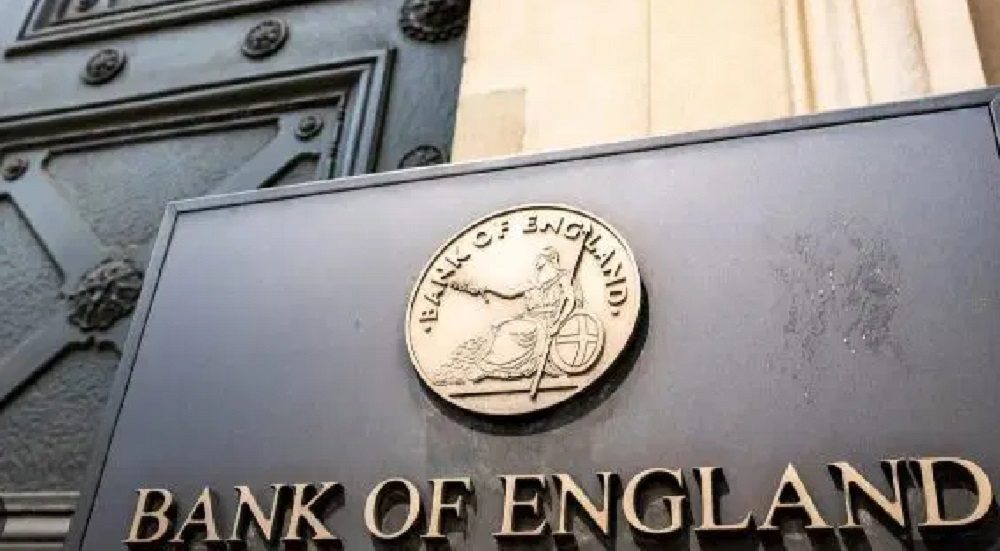
Bank of England cuts interest rate to 4.5%
- /home/naijuinz/public_html/wp-content/plugins/mvp-social-buttons/mvp-social-buttons.php on line 27
https://naijablitznews.com/wp-content/uploads/2025/02/Bank-of-England.jpg&description=Bank of England cuts interest rate to 4.5%', 'pinterestShare', 'width=750,height=350'); return false;" title="Pin This Post">
- Share
- Tweet /home/naijuinz/public_html/wp-content/plugins/mvp-social-buttons/mvp-social-buttons.php on line 72
https://naijablitznews.com/wp-content/uploads/2025/02/Bank-of-England.jpg&description=Bank of England cuts interest rate to 4.5%', 'pinterestShare', 'width=750,height=350'); return false;" title="Pin This Post">
The Bank of England, on Thursday, reduced its key interest rate by a quarter point to 4.5 percent to help support weak British growth even if UK inflation stays elevated.

“We’ll be monitoring the UK economy and global developments very closely and taking a gradual and careful approach to reducing rates further,” governor Andrew Bailey said following the expected decision.
“It will be welcome news that we have been able to cut interest rates again today.

“We’ll be monitoring the UK economy and global developments very closely and taking a gradual and careful approach to reducing rates further.”
The details of the rate cut is on the Bank’s website, titled, “Bank Rate reduced to 4.5% – February 2025.”
According to the Bank, “At its meeting ending on 5 February 2025, the Monetary Policy Committee, MPC, voted by a majority of 7–2 to reduce Bank Rate by 0.25 percentage points, to 4.5%.
“Two members preferred to reduce Bank Rate by 0.5 percentage points, to 4.25%.
“There has been substantial progress on disinflation over the past two years, as previous external shocks have receded, and as the restrictive stance of monetary policy has curbed second-round effects and stabilised longer-term inflation expectations.
“That progress has allowed the MPC to withdraw gradually some degree of policy restraint, while maintaining Bank Rate in restrictive territory so as to continue to squeeze out persistent inflationary pressures.
“CPI inflation was 2.5% in 2024 Q4. Domestic inflationary pressures are moderating, but they remain somewhat elevated, and some indicators have eased more slowly than expected.
“Higher global energy costs and regulated price changes are expected to push up headline CPI inflation to 3.7% in 2025 Q3, even as underlying domestic inflationary pressures are expected to wane further.
“While CPI inflation is expected to fall back to around the 2% target thereafter, the Committee will pay close attention to any consequent signs of more lasting inflationary pressures.”
Economy
Again, NNPC jerks up price of fuel
The Nigerian National Petroleum Company Limited (NNPCL) has increased the price of petrol at its retail stations in Abuja and nearby areas from ₦1,250 to ₦1,270 per litre.
The Genius Media Nigeria understands that the latest adjustment means customers buying Premium Motor Spirit (PMS) from NNPCL stations now pay ₦20 more for each litre than they did previously.
According to report, retailers such as MRS, Geregu, Ranoil, Emedab and Mobil are selling below the new NNPCL price.
MRS stations adjusted their price upward by ₦20, but their petrol was still being sold at about ₦1,230 per litre. This leaves a ₦40 difference between the MRS price and the new NNPCL rate.
However, not all filling stations are selling below NNPCL.
Some outlets, including Empire and AA Rano, were reported to be charging between ₦1,275 and ₦1,299 per litre, putting their prices above the state-owned company’s latest rate.
The latest NNPCL price also comes as international crude oil prices have been moving lower.
Brent crude was trading around $88.80 per barrel, while West Texas Intermediate (WTI) stood at about $81.86 per barrel at the time of the report.
In other news, the leadership of the Nigerian National Petroleum Company Limited (NNPC Ltd.) and the Nigerian Upstream Petroleum Regulatory Commission (NUPRC) have been commended for “remarkable progress” in restoring confidence, increasing production and attracting fresh investment into Nigeria’s oil and gas sector.
The Citizens Forum for Energy Accountability and Development (CFEAD) said the recent achievements announced by NNPC Group Chief Executive Officer, Bayo Ojulari, and NUPRC Commission Chief Executive, Oritsemeyiwa Eyesan, demonstrated that sustained institutional reforms and stronger operational discipline could reposition the petroleum industry as a major driver of economic growth.
Economy
UK Moves Against Chemical in Gel Nail Products Over Reproductive Health Concerns
The United Kingdom has introduced new restrictions on a chemical commonly used in some gel nail polishes amid concerns over its potential impact on fertility and reproductive health.
The restriction targets trimethylbenzoyl diphenylphosphine oxide, commonly known as TPO, a photoinitiator that enables gel polish to harden when exposed to UV light and helps improve its durability and colour retention.
Under the new rules, which took effect on Saturday across England, Wales and Scotland, manufacturers are no longer permitted to place new TPO-containing cosmetic products on the UK market.
However, beauty salons have been given until February 14, 2027, to stop using existing products containing the chemical, meaning customers could still encounter TPO-based gel polishes during the transition period.
The move follows concerns arising from animal studies that have linked TPO exposure to possible reproductive and fertility problems. The European Union introduced a similar prohibition in September 2025.
The restrictions have nevertheless attracted debate within the cosmetics industry. The Cosmetic, Toiletry and Perfumery Association has maintained that the concentration of TPO used in nail products is significantly lower than levels associated with harmful effects.
The UK decision is therefore expected to intensify discussions within the beauty industry over whether precautionary restrictions should take priority where potential reproductive risks remain under investigation.
Economy
Nigerian Stock Market Crashes For 8th Straight Session As Investors Lose Whopping N5.45tn
Investors in the Nigerian stock market recorded a cumulative loss of N5.45 trillion as the equities market extended its bearish run to an eighth consecutive session at the close of trading session on Thursday night, August 20..
Equities listed on the Nigerian Exchange Limited, NGX, have continued to experience significant declines since Tuesday, August 11, 2026 but last week, investors on the NGX lost N3.8 trillion in four consecutive bearish sessions.
From Monday to Thursday this week, stocks on the NGX have lost a total of N1.65 trillion meaning that the combined losses recorded over the last eight trading sessions amounted to N5.45 trillion, wiping out previous gains in the market.
The market extended its bearish run on Thursday as investors lost N440 billion, driven by continued profit-taking in large- and mid-cap stocks.
Market capitalisation declined by 0.30 per cent, or N440 billion, from N155.417 trillion at the opening of trading to N154.977 trillion at the close.
-
Sports21 hours agoUsain Bolt proposes to longtime partner Kasi Bennett after 13 years courtship
-
News21 hours agoTerrorists are exploiting dead persons accounts, women’s details to fund attacks- NFIU
-
News19 hours agoTravel Advisory: Alternative route as Lagos shuts Bridge for 3Weeks
-
News19 hours agoOver 10, 200 killed in two years under Tinubu govt — Amnesty International
-
News19 hours agoTo be defeated, drug barons must lose their wealth, Marwa declares at Cambridge
-
News19 hours agoKidnappers showcase video showing hundreds abducted from Nigerian mosque
-
News19 hours agoSad! Catholic Priest Commits Su!cide Over Transfer To Another Parish
-
News19 hours agoTinubu Orders Security Operatives to Rescue Niger Mosque Abduction Victims

Warning: Undefined variable $user_ID in /home/naijuinz/public_html/wp-content/themes/zox-news/comments.php on line 49
You must be logged in to post a comment Login