Connect with us

Economy

Asian stocks jump as Trump postpones painful tariffs

Published

on

ADVERTISEMENT
Zoom Ad
ADVERTISEMENT
Zoom Ad

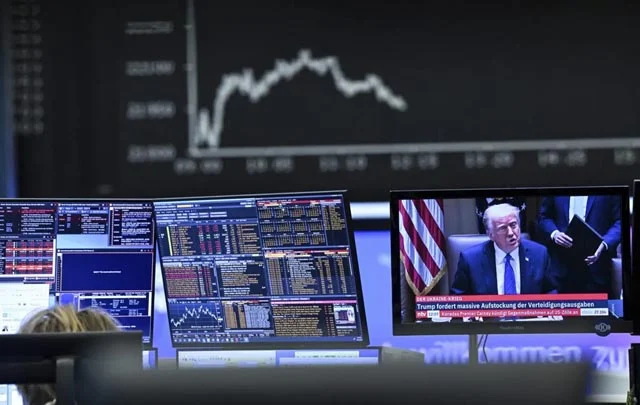
Stocks rocketed Thursday as a relief rally spread through markets after Donald Trump paused crippling tariffs on US partners, with Chinese markets even brushing off his decision to ramp up duties on Beijing to 125 percent.


The across-the-board gains tracked a blistering performance on Wall Street as the US president said he would delay for 90 days measures announced last week that set off a firestorm on trading floors and sparked global recession fears.

Trump said he would keep in place a basic levy of 10 percent on dozens of countries but upped the ante in his brutal trade war with superpower rival China by hitting it even harder after it retaliated.

China’s own 84 percent retaliatory measures kicked in at 0401 GMT Thursday, later saying that US tariffs would “severely impact the stability of the global economic order”.

Advertisement

Trump made the decision because he said investors were “jumping a little bit out of line” as markets collapsed and US Treasuries — considered the safest option in times of crisis — were also showing signs of cracking on concerns about the world’s top economy.

People “were getting yippy, a little bit afraid”, he added, referring to a term in sports to describe a loss of nerves.

The extra tariffs on Beijing, however, were “based on the lack of respect that China has shown to the world’s markets”, Trump said.

The president denied he had made a U-turn, telling reporters that “you have to be flexible”.

Advertisement

And his top trade advisor, Peter Navarro, said, “This will go down in American history as the greatest trade negotiating day we have ever had.

“We’re in a beautiful position for the next 90 days, we’ve got over 75 countries that are going to come in and negotiate with us and what they’re going to have to do, without fail, is they’re going to have to lower their non-tariff barriers.”

Trump’s shock announcement on his Truth Social network sparked a buying frenzy as Asian and European investors chased beaten-down stocks.

“Asia markets are flipping the switch — from fear to euphoria — as Trump throws a 90-day lifeline, pausing the reciprocal tariff barrage,” said Stephen Innes at SPI Asset Management.

Advertisement

“The president’s post nodded to the ‘yippy’ reaction to his historic hikes, and honestly, that sums it up.

“We just witnessed one of the all-time bouncebacks — and now, we look for Asia investors, much like their North American counterparts, to step in and buy the ‘yips’.”

Hong Kong rallied more than two percent — a third day of gains after collapsing more than 13 percent on Monday in its worst day since 1997 during the Asian financial crisis. Shanghai gained more than one percent.

The two markets have been given extra support by optimism that China will unveil fresh stimulus to support its economy in light of the tariff measures. Official data showing another drop in consumer prices last month added to those hopes.

Advertisement

– ‘Fear to euphoria’ –

Tokyo’s Nikkei surged more than nine percent, while Taipei’s 9.3 percent gain was its best rise on record — after Monday’s 9.7 percent drop represented its worst fall.

Seoul, Singapore, Jakarta, Sydney, Saigon and Bangkok climbed between four and 6.6 percent. Manila and Wellington were also well in the positive territory.

London, Paris and Frankfurt soared at the open.

Advertisement

Tech firms were the standout performers, with Sony, Sharp, Panasonic and SoftBank chalking up double-digit gains, while airlines, car makers and casinos also enjoyed strong buying.

Apple suppliers posted strong rallies — Hong Kong-listed AAC Technologies surged 5.6 percent and in Taiwan, Hon Hai added almost 10 percent.

Gold surged almost three percent to around $3,120 — around $50 short of its record touched last month — thanks to the weaker dollar and as the uncertainty saw investors rush into the safe haven.

Chihiro Ota, at SMBC Nikko Securities, said: “What happens now? If the US takes a hardline stance (in negotiations), then the market would be disappointed. If it turns out that they can engage in talks, then it may create a room for (an upswing).”

Advertisement

US Treasury yields also edged down after a successful auction of $38 billion in notes, said Briefing.com.

That eased pressure on the bond market, which had fanned worries that investors were losing confidence in the United States.

However, observers warn that the China-US standoff could be another step towards a disengagement from the world’s top two economies.

“The escalation of the trade war between the US and China suggests that a full trade decoupling is increasingly likely,” said Mali Chivakul, emerging markets economist at J. Safra Sarasin bank.

Advertisement

“Even if we may see a de-escalation later, a decoupling could still be the result.”

Trump’s trade war is also causing a headache for the US Federal Reserve as it weighs whether to cut interest rates to protect the economy, or keep them elevated to ward off the inflation many say tariffs will fuel.

Minutes from its March meeting, released Wednesday, showed members felt they “may face difficult tradeoffs if inflation proved to be more persistent while the outlook for growth and employment weakened”.

Oil prices edged down after bouncing more than four percent Wednesday, though they remain under pressure amid concerns about the global economy and its impact on demand.

Advertisement

– Key figures around 0715 GMT –

Tokyo – Nikkei 225: 9.1 percent at 34,609.00 (close)

Hong Kong – Hang Seng Index: UP 2.7 percent at 20,804.08

Shanghai – Composite: UP 1.2 percent at 3,223.64 (close)

Advertisement

London – FTSE 100: UP 6.1 percent at 8,145.26

Dollar/yen: DOWN at 147.05 yen from 147.82 yen on Wednesday

Euro/dollar: UP at $1.0968 from $1.0948

Pound/dollar: UP at $1.2875 from $1.2810

Advertisement

Euro/pound: DOWN at 85.20 pence from 85.45 pence

West Texas Intermediate: DOWN 0.6 percent at $62.00 per barrel

Brent North Sea Crude: DOWN 0.7 percent at $65.04 per barrel

New York – Dow: UP 7.9 percent at 40,608.45 (close)

Advertisement

AFP

Continue Reading
Advertisement
Click to comment

Warning: Undefined variable $user_ID in /home/naijuinz/public_html/wp-content/themes/zox-news/comments.php on line 49

You must be logged in to post a comment Login

Leave a Reply

Economy

Again, NNPCL Increases Fuel Price For Second Time In Two Days

Published

on

By

ADVERTISEMENT
Zoom Ad
ADVERTISEMENT
Zoom Ad

The Nigerian National Petroleum Company Limited, NNPCL, has increased the pump price of Premium Motor Spirit, PMS at its retail outlets for the second time in less than two days.

A market survey by DAILY POST showed that NNPCL raised its petrol price to N1,335 per litre on Wednesday from N1,270 per litre on Tuesday.

This means that the state-owned filling station increased its fuel price by N65 per litre.

The new price has been implemented at NNPCL filling stations in Wuse Zone 6 (Berger), Zone 4, and other outlets in Abuja and its environs.

Advertisement

Recall that on Tuesday, NNPCL increased its petrol pump price by N115 per litre to N1,270 per litre.

The latest increase comes amid continued petrol price volatility in the country’s downstream oil sector following Dangote Refinery’s resumption of the sale of refined petroleum products in U.S. dollars.

DAILY POST reports that crude oil prices rose by nearly 4 percent on Wednesday as airstrikes intensified in the Middle East.

Advertisement
Continue Reading

Economy

Old telecom rules can’t handle AI, digital era, says NCC

Published

on

By

ADVERTISEMENT
Zoom Ad
ADVERTISEMENT
Zoom Ad

The Nigerian Communications Commission has said Africa’s telecommunications regulators must overhaul traditional regulatory approaches to keep pace with rapid technological changes, warning that existing frameworks were no longer adequate for an industry increasingly driven by artificial intelligence, satellite services, cloud computing and digital public infrastructure.

The Executive Commissioner for Stakeholder Management at the NCC, Rimini Makama, stated this on Tuesday in Abuja during the Head of Regulators Roundtable held on the sidelines of the ongoing 7th Ordinary Session of the Conference Preparatory Committee of the African Telecommunications Union.

Makama said the telecommunications landscape had become significantly more complex, requiring regulators to rely on data and market intelligence rather than conventional regulatory methods.

“Our discussion today turns on one question that matters to every regulator in this room. How do we use data and evidence to make decisions that are smarter, more transparent, and more focused on our consumer? Our markets are no longer simple,” she said.

Advertisement

She added, “Broadband is expanding, satellite services are arriving, AI, cloud computing, and digital public infrastructure are reshaping our sector. The old regulatory approaches were built for a simpler time. They are no longer enough.”

According to her, regulators across Africa now possess unprecedented volumes of technical, market and consumer data, but the real challenge lies in converting that information into better regulatory decisions.

“To stay ahead of the problem and not just react to it, we need trusted intelligence,” Makama said.

She explained that because African digital markets were becoming increasingly interconnected, regulators faced similar responsibilities in protecting consumers, promoting competition, attracting investment and strengthening network resilience.

Advertisement

“The challenge is not collecting it. The challenge is turning it into better decisions,” she said.

Makama said the NCC had developed a regulatory intelligence ecosystem that integrates multiple data sources, including quality of service and quality of experience indicators, consumer complaints, compliance analytics and market intelligence to support evidence-based policymaking.

“It brings several data sources into one place, so that our decisions rest on evidence, quality of service, and quality of experience data, consumer complaints, compliance analytics, and market intelligence. We will walk you through some of the recent cases where this intelligence led to real and measurable outcomes,” she said.

She urged regulators across the continent to deepen collaboration by sharing practical experiences and developing trusted approaches to data verification, advanced analytics and consumer-focused regulation.

Advertisement

Makama also challenged participants to examine how regulators could ensure the independence and accuracy of regulatory data, remove barriers to information sharing and measure consumer experience beyond conventional quality-of-service metrics.

Earlier, the Executive Vice-Chairman of the NCC, Dr Aminu Maida, said African regulators were increasingly confronted with common challenges despite operating under different legal and institutional frameworks.

According to him, discussions among regulators now routinely revolve around investment, infrastructure resilience, satellite communications, cybersecurity, affordability, artificial intelligence and emerging technologies.

“We may regulate markets of different sizes, operate under different legal frameworks, and respond to different national priorities. But the realities of our work are often remarkably similar,” Maida said.

Advertisement

He added, “Someone asks, how are things back home? Five minutes later, we are discussing investment, infrastructure resilience, satellite services, cyber security, affordability, artificial intelligence, or the latest technology that has arrived just in time to test the regulatory framework we thought had finally settled.”

Maida said such shared experiences underscored the need for stronger collaboration among African regulators to avoid addressing similar problems independently.

“The challenge that one regulator is trying to solve has already been encountered in one form or another by a colleague elsewhere on the continent. So, the question really is how we make that exchange of experience more deliberate, more systematic, and more useful to our institutions,” he said.

He described the roundtable as an opportunity to strengthen evidence-based regulation by encouraging the use of data, market intelligence and practical experience in policymaking.

Advertisement

Also speaking, the Executive Commissioner, Technical Services, Sunday Oshadami, said the NCC had prioritised transparency by ensuring operators clearly understood regulatory obligations and by making key performance information available to subscribers.

He said the commission had also invested in satellite monitoring capabilities to strengthen oversight of satellite communications and improve regulatory compliance.

According to Oshadami, the commission had established facilities to monitor developments in satellite communications and continued to invest in standard monitoring solutions to support effective regulation as new technologies gain prominence.

The PUNCH earlier reported that stakeholders in Nigeria’s telecommunications sector on recently backed the Nigerian Communications Commission’s draft business rules for Mobile Virtual Network Operators, while urging the regulator to strengthen enforcement to resolve persistent operational and commercial disputes between MVNOs and Mobile Network Operators.

Advertisement
Continue Reading

Economy

Nigeria’s external reserves rise to $52.52bn – Cardoso

Published

on

By

ADVERTISEMENT
Zoom Ad
ADVERTISEMENT
Zoom Ad

Governor of the Central Bank of Nigeria, Yemi Cardoso, says Nigeria’s foreign exchange reserves has presently risen to 52.52 billion dollars.

Cardoso said this on Tuesday in Abuja, while presenting a communique issued at the end of the 306th meeting of the apex bank’s Monetary Policy Committee (MPC).

The News Agency of Nigeria (NAN) reports that he had earlier announced the decision of the MPC to retain the Monetary Policy Rate (MPR) at 26.5 per cent.

The committee also retained the Standing Facilities Corridor around the MPR at +50/-450 basis points.

Advertisement

Cash Reserve Requirement (CRR) for Deposit Money Banks was retained at 45.00 per cent, Merchant Banks at 16.00 per cent, and non-TSA public sector deposits at 75.00 per cent

According to Cardoso, gross external reserves rose to 52.52 billion dollars as of July 17, from 50.47 billion dollars
as at end-May.

He said that the rise was mainly as a result of receipts from crude oil-related taxes and third-party inflows.

“This is sufficient to finance approximately 11 months of imports of goods and services, surpassing the international benchmark of three months cover,” he said.

Advertisement

The CBN governor said that headline inflation (year-on-year) eased marginally to 15.91 per cent in June, from
15.93 per cent in May, ending the three consecutive months of uptick in price levels.

He said that the decline resulted from a decrease in the non-food component which offset the increase
in food inflation.

“Food inflation rose to 17.52 per cent in June, from 16.96 per cent in May, reflecting supply constraints.

“However, core inflation moderated to 15.92 per cent in June, from 16.82 per cent in May, largely on the back of exchange rate stability.

Advertisement

“Similarly, the 12-month average inflation rate sustained its decline to 17.63 per cent in June, from 18.36 per cent in May,’ ‘ he said.

He said that it marked the sixth month of consecutive moderation and reflected a slower pace of price increases over the medium term.’

According to him, on a month-on-month basis, headline inflation declined to 1.66 per cent in June from 1.75 per cent in May, driven by a slowdown in core inflation.

He said that real Gross Domestic Product (GDP) expanded by 3.89 per cent in the first quarter of 2026, compared with 4.07 per cent in the preceding period.

Advertisement

“This is largely driven by the resilience of the non-oil sector, which grew by 3.94 per cent, supported by improvements in telecommunications, financial services, trade, transportation, and other services sub-sectors.

“Oil sector GDP growth rate declined to 2.57 per cent in the first quarter of 2026 from 6.79 per cent in the fourth quarter
of 2025, due to the maintenance of oil facilities and installations.

“However, recent data showed improvement in economic activities as composite Purchasing Managers Index (PMI) rose to 50.1 index points in June from 49.6 index points in May,” Cardoso said.

He said that output growth was projected to remain resilient into 2026, anchored on the recent improvement in crude oil production, expansionary PMI and the positive impact of timely policy reforms.

Advertisement

“Inflation is projected to moderate further in the medium term on the back of continued stability in the foreign exchange market.

“This will also be due to lagged effect of previous monetary policy tightening and improved food supply conditions as the harvest season approaches,” he said.

He, however, said that the key risk to the outlook remained the severe and prolonged escalation of the
Middle East conflict.

“In the light of these considerations, the MPC reaffirmed its commitment to preserve price and financial system stability.

Advertisement

“The committee remains prepared to take appropriate policy measures guided by evolving macroeconomic conditions,” he said.

NAN

Continue Reading

Trending

Copyright © 2024 Naija Blitz News