

News
Nigeria, Malawi Strengthen Legislative Partnership During High-Level Visit
- /home/naijuinz/public_html/wp-content/plugins/mvp-social-buttons/mvp-social-buttons.php on line 27
https://naijablitznews.com/wp-content/uploads/2025/07/IMG-20250711-WA0041-1000x600.jpg&description=Nigeria, Malawi Strengthen Legislative Partnership During High-Level Visit', 'pinterestShare', 'width=750,height=350'); return false;" title="Pin This Post">
- Share
- Tweet /home/naijuinz/public_html/wp-content/plugins/mvp-social-buttons/mvp-social-buttons.php on line 72
https://naijablitznews.com/wp-content/uploads/2025/07/IMG-20250711-WA0041-1000x600.jpg&description=Nigeria, Malawi Strengthen Legislative Partnership During High-Level Visit', 'pinterestShare', 'width=750,height=350'); return false;" title="Pin This Post">
By Gloria Ikibah
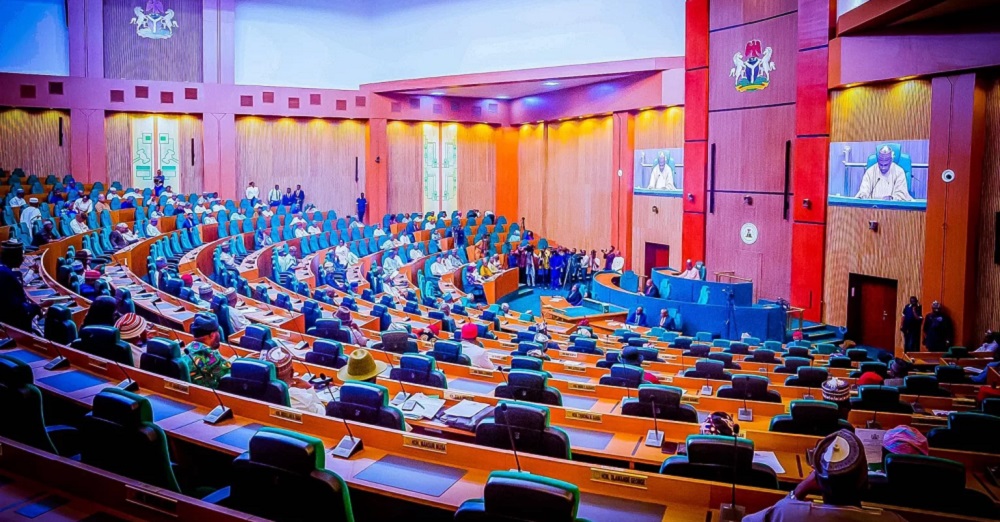
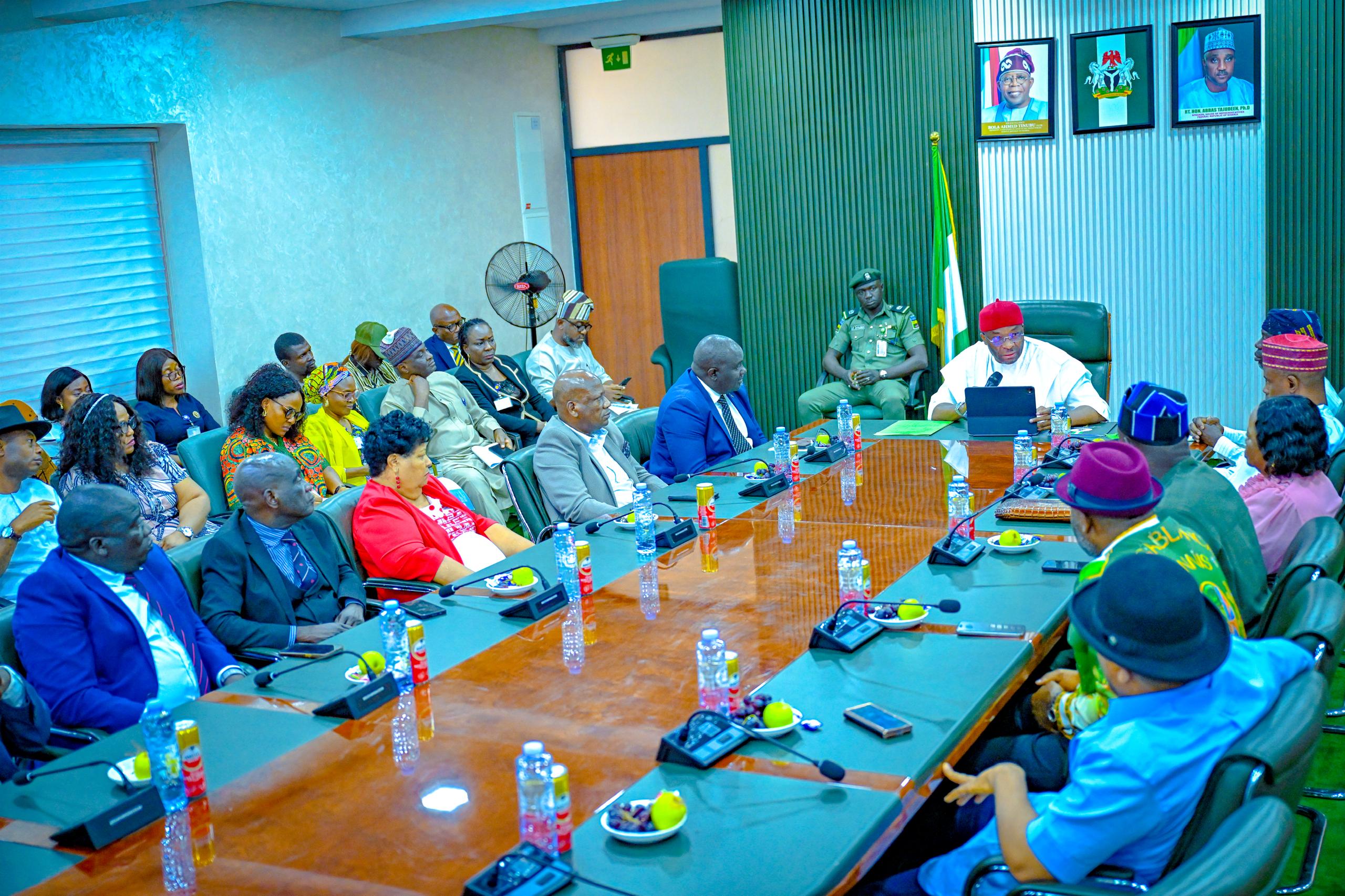
In a move aimed at reinforcing cross-national legislative engagement, a prominent parliamentary team from Malawi, led by First Deputy Speaker Madalitso Kazombo, has paid an official visit to Nigeria’s National Assembly on Tuesday.
During discussions with Deputy Speaker of the House of Representatives, Rep. Benjamin Kalu, Malawian Deputy Speaker emphasised the value of shared experience between both nations.

He noted that Malawi sees Nigeria as a key partner in advancing democratic collaboration and institutional growth.
“Iron sharpens iron,” Kazombo remarked, highlighting the mutual benefits of closer ties. He also praised Nigeria’s rich culinary culture and commended its lawmakers for their commitment to legislative excellence.
The engagement, held under the theme “Strengthening Parliamentary Ties between Nigeria and Malawi,” focused on building lasting institutional links. Kazombo reaffirmed Malawi’s intention to deepen cooperation with Nigeria in areas such as lawmaking, democratic governance, and leadership development.
He further recalled Malawi’s independence in 1964, underlining the country’s long-standing aspirations for self-driven progress.
The visit marks a strategic effort to enhance bilateral understanding and capacity-building between two African democracies.
While welcoming the Malawian delegation, Deputy Speaker Rep. Benjamin Kalu stressed the value of exchanging legislative strategies, particularly in critical areas such as constitutional reform and public inclusion.
He pointed to Nigeria’s ongoing constitutional amendment efforts, and noted key proposals designed to boost women’s representation in leadership and lower the age threshold for youth participation in electoral politics.
Kalu also used the occasion to call for stronger collaboration among African legislatures, urging collective action on the continent’s pressing challenges. He expressed concern over the rising migration of African youth to Europe and advocated for deeper intra-African partnerships focused on job creation and the establishment of resilient legislative systems that meet the needs of future generations.
In his address, Malawi’s Deputy Speaker Madalitso Kazombo commended Nigeria for its strides in legislative development, aligning with calls for stronger ties between the two countries.
Kazombo reflected on Malawi’s journey toward multiparty democracy, he eemphasised he legislature’s central role in promoting democratic values.
Speaking frankly about the importance of youth participation in governance, he cited his own political rise as proof of what young leaders can achieve when given the platform.
He noted that he contested and won his seat as an independent candidate, pointing out that Malawi’s political structure is shaped by a five-party system.
During the exchange, both leaders stressed the importance of continuous parliamentary engagement and explored the possibility of establishing a Malawian High Commission in Nigeria—signaling a potential shift in bilateral diplomacy.
The visit underscored a shared resolve to strengthen institutional cooperation, with discussions focusing on inclusive governance, democratic resilience, and regional progress.
Kazombo also shared that Malawi’s parliament is made up of 193 representatives, with systems in place to ensure increased gender representation.
News
Kuje-Gwagwalada Road Was a Death Trap for Decades, Tinubu Declares as He Commissions Phase I Dual Carriageway (Photos)
By Ojomah Austin.
President Bola Ahmed Tinubu on Wednesday, said the newly completed Phase I of the Kuje-Gwagwalada Dual Carriageway has brought an end to decades of hardship, insecurity and economic losses suffered by residents and commuters along the corridor.
Speaking through Vice President Kashim Shettima at the commissioning of the 7-kilometre dual carriageway in Kuje Area Council of the Federal Capital Territory, (FCT) Tinubu described the road as a critical economic and security infrastructure that would transform the lives of residents in Kuje, Gwagwalada, Kwali and adjoining communities.

“For decades, this road was a death trap. Traders from Kuje, Gwagwalada, Kwali and beyond lost time, goods and sometimes lives while plying this road. Criminals thrived in the darkness. Students wasted hours in traffic. Farmers could not get their produce to market on time.
“But that story ends today,” the President said.
Tinubu noted that the road, equipped with solar-powered streetlights, pedestrian walkways and modern drainage facilities, represents more than physical infrastructure.

“This 7-kilometre dual carriageway with solar-powered streetlights, pedestrian walkways and proper drainage is more than a road. It is security. It is commerce. It is dignity.
“It is the economic corridor linking Abuja to three area councils and an opening and exit route to Southern Nigeria. With the construction of this road, we have unlocked the agricultural potential of this area, opened new residential layouts and made it safer for mothers, students and workers to move at any hour,” he stated.
The President said the project was a practical demonstration of the Renewed Hope Agenda and reaffirmed his administration’s commitment to extending development beyond Abuja city centre to satellite communities.
“My people of Kuje, Gwagwalada, Kwali and all the area councils and satellite towns, hear me clearly: this government sees you. You are not forgotten.
“For too long, Abuja’s development stopped at the city centre. Under the Renewed Hope Agenda, every area council matters. Every community counts. We will keep bringing roads, water, schools and hospitals to you,” he said.
Tinubu also urged residents to safeguard public infrastructure and support government efforts through civic responsibility.
“Do not build on the median. Do not vandalise the solar lights. Pay your taxes and ground rents. When government works and citizens cooperate, development moves faster,” he added.
The President commended the Minister of the Federal Capital Territory, Nyesom Wike, for expanding development to underserved communities across the territory.
“I gave you an instruction when I appointed you: make Abuja work for all Nigerians, not just for those in Maitama and Asokoro.
“You have taken Renewed Hope to the grassroots. From judicial quarters in Katampe to roads in Kuje and Gwagwalada, you are proving that development must not be selective. You heard the cries of satellite communities and responded. That is leadership. Well done, Honourable Minister,” Tinubu said.
Earlier, FCT Minister, Barr. Nyesom Wike, said the road project was a direct response to demands made by residents, traditional rulers and stakeholders during consultations held across the six area councils shortly after the administration assumed office in 2023.
According to him, insecurity and poor road infrastructure featured prominently among the concerns raised by residents of Kuje.
Wike recalled that the administration revived the abandoned Airport Road-Kuje road project before approving the Kuje-Gwagwalada road after personally inspecting its deplorable condition.
“So, one day, while returning from Kwali after inspecting projects, I said let us pass through the road the traditional ruler had been talking about.
“As we travelled, it took us almost two hours. I asked where we were heading to and they said Kuje. I said, ‘Are we in America?’ This is within the FCT and it took us almost two hours. The road was terrible. In fact, saying it was bad is an understatement; there was practically no road,” he said.
The minister explained that the Federal Executive Council approved the project in early 2025 and that it was awarded to Gilmor Engineering Nigeria Limited.
He expressed satisfaction that the first phase had been completed within schedule and disclosed that the contractor had assured the administration that the second phase would be delivered by December 2026.
“What this means is that the people of Gwagwalada and Kuje can now interact more easily, businesses can thrive and farmers can move their produce to markets without stress. That is governance. That is bringing hope to the people,” Wike said.
Also speaking, Minister of State for FCT, Dr Mariya Mahmoud, described the project as a visible demonstration of the Renewed Hope Agenda and a testament to the Federal Government’s commitment to improving lives through strategic infrastructure investments.
She commended Wike for what she described as his exceptional leadership and determination in delivering critical infrastructure across the FCT.
Earlier, Coordinator of the Satellite Towns Development Department (STDD) Abdulkadir Zulkiflu, said the project was awarded on February 28, 2025, and consists of a 7-kilometre dual carriageway with two lanes in each direction, a three-span bridge, drainage systems and solar-powered streetlights.
He added that the project would improve access to farming communities, facilitate movement of agricultural produce, reduce travel time and stimulate economic growth in Kuje, Gwagwalada and neighbouring communities.
Zulkiflu disclosed that the second phase of the project, covering the remaining six kilometres of dual carriageway, is expected to be completed by December 2026, completing the full upgrade of the Kuje-Gwagwalada road corridor.
News
ScienceOpen Names Nigerian Scholar-Journalist Max Amuchie Expert Member
By Gloria Ikibah
In a major milestone for indigenous African and scholarship and media leadership, the global open-science discovery network ScienceOpen has officially appointed Dr. Max Nwabueze Amuchie as an Expert Member and Peer Reviewer in Social and Behavioural Sciences.
In an email conveying the appointment on Tuesday, ScienceOpen stated that the decision was based on Dr. Amuchie’s extensive publication history verified through his Open Researcher and Contributor ID (ORCID) profile.
Dr. Amuchie, the CEO and Theorist-In-Chief of Sundiata Post Media Ltd and Lead Researcher for the Sundiata Post Intelligence Unit (SPIU), joins an elite global cohort of international scholars tasked with evaluating, validating, and shaping scientific, governance, and policy literature on the world stage.
This international elevation comes on the heels of Dr. Amuchie’s extensive work in developing groundbreaking, macro-theoretical frameworks designed to analyse complex geopolitical realities in the Global South. He is the architect of The Insecurity Triad framework for African security analysis, The Trinity of State Decay (TSD) theory, and the Decoupling Sovereignty Index (DSI)—original, quantitative, and analytical instruments used for understanding, categorising, and measuring conflict, structural degradation, and functional sovereignty.
To anchor these frameworks in global academia, Dr. Amuchie’s research works have already been widely published and archived across premier scholarly platforms. His papers and data indices are preserved in world-class open-science repositories including Harvard Dataverse and Zenodo. Furthermore, his output is accessible on the Social Science Research Network (SSRN) and Mendeley—the latter owned by Elsevier, the world’s largest corporate academic publishing house. His research footprints also extend to the Social Science Open Access Repository (SSOAR), operated by GESIS – Leibniz Institute for the Social Sciences in Germany, as well as Figshare. In addition, his papers are available on major global scholarly networks such as ResearchGate and Academia.edu, and are actively indexed on Google Scholar.
Commenting on his appointment by ScienceOpen, Amuchie emphasised that the recognition represents a significant step forward for the Global South intellectual sovereignty.
“For too long, the Global South has been treated primarily as a subject of external geopolitical analysis rather than a creator of macro-theoretical blueprints,” Amuchie said. “This elevation on a premier open-science platform like ScienceOpen provides an unassailable global platform to validate indigenous African and Global South research. It ensures that our original frameworks—born out of rigorous field observations and deep academic inquiry—are recognised as primary tools for understanding state structures worldwide.”
Amuchie is a seasoned professional in the Nigerian media landscape, having served as a Member of the Editorial Board and later Abuja Bureau Chief at BusinessDay; held senior editorial positions at ThisDay, and served as Managing Editor at Leadership newspapers. He was also the CEO and Editor-in-Chief at Truetales Publications Ltd. He is an alumnus of the University of Calabar and the University of Lagos. He also maintains The Sunday Stew, a highly regarded weekly syndicated column exploring faith, character, and the structural forces shaping contemporary society.
As an official Peer Reviewer on ScienceOpen, Amuchie’s vetting powers will bridge the gap between high-velocity media dissemination and rigorous, citable academic indexing. This appointment establishes a formidable foundation for the Sundiata Post Intelligence Unit (SPIU) as it continues to pioneer data-driven, sovereign policy analysis across Africa and the wider Global South.
Headquartered in Berlin, Germany, with its primary technical and editorial operations hub in Boston, Massachusetts, USA, ScienceOpen is a leading independent open-science discovery network and research platform. Founded on the principles of Open Access, the platform democratises knowledge by breaking down academic paywalls so that researchers, policymakers, and journalists can freely share and critique global research.
ScienceOpen operates an innovative, transparent post-publication peer review system. It aggregates a massive, interconnected global database of over 85 million research records and articles. To maintain absolute academic integrity, only scholars who meet strict criteria—including a verified track record of published, peer-reviewed scientific literature linked to their international ORCID ID—are appointed as Expert Members and Peer Reviewers. These experts possess the formal authority to critique manuscripts, evaluate new analytical theories, and curate specialised research collections that shape validated scientific and policy data on the world stage.
News
BREAKING: Nigerian Government Hit with N10m ECOWAS Court Award for Assault on Journalist Oyekunle
By Gloria Ikibah
The ECOWAS Community Court of Justice has slammed a N10 million in general damages against the Federal Republic of Nigeria over the physical assault, unlawful arrest, and seizure of property belonging to a journalist with Independent Newspaper by name Jide Oyekunle.
The landmark ruling in Suit No. ECW/CCJ/APP/29/25 was secured by Avocats Sans Frontières France (Lawyers Without Borders France) on June 22, 2026, under its eRIGHTS project, supported by the European Union, which focuses on defending human rights in the digital space.
Comrade Oyekunle who is currently the Secretary of the Nigeria Union of Journalists, NUJ, Federal Capital Territory Council, on August 1, 2024, during the coverage of the #EndBadGovernanceInNigeria protests at the Eagle Square, Abuja, was physically assaulted, unlawfully detained, his photo camera was damaged, while his mobile phone was seized by armed police officers on the order of former FCT Commissioner of Police, Benneth Igweh.
The Court in agreement with Counsel to the applicant, Collins I. Maidoh-Anene, Esq., that the detention of the journalist and seizure of his mobile phone by the Nigerian police, was “excessive, unjustified, and in violation of international law”.
The ECOWAS Court subsequently found the Federal Republic of Nigeria liable for violating the applicant’s rights to freedom of expression, personal liberty, dignity, and property under the African Charter.
The Court therefore ordered the Nigerian government to pay Comrade Oyekunle the sum of N10 million in general damages.
The court found that Nigeria’s actions suppressed his live coverage, thereby breaching his right to freedom of expression under Article 9 of the African Charter.
It also ruled that the assault and detention violated his rights to personal liberty, human dignity, and freedom from degrading treatment under Articles 6 and 5, while the temporary seizure of his phone violated his right to property under Article 14.
The Court further held that Nigeria’s justification failed the test of necessity under international law, making the conduct of the security forces excessive and unlawful.
In a statement signed by the Country Director of Avocats Sans Frontières France, Barrister Angela Uwandu Uzoma-Iwuchukwu, on Tuesday, said the judgment sends a clear message that a journalist’s digital tools are extensions of the modern press and newsroom and that their arbitrary confiscation by security forces constitutes a direct assault on the public’s right to know.
She said: “The court’s pronouncement adds to the growing jurisprudence from the regional court protecting journalists and human rights defenders who document protests and public interest events.
“ASF France will continue to monitor compliance with the judgment and provide legal aid to journalists facing similar violations.
“For Avocats Sans Frontières France and the eRIGHTS project partners, this ruling strengthens legal protections for journalism in the digital age. It shields reporters from tech-based censorship and intimidation, puts security agencies on notice that targeting media practitioners during protests will attract accountability, and reaffirms the ECOWAS Court as a vital shield for civic space in the region.”
Reacting to the landmark judgment, Comrade Oyekunle, said it as a significant affirmation that journalists have the right to carry out their constitutional duties without intimidation, harassment, or attack.
According to him, democracy cannot thrive where journalists are attacked for documenting events or where citizens are punished for exercising their lawful rights.
“The decision of the ECOWAS Court is not only about me; it is about every journalist, media worker, and Nigerian citizen who believes in the right to freedom of expression, access to information, and peaceful civic participation.
“This judgment sends a clear message that security agencies and government institutions must be held accountable when they violate fundamental rights.
“Because if democracy is all about good governance, accountability, and transparency, then press freedom should not be curtailed, denied, or restricted”, he said.
Oyekunle appreciated everyone who stood by him throughout the journey, including the Nigeria Union of Journalists FCT Council, Avocats Sans Frontières France, colleagues and rights advocates, and all Nigerians who continue to defend press freedom and democratic values.
-
Metro13 hours agoAlleged Drug Trafficking: Billionaire, Two Others Face Trial in Lagos
-
Foreign13 hours agoUS Targets Alleged ISIS Funding Network, Names Nigerian
-
News5 hours agoDAY 11 of Projects Commissioning in the FCT: TInubu set to commission Kuje, Gwagwalada road today
-
News13 hours agoBenin monarch to place a curse on kidnappers, armed robbers, fixes date
-
News13 hours agoHajj: NAHCON concludes return of pilgrims’ airlifts
-
Sports13 hours agoSuper Eagles: Chelle, NFF Reach New Contract
-
News5 hours agoDAY 11 of Projects Commissioning in the FCT
-
News13 hours agoIGP bans unauthorised social media use by Police Officers

Warning: Undefined variable $user_ID in /home/naijuinz/public_html/wp-content/themes/zox-news/comments.php on line 49
You must be logged in to post a comment Login