Connect with us

News

Reps committed to tackling religious, racial discrimination in Nigeria -Speaker Abbas

Published

on

ADVERTISEMENT
Zoom Ad
ADVERTISEMENT
Zoom Ad

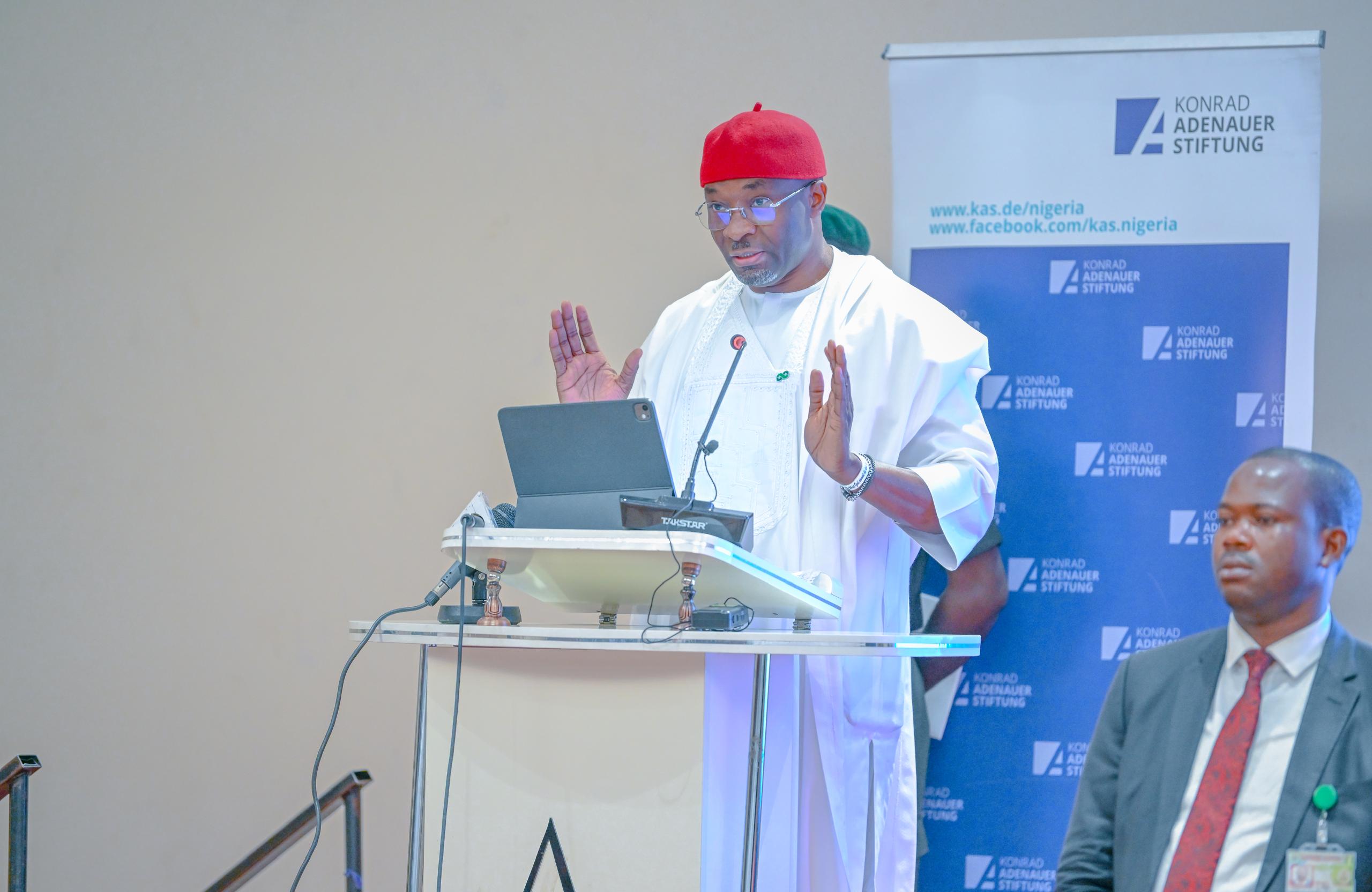
Speaker of the House of Representatives, Hon. Abbas Tajudeen, has said that the legislature is committed to combating all forms of religious and racial discrimination to ensure peaceful coexistence of Nigerians.


The Speaker gave the assurance while declaring open the 2025 Interfaith Legislative Roundtable Engagement organized by the House of Representatives in Abuja on Monday.

Represented by the Deputy Speaker, Hon. Benjamin Okezie Kalu, Speaker Tajudeen said that the Roundtable is a continuation of a global momentum that began with the Second Parliamentary Conference on Interfaith Dialogue, held in Rome in June 2025, where over 100 countries including Nigeria pledged to collaborate across faiths and parliaments to defend democratic values, protect vulnerable populations, and counter divisive rhetoric.

According to him, the dialogue stems from the communique issued at the end of the event which emphasized that peace-building must be proactive and anchored on ethics, accountability, and solidarity.

Advertisement

He said: “This Roundtable draws from those recommendations and seeks to localize them within the Nigerian context. It is instructive to mention also that the United Nations Alliance of Civilizations has also reinforced these efforts, warning that the rising tide of online hate speech and the normalization of dehumanizing rhetoric present existential threats to democratic societies.

“The House of Representatives is committed to combating all forms of religious and racial discrimination with equal urgency. In the light of this, the House, through this engagement, aims to identify legislative gaps, propose frameworks, and create tools that can meaningfully curb these threats while promoting civic education and peaceful coexistence.

“As outlined in our Legislative Agenda, we are focused on upholding the rule of law, fostering peace-building and dialogue, and deepening inclusion, especially for youth and marginalized communities. This engagement aligns squarely with those goals. From hate speech regulation in digital spaces to faith-based education for tolerance, we aim to evolve policies that not only protect freedom of belief but also inspire a generation of responsible citizenship.”

Beyond the core significance of the Roundtable, Speaker Tajudeen also said it is essential that the stakeholders begin to explore how faith-based education can serve as a frontline tool against extremism and divisive ideologies.

Advertisement

He added that misinformation, indoctrination and poor civic understanding escalate religious conflicts.

Proferring solutions however, Speaker Tajudeen emphasized the need to enhance the digital literacy of faith influencer and clerics, stressing that the House remained committed to defending the Constitution.

“Many of the vulnerabilities that breed religious conflict are rooted in misinformation, indoctrination, and poor civic understanding. By supporting reforms that integrate constitutional literacy, critical thinking, and peace studies into religious curricula across madrasas, seminaries, and faith-based schools, we can build a generation that is both spiritually grounded and civically informed.

“Similarly, there is a need to enhance digital literacy among faith influencers and clerics, who now command significant followings online. Empowering them with responsible digital communication skills, content moderation ethics, and conflict-sensitive engagement strategies will help de-escalate online tensions and prevent the manipulation of religious sentiment on social media.

Advertisement

“No citizen should be discriminated against politically, economically or socially on the basis of his faith or persuasion. As a responsible House, we remain firmly committed to defending the Constitution and ensuring, through appropriate legislative actions and oversight, that this constitutional provision is enforced at all levels of governance”, the Speaker said.

Continue Reading
Advertisement
Click to comment

Warning: Undefined variable $user_ID in /home/naijuinz/public_html/wp-content/themes/zox-news/comments.php on line 49

You must be logged in to post a comment Login

Leave a Reply

News

FG announces New Framework to Reintegrate Repentant Terrorists, Bandits

Published

on

ADVERTISEMENT
Zoom Ad
ADVERTISEMENT
Zoom Ad

The Federal Government has introduced a new operational framework aimed at strengthening the disarmament, demobilisation and reintegration (DDR) of former terrorists, bandits and other individuals who have renounced armed violence across Nigeria.

The initiative, unveiled through the National Counter Terrorism Centre (NCTC) under the Office of the National Security Adviser (ONSA), is designed to improve coordination among government agencies and ensure a more structured approach to rehabilitating ex-combatants while promoting lasting peace in conflict-affected communities.

The National Coordinator of the NCTC, Major General Adamu Laka, disclosed this on Monday during the National Validation Workshop on the Standard Operating Procedures (SOPs) for Disarmament, Demobilisation and Reintegration held in Abuja.

According to Laka, the newly developed procedures will guide the implementation of the DDR programme at the federal level and in the pilot states of Kaduna, Katsina and Zamfara.

Advertisement

He explained that the initiative forms part of the Federal Government’s broader strategy to tackle insecurity through a combination of military operations and non-military interventions aimed at addressing the root causes of violent extremism.

Laka said the Standard Operating Procedures were developed to ensure that the government’s reintegration programme is implemented in a coordinated, transparent and effective manner.

He noted that the guidelines provide practical direction for ministries, security agencies, civil institutions and other organisations involved in identifying, processing, rehabilitating and reintegrating individuals who have abandoned violence.

According to him, the framework clearly outlines the responsibilities of participating institutions, promotes accountability and strengthens collaboration among stakeholders, while eliminating overlaps in responsibilities.

Advertisement

The NCTC coordinator observed that although Nigeria already has a National DDR Framework, there was a need for detailed operational guidelines to translate policy objectives into practical actions.

“Recognising that a policy framework alone is insufficient to guide implementation, the NCTC and its partners subsequently developed a comprehensive set of Standard Operating Procedures to translate the strategic objectives of the National DDR Framework into practical guidance for implementing institutions,” Laka said.

He explained that the SOPs establish uniform standards for implementing the programme nationwide while clearly defining the roles and responsibilities of each participating agency.

Laka disclosed that the framework was developed after extensive consultations with security agencies, government institutions, peacebuilding organisations and other relevant stakeholders.

Advertisement

According to him, the procedures draw from Nigeria’s previous experiences, international best practices and the country’s unique security realities.

“These Standard Operating Procedures have been developed through extensive consultations and draw upon national experiences, international best practices, and the unique realities of the Nigerian context,” he added.

He noted that the consultations considered the experiences of communities affected by terrorism and banditry as well as lessons learned from similar rehabilitation programmes in other countries.

The Federal Government selected Kaduna, Katsina and Zamfara as pilot states for the implementation of the new framework due to the prolonged security challenges confronting the North-West region.

Advertisement

The three states have witnessed repeated attacks by terrorists, bandits and kidnappers, resulting in numerous deaths, displacement of residents and disruption of economic and social activities.

Officials said the pilot phase would enable the government to evaluate the effectiveness of the guidelines, identify implementation gaps and make necessary adjustments before extending the programme to other parts of the country.

Laka stressed that the initiative reflects the government’s belief that military operations alone cannot permanently resolve Nigeria’s security challenges.

He said effective disarmament, rehabilitation and reintegration programmes would help reduce the likelihood of former fighters returning to violent groups while also supporting reconciliation and the recovery of communities devastated by years of conflict.

Advertisement

The NCTC coordinator, however, emphasised that the success of the programme would depend on effective collaboration among government institutions, security agencies, traditional rulers, community leaders, civil society organisations and other stakeholders.

He reaffirmed the Federal Government’s commitment to implementing comprehensive strategies aimed at restoring peace, enhancing public safety and rebuilding communities affected by terrorism, banditry and other forms of armed violence.

Continue Reading

News

Court verdict will not affect our candidates primaries elections-ADC

Published

on

ADVERTISEMENT
Zoom Ad
ADVERTISEMENT
Zoom Ad

…to challenge judgement

The African Democratic Congress (ADC) has promised its members and supporters that the Court of Appeal verdict on the party’s congresses will not invalidate its primary elections or the candidates who emerged from them.

This was contained in a statement issued on Monday by the party’s National Publicity Secretary, Mallam Bolaji Abdullahi, the ADC said the judgment only relates to the election of its ward, local government and state executive committees and has no impact on the direct primaries conducted by the party.

“The African Democratic Congress (ADC) notes the judgment delivered by the Court of Appeal in Abuja on Monday in a matter relating to party congresses for the election of ward, local government and state executive committees of the party,” the statement read.

Advertisement

The party stressed that the ruling does not invalidate the emergence of its candidates at any level.

“We wish to assure members of the party and the general public that this judgment has no effect whatsoever on the direct primaries through which the party’s candidates have emerged at all levels,” it said.

The ADC also disclosed that it had begun the process of challenging the judgment at a higher court, insisting that it disagrees with the decision.

“The party has already commenced the process of appealing the judgment, which we respectfully disagree with and consider to be legally unsustainable,” the statement added.

Advertisement

The party further said it took note of the dissenting judgment delivered by the presiding justice, describing it as more consistent with its position and the law.

We also note the dissenting judgment of the presiding Justice, which, in our view, more accurately reflects the settled position of the law and the party’s position,” it stated.

The ADC appealed to its members and supporters across the country to remain calm and focused despite the court ruling.

“We urge all party members and the millions of our supporters to remain calm, confident and focused,” the statement said.

Advertisement

The party said it would continue to pursue its goal of offering Nigerians a credible alternative through constitutional and lawful means.

“The African Democratic Congress remains committed to the task of providing Nigerians with a credible alternative and will continue to pursue that mission in accordance with the Constitution and the rule of law,” .

Continue Reading

News

Orire: Nigerian Army gives reasons why drones could not locate kidnappers

Published

on

ADVERTISEMENT
Zoom Ad
ADVERTISEMENT
Zoom Ad

The Nigerian Army has given reasons why drones deployed during the rescue operation for abducted pupils, teachers and other victims in Oriire Local Government Area of Oyo State were unable to effectively track the kidnappers.

Speaking during the formal handover of the rescued victims to the Oyo State Government, the General Officer Commanding (GOC) 2 Division, Nigerian Army, said the operation was particularly difficult due to the challenging terrain within the forest where the victims were held.

The GOC disclosed that after the initial operation, troops continued to pursue the abductors using intelligence and advanced surveillance technology. However, the kidnappers had moved deeper into the dense forest, making it increasingly difficult to locate them.

According to him, the military deployed drones and other technological assets to support the search, but the thick forest canopy significantly reduced the effectiveness of aerial surveillance.

Advertisement

He explained that the dense vegetation concealed the kidnappers beneath the trees, preventing drones from detecting their exact location.

Despite the setback, the GOC said troops maintained sustained pressure on the abductors through coordinated intelligence-driven operations, which eventually forced a breakthrough that led to the successful rescue of the victims.

He reiterated the Nigerian Army’s commitment to working with other security agencies to combat kidnapping and restore safety across Oyo State and the country.

Advertisement
Continue Reading

Trending

Copyright © 2024 Naija Blitz News