Connect with us

News

Clarify how you spent N54bn on school renovation -Abia APC chieftain queries Otti

Published

on

ADVERTISEMENT
Zoom Ad
ADVERTISEMENT
Zoom Ad

By Kayode Sanni-Arewa and Prosper Olayiwola

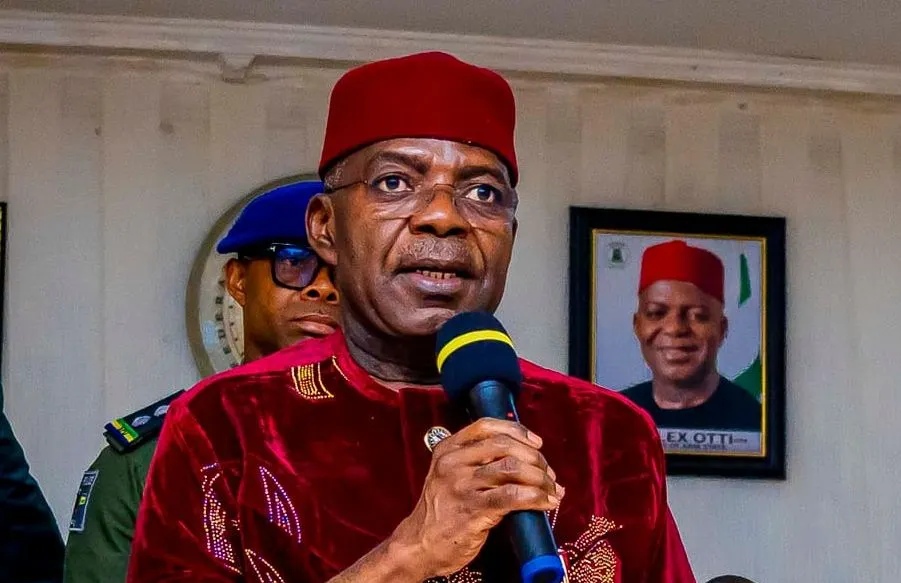
A chieftain of the All Progressives Congress (APC) in Abia State, Prince Paul Ikonne, has called on Governor Alex Otti to provide clarity on the alleged ₦54 billion school renovation expenditure, accusing him of distracting the public with contradictions.

Governor Otti, during his monthly media chat last weekend, dismissed claims that ₦54 billion was missing from the state treasury, describing the allegations as baseless and stemming from ignorance about government budgeting and spending.

Reacting in a statement signed by his Chief Press Secretary, Ujo Justice, Ikonne questioned why a governor who prides himself on having “seasoned accountants” in his administration would contradict his own government’s records.

Advertisement

He insisted that Abians deserve answers on “where the schools are, and where the ₦54 billion went.”

The APC stalwart recalled that similar sums had been earmarked in the past, including ₦18 billion reportedly set aside for school renovations, with little to show on the ground.

Citing a recent online investigative report, Ikonne noted that official budget
performance documents contradict Otti’s claims.

According to the report, Abia State recorded ₦54.066 billion spent on rehabilitation and repairs of public schools in the last quarter of 2024 alone, while total expenditure for the fiscal year stood at ₦58.323 billion.

Advertisement

Ikonne argued that if the governor insists only ₦2.1 billion was spent on schools, then he must explain why his own administration’s records show otherwise.

He further pointed to the approved 2024 budget, which allocated ₦64.7 billion for the renovation or modelling of 51 schools, averaging ₦1.26 billion per school — a figure he said raises more questions than answers.

The APC leader urged Governor Otti to be transparent and accountable, stressing that education is too critical an issue for Abians to be left in the dark.

“This data,” Ikonne stressed, “makes it clear that the governor is either deliberately misleading Abians or is unaware of what his government is signing off.”

Advertisement

He welcomed the Freedom of Information (FOI) request submitted by the Foundation for Environmental Rights, Advocacy & Development (FENRAD), which is demanding a breakdown of the ₦54 billion, including the list of schools supposedly renovated, their names, locations, and the nature of works done.

“Governor Otti should stop hiding behind semantics. Budgets are estimates, but expenditures are facts. The documents clearly show ₦54 billion was reported as spent between October and December 2024. If he disputes this, let him publish the schools. Abians are not asking for excuses — we are asking for evidence,” Ikonne said.

The APC chieftain concluded by urging the governor to prioritize truth over propaganda. He added that Dr. Otti should realize that leadership is about accountability, not storytelling. He cannot claim to be the face of transparency while avoiding the simplest of questions: show us the schools.

Advertisement
Continue Reading
Advertisement
Click to comment

Warning: Undefined variable $user_ID in /home/naijuinz/public_html/wp-content/themes/zox-news/comments.php on line 49

You must be logged in to post a comment Login

Leave a Reply

News

PenCom, ICPC recover over N3b un-remitted pension contribution

Published

on

ADVERTISEMENT
Zoom Ad
ADVERTISEMENT
Zoom Ad

By Kayode Sanni-Arewa

The Independent Corrupt Practices and Other Related Offences Commission (ICPC) in partnership with the National Pension Commission (PenCom) have recovered over N3 billion un-remitted pension contributions from employers.

In a statement signed by the Commission, the recovery was achieved through an ICPC-PenCom enforcement initiative aimed at addressing pension contribution defaults and protecting the retirement savings of workers.

“The recovered funds, obtained from defaulting employers in the electricity sector, have been fully remitted into the respective Retirement Savings Accounts (RSAs) of affected employees in accordance with the provisions of the Pension Reform Act (PRA) 2014.

Advertisement

The recovery demonstrates the effectiveness of the partnership between PenCom and ICPC in enforcing compliance with the PRA 2014 and ensuring that employers fulfil their statutory pension obligations.

PenCom had earlier signed a Memorandum of Understanding (MoU) with ICPC in October 2025 to establish a framework for collaboration on the recovery of unremitted pension contributions, investigation of pension-related infractions, and enforcement of compliance with the PRA 2014.

The ICPC is currently investigating several private sector employers referred by PenCom for non-compliance with the PRA 2014. With the ongoing collaboration, additional recoveries would be achieved as the investigations progress, under the PRA 2014, employers are required to deduct and remit pension contributions into employees’ RSAs within seven working days from the payment of salaries,” the statement read.

The statement added that failure to comply with this requirement constitutes a violation of the law and attracts sanctions, including the recovery of outstanding contributions, penalties and, where necessary, prosecution. All employers, particularly those in the private sector, are required to regularize their pension remittances and ensure full compliance with the provisions of the PRA 2014 to avoid regulatory and enforcement actions.

Advertisement

PenCom reaffirms its commitment to protecting the retirement savings of workers, promoting compliance with the Contributory Pension Scheme (CPS), and ensuring that pension contributions deducted from employees are promptly remitted into their RSAs.

Continue Reading

News

Mixed reactions trail FG’s decision to replace NYSC khaki with Adire

Published

on

ADVERTISEMENT
Zoom Ad
ADVERTISEMENT
Zoom Ad

By Francesca Hangeior

The federal government’s decision to replace the National Youth Service Corps (NYSC) khaki uniform with Adire fabric has sparked mixed reactions, with many Nigerians divided over whether the move promotes local industry or undermines one of the scheme’s strongest national symbols.

Minister of Youth Development, Ayodele Olawande, confirmed the change on Thursday during an appearance on Channels Television’s The Morning Brief, saying the initiative was designed to boost local textile production and keep government spending within the country.

“It’s Adire. Adire is being produced in Nigeria. We have them in Ogun; we have them in Kwara; we have textile industries. Let’s put our money back into the country,” the minister said.

Advertisement

The announcement follows Monday’s approval by the Federal Executive Council (FEC) of the most extensive reforms to the NYSC since the scheme was established in 1973.

However, the proposed uniform change has generated widespread debate on X, with opinions sharply divided.

Opposing the proposal, @totematthew wrote: “Adire? Reforms should be thoroughly reviewed and deliberated before being presented to the public. Adire is a cultural heritage of the Yorubas. How then do you translate same to a uniform.

Echoing that sentiment, @skood009 said: “I’m Yoruba, and I honestly don’t think picking Adire alone reflects the full diversity of Nigerian culture. Adire is specifically Yoruba heritage. They should have chosen something that represents the Yoruba, Igbo, and Hausa cultures collectively, or better still, have three different attires representing each major ethnic group equally.”

Advertisement

For @ennyola0015, the issue was preserving the NYSC tradition. “People resist change, and this is one of the few changes I will vehemently resist. Replacing the iconic khaki with Adire as the NYSC uniform is unnecessary. Instead, Adire should be reserved for special occasions such as Passing Out Parades, cultural events, and community service activities.”

@OlajideAlabi1 also argued for retaining the existing uniform. “Naah, I do not think this is a good idea, it can be used for special occasions within the service year, but I think the NYSC uniform should be retained for continuity… it’s iconic.”

Others questioned whether the proposal addressed the scheme’s most pressing challenges

@mrkaydeed wrote, “You mean a committee sat down, reviewed the challenges facing NYSC, and decided that replacing khaki with Adire was the best use of their time? What are they smoking in this administration?”

Advertisement

In a similar vein, @nailzbyjae posted: “Peak governance: solve problems nobody complained about. If changing khaki to Adire is the biggest youth development idea on the table, then we’re in bigger trouble than we thought.”

Another user, @omonoile, criticised the proposal, saying: “The way Tinubu monopolized Lagos and everybody started doing whatever they like, is the same thing he is doing right now in Nigeria. What do you mean NYSC uniform will change to Adire.”

Others, however, defended the reform

@btunddej argued: “For over 50 years, Nigerian graduates have proudly worn a uniform whose origins lie in colonial India through the British Empire… If Nigerians could embrace a fabric with Indian and colonial origins as a national symbol, perhaps we can at least give a Nigerian-made textile with Yoruba origins an opportunity to earn that same status.”

Advertisement

He added: “The question is not whether Adire is Yoruba in origin; it clearly is. The real question is… what indigenous alternative comes closer in function and practicality? Not every national symbol begins as national.”

Supporting the government’s economic argument, @ImanaGodwin wrote: “This is actually a good idea. We need to start patronizing made in Nigeria product. It boost our economy there by strengthen the naira. The only issue is Adire belongs to Yoruba people.”

Also welcoming the proposal, @jpremewwcoin said: “From khaki to Adire is one reform nobody saw coming. If implemented, it would be one of the biggest visual changes in NYSC history. After decades of the same look, corps members might finally have a uniform that reflects a bit more Nigerian culture and identity.”

Advertisement
Continue Reading

News

Why there is heavy security presence in Abuja — Security agencies

Published

on

ADVERTISEMENT
Zoom Ad
ADVERTISEMENT
Zoom Ad

By Francesca Hangeior

Security agencies on Thursday explained the reason behind the heavy deployment of security personnel and barricades across parts of Abuja’s city centre.

They assured residents and visitors that the measures are routine and aimed at maintaining law and order amid increasing protests in the Federal Capital Territory.

The barricades, which have been mounted at strategic locations in the city centre in recent days, have caused gridlock and delays for thousands of motorists, civil servants and other workers moving to and from offices in the Federal Capital Territory.

Advertisement

Responding to concerns over the security measures during a joint media briefing by security and intelligence agencies, Force Public Relations Officer, CSP Anietie Iniedu, assured residents that there was no security threat warranting panic.

“It is a joint operation. There is no cause for alarm at the moment,” Iniedu said.

He explained that the security agencies had observed an upsurge in protests within the city centre and had consequently intensified security deployments to ensure public safety.

“We’ve noticed that there has been an upsurge of protests in the city centre, and we’re trying to maintain law and order as is our basic and primary responsibility. The deployments are basically deployments with movement from one location to the other to ensure that our city centre is safe,” he said.

Advertisement

The police spokesman stressed that the heightened security presence was particularly important because Abuja serves as Nigeria’s capital city and hosts diplomatic missions, government institutions and foreign investors.

“Remember, we’re in the capital, and there’s a lot that has to be done to ensure confidence in those in the city centre and also for our foreign investors,” he added.

Speaking further, Iniedu said the Nigeria Police Force had expanded its security strategy beyond intelligence-led policing to what he described as “intelligence-led community collaborative policing.”

He said the approach recognises that intelligence gathering alone is insufficient to tackle emerging security threats and therefore places greater emphasis on collaboration with local communities.

Advertisement

“We’ve seen that intelligence alone won’t help us. We have gone far to create collaborative processes with our communities,” he said.

Also speaking, Kingsley Amako of the National Coordination Office of the Nigerian Financial Intelligence Unit said security agencies had continued to strengthen intelligence gathering and financial surveillance to combat terrorism financing.

“We have very robust intelligence-gathering mechanisms. As they are evolving into new tricks and changing their tactics, we are also evolving with them,” Amako said.

He noted that while some security operations could not be disclosed publicly, agencies were working collaboratively to counter evolving threats and urged the media to engage security institutions whenever clarification was required.

Advertisement
Continue Reading

Trending

Copyright © 2024 Naija Blitz News