Connect with us

News

FG approves new NYSC regulation – thesis, report’s submissions now mandatory for participants

Published

on

ADVERTISEMENT
Zoom Ad
ADVERTISEMENT
Zoom Ad

By Kayode Sanni-Arewa and Faith Abdulkadiri

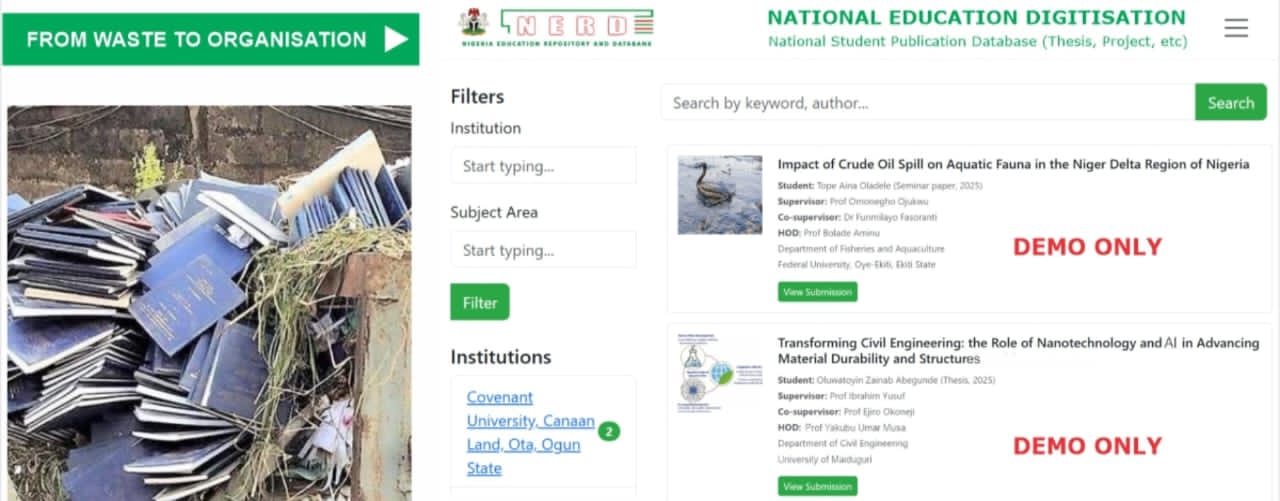
In a decisive move, President Bola Ahmed Tinubu has invoked provisions in Sections 2(4)(4) and 16(1)(C) of the NYSC Act, and approved a far-reaching reform that makes compliance with the National Policy for the Nigeria Education Repository and Databank (NERD) a mandatory requirement for mobilisation into or exemption from the National Youth Service Corps (NYSC).

The compliance directive was Item 2(ix) in an enforcement circular recently issued by the Secretary to the Government of the Federation, Senator George Akume, who conveyed the approval for the adjustment of “NYSC mobilisation criteria in accordance with the President’s regulation requiring proof of NERD Policy compliance for all prospective Corps members, regardless of where they were educated.”

Apart from provisions in the policy meant to check certificate racketeering and honour abuse, one of the new mandatory requirements of Nigerian students in the policy is the deposit of academic outputs, which include thesis or project reports.

Advertisement

In Section 6.1.23 of the policy, the requirement is designed “as a quality assurance check and as a yearly independent proof of continuous academic enrolment and affiliation” as it is expected to inviolably time-stamp scholarship, academic activities, and footprint regardless of location.

Earlier in March 2025, while issuing the Declaration of Effectiveness for NERD, the Minister of Education, Dr. Tunji Alausa, stated that following the declaration, “the approved stipulations for mandatory submission of academic outputs as provided in Sections 2.3, 4.3(1), and 7.6.11(c), among others, of the approved National Policy for the NERD Programme shall become obligatory requirements in Nigeria.”

He further stated that “the NERD Policy applies in equal
measures to all education delivery institutions regardless of ownership type (public, private, military or civilian) whether within or outside the direct supervision of the Federal Ministry of Education, such as Colleges or Schools of Nursing, Agriculture, specialised research
centres and institutes, etc.”

The SGF circular has now clarified that, effective from October 6, no Nigerian graduate – whether from a Nigerian university, polytechnic, college of education, or an overseas institution will henceforth be mobilised for or exempted from NYSC without proof of NERD compliance.

Advertisement

This bold step is a masterstroke in safeguarding the nation’s intellectual assets while restoring credibility to academic processes and qualifications.

The directive does not, however, affect serving Corps members or those enrolled before the enforcement date.

A copy of the approved NERD policy obtained by our correspondent shows that the President also approved an academic output monetisation and reward mechanism for students and their lecturers, which was proposed to the Federal Cabinet by Alausa to ensure students and lecturers can earn lifetime revenues from their academic deposits.

The policy encourages each higher institution to set up its local repository.

Advertisement

More significantly, the policy creates an illuminated pathway with a well-structured collaborative framework where the various autonomous institutions had hitherto operated as silos.

The Federal Government’s circular to Ministries, Departments, Agencies (MDAs), and higher institutions of learning (public and private, civilian and military alike) directs full enforcement of the NERD Policy.

In addition, critical data bodies, including the National Identity Management Commission (NIMC), are to provide inter-organisation data exchange support via Application Programming Interfaces (APIs) to facilitate onboarding and data validation.

Underscoring the significance of the directive, spokesperson for NERD, Haula Galadima, explained that each item deposited by a student shall feature the full name of the student, and those of his supervisor, co-supervisor, if any, and that of the Head of Department, as well as the sponsoring institution and department.

Advertisement

Providing insight, she stated that “apart from the mandate to verify for authenticity as a national flagship, the NERD digitisation programme has a clear objective – to raise the bar in the quality of academic content, output and presentation nationwide. One way NERD intends to accomplish this task, based on its mandate, is to strengthen the supervision processes in the nation’s higher institutions without getting involved in the processes. If our eminent scholars are aware that their names will appear next to those of the students they supervise on a globally available digital platform, there is the likelihood that each lecturer would up his or her standard. Very few lecturers would want their names associated with poorly produced academic works. NERD is therefore poised to help each lecturer earn his ‘earned allowances’ by providing thorough supervision.”

Galadima had earlier stated that the onboarding process for all higher institutions, MDAs and corporate organisations is through https://ned.gov.ng/onboarding

● Why it matters

The NERD Policy is Nigeria’s answer to decades of intellectual waste. For too long, thousands of theses, dissertations, and research projects – brimming with insights capable of transforming agriculture, medicine, engineering, and governance – have gathered dust in libraries, unorganised and untapped.

Advertisement

The NYSC will now serve as a quality assurance check to enhance national productivity with a legal mandate to ensure all graduates are contributors to the national pool of knowledge.

Apart from the digitisation of current manuscripts, NERD is also designed to help institutions digitise their historical academic records and publications.

The NERD digital platform will organise, classify, and warehouse over 90 years’ worth of academic research across all Nigerian tertiary institutions and serve as a collaborative hub for Nigerian educational institutions, going back to when institutions like Yaba Higher College, which was established in 1932 or the University College Ibadan in 1948.

President Tinubu’s directive on enforcement means Nigeria can now classify, safeguard, and preserve its historical body of knowledge, converting academic outputs into real economic and development values.

Advertisement

In doing so, the administration is not only protecting, enhancing, or preserving intellectual properties but also laying the foundation for innovation-driven growth and competitive intellectual output commercialisation.

● Stakeholders’ response

This NERD initiative reflects President Tinubu’s broader agenda of renewed hope through institutional reforms. By linking NYSC mobilisation directly to the NERD framework, he has demonstrated an unmatched statesman’s acumen and a rare political will to enforce standards and restore dignity to Nigeria’s education sector in a systemic manner.

Educational stakeholders have applauded the NERD programme. According to Haruna Abdullahi, an energy expert and Associate Professor of Physical Chemistry at the Federal University Dutsin-Ma, Katsina State, “NERD is a game changer. There is a part that addresses our publishing needs as lecturers – the national publication indexing service. People talk less about that. That aspect is for lecturers. It creates an acceptable national indexing alternative for academics that can match the best globally and be acceptable for promotion and other career-related objectives. That is a win-win as it will, in turn, let the nation set its research agenda.”

Advertisement

Abdullahi opined that “for young Nigerians preparing for NYSC, the message is equally clear: your thesis, dissertation, or project is no longer a mere graduation requirement – it is an asset kept in trust for you and for the future of the nation. It’s also saying your project work or thesis is important. Long after your graduation, it can be accessed online, referenced for improvements, or simply to determine the kind of student you were!”

Also, Prof. Adenike Adeniji, the first female Vice Chancellor of the Federal University of Technology Akure (FUTA), spoke at the NERD stakeholders meeting in Abuja that she hoped that the NERD programme “kicks start immediately”, stating that “this is something that we all have been expecting. It should have happened a long time ago, but now that we are in it, there should be no delay again. Coming from the education sector, we know the pressure we face from time to time trying to meet the needs of our students. I think at this time, we are getting it right.”

Similarly, former Vice Chancellor of the Adekunle Ajasin University Akungba Akoko, Prof. Igbekele Ajibefun, who is the incumbent Commissioner for Education in Ondo State, described the NERD Programme as ranking “among the most important reforms in the education sector since 1999.”

Ajibefun, who had earlier commended the Minister of Education, Alausa, for the NERD Programme, added that “NERD sends a clear message to education stakeholders, administrators, lecturers, students, institutions, and corporate businesses alike: Nigeria values education integrity – it values its intellectual capital, and that the President is ready to champion the process.”

Advertisement

● Looking Ahead

From 30 March each year, all organisations and higher institutions must now file annual compliance reports to NERD, enhancing monitoring and evaluation to ensure sustainability, continuity, and accountability. The ripple effect is expected to boost the credibility of Nigerian publications and certifications globally, discourage academic output waste, eliminate opportunities for academic fraud, and strengthen confidence in Nigerian graduates as valuable contributors to national and international development.
Continue Reading
Advertisement

News

Obi’s TV interview exposed lack of policy depth — presidential aide

Published

on

By

ADVERTISEMENT
Zoom Ad
ADVERTISEMENT
Zoom Ad

Senior Special Assistant to the President on Public Engagement, Frederick Nwabufo, on Monday criticised the presidential candidate of the Nigeria Democratic Congress (NDC), Peter Obi, describing his recent television interview as further evidence of what he called the opposition leader’s lack of policy depth and understanding of governance.

Reacting in a post on his verified X handle, @FredrickNwabufo, to Obi’s appearance on Channels Television on Sunday night, Nwabufo said the interview showed the NDC candidate had failed to articulate any concrete alternative policy direction.

“Peter Obi’s interview shows him again to be vacant of deep thought, understanding of governance, and taken up by syrupy rhetoric. He still has no plan, no alternative, and no policy plank, beyond a mouthful of sentimental nothings”, he said.

The presidential aide also faulted Obi’s claim that he would unite Nigeria, arguing that the opposition candidate failed to explain how he intended to achieve that objective.

Advertisement

“Obi claimed he would unite Nigeria, but failed to explain how beyond the tired refrain of his cooks and ADC being northerners”, Nwabufo said, adding that “his utterances, actions, and those of his followers have but deepened the chasm”.

According to him, national cohesion is built on “inclusive governance, economic integration, and equitable citizenship”, stressing that “the balancing forces of national cohesion are governance and the economy”.

He argued that strengthening national unity requires governments to ensure that “public resources are delivered to all citizens regardless of faith, ethnicity, or social standing and that the government is fair and just to all”.

Nwabufo said President Bola Tinubu had demonstrated those principles by ensuring that “the six geopolitical zones are equal beneficiaries of its programmes, initiatives, and projects, and indeed, all the accruals of governance”.

Advertisement

He further cited the administration’s appointments into public offices, saying, “He appointed young professionals from diverse backgrounds at an unprecedented scale. For the first time in the evolution of Nigeria, young people are superintending strategic sectors of government”.

The presidential spokesman also defended the President’s approach to national leadership, saying Tinubu had addressed concerns over the composition of the nation’s service chiefs while maintaining a unifying posture.

“There was a time, not so long ago, when the ethnic composition of the service chiefs was often a sore point for controversy, but in his true form as an architect of unity, balancing competence and patriotism, the President put an end to the concerns with wisdom”, he said.

He added that “President Tinubu, by his body language and extempore utterances, has maintained a nationalist and unifying position, bringing all together, and not given to divisive rhetoric. He has continued on the unifier’s path, stitching the national fabric, building a more cohesive nation and forging a shared future for us all”.

Advertisement

Responding to Obi’s criticism of the Renewed Hope Agenda, Nwabufo said the opposition candidate had failed to acknowledge what he described as visible gains from the administration’s reforms.

“Obi needs to get off the high of his rabid movement. The unmistakable trail of Renewed Hope shimmers across all villages, towns, cities, and local government areas in all six geopolitical zones”, he said.

He disclosed that members of the Presidential Communications Team had toured the country’s six geopolitical zones “to see things for themselves, feel the pulse of Nigerians, and conduit feedback to the government”.

Nwabufo added that the administration had documented evidence of economic improvements and transformative programmes, including the Nigerian Education Loan Fund (NELFUND) and interventions by the Small and Medium Enterprises Development Agency of Nigeria (SMEDAN).

Advertisement

“If Obi cares, there’s a digital binder full of reports of Nigeria’s economic turnaround under the current administration, inclusive of many transformative projects, policies, and programmes, such as NELFUND, that are impacting Nigerians at the critical cellular level”, he said.

He concluded that “under Renewed Hope, that hardworking young trader in Amatutu village in Agulu, Anambra can now get support for his small business through SMEDAN, and that brilliant child in Mopa Muro can go to university through NELFUND without the constraints of finance. This is simply Renewed Hope manifest”.

Continue Reading

News

Lagos varsity unions issue seven-day ultimatum, threaten indefinite strike

Published

on

By

ADVERTISEMENT
Zoom Ad
ADVERTISEMENT
Zoom Ad

Workers’ unions across Lagos State-owned universities have given the Lagos State Government a seven-day ultimatum to address their outstanding demands or face an indefinite strike.

The unions also called on the state government to immediately implement the Federal Government’s agreements with the Academic Staff Union of Universities (ASUU), Senior Staff Association of Nigerian Universities (SSANU) and National Association of Academic Technologists (NAAT), which they said took effect from January 1, 2026.

They further demanded the release of funds for the payment of the N50,000 palliative promised to staff on May 1, 2026, warning that failure to meet their demands within the stipulated period would trigger an indefinite industrial action.

The ultimatum was announced on Monday at a joint press conference organised by the Joint Action Committee (JAC) of Lagos State-owned universities at the Lagos State University (LASU), Ojo campus.

Advertisement

The briefing was attended by representatives of ASUU, the Non-Academic Staff Union (NASU), SSANU and NAAT, who urged the government to take urgent steps to avert a disruption of academic activities across the state-owned institutions.

The affected institutions are Lagos State University (LASU), Lagos State University of Science and Technology (LASUSTECH), Lagos State University of Education (LASUED) and Lagos State University College of Medicine (LASUCOM).

Speaking on behalf of the unions, Chairman of ASUU-LASU, Prof. Ibrahim Bakare, said Governor Babajide Sanwo-Olu had announced on May 1, 2026, that all Lagos State workers would receive a N50,000 palliative, adding that the official communication from government indicated that tertiary institutions were included in the arrangement.

According to him, while workers in the Lagos State Civil Service received the payment, staff of the state-owned universities were excluded despite repeated engagements with university management and government officials.

Advertisement

Bakare said the unions had written to and held consultations with the offices of the governor, deputy governor, commissioners for Tertiary Education and Establishments and Training, the Head of Service, the Speaker of the Lagos State House of Assembly, the Accountant-General and relevant permanent secretaries in an effort to resolve the matter.

He, however, expressed disappointment over what he described as an unsatisfactory response from the government, noting that a letter received by the unions was vague and failed to provide a clear commitment towards implementing the governor’s promise.

“We explored every peaceful and reasonable avenue available to us because we believe in dialogue. Unfortunately, our members have become exhausted and can no longer continue to wait while other categories of public servants have received the payment,” he said.

Bakare disclosed that after consultations across the affected institutions, the unions resolved to issue a seven-day ultimatum to enable the government process the necessary approvals and release the funds.

Advertisement

He warned that failure to meet the demand before the expiration of the ultimatum would compel the unions to determine their next line of action, including embarking on industrial action.

“We pray industrial action does not happen, but if we are pushed to that point, we will have no other option. We cannot continue to allow our members to suffer under the current economic realities,” he said.

Bakare said Lagos had accumulated seven months of outstanding liabilities under the Federal Government agreements, despite assurances previously given by the Deputy Governor,  Obafemi Hamzat that future federal agreements would be implemented promptly to avoid a backlog of arrears.

He noted that several state-owned universities in Ekiti and Osun states had already implemented the agreements, describing Lagos State’s delay as surprising for a state regarded as one of the country’s most developed.

Advertisement

The unions also renewed calls for the fulfilment of other welfare commitments, including the release of staff buses promised by Sanwo-Olu and the resolution of the outstanding 20 per cent salary-related issue discussed during previous negotiations with the government.

Also speaking, Chairman of NASU-LASU, Comrade Obafemi Sanni, said the unions were forced to issue the ultimatum because of what he described as the government’s lackadaisical attitude towards implementing agreements affecting workers in tertiary institutions.

He maintained that if the government failed to act before the ultimatum expires, the unions would have no alternative but to embark on an indefinite industrial action.

The unions said they remain committed to dialogue but insisted that the welfare of workers must receive urgent attention to sustain industrial harmony across Lagos State-owned universities. Union representatives from other universities appealed to the state  to accede to their demands,noting that many of their members were dying.

Advertisement
Continue Reading

News

Kidnappers demand N200m to free abducted Kebbi High Court Judge

Published

on

By

ADVERTISEMENT
Zoom Ad
ADVERTISEMENT
Zoom Ad

Kidnappers holding Kebbi State High Court Judge, Justice Faruku Hassan Bunza, have demanded a N200 million ransom from his family for his release, as security operatives intensify efforts to rescue him.

Kebbi State Commissioner of Police, Umar Muhammad Hadejia, disclosed the ransom demand while briefing journalists on Monday in Birnin Kebbi.

He said the police received intelligence on the demand after launching a swift response to the judge’s abduction, which occurred in the early hours of Sunday at his residence along Zogirma Road in Bunza.

According to Hadejia, the Command has deployed a combined team of police operatives to comb suspected escape routes used by the kidnappers in a bid to rescue the judge unharmed and apprehend those responsible.

Advertisement

He added that multiple checkpoints had been mounted along strategic routes believed to have been used by the abductors to prevent their escape.

The police commissioner expressed confidence that the ongoing operation would lead to the safe rescue of the judge and the arrest of the kidnappers.

Hadejia also confirmed the killing of a suspected kidnapper, Abdulaziz Dogo, and the arrest of another suspect, Ibrahim Abdulwahab, both residents of Ilesha in Kwara State, over the abduction of former Kebbi State Deputy Speaker, Muhammad Samaila Bagudo, on October 31, 2025.

He advised residents, particularly government officials, to avoid travelling late at night, warning that such journeys expose them to attacks by bandits and kidnappers.

Advertisement

The commissioner said the judge’s family informed the police that he frequently travelled at night despite repeated warnings.

He added that the family also reported that the kidnappers had contacted a registrar of the High Court in Abuja regarding negotiations over the N200 million ransom.

Continue Reading

Trending

Copyright © 2024 Naija Blitz News