Connect with us

News

Presidency, CAN clash over Christian genocide claim

Published

on

ADVERTISEMENT
Zoom Ad
ADVERTISEMENT
Zoom Ad

The Christian Association of Nigeria on Monday accused the Presidency of misrepresenting its position on the alleged killing of Christians in Nigeria, describing a statement released after a recent meeting with presidential aide, Daniel Bwala, as false, misleading, and insensitive.


CAN said the Presidency’s version of the meeting gave the false impression that the association dismissed claims of a “Christian genocide” in Nigeria, a position it described as “completely untrue and unfair.”

But reacting to CAN during an interview on Arise TV on Tuesday, Bwala maintained his stance, insisting that there is no Christian genocide under the current administration of President Bola Tinubu.

The presidential aide contended that the report CAN based its claim of genocide on was outdated.

Advertisement

“Anybody who believes in research will look at the methodology,” Bwala said. “That report’s data came from local media, NGOs, and unnamed development partners who, ironically, were the ones that introduced the issue of religion into the study.”

The controversy followed a visit by Bwala, the Special Adviser to the President on Media and Policy Communication, to the CAN Secretariat at the National Christian Centre, Abuja, on Monday, October 20, 2025.

Following the visit, a statement titled “Presidency Debunks Western Christian Genocide Narrative in Dialogue with CAN Leadership” circulated online, quoting CAN President, Archbishop Daniel Okoh, as allegedly describing the crisis as a “so-called genocide.”

Reacting on Tuesday, Archbishop Okoh said the portrayal of the meeting was a deliberate attempt to distort facts and downplay the suffering of Christians who have been victims of repeated attacks across the country.

Advertisement

Giving its version of the meeting, CAN said, “During the visit, Barrister Bwala sought to understand CAN’s position regarding the global reactions to remarks by United States Senator Ted Cruz, who described the widespread attacks on Christian communities in Nigeria as a ‘Christian genocide.’

“He noted that both Christians and Muslims have suffered from insecurity, adding that the current administration inherited the problem and is working to address it. CAN made it clear that its position on this issue has long been established and remains unchanged.”

CAN insisted that at no point during the meeting did its President or any member of its delegation downplay the killings or question their genocidal nature.

“That portrayal is completely false and grossly unfair. The meeting was recorded by CAN’s media team, and at no point did Archbishop Okoh use such words or express such a view.

Advertisement

“Referring to the tragedy as a ‘so-called genocide’ trivialises the pain of countless Christians who have lost loved ones, homes, and places of worship in targeted attacks,” Okoh said.

He stressed that CAN’s position on the killings has long been established and remains unchanged, adding that referring to the tragedy as a “so-called genocide” trivialises the pain of thousands who have lost loved ones, homes, and places of worship in targeted attacks.

Okoh explained that during the meeting, CAN’s Director of Planning, Research and Strategy, Bishop Mike Akpami, presented verified data from www.orfa.africa showing consistent and targeted attacks on Christian communities across several regions of Africa, including Nigeria.

He said the association’s stance was rooted in evidence and not emotion, insisting that the killings bore clear signs of systematic persecution.

Advertisement

CAN further accused the Presidency of attempting to blunt international scrutiny by twisting its remarks.

“The Christian Association of Nigeria wishes to correct recent media reports following the visit of Barrister Daniel Bwala. At no point did we dismiss the reality of Christian persecution. Any suggestion to that effect is false,” the statement said.

The association urged government officials and the media to communicate responsibly on issues as sensitive as faith-based violence, warning that careless statements could “deepen wounds and undermine peace.”

It also renewed its call on the Federal Government and security agencies to act decisively and transparently to halt the killings and bring perpetrators to justice.

Advertisement

“We call on the government to act with urgency, fairness, and empathy. Words must match action if peace and justice are to prevail,” CAN stated.

However,the Presidency dismissed claims by the CAN, insisting there is no Christian genocide in Nigeria.

Bwala, who spoke during an interview on Arise News’ Prime Time on Monday, faulted CAN’s reliance on a report compiled by the Observatory for Religious Freedom in Africa, covering the period between October 2019 and September 2023, with only four months overlapping with the Tinubu administration.

“Anybody who believes in research will look at the methodology,” he said, adding, “That report’s data came from local media, NGOs, and unnamed development partners who, ironically, were the ones that introduced the issue of religion into the study.”

Advertisement

He further noted that within the ORFA report, the findings acknowledged that both Muslims and Christians have been victims of attacks by violent groups such as Boko Haram and bandits.

“Muslims are killed by the same groups that kill Christians, Muslims are abducted by the same groups that abduct Christians, only in different proportions,” Bwala explained.

He added that the report’s statistical breakdowns do not meet the threshold to justify claims of genocide, emphasising that genocide, by definition, involves a coordinated, intentional effort, often state-led, to eliminate a particular group based on identity.

“How can you, in all honesty, use a proportional report to establish genocide?” Bwala queried.

Advertisement

“Even the organisation that published the data never described it as genocide,” he added.

Bwala said the Observatory for Religious Freedom in Africa, which published the report, was founded in the Netherlands and has conducted research exclusively in Nigeria.

He argued that this narrow focus and reliance on unverifiable sources undermine its credibility.

He also faulted U.S. Senator Ted Cruz’s recent statement describing Nigeria as a site of Christian genocide, saying such claims were “politically motivated and detached from verified facts.”

Advertisement

“The Nigerian government is not part of any genocide,” Bwala said firmly, adding, “President Tinubu has been consistent in pursuing peace, security, and unity across all regions, and his administration’s actions contradict the narrative of persecution.”

Sultan, Kukah dismiss genocide claim

Meanwhile, the Sultan of Sokoto, Alhaji Sa’ad Abubakar III, and the Catholic Bishop of Sokoto Diocese, Matthew Hassan Kukah, have both dismissed claims of genocide against Christians in northern Nigeria, describing such allegations as misleading, divisive, and potentially harmful to the country’s fragile peace.

Speaking separately in Birnin Kebbi and the Vatican City on Tuesday, the two prominent clerics urged Nigerians and the international community to exercise restraint, emphasising that recent narratives of “religious persecution” risk undermining ongoing interfaith reconciliation efforts.

Advertisement

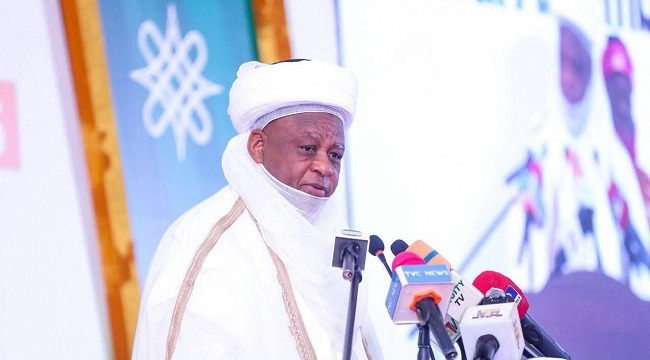
At the opening of the Northern Traditional Rulers Council meeting in Birnin Kebbi, the Sultan, who is also Chairman of the Council, said the allegations were “false and destabilising,” insisting that Christians and Muslims in the North have coexisted peacefully for centuries.

“Those alleging genocide must come forward with proof,” Abubakar said. “From time immemorial, Christians and Muslims in the North are brothers. Such falsehoods are only meant to sow discord among inseparable faithful.”

He commended the Nigerian Army for its efforts in restoring peace across the country, adding: “Without the military, we wouldn’t be here today holding this meeting in peace and comfort. We must continue to encourage and support them to do more.”

The monarch also warned against the reckless use of social media, which he said was fuelling misinformation, and urged the Federal Government to strengthen regulation of online platforms.

Advertisement

In his remarks at the same event, the Chief of Defence Staff, Gen. Christopher Musa, pledged that the armed forces remain determined to “defeat bandits and insurgents,” while Kebbi State Governor, Dr Nasir Idris, reaffirmed his administration’s support for security agencies, dismissing reports that the state hired foreign security contractors.

Meanwhile, in the Vatican City, Bishop Kukah cautioned against renewed calls to designate Nigeria as a “Country of Particular Concern” over alleged religious persecution, warning that such action could damage national reconciliation and embolden extremists.

Speaking at the launch of the Aid to the Church in Need’s 2025 World Report on Religious Freedom, Kukah acknowledged ongoing security challenges but said the administration of President Bola Tinubu had shown “genuine signs of inclusion” that deserved encouragement rather than punishment.

“Acts of impunity still persist,” he said, “but re-designating Nigeria a Country of Concern will hurt the initiatives we are working on with the current government. It will increase tensions, sow doubt, and allow criminals to exploit the situation.”

Advertisement

The cleric’s remarks followed renewed agitation in the United States after Senator Ted Cruz alleged that over 50,000 Christians had been killed in Nigeria since 2009.

Kukah said while Nigeria was “still bleeding,” Tinubu’s early steps had helped rebuild trust, citing the appointment of Christians to key positions, including the Chief of Army Staff and the National Security Adviser, as evidence of balance and inclusion.

“The President and the Vice President are Muslims, yet Christians have not felt alienated,” he said. “These are confidence-building measures aimed at inspiring citizens’ sense of belonging.”

He contrasted the Tinubu administration’s approach with that of former President Muhammadu Buhari, accusing the latter of deepening divisions through sectarian appointments that “gave legitimacy to the persecution of Christians.”

Advertisement

“The last eight years marked the worst phase in the history of interfaith relations in Nigeria,” Kukah said. “That administration gave oxygen to jihadists by virtue of its policies which overtly favoured Islam and northern Nigeria.”

Both religious leaders, however, agreed that Nigeria’s path to peace lies in unity, interfaith cooperation, and the rejection of divisive rhetoric.

Credit: PUNCH
Advertisement
Continue Reading
Advertisement

News

Certified True Copy of court judgment ordering NDC deregistration emerges (Photos)

Published

on

By

ADVERTISEMENT
Zoom Ad
ADVERTISEMENT
Zoom Ad

The Certified True Copy (CTC) of the Federal High Court judgment ordering the deregistration of the Nigeria Democratic Congress (NDC) has emerged.

The ruling, delivered by Justice Isa H. Dashen of the Federal High Court, Lokoja Judicial Division, set aside the court’s earlier judgment of December 10, 2025, which had directed the Independent National Electoral Commission (INEC) to register the NDC as a political party.

According to the judgment, the earlier decision was nullified because it affected the legal rights of the Peace Movement Party (PMP), which claimed ownership of the logo used by the NDC but was not joined as a party in the original suit.

Following the ruling, INEC is expected to remove the NDC from its list of recognised political parties.

Advertisement

However, the commission has maintained that it will act only after reviewing the Certified True Copy of the judgment.

INEC National Commissioner and Chairman of the Information and Voter Education Committee, Mohammed Kudu Haruna, said the commission had applied for the court document before taking any decision.

> “We have applied for the Certified True Copy of the judgment. Until we receive it, we cannot be in a position to comment on it. However, the position that existed before the December 10, 2025 judgment was that INEC rejected NDC’s letter of intent to be registered as a political party,” Haruna said.

The development comes as the NDC continues to face challenges ahead of the 2027 general elections.

Advertisement

The party has alleged that it was denied the portal access code required to upload the names of its candidates to INEC’s nomination portal, a situation it says threatens the political aspirations of its presidential candidate, Peter Obi, vice-presidential candidate Rabiu Kwankwaso, and other party candidates.

INEC recently shifted the release of portal access codes from June 26 to Monday, June 29, to streamline submissions by eligible political parties.

Under the commission’s timetable, presidential and National Assembly candidates are expected to upload their nomination forms between June 27 and July 11, 2026, while governorship and state assembly candidates have from July 18 to August 8, 2026.

Confirming the denial of access, the NDC’s National Publicity Secretary, Osa Director, said the party’s request for the upload credentials was unsuccessful.

Advertisement
17826632947874318509990474909702
20260628 1710385124316812082387099

“We approached INEC to collect the access code to upload the names of our candidates to the INEC portal. They told us that they will get back to us,” he said.

Director added that the party would return to the commission while pursuing legal action to halt the implementation of the court judgment.

“We will go back there by tomorrow. I believe by tomorrow we must have filed a stay of execution in court,” he said.

Full Judgement:

FB IMG 1782672446645
FB IMG 1782672448894
FB IMG 1782672451197
FB IMG 1782672453415
FB IMG 1782672455614
FB IMG 1782672458499
FB IMG 1782672463363
FB IMG 1782672465495
FB IMG 1782672468610
FB IMG 1782672470528
FB IMG 1782672480244
FB IMG 1782672482633
FB IMG 1782672484584
FB IMG 1782672486372
FB IMG 1782672489905
Continue Reading

News

Bandit kingpin’s leaked audio threatens attacks in Katsina unless demands are fulfilled

Published

on

By

ADVERTISEMENT
Zoom Ad
ADVERTISEMENT
Zoom Ad

A leaked audio recording allegedly featuring notorious bandit leader Kachalla Muhammadu (also known as Kachalla Maha or Muhammadu Kachalla), has sparked widespread alarm in Katsina State. In the Hausa-language recording circulating on social media, the bandit commander issues dire threats of coordinated mass attacks on civilians, infrastructure, and elites if his demands are not fulfilled.

According to summaries and excerpts shared widely on X and local media, Kachalla Muhammadu demands:

The immediate release of two of his arrested associates.
The return of seized cattle.

He warns that failure to meet these conditions by a reported deadline (as recent as June 29 in some accounts) will trigger:

Advertisement

Deadly attacks on civilians and farms in Matazu and surrounding areas.
Strikes on Jikamshi town.
Attacks on villages in Kano State.
Destruction of the strategic Karaduwa Bridge.
Broader disruption of farming activities and potential targeting of prominent individuals (elites).

The bandit leader also boasts of having informants within the security forces who allegedly tip him off about impending operations, including high-level strategies. He claims involvement in recent incidents and disputes official accounts surrounding the death of retired Major General Rabe Abubakar (also referred to as General Rabe), who was abducted along with his wife. Kachalla allegedly links the general’s death to a snake bite in captivity rather than other reported causes and accuses locals of betrayal.

Kachalla Muhammadu has been linked to a series of violent activities in the Matazu-Musawa axis of Katsina State, including cattle rustling, kidnappings, and attacks on communities. He was reportedly once part of a government-backed peace initiative but has since resumed operations amid disputes over arrests and seizures during military actions.

The abduction of retired Maj. Gen. Rabe Abubakar and his wife drew significant attention, with the general later dying in captivity. Security forces have conducted operations in the area, rescuing some hostages and arresting alleged associates of the bandit leader, but Kachalla Maha remains at large.

Advertisement

https://x.com/abdool_moh/status/2071175115010654540?ref_src=twsrc%5Etfw

The audio has fueled outrage and fear among residents, with many expressing concerns over alleged infiltration of security networks and the boldness of bandit groups. Local officials, including the Matazu Local Government Chairman, have reportedly engaged in negotiations with the bandit leader in previous leaked communications.

Authorities have not yet issued an official response to the latest audio as of the latest reports. Security operations continue in the region, with troops targeting bandit hideouts.Note: Details stem from unverified circulating audio and social media reports. Official confirmation and independent verification are ongoing. Residents in affected areas are advised to remain vigilant.

Advertisement
Continue Reading

News

Don’t Speak For Victims, We Need Help’ – Christians Reject Trump’s Claim Of Ending Killings In Nigeria.

Published

on

By

ADVERTISEMENT
Zoom Ad
ADVERTISEMENT
Zoom Ad

The Christian Association of Nigeria in the 19 northern states and the Federal Capital Territory, alongside the Ecumenical Synods of Bishops, Archbishops, Apostles and Senior Clergy, has flatly rejected United States President Donald Trump’s assertion that American military intervention has ended the killing of Christians in Nigeria, describing the claim as dangerously misleading and detached from reality.

Trump had declared during a Washington event on Friday that recent US military action in Nigeria largely halted attacks on Christian communities and significantly weakened those responsible for the violence.

“As you know, we recently struck Nigeria and largely ended the slaughter of great Christian populations,” the US President told his audience.

But responding with palpable frustration, Chairman of CAN in the 19 northern states and the FCT, Rev. Joseph Hayab, insisted that only victims of insecurity—not the American president—could assess whether any meaningful improvement had occurred.

Advertisement

“The right people who should tell whether Trump has succeeded should be Nigerian Christians or Northern Christians, not Trump himself. But probably he is getting his information from the wrong source,” Hayab told Sunday PUNCH.

“Trump should allow the victims to make that confession, not him. The victims are the right people who can tell whether whatever he has done has yielded any success.”

While acknowledging that the United States had carried out operations against terrorist elements, Hayab maintained that the intervention had not stopped the daily bloodshed.

“The strategy Trump’s America is adopting is not good enough because after the US forces struck in Sokoto last December, they went on a long recess. They came recently again and killed some ISIS commanders, but people are still being killed here every day,” he stated.

Advertisement

The CAN chairman issued a direct appeal: “We want help, but the help shouldn’t be propaganda. It should be genuine help, not propaganda or misinformation.”

He challenged the White House narrative by pointing to ongoing abductions across multiple states.

“All those people who are still in bandits’ captivity in Oyo, Kwara and Kogi, what has happened? People are still in Kwara, Katsina, Borno and other states. Trump and his men can find a better story.”

In a separate reaction, the Ecumenical Synods of Bishops, Archbishops, Apostles and Senior Clergy said there was no convincing evidence that the reported US intervention had achieved the results Trump claimed.

Advertisement

International Secretary of the body, Archbishop Osazee William, did not mince words.

“I don’t seem to agree with him because, in the first place, I have yet to see evidence of that claim. I think there was a kind of warning strike in Sokoto, but I didn’t see any visible killing. This is not the kind of intervention we were hoping and looking forward to. We are looking at a good intervention,” he said.

William also expressed deep concern over reports of possible behind-the-scenes negotiations that may be shaping the US position on Nigeria’s security challenges.

While acknowledging that a symbolic message may have been sent through the reported operation, the bishops insisted it had not addressed the country’s escalating security crisis.

Advertisement

The Christian leaders jointly called for sustained, transparent collaboration between Nigerian authorities and international partners to tackle insecurity, protect vulnerable communities, and restore lasting peace—not score political points through “propaganda.”

Continue Reading

Trending

Copyright © 2024 Naija Blitz News