Connect with us

News

Insecurity: Tinubu orders Ministry of Interior, security to immediately withdraw police officers from VIPs

Published

on

ADVERTISEMENT
Zoom Ad
ADVERTISEMENT
Zoom Ad

President Bola Tinubu directed the Minister for Interior to work with the Inspector General of Police and the Nigeria Security and Civil Defence Corps to replace the affected police personnel with NSCDC officers.


President Bola Tinubu directed the Minister for Interior to work with the Inspector General of Police and the Nigeria Security and Civil Defence Corps to replace the affected police personnel with NSCDC officers.

President Bola Ahmed Tinubu has reiterated his order that police officers currently attached to prominent individuals be withdrawn and redeployed to areas ravaged by insecurity.

“I honestly believe in what I said, and I call on the IG. I hope the Minister for Police Affairs is here. So if you have any problem of security because of the nature of your assignment, please contact the IGP and get my clearance,” he stated during the Federal Executive Council Meeting on Wednesday.

Advertisement

Addressing concerns raised over the security implications of the withdrawal, Tinubu directed the Minister for Interior, Olubunmi Tunji-Ojo, to work with the Inspector General of Police and the Nigeria Security and Civil Defence Corps (NSCDC) to replace the affected police personnel with NSCDC officers.
“The Minister for Interior should liaise with the IGP and the civil defence structure to replace those police officers who are on special security duties so that you don’t leave people exposed.

“NSA and DSS to provide further information and form themselves into a committee and review the structure,” he stated.
The President maintained that Nigeria could not afford to leave volatile areas without essential security manpower.
“It [withdrawal order] should be affected. We face challenges here and there of kidnapping and terrorism.
“We need all the forces that we can utilise. I know some of our people are exposed. I understand that we have to make exceptional provision for them, and then civil defence [personnel] are equally armed,” he added.

Presidential Order

On November 24, Tinubu, during a security meeting with service chiefs, the IGP and the Director-General of the Department of State Services, ordered the withdrawal of police personnel from VIP security duties.
President Bola Ahmed Tinubu has ordered the withdrawal of police officers currently providing security for Very Important Persons in the country.
“Henceforth, police authorities will deploy them to concentrate on their core police duties,” a statement by the Special Adviser on Information and Strategy, Bayo Onanuga, partly read.
Three days later, the IGP, Kayode Egbetokun, said that 11,566 police personnel had been recalled following the presidential directive.

Advertisement

FILE: Policemen

Egbetokun, who disclosed this during the strategic officers conference, also said that the redeployment of the affected personnel to underserved communities had since commenced.

Mixed Reactions

While some Nigerians lauded the initiative, others raised concerns about the implementation.
The lawmaker representing Borno South Senatorial District, Senator Ali Ndume, said that the presidential directive should be extended to the National Assembly.
Ndume noted that while the number of police personnel guarding NASS was too much, he alleged that some of his colleagues had police officers attached to their wives and children, a situation he said was insulting.
“I thought today I would not see so many police in the National Assembly, but there are still crowded police in the National Assembly. So I don’t know what the IGP is talking about.

Advertisement

“You can’t imagine what is happening. Some of our colleagues, some ministers have police [officers] attached to their wives. What is their business with that? [They] have police attached to their children,” he said on Channels Television’s Politics Today.

Similarly, Nobel Laureate Wole Soyinka faulted the large number of armed security personnel accompanying Seyi Tinubu, the son of the President.
“I looked around, and there was nearly a whole battalion occupying the grounds of the hotel in Ikoyi.
“So, when I got back in my car, and I asked the driver who that young man was, and he told me, and I saw this SWAT team, a mixture; they were heavily armed, at least some 15 or so heavily armed to the teeth security personnel looked sufficient to take over a small country neighbouring city like Benin,” at the 20th Wole Soyinka Centre for Investigative Journalism (WSCIJ) Awards in Lagos on Tuesday.
A retired Assistant Inspector General of Police (AIG), Abutu Yaro, has advised that Tinubu’s directive for the police to withdraw personnel from VIPs be implemented with serious caution.
He warned that if not handled carefully, the withdrawal could trigger regrettable fallouts.
Also, a former Director of the Department of State Services (DSS), Mike Ejiofor, raised concerns over the directive to transfer VIP protection duties from the police to the NSCDC.
Ejiofor insisted the corps neither has the manpower nor the training to take on such a sensitive role.
“The NSCDC does not have the capacity; they are not trained for it. They don’t have the numbers to deploy, and their statutory function is to provide security for critical infrastructure.
“That means you would also have to train them for VIP protection, so it is a very dicey situation,” Ejiofor said in an interview on Channels Television’s Politics Today.

Senate Resolution

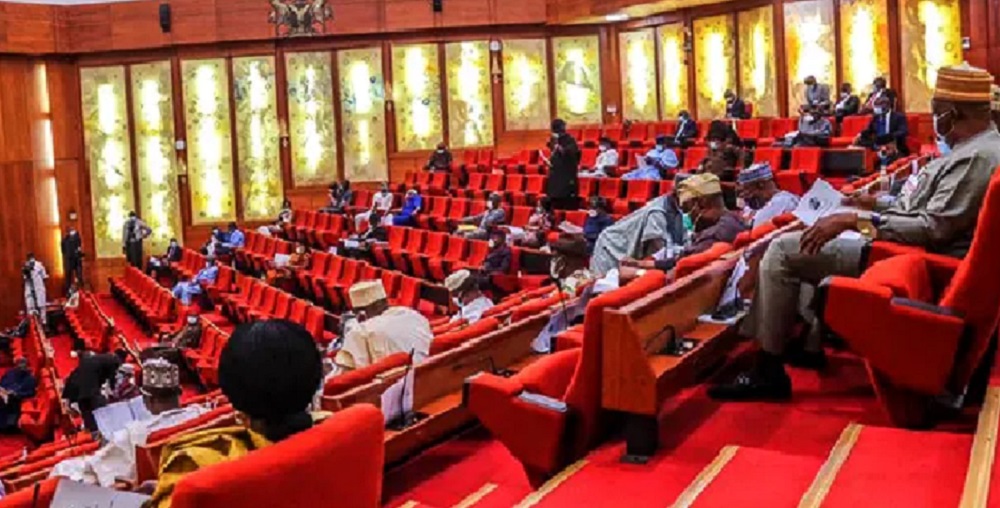
But following complaints that lawmakers were being singled out while other influential individuals continued to enjoy full security cover, the Senate on Wednesday directed its Committee on Police Affairs to investigate the alleged selective implementation of Tinubu’s order withdrawing police escorts from VIPs.

Advertisement

The resolution was reached after Senator Abdul Ningi (Bauchi Central) raised a point of order under Order 9 during plenary, expressing outrage that his only police orderly had been withdrawn despite the continued protection of ministers, business executives, political families, and celebrities.
Ningi warned that the uneven enforcement of the President’s directive could expose lawmakers to security threats and undermine the intent behind the order, issued in November as part of a broader national security strategy to improve police efficiency and public safety.
“It should be done across the board. I have seen ministers with heavy security, business concerns with their orderlies, children of political office holders with orderlies, and even singers enjoying full protection. But a Senator of the Federal Republic cannot have even one orderly? This is unheard of in any democracy,” he stated.
Continue Reading
Advertisement

News

Photos: We’re building infrastructure for a knowledge-driven economy – Tinubu

Published

on

ADVERTISEMENT
Zoom Ad
ADVERTISEMENT
Zoom Ad

President Bola Tinubu has said that his administration was building road infrastructure to lay the needed physical foundation for a knowledge-driven economy, stressing that education, justice, and innovation need roads to thrive.

Tinubu stated this in Abuja on Tuesday, while flagging off the construction of Collector Road CO1 in the Institutional Research District, from Nile University to Ring Road III.

Represented by the National Chairman of the All Progressives Congress, Prof Nentawe Yilwatda, the President said that the project included dualisation of the road from Baze University roundabout to Nile University, that is the Base University.

He noted that three years into his administration, the results were speaking out.

“From the Southern Parkway to the Institution and Research District, we are laying the physical foundation for a knowledge-driven economy.

“Today, we provide those roads that are needed to provide justice, education, and innovation to our people.

“To the university community, this road is more than a route. It is a connection between learning, law, and the future of our capital,” he said.

He pointed out that the Institution and Research District was designed to be the intellectual heart of Abuja, adding that universities, law chambers, research centers, and innovation hubs were growing in the area.

Advertisement

He, however, stressed that ideas could not move if roads do not move and connect the heart and people together.

Tinubu further said: “Under the Renewed Hope Agenda, we made a choice to finish what was started and to start what we must finish.

“The first phase of this corridor connecting the Body of Benchers, Nile, and Base University is done and ready for commissioning. Today, we begin the next phase to Ring Road III to complete the loop.

“That is how we build a city—with a plan. Not a city of abandoned pieces. Infrastructure must be continuous, and it must also be useful to the people within the environment”.

He commended FCT Minister Nyesom Wike for turning FCT into a delivery agency, stressing that the transformation of Abuja under the minister’s watch is bold, visible and worthy of commendation.

He said, “Wike, your energy is unmatched. You took over a capital with many stalled projects and turned the FCTA into a delivery agency. ‘Mr. Projects’ is not a slogan, it is a record. You have revived sleeping roads, built new interchanges, and brought development to satellite towns. You have domesticated the Renewed Hope Agenda; street by street, district by district. The transformation of Abuja under your watch is bold, visible, and worthy of commendation. Well done, Minister Wike.”

Advertisement

In his remarks, Wike explained that the project was considered following a plea by the Body of Benchers to provide access roads to ease the movement of people in and out of the area.

He assured FCT residents that the Tinubu administration would fulfill all the promises made to the people of FCT, adding that the project would be completed by January 2027.

The minister said that he would continue to deliver life-impacting projects to FCT residents as directed by Tinubu, stressing that the delivery would not be affected by 2027 political activities.

Earlier, acting Executive Secretary, Federal Capital Development Authority, Mr Richard Dauda, said that the Institutional Research District of the FCT is located in Phase III of the city.

Advertisement

Dauda said that the area was planned to accommodate educational institutions like universities, research institutions, and other government institutions as provided in the Abuja master plan.

He added that the district was being developed in stages, with this project being a major intervention in the opening of this district.

He explained that the scope of the current stage involved the construction of Collector Road CO1, from the Nile University to Ring Road III with a total length of about six kilometres.

He added that the project also included the dualisation of the section from the Base University Junction to Nile University.

Advertisement
Continue Reading

News

Just in: Kidnapped APC Chairman, Another Victim Die in Abductors hideout

Published

on

ADVERTISEMENT
Zoom Ad
ADVERTISEMENT
Zoom Ad

Tragedy struck in northern Nigeria following reports that two abducted victims, including a former chairman of the All Progressives Congress (APC) in Koko/Besse Local Government Area of Kebbi State, have died while in captivity.

The deceased, Alhaji Muhammadu Mai Barga Besse, who previously served as APC chairman in the local government area, was reportedly held hostage by armed kidnappers for an extended period before his death. Another victim who was abducted alongside him was also confirmed dead, although his identity had not been officially disclosed at the time of filing this report.

The sad development comes months after disturbing videos emerged online showing the victims in dire conditions while being held captive in the notorious Birnin Gwari forest.

The footage sparked widespread concern among family members, political associates and members of the public who called for urgent intervention to secure their release.

Advertisement

Despite efforts made during their captivity, both men were reportedly never reunited with their families before their deaths.

The incident has once again drawn attention to the persistent security challenges facing communities across northern Nigeria.

The Birnin Gwari axis, located along the Kaduna-Niger corridor, has become one of the country’s most dangerous regions, with criminal gangs and armed bandits frequently carrying out kidnappings, attacks on villages and other violent crimes.

Residents and stakeholders have repeatedly called on security agencies to intensify operations in the area and dismantle criminal hideouts within the vast forest, which has long served as a sanctuary for armed groups.

Advertisement

News of the deaths has generated an outpouring of grief on social media, with many Nigerians expressing sadness over the fate of the victims and urging authorities to strengthen efforts against kidnapping and banditry.

Popular social media personality Denglishalhajii also shared the development on Instagram, mourning the victims and drawing attention to the growing insecurity affecting many parts of the region.

The deaths of the former APC chairman and his fellow captive have further underscored the human cost of the country’s security crisis, leaving families, friends and political associates in mourning while raising renewed concerns about the safety of citizens in vulnerable communities.

Advertisement
Continue Reading

News

Tinubu Seeks Constitutional Backing For State Police, Writes Senate

Published

on

ADVERTISEMENT
Zoom Ad
ADVERTISEMENT
Zoom Ad

President Bola Tinubu has asked the senate to approve a constitutional amendment bill seeking to establish state police across Nigeria as part of efforts to strengthen the country’s security architecture.

The request was contained in a letter dated June 15, 2026, and read on the floor of the senate on Tuesday by Godswill Akpabio.

In the correspondence, Tinubu said the proposed Constitution of the Federal Republic of Nigeria (Alteration) State Police Bill, 2026, seeks to amend the 1999 constitution to provide a legal framework for the creation of state police services.

The president said the bill is designed to address Nigeria’s evolving security challenges by introducing a dual policing structure that would allow both federal and state policing systems to operate within a constitutional framework.

Advertisement

According to him, the proposal builds on previous legislative efforts by both chambers of the national assembly and contains additional safeguards to ensure effective implementation.

“This bill builds on the significant work already done in this regard by the House of Representatives and the Senate, and incorporates additional safeguards to ensure that the creation of a dual policing structure to address our nation’s evolving national security challenges, will be achieved quickly and effectively to the benefit of all Nigerians,” Tinubu said.

The president described the proposed legislation as a key component of his administration’s broader plan to reform Nigeria’s security system and improve the protection of lives and property.

“The proposed legislation is a critical component of our administration’s strategy to reorganize Nigeria’s security architecture to better protect our citizens, and I’m confident that the Senate will act quickly to consider and pass this bill,” he added.

Advertisement

Read Also: Amnesty International Demands Immediate Release of Omoyele Sowore, Condemns Detention

Tinubu urged lawmakers to give the proposal expeditious consideration.

Following the reading of the letter, Akpabio referred the bill to the senate committee on constitution review for further legislative action.

The committee was directed to report back to the chamber on the next legislative day.

Advertisement
Continue Reading

Trending

Copyright © 2024 Naija Blitz News