Connect with us

News

2026 budget: Obi slams FG over N17.8tn loan plan

Published

on

ADVERTISEMENT
Zoom Ad
ADVERTISEMENT
Zoom Ad

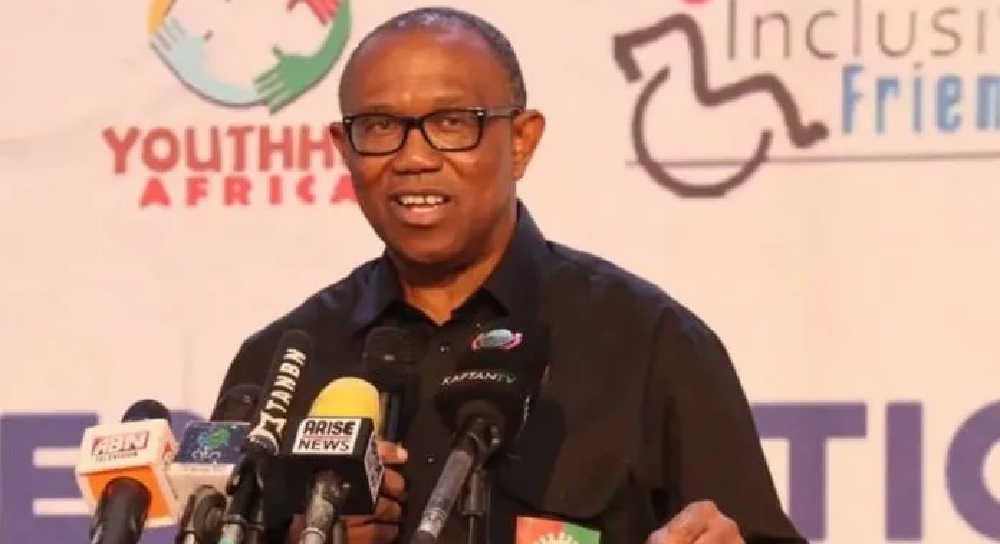
The 2023 presidential candidate of the Labour Party, Peter Obi, has described the Federal Government’s plan to borrow N17.89tn in 2026 to fund the budget deficit as “fiscal rascality.”


Obi, in a post on his X handle on Friday, said the country could not continue to “mortgage the future” of its young population through what he called “thoughtless borrowing.”

The Federal Government had announced plans to borrow N17.89tn in 2026 to fund a widening budget deficit as revenue projections fall sharply below expenditure needs, according to the 2026 budget framework obtained from the Budget Office of the Federation.

According to the document, the borrowing requirement is driven by a larger fiscal deficit and a weaker revenue outlook, even though overall expenditure is projected to fall slightly compared with the current year. The framework puts the 2026 fiscal deficit at N20.12tn, up from N14.10tn approved for 2025.

Advertisement

Commenting on the plan, Obi questioned why the government was discussing fresh borrowing when the 2024 budget was still being implemented and details of the 2025 budget remained unclear.

He said, “Today, Nigerians woke up again to the troubling news that the Federal Government is planning to borrow about N20tn in new loans to finance the 2026 budget. This is at a time when debt servicing alone is projected to gulp nearly half of our national revenue, and when our borrowing requirement has surged by over 72 per cent.

“At a time when Nigerians are struggling under unprecedented hardship, insecurity, and unemployment, we must ask the most important and logical questions: Where is the revenue from 2025?

“How can we be discussing trillions in new borrowing for 2026 when we are still implementing the 2024 budget? One is genuinely worried. This suggests, very clearly, that the 2025 budget is still untouched and unimplemented.”

Advertisement

Obi also questioned the revenues reportedly generated by the Federal Government so far.

“So, where are all the revenues that accrued in 2025, even when we were told that we had surpassed revenue targets since August?

“It is time for us to stop this fiscal rascality, especially with uncontrolled and unexplained borrowing that is not being invested in the productive sectors of our nation but instead ends up in consumption,” he added.

The former Anambra State governor maintained that Nigeria could not borrow its way into prosperity, saying, “Nations do not develop by consuming more than they produce. They develop by producing, exporting, and creating value, while building strong institutions that ensure accountability and efficient use of public funds.

Advertisement

“We cannot tell Nigerians that revenue is increasing while simultaneously increasing borrowing to ridiculous historic levels. Governance must be built on transparency, not propaganda.

“We cannot build a new Nigeria on the foundation of misleading figures, rising debts, shrinking production, and continuous hardship. Our nation must move forward,” Obi said.
Continue Reading
Advertisement

News

FG, states, LGAs share ₦2.551trn as June 2026 revenue

Published

on

ADVERTISEMENT
Zoom Ad
ADVERTISEMENT
Zoom Ad


The Federation Account Allocation Committee (FAAC), at its July 2026 meeting chaired by the Honourable Minister of Finance and Coordinating Minister of the Economy, Mr. Taiwo Oyedele, has shared a total of ₦2.551 trillion among the Federal Government, the 36 States and 774 Local Government Councils as Federation Account revenue for June 2026.

The meeting, held in Abuja, was attended by the Accountant General of the Federation, State Commissioners of Finance and other members of the Committee.

The amount distributed comprised ₦1.810 trillion in Statutory Revenue and ₦740.724 billion from Value Added Tax (VAT).

Advertisement

From the Statutory Revenue, the Federal Government received ₦849.366 billion, the State Governments ₦430.810 billion, while the Local Government Councils received ₦332.136 billion. The oil producing States also received ₦197.610 billion as 13 per cent derivation.

The VAT distribution saw the Federal Government receive ₦74.072 billion, the State Governments ₦407.398 billion, while the Local Government Councils received ₦259.253 billion.

In all, the Federal Government received ₦923.438 billion, the State Governments ₦838.208 billion, the Local Government Councils ₦591.390 billion, while ₦197.610 billion was shared as 13 per cent derivation to the oil producing States.

FAAC noted that gross revenue available in June 2026 stood at ₦4.501 trillion, comprising ₦3.701 trillion in statutory revenue and ₦799.746 billion in gross VAT collections.

Advertisement

The Committee observed a strong improvement in revenue performance during the month.

Gross statutory revenue increased by ₦1.049 trillion over the figure recorded in May 2026.

The growth was driven largely by higher receipts from Companies Income Tax, Value Added Tax, Import Duty, Customs Excise Tariff Levies, Petroleum Royalties, Gas Flared Penalties, Rental Income and Miscellaneous Oil Revenue.

However, collections from Petroleum Profit Tax, Hydrocarbon Tax, Mineral Royalties and Fees recorded declines.

Advertisement

VAT collections also recorded positive growth.

Gross VAT revenue rose from ₦743.668 billion in May to ₦799.746 billion in June, representing an increase of ₦56.078 billion.

Continue Reading

News

Senator Ikpea Thumbs Down Reintegration of Repentant Boko Haram Members

Published

on

ADVERTISEMENT
Zoom Ad
ADVERTISEMENT
Zoom Ad

Chairman of the Senate Committee on Drugs and Narcotics, and the senator representing Edo Central, Senator Joseph Ikpea, has thumbed down the rehabilitation and reintegration of repentant Boko Haram members into society, insisting that individuals involved in terrorism should face the full weight of the law rather than be returned to civilian life.

Speaking with journalists after the inaugural meeting of the Senate Committee on Drugs and Narcotics at the National Assembly on Wednesday, Ikpea described the policy of reintegrating former insurgents as “unreasonable,” arguing that it undermines the sacrifices of security personnel and victims of terrorism.

According to him, insurgents responsible for the killing of innocent Nigerians and members of the armed forces should not be rehabilitated or reintegrated into society.

“I don’t understand the rationale behind reintegrating Boko Haram members into society. Our gallant soldiers have lost their lives protecting the country from these terrorists. If someone has committed acts of terrorism and is apprehended, such a person should face the consequences of the law,” he said.

Advertisement

The senator maintained that Boko Haram and other terrorist groups remain enemies of every Nigerian, irrespective of religion or ethnicity, noting that they target Christians, Muslims, civilians and security personnel alike.

Ikpea also alleged that some recent kidnapping incidents across the country could have political undertones, suggesting that certain actors may be exploiting insecurity to undermine the government ahead of future elections.

On the issue of drug control, the committee chairman disclosed that the Senate Committee on Drugs and Narcotics would review the proposed bill seeking to impose the death penalty for drug-related offences after a thorough examination of the legislation.

He explained that he was not a member of the Senate when the bill was previously debated and therefore could not comment on its current status.

Advertisement

“I have no idea about that bill because I was not a senator when it came up on the floor. My committee will look at it and advise accordingly. For now, I cannot say much about it,” he said.

Ikpea noted that the committee’s inaugural meeting was convened to outline its legislative agenda and oversight responsibilities.

He said one of its immediate priorities would be strengthening oversight of the National Drug Law Enforcement Agency (NDLEA) and inspecting rehabilitation centres across the country to ensure they comply with approved operational standards.

“We are planning to visit rehabilitation centres to ensure they meet the required standards. You cannot just establish a rehabilitation centre without complying with the necessary regulations. We want to ensure they are operating properly and delivering quality services,” he said.

Advertisement

Speaking on the proposed death penalty for drug traffickers, the senator declined to take a firm position, saying punishment for offences should be proportionate to the crimes committed and that the final decision rests with the National Assembly and the Federal Government.

“Every offence should attract punishment commensurate with its severity. Different countries have different laws on drug trafficking. Whatever the Senate and the Federal Government eventually decide will be respected,” he stated.

Ikpea further raised concern over the growing prevalence of drug abuse among Nigerian youths, warning that the trend poses a serious threat to the nation’s future.

Citing estimates that about 14 million Nigerians are affected by drug abuse, he advocated the introduction of drug education into school curricula from the primary level to discourage substance abuse from an early age.

Advertisement

“The youth are the leaders of tomorrow. If we fail to educate them on the dangers of drug abuse, the nation’s future will be in jeopardy. We are looking at introducing drug education into school curricula so children understand the consequences from an early age,” he said.

Continue Reading

News

UK Backs National Assembly Security Dialogue as Push for State Policing Gathers Momentum

Published

on

ADVERTISEMENT
Zoom Ad
ADVERTISEMENT
Zoom Ad

UK Backs National Assembly Security Dialogue as Push for State Policing Gathers Momentum

By Gloria Ikibah

The UK Government-funded Strengthening Peace and Resilience in Nigeria (SPRiNG) Programme has thrown its weight behind the National Assembly Security Roundtable, describing the initiative as a timely platform to advance security sector reforms, strengthen institutional accountability and accelerate discussions on state policing.

In a statement issued ahead of the roundtable, scheduled for Wednesday as part of the National Assembly Open Week 2026, it said that the engagement will bring together Nigeria’s top security chiefs, lawmakers and governors to review the country’s security challenges and identify the legislative and budgetary measures needed to improve the nation’s security architecture.

Advertisement

The meeting, to be held at the Conference Hall of the National Assembly Library Trust Fund, is expected to examine the support required by security agencies while also advancing constitutional reforms relating to state policing.

Among those expected at the event are the National Security Adviser, Chief of Defence Staff, Inspector-General of Police,  Ministers of Defence, Interior and Police Affairs, as well as the governors of Kaduna, Katsina, Plateau and Benue — the four focal states of the SPRiNG Programme — alongside their counterparts from Kwara, Zamfara, Niger and Borno states.

Speaking on the significance of the dialogue, the Head of Development Cooperation at the British High Commission in Abuja, Cynthia Rowe, said lasting security can only be achieved through strong and accountable institutions.

She said: “Sustainable security requires strong, accountable institutions that are responsive to the needs of the people. The UK Government remains committed to supporting Nigeria’s legislative frameworks to ensure that security interventions are transparent, well-resourced, and firmly rooted in respect for human rights. This roundtable is a commendable step towards codifying reforms that will protect vulnerable communities and foster long-term stability.”

Advertisement

According to the statement, the roundtable’s agenda aligns closely with the SPRiNG Programme’s security sector reform objectives, with discussions expected to focus on banditry, kidnapping, farmer-herder conflicts, inter-agency collaboration, technology-driven security operations and modern approaches to community engagement.

The Team Leader of the SPRiNG Programme, Ukoha Ukiwo, said experience from the programme’s work across participating states had shown that peacebuilding efforts require solid legal backing to succeed.

“Our work across our state compacts has continually highlighted that operational peacebuilding must be backed by robust legal frameworks. The focus of this roundtable on state policing, security funding, and accountability is incredibly timely. By bridging the gap between grassroots realities and legislative action, we can ensure that informal and formal security architectures work cohesively to build formidable resilience in communities across Nigeria”, he said.

The meeting is expected to produce a comprehensive communiqué outlining priority security reforms, including recommendations on the implementation of state policing and other public safety initiatives.

Advertisement

It added that the SPRiNG Programme would continue to support engagements with relevant stakeholders to ensure that resolutions reached at the dialogue are translated into concrete policy actions.

Continue Reading

Trending

Copyright © 2024 Naija Blitz News