News
Senate to pass ₦58.47trn 2026 Budget, Electoral, Constitution Reforms in final 16 months
- /home/naijuinz/public_html/wp-content/plugins/mvp-social-buttons/mvp-social-buttons.php on line 27
https://naijablitznews.com/wp-content/uploads/2024/11/Senate.jpg&description=Senate to pass ₦58.47trn 2026 Budget, Electoral, Constitution Reforms in final 16 months', 'pinterestShare', 'width=750,height=350'); return false;" title="Pin This Post">
- Share
- Tweet /home/naijuinz/public_html/wp-content/plugins/mvp-social-buttons/mvp-social-buttons.php on line 72
https://naijablitznews.com/wp-content/uploads/2024/11/Senate.jpg&description=Senate to pass ₦58.47trn 2026 Budget, Electoral, Constitution Reforms in final 16 months', 'pinterestShare', 'width=750,height=350'); return false;" title="Pin This Post">
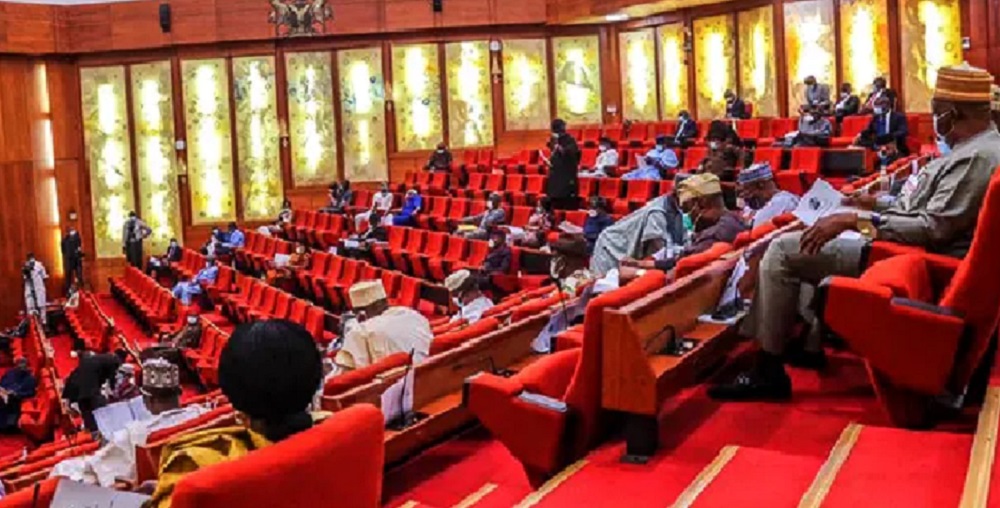
With just 16 months left in the life of the 10th National Assembly, the Senate has outlined an ambitious legislative agenda anchored on the passage of the ₦58.47 trillion 2026 Appropriation Bill, far-reaching electoral reforms ahead of the 2027 general elections, and the conclusion of the ongoing review of the 1999 Constitution.

Leader of the Senate, Senator Opeyemi Bamidele (APC – Ekiti Central) disclosed this ahead of resumption of plenary on Tuesday, stressing that the Assembly remains committed to defending the trust reposed in it by Nigerians while responding swiftly to domestic and global challenges.
Bamidele noted that of the 48 months constitutionally allotted to the Assembly, only 16 months remain, a reality that underscores the urgency for decisive, people-centred legislation capable of strengthening governance, stabilising the economy and enhancing Nigeria’s global competitiveness.

“The burden of trust our constituents repose in us is one we struggle daily to defend and treasure never to breach,” he said, adding that the National Assembly would continue to prioritise reforms that promote national cohesion, economic diversification and institutional resilience.
According to him, the last 32 months of the 10th Assembly have been devoted to reforms across critical sectors aimed at repositioning Nigeria from an extraction-dependent economy to a diversified, productivity-driven and globally competitive state.
He said the next phase of legislative work would focus on consolidating these gains while concluding landmark initiatives on electoral governance, fiscal sustainability and constitutional restructuring.
Top on the agenda is the scrutiny and passage of the 2026 Appropriation Bill, estimated at ₦58.47 trillion, which President Bola Ahmed Tinubu, presented to a joint session of the National Assembly on December 18, 2025.
Bamidele disclosed that committees in both chambers are already examining the revenue and expenditure projections, describing the budget as critical to macro-economic stability, job creation, rising incomes and improved quality of life across the federation.
He added that the Assembly is determined to restore and sustain a January-to-December budget cycle, noting that recent fiscal reforms, particularly the enactment of the 2025 Tax Reform Act, have recalibrated Nigeria’s fiscal space to reflect socio-economic realities.
The new fiscal regime, he explained, eases the tax burden on low-income earners while placing greater responsibility on high-income earners, a move expected to improve revenue generation, shrink budget deficits and ensure sustainable funding of government programmes.
Beyond the budget, the Senate has prioritised the review of the Electoral Act, 2022, with a view to delivering a more credible, transparent and accountable electoral framework ahead of the 2027 general elections.
Bamidele said the proposed Electoral Bill, 2025 contains no fewer than 20 defining provisions designed to strengthen the credibility of elections, enhance the independence of the Independent National Electoral Commission (INEC) and guarantee the security of votes.
Among the innovations in the Bill are the recognition of voting rights for eligible prisoners, mandatory release of election funds to INEC at least one year before polls, electronically generated voter identification with QR-coded downloadable voter cards, and compulsory electronic transmission of polling unit results.
According to him, the Bill also standardises delegates for indirect primaries, tightens voter registration requirements, extends publication periods for candidates’ details, strengthens regulation of party conventions, raises campaign spending limits and imposes stiffer penalties for electoral offences.
On vote buying and related malpractices, the proposed law prescribes fines of up to ₦5 million, mandatory jail terms, and a 10-year ban from contesting elections, a move lawmakers say will end impunity and entrench a culture of consequence in the electoral system.
Bamidele expressed confidence that, if passed, the reforms would significantly improve the credibility of elections starting from 2027, adding that reports from the Committees on INEC in both chambers would soon be presented for clause-by-clause consideration.
He said the Senate is also at an advanced stage in the review of the 1999 Constitution.
“Technical sessions have been concluded, public hearing reports submitted, and stakeholder engagements completed,” he said.
Bamidele said the report of the Constitution Review Committee, chaired by Deputy Senate President Barau Jibrin, would be laid before the Senate before the end of the first quarter of 2026 for debate and voting.
He noted that the process would subsequently move to the 36 State Houses of Assembly, whose approval by a two-thirds majority is constitutionally required to effect any alteration.
As the Assembly enters what he described as a critical phase, Bamidele reaffirmed the Senate’s commitment to good governance, enhanced security and improved welfare of Nigerians.
“At this defining moment, the onus rests on us more than ever to reinforce our constituents’ trust in their representatives, in the National Assembly and in our fatherland,” he said.
News
FG declares Friday June 12 public holiday for Democracy Day
The Federal Government has declared Friday, June 12, 2026, a public holiday to mark 27 years of untruncated democratic rule.
Minister of Interior Dr Olubunmi Tunji-Ojo announced the holiday on Thursday, June 11, in a statement signed by the Permanent Secretary of the Ministry, Magdalene Ajani.
—“Democracy thrives on rule of law and accountability””—
Tunji-Ojo reaffirmed the government’s commitment to preserving democratic ideals, rule of law, transparency, accountability and inclusive governance as Nigeria commemorates June 12.
Advertisement
He described the date as significant in the nation’s history, honouring “the courage, resilience, and sacrifices of Nigerians whose efforts made democratic governance possible.”
“Their legacies continue to inform the values and responsibilities of the Nigerian state,” the minister said.
*Security and civic responsibility stressed*
The minister assured that the Ministry of Interior, in collaboration with security agencies, would take appropriate measures to maintain and strengthen internal security during the holiday.
He noted that a secured and stable environment remains essential for democracy and national development.
Tunji-Ojo urged Nigerians to use the holiday for civic reflection. “As we mark this historic day, every Nigerian is encouraged to remain law-abiding, uphold the institutions that sustain our democracy, and remember that the strength of any democracy lies ultimately in the character of its citizens,” he stated.
—June 12 significance—
June 12 was formally adopted as Democracy Day in 2018 to honour the annulled 1993 presidential election widely believed to have been won by MKO Abiola. This year’s commemoration marks 27 years since the return to civil rule in 1999.
The holiday applies to all public and private institutions nationwide. Banks, government offices and many businesses are expected to close, while essential services will remain operational.
News
BREAKING: Reps Names New Minority Principal Officers as Fred Agbedi Emerges Minority Leader
…Abbas pledge collaboration with opposition leaders to advance 10th Assembly’s legislative agenda
By Gloria Ikibah
The Speaker of the House of Representatives, Rt. Hon. Tajudeen Abbas, has formally announced the completion of the minority leadership structure in the 10th House following the nomination and endorsement of three lawmakers to fill vacant principal officer positions.
Speaking during plenary, Abbas informed members that the minority caucus had unanimously agreed on the appointments through a consensus arrangement.
According to the Speaker, the nomination was conveyed to the House in line with the decision of minority members of the 10th Assembly.
He said: “The election of the House of Representatives, Federal Republic of Nigeria, the minority members of the 10th Assembly hereby unanimously nominate the following members by consensus to fill the vacant positions of the minority in the parliament.”
Announcing the appointments, Abbas stated: “Number one, Minority Leader, Rt. Honourable Frederick Abedi PhD. Number two is the position of Minority Whip, and the person they have endorsed is no other than Honourable Monsur Soro.
He added: “The last but not the least is my brother from the northwest, in person of Rt. Honourable Abdusamadu Dasuki, the position of Deputy Minority Leader.”
Following the announcement, the Speaker congratulated the newly appointed principal officers and expressed confidence in their ability to contribute meaningfully to the work of the House.
He also assured the new opposition leaders of the support of the House leadership as they assume their responsibilities.
“So honourable colleagues, today the body of principal officers is complete, and I want to seize this opportunity on behalf of the whole entire house to congratulate the three people and to wish them all the best in their new positions.
“And let them be assured that the leadership of the house will work with them assiduously in ensuring that we achieve our legislative agenda objectives of this very important 10th Assembly,” Abbas said.
The Speaker wished members well and prayed for continued success in the work of the legislature.
“May God bless you all”, he concluded.
News
Xenophobic attacks: Nigerians Evacuated From South Africa In First Batch Return Home
Finally the first set of Nigerians evacuated from South Africa has arrived at the Murtala Mohammed International Airport in Lagos following renewed xenophobic attacks in the country.
The Air Peace flight carrying the returnees arrived at the airport around 10:25 am on Thursday.
Nigeria’s Minister of State for Foreign Affairs, Sola Enikanolaiye, among others, was on hand to welcome the 258 evacuees who were escorted by officials of the Nigerian Mission in South Africa, led by the Acting High Commissioner, Temitope Ajayi.
Addressing the returnees, Enikanolaiye said Nigeria will not stand idly by while its citizens are subjected to attacks and harassment wherever they may be in the world; hence, the swift and necessary action to bring them home.
In a statement following their arrival, the Foreign Affairs Ministry’s spokesperson, Kimiebi Ebienfa, quoted Enikanolaiye as commending the excellent coordination of the process by the High Commission of Nigeria in Pretoria.
He urged Nigerians in South Africa to remain law-abiding and vigilant and to report any threats to the Nigerian Mission. The minister said that the Federal Government remains fully engaged with the South African authorities at the highest levels to ensure the protection of Nigerian nationals and to address the root causes of these incidents.
The minister conveyed the heartfelt greetings and assurances of President Bola Tinubu to the returning nationals.
“No Nigerian should live in fear simply because of their nationality. The evacuation does not signal defeat; it underscores the proactive and citizen-centred foreign policy of the Tinubu administration,” the statement read in part. “More flights carrying returnees are expected to arrive in the country in the coming days as the evacuation exercise continues.”
The returning nationals are undergoing the process of documentation, profiling, and necessary medical checks and will be provided with temporary accommodation before being reunited with their families, the ministry said.
Anti-foreigner violence has convulsed South Africa for weeks as gangs armed with sticks, whips, and shields have marched through parts of the “rainbow nation”, demanding that people with no residency papers leave by June 30.
Foreign nationals have reported being intimidated and beaten by mobs going door to door, families have been forced from their homes, and many have left in the face of the threats.
Ghana, Mozambique, and Malawi have already repatriated hundreds of their citizens in recent weeks.
South Africa is Africa’s largest economy and hosts more than three million foreigners, just over five per cent of its population, according to the country’s statistics agency.
-
News21 hours agoBinani Air Celebrates First Month in the Skies, Eyes Bigger Future
-
News15 hours agoKano Screens 720 Couples for State-Sponsored Mass Wedding Programme
-
News15 hours agoAlleged N2bn scam: EFCC tells Court how Sirika hired Ethiopian Airlines aircraft for three-day exhibition
-
News15 hours agoEx-NNPCL Boss Kyari Challenges Senate Over Arrest Warrant, N210trillion Probe, Cites Medical Trip Abroad
-
News11 hours agoSenate Orders Kyari’s Arrest Over Alleged ₦210 Trn NNPCL Financial Infractions
-
News15 hours agoNationwide protest to begin on Democracy Day as insecurity continue to escalate
-
News15 hours agoPastor Kumuyi Explains Why None of His Sons Will Inherit Deeper Life Church
-
News14 hours ago2027: INEC restores 22 State constituencies in kogi, Benue, Delta, Jigawa