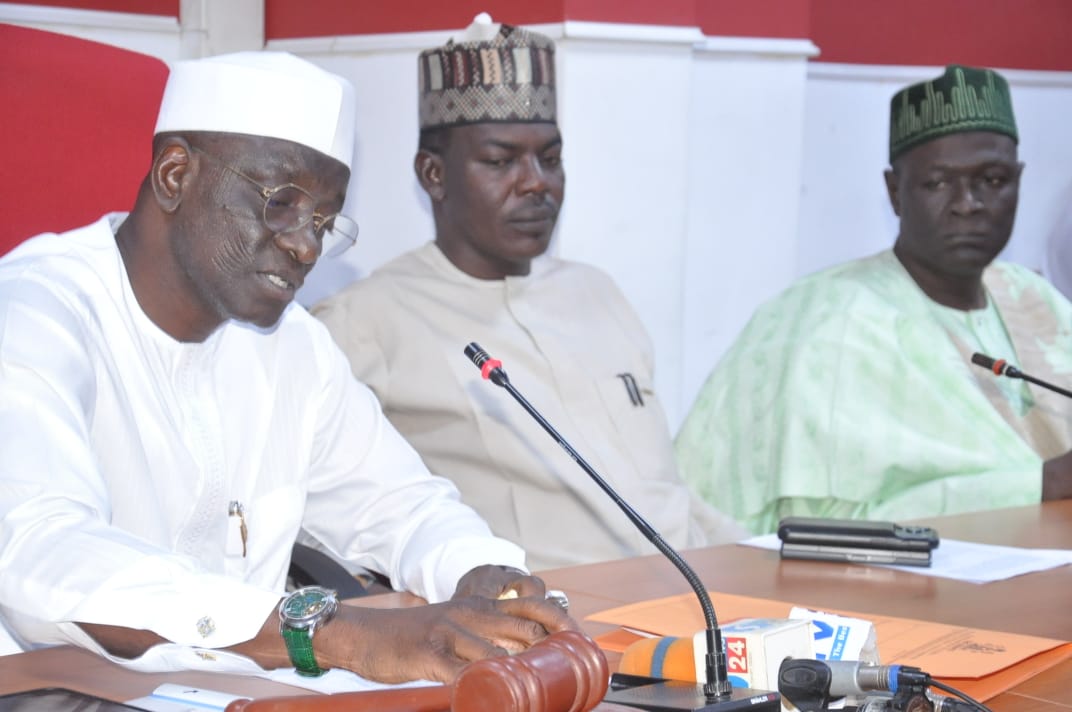
The Chairman of the Senate Public Accounts Committee, Senator Ahmed Wadada Aliyu, has raised serious concerns over inconsistencies in the financial statements of the Nigerian National Petroleum Company Limited (NNPC) spanning 2017 to 2023, directing the company to account for and refund a combined ₦210 trillion flagged in its books.


Briefing journalists in Abuja on the ongoing inquiry, Wadada said the committee’s investigation—ongoing since May 2025—has uncovered significant discrepancies in the company’s audited financial statements, particularly in accrued expenses and sundry receivables.
According to him, the committee discovered that NNPC reported ₦103 trillion as accrued expenses in 2022 without providing adequate breakdowns or supporting documentation.
“The explanations provided by NNPC management were inconsistent and unsatisfactory,” Wadada told reporters.
He explained that the company initially claimed the amount covered retention fees, legal fees and audit fees, but failed to provide a detailed breakdown when requested by the committee. 
“When pressed further, the management changed its explanation, stating that the accrued expenses represented cash calls owed to joint venture partners. However, the cash call regime ended in 2016, making that claim questionable,” he said.
The Senate panel also flagged ₦107 trillion recorded as sundry receivables, noting that the oil company could not identify the debtors linked to the figure.
“The company could not provide the identities of the debtors responsible for the ₦107 trillion receivables. In some instances, the receivables were linked to defunct banks,” Wadada stated.
Beyond these figures, the committee identified several other financial irregularities in the records of NNPC and its subsidiary, the National Petroleum Investment Management Services (NAPIMS).
Among the findings were ₦3.8 trillion in subsidy costs allegedly duplicated in the books of both NNPC and NAPIMS, as well as ₦5 trillion in direct production costs charged by NAPIMS despite the agency not being directly involved in crude oil production.
The committee also queried ₦5.9 billion reportedly spent on incorporation expenses, noting that both NNPC and NAPIMS appeared to have charged the same expenses separately.
“These financial entries raise serious accountability concerns and have therefore been rejected by the committee,” Wadada said.
Consequently, the panel directed NNPC to refund ₦210 trillion, representing the combined value of the ₦103 trillion accrued expenses and ₦107 trillion sundry receivables.
The committee further demanded that the company refund production costs that were charged against crude oil revenues without adequate justification.
As part of the investigation, the panel announced plans to summon former NNPC executives, including former Group Chief Executive Officer Mele Kyari, as well as Umar Ajia and Bala Wunti, alongside external auditors involved in preparing the company’s financial statements.
“They will be invited to appear before the committee to provide explanations regarding the infractions identified in the financial reports,” Wadada said.
He added that the committee would also commence a forensic audit of NNPC’s financial statements from 2017 to 2023 in line with Section 85 of the Constitution.
According to the lawmaker, the investigation is part of the Senate’s oversight responsibility to ensure transparency and accountability in the management of public resources.
“The objective of this exercise is to enhance public fund generation and ensure proper utilization of national resources,” Wadada said.
He added that the committee’s work aligns with the economic reform agenda of Bola Ahmed Tinubu, noting that the administration’s Renewed Hope governance agenda prioritizes transparency and fiscal responsibility.
“Our mandate is to ensure that every kobo due to the Nigerian people is properly accounted for,” Wadada said.