Economy
US-Iran conflict: MAN outlines measures to mitigate effect on Nigerian manufacturers
The Manufacturers Association of Nigeria (MAN) has warned that the unfolding geopolitical tensions in the Middle East poses immediate, severe and multifaceted risks to Nigeria’s manufacturing sector, while outlining urgent pathways to safeguard industry operators.

Director General of MAN, Segun Ajayi-Kadir, in a statement, said the sector is already grappling with the ripple effects of the global energy shock triggered by the conflict, warning that the sector’s projected 3.1 per cent real growth target for 2026 is now under serious threat.
According to him, manufacturers’ heavy reliance on gas and Automotive Gas Oil (diesel) for production has exposed them to spiraling energy costs, as rising global crude oil prices continue to push domestic pump and depot prices upward, eroding operating margins.

“Energy cost escalation is biting hard. Many manufacturers are seeing their margins wiped out almost overnight,” Ajayi-Kadir stated.
He further noted that imported inflation and escalating freight costs are compounding the crisis. Extended transit times and higher shipping expenses and logistics expenses, he explained, have made the importation of critical raw materials increasingly prohibitive.
“The implication is clear – production costs are rising sharply, while consumer purchasing power is weakening. This has created a dangerous situation where manufacturers are battling both high costs and unsold inventories.
“Manufacturers are now confronted with the dual threat of skyrocketing production costs and unsold inventories, a development that could derail the sector’s projected 3.1 per cent growth in 2026,” he said.
To mitigate the looming crisis, MAN called on the Federal Government to urgently implement targeted interventions. These include fast-tracking the Presidential Compressed Natural Gas (CNG) initiative for industrial clusters to reduce dependence on diesel, and establishing a dedicated foreign exchange window through the Central Bank of Nigeria for the importation of critical inputs.
The association also advocated for the domestication of petroleum supply chains by ensuring that local refineries prioritise supply to domestic manufacturers at competitive rates, alongside a temporary suspension of logistics levies and multiple taxation on haulage.
“The current crisis is a stark reminder of Nigeria’s vulnerability to external shocks due to our dependence on imported inputs,” Ajayi-Kadir said. “While we cannot control global geopolitics, we can control our domestic response.”
He stressed that the situation presents a critical opportunity for Nigeria to pivot towards genuine manufacturing self-sufficiency, warning that failure to act decisively could result in widespread factory closures and job losses across the country.
To cushion logistics pressures, MAN recommended an immediate six-month suspension of multiple haulage levies, highway taxes and transit tolls imposed on manufacturers.
“We cannot control global geopolitics, but we can control our domestic response,” Ajayi-Kadir stated. “This crisis must serve as a catalyst for building a more resilient and self-sufficient manufacturing sector, rather than repeating the mistakes of the past.”
He warned that failure to act decisively could lead to widespread factory closures, job losses and a significant setback to Nigeria’s industrialisation drive.
Economy
NDIC moves to wind down 89 failed banks
The Nigeria Deposit Insurance Corporation (NDIC) has commenced the final phase of winding down 89 defunct Microfinance Banks (MFBs) and Primary Mortgage Banks (PMBs) across the country following their acquisition by new operators under its resolution framework, it emerged on Wednesday.
The Corporation said the move follows the earlier revocation of licences by the Central Bank of Nigeria (CBN) in May 2023, which affected 179 microfinance banks and four primary mortgage banks.
Under the Purchase and Assumption (P&A) model, according to Hawwau Gambo, the Head of Communication and Public Affairs, 89 new institutions were subsequently licensed to take over the assets and liabilities of the failed banks and have since commenced operations under new identities.
NDIC, acting as liquidator, the statement noted, will now approach various divisions of the Federal High Court to obtain formal orders dissolving the defunct entities and discharging the Corporation from its liquidation responsibilities, in line with its enabling law.
A breakdown of the affected institutions shows that Lagos accounts for the highest number, with 27 banks undergoing the process.
This is followed by Osun with seven, Anambra with six, the Federal Capital Territory (FCT) with five, while Akwa Ibom, Ogun, and Adamawa recorded four each.
Oyo, Kaduna, Edo, and Niger recorded three each.
Other states affected include Benue, Delta, Imo, and Ondo, with two each, while Abia, Ekiti, Enugu, Rivers, Plateau, Nasarawa, Kano, Kwara, Jigawa, and Katsina recorded one each.
The Corporation said the exercise aims to bring closure to the resolution process while ensuring depositors’ interests remain protected, and the financial system remains stable.
The NDIC added that the transition under the P&A arrangement has allowed continuity of banking services in affected locations, as the acquiring institutions have fully taken over operations of the defunct banks.
Economy
Nigeria’s Inflation hits15.38% in March
Nigeria’s headline inflation rate rose to 15.38% in March 2026, reflecting a modest increase from the 15.06% recorded in February.
This is according to the latest data from the National Bureau of Statistics (NBS).
The Consumer Price Index (CPI) increased to 135.4 in March 2026, reflecting a 5.4-point increase from the preceding month (130.0).
In March 2026, the headline inflation rate rose to 15.38%, up from 15.06% in February 2026 and stood 27.35% in the same month of the preceding year (March 2025).
Looking at the movement, the March 2026 headline inflation rate showed an increase of 0.32% compared to that recorded in February 2026.
However, on a month-on-month basis, the rate in March 2026 was 4.18%, which was 2.17% higher than the rate recorded in February 2026 (2.01%).
The percentage change in the average CPI for the twelve months ending March 2026 over the average for the previous twelve-month period was 20.05%, showing a 1.48% increase compared to 18.58% recorded in March 2025.
On a year-on-year basis, in March 2026, the Urban inflation rate was 14.64%. On a month-on-month basis, the Urban inflation rate was 3.16% in March 2026, up by 0.61% compared to February 2026 (2.55%).
The corresponding twelve-month average for the Urban inflation rate was 20.04% in March 2026. This was 0.06% points lower compared to the 20.10% reported in March 2025.
Rural inflation rate in March 2026 was 17.22% on a year-on-year basis.
On a month-on-month ba sis, the Rural inflation rate in March 2026 was 6.73%, up by 6.02% compared to February 2026 (0,71%).
The corresponding twelve-month average for the Rural inflation rate in March 2026 was 19.74%. This was 2.93% points higher compared to the 16.81% recorded in March 2025.
The food inflation rate in the month under review was 14.31% on a year-on-year basis and stood at 25.22% in the same month of the preceding year (March 2025).
However, on a month-on-month basis, food inflation rate in March 2026 was 4.17%, down 0.52 percentage points from February 2026 (4.69%).
The drop was attributed to the rate of change in the average prices of the following products: Yam, Ginger (Fresh), Cassava Tuber, Groundnuts (Shelled), Irish Potatoes, Avenger (Ogbono/Apon) – Dried Ungrinded, Toma toes (fresh), Cassava Flour sold loose, etc.
NBS said average annual rate of Food inflation for the twelve months ending March 2026 over the previous twelve-month average was 18.21%, which was 17.81% points lower compared with the average annual rate of change recorded in March 2025 (36.02%).
The “All items less farm produces and energy” or Core inflation, which excludes the prices of volatile agricultural produce and energy, stood at 16.21% in March 2026 on a year-on-year basis; a decline of 10.91% points when compared to the 27.12% recorded in March 2025.
On a month-on-month basis, the core inflation rate was 4.03% in March 2026, up by 3.14% points compared to Feb ruary 2026 (0.89%).
The average twelve-month annual inflation rate was 21.09% for the twelve months ending March 2026, which was 6.25% points lower than the 27.34% recorded in March 2025.
On a state level, headline inflation was highest in Bayelsa Year-on-Year with (27.37%), Sokoto (26.03%), and Bauchi (23.67%), while Osun (5.25%), Kano (9.85%), and Kaduna (10.38%) recorded the lowest rise.
On a Month-on-Month basis, however, March 2026 recorded the highest increases in Zamfara (10.77%), Bauchi (9.37%), and Sokoto (9.05%), while Lagos (1.54%), Akwa Ibom (1.80%), and Rivers (1.89%) recorded the lowest rise in the Month-on-Month inflation.
Food inflation was highest in Bayelsa (33.35%), Sokoto (28.02%), and Adamawa (21.67%), while Kano (4.29%), Oyo (4.86%), and Katsina (7.48%) recorded the slowest rise on a Year-on-Year basis.
On a Month-on-Month basis, however, March 2026 food inflation was highest in Sokoto (11.78%), Niger (8.59%), and Gombe (8.10%), while Katsina (0.09%), Ogun (0.77%), and Adamawa (1.30%) recorded the slowest rise in Food inflation on a Month-on-Month basis.
Economy
Nigeria becomes net petrol exporter as Dangote Refinery ships 44,000bpd
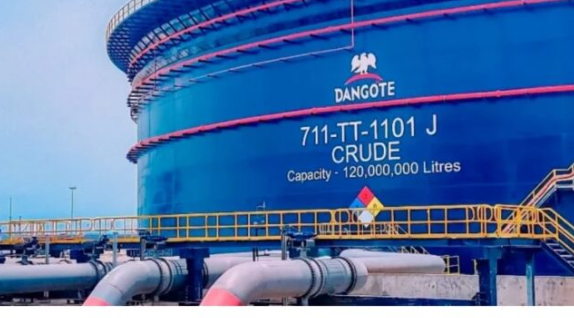
Nigeria has reached a historic milestone in its downstream oil sector, emerging as a net exporter of petrol for the first time, largely driven by increased production from the Dangote Petroleum Refinery.
Industry data shows that the 650,000 barrels-per-day facility exported about 44,000 barrels per day (bpd) of petrol in March 2026, resulting in a surplus of roughly 3,000 bpd for the month.
The development marks a major turnaround for a country that has long relied heavily on imported refined petroleum products.
The shift from import to export reflects a structural transformation in Nigeria’s oil trade, with positive implications for foreign exchange earnings, energy security, and regional fuel supply dynamics.
In a significant expansion of its export reach, the refinery also delivered a 317,000-barrel cargo of petrol to Mozambique—its first shipment to East Africa. Another consignment is expected to be delivered to Beira in April, underscoring growing regional demand as buyers seek alternatives to Middle Eastern supplies amid ongoing geopolitical tensions.
Data from Kpler further revealed that Nigeria’s petrol imports plunged to 41,000 bpd in March, the lowest level on record, highlighting the rapid displacement of imports by local refining.
It would be recalled that in September last year, President of the Dangote Group, Aliko Dangote, projected that the refinery would turn Nigeria into a net exporter of fuel while ending decades of fuel scarcity.
“We have been battling fuel queues since 1975, but today Nigerians are witnessing a new era,” he said.
-
News22 hours agoIran slams US blockade as ‘grave violation of sovereignty’
-
News22 hours agoEl-Rufai distances self from comments on political aspirations attributed to associate
-
News20 hours agoEdun Urges Developing Countries to Adopt Measures to Cushion Global Shocks
-
News15 hours agoInsecurity: Nine feared killed in Benue attack
-
News17 hours agoJune Deadline Non-Negotiable, Wike Warns Contractors as FCT Targets Tinubu’s Anniversary For Projects Commissioning(Photos)
-
Opinion4 hours agoWhy PDP Should Pick Dr Olotu Akpodiete as Candidate for Ughelli North, South and Udu Federal Constituency
-
News16 hours agoFinally, NAF releases list of successful candidates
-
Economy15 hours agoNigeria’s Inflation hits15.38% in March