Connect with us

Opinion

ENIKANOLAIYE: DIPLOMAT-ORACLE AS FOREIGN MINISTER

Published

on

ADVERTISEMENT
Zoom Ad
ADVERTISEMENT
Zoom Ad

By Tunde Olusunle

He was a 40 year-old, Assistant Director in the foreign service at the outset of the administration of President Olusegun Obasanjo in 1999. Nigeria’s foreign relations space was dominated by a robust mix of career veterans and the political class, which underscored the primacy the new democratic dispensation was going to accord diplomacy. Obasanjo himself was the country’s diplomat-in-chief having built tremendous capacity beginning from his years in office as Nigeria’s military Head of State between February 1976 and September 1979. Whereas the two Foreign Affairs Ministers, Sule Lamido and Dubem Onyia (of blessed memory) were of the political class, Obasanjo intentionally fortified himself with experienced foreign affairs experts to guide the policy slant of his government.

These included the Cambridge-trained Patrick Dele-Cole, PhD, a first class degree honours holder who had previously served as Nigeria’s Ambassador to Argentina and Brazil, and Ambassador Ralph Uwechue, PhD, who opened Nigeria’s embassy in Paris, France, in 1966, as its pioneering envoy. Obasanjo’s State Chief of Protocol, (SCOP), Ambassador Jonathan Oluwole Coker, had been previously decorated with the twin honours of Commander of the National Order of Cote d’Ivoire, and Commander of the Legion of Honour of France, in 1999 to underscore his foreign service exertions. His Deputy, Ambassador Wisdom Baiye, was a renowned linguistic diplomat, translator and interpreter. Besides their primary responsibilities in the State House, Obasanjo productively engaged them as Special Envoys on Ivorien and Burundi peace processes, respectively. Such was the extent to which Obasanjo tapped from the experience of core diplomats in repositioning Nigeria in the global foreign affairs orbit.

Unknown to many, Audu-Rafiu Olusola Enikanolaiye was a critical, unobtrusive component of the diplomatic ascendancy of the Obasanjo government. He was specifically headhunted in August 1999, just months into the life of the new regime, by the very cerebral Ambassador Patrick Dele-Cole, who was Special Adviser to the President on International Relations, from his parent ministry. Cole engaged Enikanolaiye to serve as his Special Assistant, and add breadth to the foreign policy thrust of the administration. He was just on time for the historic visit to Nigeria, of former United States President, Bill Clinton and his wife, Hilary, which began August 26, 2000, the first such look-in into Nigeria by an American President, since President Jimmy Carter visited Obasanjo as military Head of State between March and April, 1978.

Advertisement

As Special Assistant on Special Duties to President Obasanjo all through his two terms in office myself, I speak with authorial confidence about the evolution of that government. Enikanolaiye was a regular at various audiences granted by the President, and meetings chaired or attended by him at home or abroad, which bordered on diplomacy. The Obasanjo government was defined by a “shuttle diplomacy” approach to foreign relations, targeted at rebuilding Nigeria’s pariah profile in the global eye, securing debt relief and positioning Africa as a genuine leader in African affairs. This entailed extensive travels by Obasanjo. Enikanolaiye was famous for taking copious notes of proceedings at such engagements, ostensibly to enrich briefs and advisories to be laid subsequently on the desk of the President, as the scholar-diplomat he is. Civil servants, notably, are to be seen, and not to be heard. Their inputs, irrespective of originality or profundity, never bear their imprimatur as they remain constrained to the shadows of anonymity.

In June 2001, Enikanolaiye returned to the “African Department” of the Foreign Affairs Ministry, at a time Africa remained the centrepiece of Nigeria’s diplomatic focus. It was the period when the Obasanjo government decisively resolved the civil wars in the neighbouring countries of Liberia, (which included granting asylum in Nigeria to former Liberian warlord and controversial President, Charles Ghankey Taylor) and Sierra Leone. The Obasanjo administration equally reinstated the momentarily displaced administration of former President Fradique de Menezes of Sao Tome and Principe, within a week of his ouster by dissidents, in July 2003. The erstwhile Organisation of African Unity, (OAU), was equally reconceived as the “African Union,” (AU), styled after the “European Union,” (EU). That milieu equally birthed the “New Partnership for African Development,” (NEPAD), to promote socioeconomic development between African countries. Such was the frenzy of diplomatic activity, even activism in the immediate aftermath of the return of democracy.

Enikanolaiye subsequently served as Minister in Nigeria’s High Commissions in Ottawa, Canada and London, United Kingdom, before functioning as High Commissioner of Nigeria to New Delhi, India. In between these postings, he had stints as Deputy Director and Director respectively, in the Office of the Honourable Minister of Foreign Affairs, through the tenures of several Ministers. These included Chief Ojo Maduekwe and Ambassador Olugbenga Ashiru, (both of blessed memory), as well as Professor Viola Onwuliri and Ambassador Aminu Bashir Wali. It is a measure of the quality he exuded and the insights he brought to bear on his work that Enikanolaiye who was promoted substantive Director, January 1, 2010, was appointed *Ambassador in-situ,* three years later in February 2013, and retained at the headquarters of the Foreign Ministry, to continue to illuminate the paths of successive chief executives of the ministry.

While it was fulfilling enough to make it to the very peak of his foreign service career as Ambassador, Enikanolaiye was on August 5, 2016 appointed Permanent Secretary, which enthroned him at the very pinnacle of the public service. Whereas the President at the time, Muhammadu Buhari, was at liberty to assign him to any federal ministry, Enikanolaiye was sustained in the Foreign Ministry, thus consummating his place as a virtual oracle in that ecosystem. He retired in August 2017, after an unblemished, most eventful, most meritorious 35-year career, during which he received training at home and abroad, including exposures in Berlin, Germany; New York, USA; Beijing, China; Oxford, UK and Alexandria, Egypt. In addition to postings to UK, Canada and India, he equally served in Addis Ababa, Ethiopia and Belgrade, Serbia.

Advertisement

Enikanolaiye has represented Nigeria on several key foreign assignments as member and leader of delegations to meetings, conferences and summits. These include the Economic Community of West African States, (ECOWAS); the African Union, (AU); the European Union, (EU) and the Organisation of Islamic Cooperation, (OIC). He has also represented Nigeria in NEPAD; the Commonwealth; the United Nations, (UN) and several binational and multilateral engagements. These have taken him through Jeddah, Saudi Arabia; Paris, France; Brussels, Belgium; Windhoek, Namibia; Yokohama, Japan; Kuwait City, Kuwait; Islamabad, Pakistan; Vienna, Austria; Rio de Janeiro, Brazil; Dakar, Senegal; Lome, Togo; Bamako, Mali; Yamoussukro, Cote d’Ivoire; Algiers, Algeria and Pretoria, South Africa, among others.

Six years after retirement, Enikanolaiye was in October 2023, tapped by the administration of President Bola Ahmed Tinubu, to serve as Senior Special Assistant, (SSA), on Foreign Relations, to add fibre to the foreign policy arm of the government. The high points of his tenure included providing strategic advice on foreign relations; the advancement of Nigeria’s diplomatic interests and the promotion of regional stability. His extensive background as a lifelong diplomat, helped strengthen the foreign policy framework of the Tinubu administration. His nomination as Minister of State for Foreign Affairs April 29, 2026, was largely informed by his quiet effectiveness in the gradual reengineering of Nigeria’s foreign policy vibrancy, which plummeted over the years.

When he appeared before the Nigerian Senate for screening, Wednesday May 6, 2026, Enikanolaiye left the parliament in no doubt about the urgent imperative for a “more robust foreign policy, which will be anchored on firmness, reciprocity and measurable outcomes.” He observed that diplomacy must transcend rhetoric, and proceed decisively to strategic and visible action. He alluded to recurring xenophobic violence and eliminations of Nigerians in select African countries and noted that Nigeria must henceforth be more assertive in protecting its citizens and interests. He seemed to echo the July 2003 lockdown of the Nigerian-Benin Republic borders by Obasanjo at the height of recurring car robberies in Nigeria which were ferried across to the country’s French-speaking neighbour.

With its economy feeling the bite of strangulation within days of the border closure, the Beninese President at the time, Mathieu Kerekou, hurried to Nigeria to pledge cooperation with the Nigerian government to mitigate the criminality. Nigeria, Enikanolaiye said must not only speak but act, including tabling reports of such inhumane treatment of its people before the AU for necessary action. He also spoke about the inevitability of adequate funding for Nigeria’s diplomatic corps and its operations across the globe, while advocating a more economically beneficial management of Nigerian government-owned real estate across the world, away from the wasting assets many of them are. Enikanolaiye believes that many of Nigeria’s over 500 properties across continents can be managed via public-private partnership to generate revenue for government.

Advertisement

Enikanolaiye showed early signs of being notably prodigious very early in life. He posted one of the best results in his graduating class in secondary school, at the Victory College of Commerce, Edidi, Isin local government area of Kwara State in 1977, winning the awards for Best Student in English Language, Economics and Biology. He studied Political Science for his first degree at the Ahmadu Bello University, (ABU), Zaria, between 1977 and 1981, under a scholarship offered by the Kwara State Government, posting a First Class Honours. He was awarded Distinctions for his Postgraduate Programme in Diplomatic Studies at the University of Oxford in 1991, and his Masters in International Law and Diplomacy, (MILD), at the University of Lagos in 1992, respectively. He was also the “Best Officer Trainee” in his class, at the Nigerian Foreign Service Academy, Ministry of Foreign Affairs, Lagos, in 1984. He joined the foreign service August 4, 1982. Enikanolaiye was born September 14, 1959, in Igbagun, Yagba East council area, Kogi State and is happily married with children.

*Tunde Olusunle, PhD, Fellow of the Association of Nigerian Authors, (FANA), teaches Creative Writing at the University of Abuja*


Continue Reading
Advertisement

Opinion

THE SUNDAY STEW – 16: The Three-Month Sprint (2): Vocabulary, Concepts, Metaphors

Published

on

ADVERTISEMENT
Zoom Ad
ADVERTISEMENT
Zoom Ad

By Max Amuchie | The Sunday Stew

Every serious intellectual undertaking eventually reaches a threshold where it can no longer rely entirely on inherited language. It must create its own vocabulary.

The three-month sprint that produced The Insecurity Triad, the Trinity of State Decay (TSD), and the Decoupling Sovereignty Index (DSI) crossed that threshold repeatedly. New realities demanded new concepts, and new concepts demanded new names.

Some of those names describe the architecture of collapse. Others describe the mechanisms that sustain it. Still others describe what recovery requires. Together, they form a vocabulary of sovereignty — its decay, its distortion, and its possible reconstruction.

Advertisement

The Grammar Beneath the Vocabulary
Before naming the concepts, it is worth naming the architecture that organises them.

The Insecurity Triad identified three vectors through which rival sovereignty is produced: Money, Land, and Mind. Kidnapping finances violence through ransom economies — that is Money. Banditry governs territory and controls the means of production — that is Land. Terrorism reshapes the ideological order, rewriting who commands loyalty and who commands fear — that is Mind.

These three vectors do not operate in isolation. They converge. And their convergence is what makes The Insecurity Triad a system rather than a catalogue of threats.

What the Trinity of State Decay reveals is what happens to a state when that convergence is sustained. Money drains the state’s fiscal and security capacity. Land slips from its territorial grip. Mind withdraws — citizens, communities, and eventually institutions themselves stop believing that the state is the relevant authority. The Trinity maps the structural consequences of what the Triad set in motion.

Advertisement

The Decoupling Sovereignty Index then asks the measurement question: how far has each vector decoupled? M1 tracks the Money dimension — the degree to which ransom economies and rival revenue systems have displaced the state. L tracks the Land dimension — the erosion of territorial authority and enforceability. M2 tracks the Mind dimension — the collapse of psychological allegiance and institutional legitimacy.

Every concept that follows in this column lives inside that architecture. The Institutional Mirage is what the Mind dimension produces at the level of governance. The Shadow Order is what Land and Money produce when they combine to constitute rival authority. The Ransom Economy is Money in its most organised form. Constitutional Erasure is Land rewritten at gunpoint. The Psychology of the Table is Mind in its most exclusionary expression.

Money. Land. Mind. That is the grammar. What follows is the vocabulary it generates.

The Architecture of Collapse
Among the formulations that emerged was the Trinity of State Decay.

Advertisement

Consider what happens when a state begins to lose its grip.
It does not lose one thing. It loses three — simultaneously, and in ways that accelerate each other.

Territory slips first, or perhaps institutions do, or perhaps the people withdraw their faith before either of the others move. The sequence varies. What does not vary is the convergence.

The first dimension is territorial: the state’s control of physical space becomes contested, fragmented, then absent in places it once claimed without effort.

The second is institutional: governance structures remain formally intact — ministries open, officials report, procedures are observed — but effectiveness drains away, and with it, public confidence.

Advertisement

The third is psychological: citizens stop believing. Not all at once. Not loudly. But progressively, they withdraw their emotional allegiance from the state and redirect their trust toward other identities, other authorities, other protections.
And then the loop closes.

Land is lost because institutions have weakened. Institutions weaken because citizens no longer trust them. Citizens withdraw their trust because the state can no longer protect the land.

Each failure licenses the next. Each decay deepens the others. The trinity does not merely describe deterioration — it drives it.

That is what makes it a trinity rather than a list.

Advertisement

But what fills the space that the decaying state vacates? Two concepts answer that question, and they must be understood together.

The first is the Institutional Mirage. When a state loses empirical authority — the actual capacity to protect, compel and deliver — its formal structures do not always disappear. They persist. Ministers are appointed. Budgets are passed. Ceremonies are conducted. The architecture of governance remains visible, sometimes impressively so. But it no longer functions as architecture. It functions as scenery.

The Institutional Mirage is the state performing sovereignty it no longer possesses.

The second concept is the Shadow Order. Into the spaces the Mirage cannot reach, alternative authority structures move. They may be armed groups, criminal networks, ethnic militias, or insurgent organisations. They collect their own revenues, enforce their own rules, and provide their own version of protection — however brutal or extractive. They do not merely fill a vacuum. They constitute a rival sovereignty.

Advertisement

The Institutional Mirage and the Shadow Order are not opposites. They are a system. One performs authority without possessing it. The other possesses authority without performing it in the language of the state. Together, they represent the decoupling at the heart of the Trinity of State Decay: the separation of juridical sovereignty from empirical sovereignty, of the state that exists on paper from the state that exists on the ground.

The Mechanisms of Sustenance
Collapse of this kind does not sustain itself through inertia alone. It requires mechanisms — arrangements, transactions and distortions that keep the system operational even as it deteriorates.

Three concepts describe these mechanisms:
The first is the Ransom Economy. In zones where the Shadow Order operates and the Institutional Mirage cannot reach, kidnapping ceases to be merely criminal. It becomes economic. Ransom payments circulate as a form of revenue — funding armed groups, sustaining supply chains of complicity, and generating employment in the logistics of abduction and negotiation. The Ransom Economy is not a disorder within the economy. In the territories where it operates, it is the economy.

The second mechanism is Pacification Bargaining. Faced with armed groups it cannot defeat militarily, the state — or the communities caught between the state and the Shadow Order — enters into informal negotiations. Cattle corridors are quietly conceded. Seasonal movements are permitted. Attacks pause in exchange for unspoken accommodations. The bargaining is never acknowledged publicly, because acknowledging it would require admitting the limits of state authority. But it happens. And each round of bargaining, however tactically rational, extends the life of the arrangement it was meant to manage.

Advertisement

The third is Constitutional Erasure. This is not a legal phenomenon. It does not occur in courtrooms or parliamentary chambers. It occurs on the ground, at gunpoint. This is, in the most precise sense, a Violent Amendment of the Constitution — not through any legitimate process of revision, but through the barrel of a gun. The armed group does not petition the state to redraw its map. It redraws it unilaterally, inscribing its own authority where the constitution once held.

Constitutional Erasure is the illegal process by which armed non-state actors unmake the official state map and replace it with their own sovereign order. Where the state’s constitution says one thing about who governs a territory, the gun says another — and the gun wins. The armed group does not merely occupy the space. It renames it. It redraws it. It inscribes its own authority onto territory that the constitution still claims but can no longer hold.

This is counter-constitutional inscription: a rival cartography written in violence.

The constitution remains on paper. But on the ground, a different document governs — unwritten, unratified, enforced by the threat of death. What is erased is not the text of the state’s founding law but the physical reality it was meant to describe.

Advertisement

The Psychology of Recognition
Beneath the structural and economic dimensions of decay lies something harder to measure but no less consequential: the question of who belongs.
Political power is frequently imagined through offices, armies and constitutions. Yet societies often possess another, less visible metric of authority.
Who sits at the table?
Who is invited?
Who is absent?

The Architecture of Resurrection
Perhaps the most hopeful formulation to emerge from the sprint was the idea of the Architecture of Resurrection.

Most analyses of state fragility devote considerable attention to decline and collapse. Far less attention is given to recovery. Yet history repeatedly demonstrates that societies possess remarkable capacities for renewal.

The Architecture of Resurrection refers to the institutional, psychological and political design necessary for rebuilding state effectiveness and legitimacy after periods of profound disruption.

Advertisement

Resurrection is not restoration
A building that has partially collapsed cannot simply be painted and declared repaired. It requires redesign. Its foundations must be reassessed. Structural weaknesses must be corrected. New load-bearing systems must be introduced.

The same principle applies to states
The Architecture of Resurrection therefore concerns the deliberate reconstruction of authority, trust and institutional capability. It asks difficult questions.

How is territorial control re-established?
How is confidence in institutions rebuilt?
How are psychologically alienated populations reintegrated into a common political project?
How does sovereignty become recoupled — the Institutional Mirage dissolved into functional authority, the Shadow Order displaced, the Ransom Economy dismantled, Pacification Bargaining replaced by genuine security provision, Constitutional Erasure reversed by the renewed enforceability of rights?
How are communities that have been excluded from the table brought back — not as afterthoughts but as constitutive members of the political project?

The metaphor is intentionally architectural because durable recovery requires design, sequencing and structural coherence. Political resurrection cannot be improvised.

Advertisement

These concepts did not emerge in isolation. They emerged in conversation with one another— each one clarifying, qualifying or extending the others.

States do not live merely through constitutions and coercive instruments. They also live through perceptions. They survive because people believe institutions matter, believe they belong at the table, and believe collective political life remains worth investing in.

Conversely, states decay when these sustaining beliefs weaken—when the Institutional Mirage replaces genuine authority; when the Shadow Order occupies the spaces the state has abandoned; when the Ransom Economy becomes normalised; when Pacification Bargaining substitutes for security provision; when Constitutional Erasure progressively empties the law of its force; and when the Psychology of the Table degenerates into a psychology of permanent exclusion.
That is why vocabulary matters. These are not merely descriptive terms; they are diagnostic concepts that identify the mechanisms through which sovereignty decouples from authority and states slide along the continuum of decay.

The Trinity of State Decay reveals the multidimensional nature of collapse. The Institutional Mirage and the Shadow Order name the twin faces of decoupled sovereignty. The Ransom Economy, Pacification Bargaining and Constitutional Erasure describe the mechanisms that sustain it.  The Architecture of Resurrection directs attention toward the design principles of renewal.

Advertisement

Together, they demonstrate that scholarship is not simply the accumulation of information. It is also the invention of language capable of capturing realities that old vocabularies struggle to describe.

For sometimes the first step toward understanding a crisis is learning to name it.

And sometimes the first step toward renewal is discovering the words that make recovery imaginable.

Trust is sacred. Stay seasoned.

Advertisement

•Dr. Max Amuchie is an Independent Scholar-Journalist, Media CEO, and Lead Researcher at the Sundiata Post Intelligence Unit (SPIU). He is the architect of The Insecurity Triad framework for African security analysis, the Trinity of State Decay theory, and the Decoupling Sovereignty Index (DSI)—original, indigenous analytical  frameworks for understanding, categorising, and measuring conflict, state decay, and sovereignty in the Global South. He writes The Sunday Stew, a weekly syndicated column on faith, character, and the structural forces that shape society, with a focus on Nigeria, Africa, and the Global South in a changing world.
X (formerly Twitter): @MaxAmuchie | Email: max.a@sundiatapost.com | Tel: +234(0)8053069436

Continue Reading

Opinion

Distinguished Ego, Reckless Falsehoods and Senator Oshiomole’s Journey of Self-Destruct

Published

on

By

ADVERTISEMENT
Zoom Ad
ADVERTISEMENT
Zoom Ad

By Ken Harries Esq

There are few spectacles more embarrassing in politics than a man arguing passionately against himself while pretending to be attacking someone else. Psychologists call this cognitive dissonance. The rest of us call it eating your own words without choking. It is a difficult performance. The audience remembers the speech made earlier out of conviction, the newspapers preserve the quotes, and the politician is left insisting that black is white and that he has always believed the reverse of what he said. This is a classic Catch-22 situation.

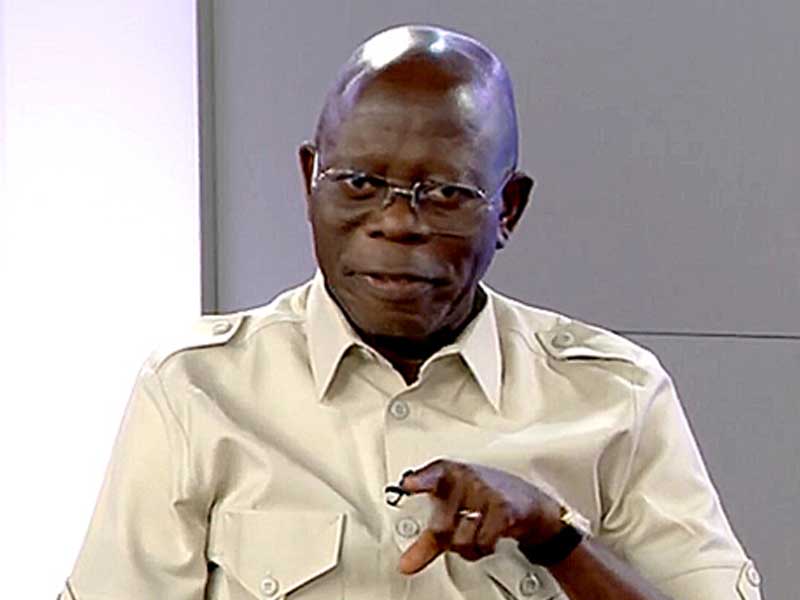
Senator Adams Aliyu Oshiomhole is presently engaged in such a trial. He finds himself confronted not by Senator Godswill Akpabio, but by a far more formidable adversary: his own words. The evidence against him is not supplied by his enemies. It is supplied by his own mouth. The falcon cannot hear the falconer.

In May 2025, Oshiomhole stood on the floor of the Senate and delivered one of the most effusive endorsements ever offered by a senator to another. Under Akpabio’s leadership, he posited, opposition politicians were joining the APC voluntarily and happily. The atmosphere in the Senate had become more cordial. Political tensions were easing. Defections were taking place without intimidation, coercion or conflict.

Advertisement

Then came the line that would become impossible to forget. “Mr Senate President, I thought that you would enter the Guinness Book of Records.”

For Oshiomhole, Akpabio’s leadership was not merely effective but profound. It was exceptional. He described it as “truly uncommon and increasingly uncommon.” He praised Akpabio’s patience, warmth and ability to attract political opponents through persuasion rather than pressure. He spoke admiringly of the Senate President’s smile and suggested that his leadership style had succeeded where others had failed. This was not a routine parliamentary courtesy. It was lavish public endorsement and heartfelt sentiments.

Indeed, Oshiomhole went even further to contextualize his praise of Akpabio. He reminded his audience of his reputation as someone  who always speaks out of conviction, and added that public figures had an obligation to acknowledge success when they saw it.

That was Oshiomhole speaking. That was Oshiomhole’s standard. That was Oshiomhole’s record. That was Oshiomhole being Oshiomhole.

Advertisement

Now, fast forward to June 2026.

Appearing on a podcast, the same Oshiomhole launched one of his strongest (and strangest) attacks yet on Akpabio. Among other claims, he alleged that the Senate President’s daughter had secured employment at the Nigerian National Petroleum Company Limited through improper influence and outside normal procedures. The allegation was serious and spurious. It was also, according to Akpabio’s colleagues, completely false.

The Senate President’s Spokesperson stated that it is trite that whoever alleges must proof. He asserted further that none of Akpabio’s children work at NNPC or any of its subsidiaries. Suddenly, the issue was no longer about Akpabio. The issue became a test of Oshiomhole’s integrity and conscience.

How does a former labour leader, former governor, former national chairman of the ruling party and serving senator make such a damaging allegation without first establishing a basic fact: whether the person in question even works where he claims? More troubling still was Oshiomhole’s own explanation for the allegation: “Somebody told me.”

Advertisement

Those three words should worry every Nigerian. Not because politicians should never raise concerns about public institutions. They should. Not because powerful people should be shielded from scrutiny. They should not. But because a democracy cannot function when public accusations are built on hearsay rather than evidence.

The low standards expected from a roadside gossip are not the standards expected from a senator of the Federal Republic. And that is what makes this episode so disappointing and worrisome. Like the first Adam, this Adams gave Eve the apple of lies and digested it.

Adams should have known better. He is not an ordinary politician. His place in Nigeria’s political history compels him to be more circumspect in his communication. He rose through the labour movement to become one of the country’s most recognisable public figures. He challenged military rule. He led workers’ struggles. He governed Edo State. He chaired the APC at a critical period in its development.

Few public figures have accumulated such political capital. Yet the path he toed which made Oshiomhole formidable now appears increasingly to be covered with indignity and less than noble motives.

Advertisement

For much of his career, he thrived on confrontation. There was always a cause to champion, an adversary to challenge or an institution to hold accountable. That instinct served him well when it was anchored in facts and robed with decency.

The danger comes when confrontation becomes an end in itself. Then the need to fight begins to outweigh the need to verify. Then attention becomes more important than accuracy. Then the line between advocacy and recklessness begins to disappear. The contradiction in Oshiomhole’s treatment of Akpabio is therefore impossible to ignore.

A little over a year ago, he was publicly suggesting that Akpabio deserved a place in the Guinness Book of Records. Today, he paints him with tar brush as a beneficiary of nepotism. A little over a year ago, he praised Akpabio’s leadership as a model of political inclusion and persuasion. Today, he portrays him as a leader whose conduct deserves public suspicion. A little over a year ago, he was urging Nigerians to acknowledge what was working.  Today, he is making allegations that appear incapable of surviving basic scrutiny and integrity test.

What changed? Did new evidence emerge? Did Akpabio suddenly become a different person? Or is something else at work? Some observers point to Oshiomhole’s growing frustration with developments within the Senate itself, particularly debates around the chamber’s rules and leadership structure. Whether that explanation is accurate or not, it highlights an uncomfortable reality about Nigerian politics and politicians’ sweet descent.

Advertisement

Too often, political disagreements that should remain institutional become personal. Policy disagreements become personality conflicts. Procedural disputes become vendettas. Legitimate criticism becomes a vehicle for settling scores. And when that happens, truth is usually the first casualty. This is where Senator Oshiomhole risks damaging something far more valuable than any political rivalry.

He risks damaging his credibility. Credibility is a strange asset. It takes decades to build and only moments to diminish. It is the reason people listen when a public figure speaks. It is the foundation upon which influence rests. Once it begins to erode, every future intervention becomes harder to take seriously.

That is the tragedy here. Oshiomhole does not need sensational allegations to remain relevant. He has already earned relevance. He does not need unverified claims to command attention. His record already guarantees attention. He does not need to manufacture controversy and peddle rumours. His experience alone should mean his voice would always matter in national conversations.

What he needs is the discipline that once distinguished him from countless others in public life. The discipline to verify before accusing. The discipline to separate evidence from rumour. The discipline to recognise that prominence carries responsibilities. History is often kinder to politicians than their contemporaries. It overlooks many mistakes and forgives many errors. But history is also unforgiving when it comes to patterns.

Advertisement

And a pattern appears to be emerging. The labour leader who once built a reputation on speaking truth to power now risks becoming associated with speaking before establishing the truth. The politician who once demanded accountability now finds himself facing questions about his own standards. The man who urged others to “put a record” when things were going well now stands accused of abandoning the record altogether when it became politically convenient.

That is why this story is ultimately not about Godswill Akpabio. It is about Adams Aliyu Oshiomhole. It is about the danger of allowing ambition, frustration and ego to eclipse judgement. It is about how distinguished careers are rarely destroyed by a single scandal or a single defeat.

More often, they unravel through a series of avoidable choices. A careless allegation here. An unverified claim there. A growing willingness to sacrifice accuracy for effect. For a man of Oshiomhole’s stature, that should be the real concern. Because the greatest threat to his legacy is not Akpabio but ego and himself

It is the possibility that, after spending decades building a reputation for courage and credibility, Adams Oshiomole may now be remembered for diminishing both with reckless falsehoods and needless ego of his own making.

Advertisement

Ken Harries Esq is an Abuja based Development Communication Strategist

Continue Reading

Opinion

Nuclear Safety at Zaporizhzhia Nuclear Power Plant under Russian Occupation: Threats, Legal Violations, and Ukraine’s Stance

Published

on

By

ADVERTISEMENT
Zoom Ad
ADVERTISEMENT
Zoom Ad

By Artem Kovalenko

From the outset of Russia’s full-scale invasion of Ukraine in 2022, disregard for the principles of nuclear safety and security has been a persistent feature of Russia’s misconduct.

In particular, Russia has threatened the safe operation of Ukrainian nuclear power plants, raising the risk of a nuclear emergency whose effects would be felt far from the borders of Ukraine.

Four years ago, on March 4, 2022, Russian military forces attacked and seized the Zaporizhzhia Nuclear Power Plant (ZNPP) – the largest nuclear plant in Europe (6 reactors, 5,700 MW installed capacity).

Advertisement

Russia turned ZNPP into a military base, disrupted its normal operations, damaged infrastructure, detained plant employees, and restricted access for experts from the International Atomic Energy Agency to critical areas of the plant, making a full and objective safety assessment impossible.

Four years of illegal control pose a direct threat to global nuclear security. For the first time in history, a civilian nuclear facility of this scale is being operated not by its lawful operator, but by an aggressor state.

The Russian Federal Service for Environmental, Technological and Nuclear Supervision (“Rostechnadzor”) directly controls the operation of the NPP and has already launched an unlawful modernization of the station’s radiation monitoring systems without the authorization of the legitimate operator (Ukraine) and without compliance with IAEA standards.

On July 1, 2023, the President of Ukraine, Volodymyr Zelenskyy, stated in an interview with Spanish media: “The Zaporizhzhia Nuclear Power Plant is mined — that is a fact. The IAEA confirms that the Zaporizhzhia plant is mined”.

Advertisement

Russia’s activities at ZNPP constitute a systematic violation of international nuclear law and treaty obligations under the Statute of the International Atomic Energy Agency, the Convention on Nuclear Safety (1994), and UN General Assembly Resolutions ES-11/1 and ES-11/4.As of June 2026, the ZNPP continues to be a critical unresolved issue within the framework of the peace settlement for the Russia-Ukrainian war.

However, Ukraine and Russia maintain fundamentally different visions regarding the settlement of the Zaporizhzhia NPP issue.

Ukraine is pushing for the total restoration of its sovereign control over the Zaporizhzhia NPP and the demilitarization of Enerhodar, emphasizing that Russia must be entirely barred from the plant’s management.

Only this approach complies with international law and stands as the sole option to eliminate the threat of an illegal restart of the Zaporizhzhia NPP.

Advertisement

Russia demands the preservation of its operational control over the Zaporizhzhia NPP, alongside the scheduled restarting of the station’s nuclear reactors under its domestic Russian regulatory framework.

However, any attempt to restart the nuclear reactors without full compliance with international safety standards and independent regulatory oversight constitutes a direct threat to nuclear safety.

Meanwhile, the US is proposing its own compromise option: tripartite management (Ukraine-US-Russia, 33/33/33%) with the subsequent distribution of the generated electricity.

However, this scenario remains unacceptable because granting Russia any stake in the ZNPP’s management would de facto legitimize the occupation, representing a direct violation of Ukraine’s national sovereignty.

Advertisement

In response to the US initiative, Ukraine proposes a joint US-Ukrainian management structure for the Zaporizhzhia NPP (50/50%).

Under this model, the American side would distribute 50% of the generated electricity, while Russia would be completely barred from the plant’s management.

This option complies with international law and eliminates the risk of legitimizing the occupation of the ZNPP.At the same time, Ukraine’s core position remains clear: the Zaporizhzhia NPP must be fully demilitarized and returned under Ukrainian sovereign control, as this is the only guarantee of nuclear safety for Europe and the entire world.

To prevent a potential nuclear catastrophe, the international community must publicly support the full return of the Zaporizhzhia NPP under Ukrainian sovereign control, while condemning the illegal modernization of the plant and plans to restart its reactors under Russian licenses.

Advertisement

Concurrently, it is of paramount importance to endorse the expansion of the IAEA mission’s mandate to enable full-scale independent monitoring of the Zaporizhzhia NPP.

In turn, China, as a permanent member of the UN Security Council and a nuclear-weapon state bearing special responsibility for maintaining the nuclear non-proliferation regime, must use its diplomatic influence on Russia to halt the illegal actions of “Rostekhnadzor” and prevent the restart of the ZNPP reactors.

Thus, the only path to restoring security in Europe is the complete and immediate withdrawal of Russian troops and personnel from the Zaporizhzhia NPP, its return under Ukrainian control, the release of all unlawfully detained individuals, and increased international pressure, including sanctions against “Rosatom” and “Rostekhnadzor”.

The ZNPP was and remains a Ukrainian facility, and its return is not only a matter of Ukraine’s sovereignty, but also a matter of global security.”Artem, a public relations expert, writes from Kyiv, Ukraine.

Advertisement
Continue Reading

Trending

Copyright © 2024 Naija Blitz News