
Opinion
Abu Inu-Umoru at 63: Still building without bragging, By Sufuyan Ojeifo


- /home/naijuinz/public_html/wp-content/plugins/mvp-social-buttons/mvp-social-buttons.php on line 27
https://naijablitznews.com/wp-content/uploads/2026/05/34fad9e0-7557-47d5-8502-21479185aecb-1000x600.jpeg&description=Abu Inu-Umoru at 63: Still building without bragging, By Sufuyan Ojeifo', 'pinterestShare', 'width=750,height=350'); return false;" title="Pin This Post">
- Share
- Tweet /home/naijuinz/public_html/wp-content/plugins/mvp-social-buttons/mvp-social-buttons.php on line 72
https://naijablitznews.com/wp-content/uploads/2026/05/34fad9e0-7557-47d5-8502-21479185aecb-1000x600.jpeg&description=Abu Inu-Umoru at 63: Still building without bragging, By Sufuyan Ojeifo', 'pinterestShare', 'width=750,height=350'); return false;" title="Pin This Post">


There are two broad categories of success in this country. The first announces itself long before it arrives. It travels with noise, dresses in spectacle, and insists, sometimes rather impatiently, that you take notice. The second is quieter, almost reluctant to be seen. It builds, it steadies, it gives, and if you are not paying attention, you might miss it entirely until you begin to notice that things are working where they once did not.
Chief (Dr.) Abu Inu-Umoru belongs, without argument, to the second tradition.
On May 9, 2026, he turns 63. If he had his way, the date would pass like any other. No orchestration. No choreographed goodwill messages. No carefully staged reminders of relevance. Just another day to get on with the business of building, solving, and quietly carrying responsibilities that would weigh heavily on louder men.
That, precisely, is why the moment demands to be marked.
For in a time and place where noise has become a kind of currency, silence backed by substance deserves its own form of recognition.
His story, like many consequential Nigerian stories, begins in inheritance but refuses to end there. Born on May 9, 1963, in Warrake, Owan East Local Government Area of Edo State, he arrived into the orbit of the late Alhaji Inu Umoru, a man of means and reach. But inheritance, as experience repeatedly teaches, is only a beginning. It can produce complacency just as easily as it can inspire discipline.
In Abu Inu-Umoru’s case, it did the latter.
He left Nigeria in 1984, not for leisure but for preparation. At the College of Alameda in California, he earned an Associate’s degree in 1986. By 1989, he had obtained a Bachelor’s degree in Business Administration from Central Connecticut State University. Years later, he would return to the classroom at Harvard Business School, completing the Owner President Management programme, not for ornament but for refinement.
To be clear, these were not certificates to be framed and admired. They were tools to be used. And use them he did.
The defining test of those tools came not in comfort, but in crisis.
When Setraco Nigeria Limited, one of the flagship companies founded by his late father, became entangled in a debt burden reportedly in the region of ₦17 billion, the easier path would have been distance. Many in similar circumstances have perfected the art of strategic absence when the numbers begin to turn unfriendly.
He chose presence.
Stepping into the storm, he applied corporate discipline with a clarity that can only come from both training and temperament. Financial leakages were identified and blocked. Dubious practices were confronted. Systems that had been bent were straightened. It was painstaking work, the sort that attracts little applause because it lacks glamour.
Within two years, the debt was cleared.
Today, Setraco stands as something of an anomaly in the Nigerian business environment: a major construction company with no bank debt. That outcome is not a matter of chance. It is the result of deliberate stewardship, sustained attention, and a refusal to indulge the small compromises that often grow into large crises.
Yet, if you ask around, you will find that the balance sheet is not what people mention first.
They speak, instead, of choices.
One story, now widely circulated in informed circles, captures the man more effectively than any financial report. At a moment when he had the ear of government and could have reasonably asked for the settlement of obligations owed to his company or the facilitation of new business opportunities, Abu Inu-Umoru made a different request.
He asked for a road.
Not a road to his house. Not a project designed to carry his name in bold lettering. A road for his community. The Warrake-Iyakhara-Egono axis, long neglected, needed intervention. That was his priority.
It is the kind of decision that does not trend. It does not lend itself to dramatic headlines. But it shows, with unusual clarity, the internal ordering of a man’s values.
In a society where access is often monetised and influence is treated as a private asset, choosing collective benefit over personal advantage is not merely admirable. It is instructive.
Those who have encountered him at close quarters tend to return to the same theme: a humility that is neither rehearsed nor strategic. It is simply there.
There is the now familiar anecdote of a dinner where, upon being approached by a guest while eating, he rose to his feet to receive him. Not a nod across the table. Not a distracted acknowledgment. He stood, engaged fully, and even took the time to commend the guest’s work.
It is a small gesture. But character, as it turns out, is often a collection of such small gestures, consistently applied.
His birthdays tell a similar story. The 58th passed with barely a ripple. The 60th, a milestone that many would convert into a festival of self-advertisement, required persuasion from those around him before any form of acknowledgment could be extracted. This is not the carefully curated modesty of public figures who secretly enjoy the performance of restraint. It is something more genuine, and occasionally inconvenient for those who sincerely wish to celebrate him for the great human being that he is.
Meanwhile, despite his reticence, traditional authority has since recognised what public noise often overlooks. The Otaru of Auchi conferred on him the title of Kauthar, a recognition that speaks to abundance and multiplicity. It is an apt title, not simply because of material success but also of impact. The abundance is visible in enterprises that employ, in communities that benefit, and in relationships sustained over time.
Beyond Setraco, his business interests extend across sectors. Petra Quarries Limited, Aerotek Agro-Allied Company Limited, Beer Barn Limited, and Presto Hotels Limited all sit within a portfolio that reflects both diversification and discipline. Hartland Engineering and Construction Company stands as evidence of initiative, built from the ground up alongside the family enterprise.
Yet, to interact with him without prior knowledge is to encounter none of this as performance. There is no burdened display of achievement, no insistence on recognition. He moves with a certain lightness, leaving behind tangible outcomes rather than managed impressions.
This, perhaps, is where the deeper lesson lies.
Nigeria, in its current phase, often appears to reward volume. The loudest voices dominate the conversation. Visibility is frequently mistaken for value. In such an environment, the temptation to equate noise with effectiveness becomes almost irresistible.
And then comes a life like Abu Inu-Umoru’s, quietly making the counter argument.
It suggests that it is still possible to build enduring institutions without constant self-announcement. That leadership can be exercised without theatrics. That generosity does not require viral validation to be meaningful. That influence, properly understood, is a tool for widening opportunity rather than narrowing it.
At 63, there is a certain maturity to this example. The years have added depth, but they have not altered the essential disposition. The same restraint. The same focus. The same commitment to using position as an instrument rather than a pedestal.
He will, in all likelihood, treat this birthday as he has treated the others. With a shrug, perhaps even mild discomfort at the attention. Work will continue. Decisions will be made. Lives will be affected, often without the beneficiaries knowing the full story behind their improved circumstances.
But for those who have observed closely, who have benefited directly or indirectly, and who understand the rarity of this particular combination of capacity and character, silence would be an error.
So this tribute insists, gently but firmly.
It insists that Nigeria still produces men who build without bragging, who give without recording, and who, when presented with the opportunity to serve themselves, choose instead to serve others. It insists that such examples, far from being outdated, may well hold the key to a more stable and grounded public culture.
Happy 63rd birthday to the Kauthar of Auchi, a man whose greatest statements are made not in words but in works.
May the years ahead bring continued strength for the tasks he carries with such quiet competence. And may his type, still far too small for a country of this size and ambition, find reason to grow.
■ Sufuyan Ojeifo is the publisher/editor-in-chief of THE CONCLAVE online newspaper. www.theconclaveng.com

By Sonny Aragba-Akpore
An ambitious 90,000 km optic fiber network is in the offing by the government of Nigeria.
When actualised,it’s expected to boost coverage and expand network connectivity taking services to unserved and underserved areas of the 774 council areas in the country.
With necessary funding secured and Special Purpose Vehicle in Place,Bosun Tijani,Nigeria,s Communications,Innovation and Digital Economy Minister is optimistic that the race to Bridge the digital divide has begun.
The 90,000 km optic fiber ring being proposed will augment the existing 35,000 network infrastructure.
The funding which was secured by different sources will build the new infrastructure round the country and take services to underserved and unserved areas of the six geopolitical zones of Nigeria.
The Minister is quoted as saying that “by the time we are done, it’s going to be either the third or second longest fibre-optic network on the African continent, somewhere between what we have in South Africa and Egypt. And this is a project that is starting implementation in October. We have raised the funding for it,” the Minister said.
“To ensure comprehensive coverage”he explained that “the infrastructure strategy combines terrestrial fiber, mobile towers, and satellite technology. While presidential approval includes installing telecom towers in underserved locations, the government will deploy satellite connectivity in hard-to-reach or terrain-impracticable areas to guarantee network access for over 20 million currently unserved citizens.”
The Government has incorporated Bridge Open Access (Bridge OA), an independent Special Purpose Vehicle established under Project BRIDGE to execute and manage the infrastructure backbone. Confirming that necessary funding has been secured, the Minister noted that President Bola Tinubu approved the project to aggressively deepen broadband penetration across the country.
The Scheduled roll out is in October 2026 at an estimated cost of $2 billion, funded via public-private partnership (PPP) combining debt from development finance institutions and equity from private companies.
The Federal Government holds a minority stake between 25% and 49%.
It extends Nigeria’s total fiber backbone from roughly 35,000 km to 125,000 km, making it one of the longest networks in Africa.
It aims to connect every state, local government area, ward, and over 200,000 social, educational, and healthcare institutions.
The advisory, structural, and funding partnerships driving the Project BRIDGE SPV include several major technical and development entities.These include
Strategic Advisory & Procurement Partners like
Bluechip Technologies Limited that was appointed as the Lead Partner in the consortium awarded the ₦451.8 million advisory contract by the Ministry of Communications, Innovation and Digital Economy (FMCIDE). They are tasked with designing the implementation-ready supply chain and procurement strategy for the entire network rollout.
Bluechip Communications Limited is acting as the Member Partner alongside Bluechip Technologies within the Joint Venture while Infrastructure Concession Regulatory Commission (ICRC) is Providing the standardized Model Public-Private Partnership (PPP) Agreement framework to align legal, structural, and risk allocations with global best practices.
Core Funding & Technical Design Partners are in charge of the
project design, technical studies, and financial structures closely tied to a working group of global development financial institutions (DFIs) co-led by the Nigerian government while
African Development Bank Group (AfDB) Co-leads the working group and approved $200 million for the Digital Value Chain Infrastructure project under Project BRIDGE.
The World Bank Group is backing the initiative with a foundational $500 million financing agreement.
The European Bank for Reconstruction and Development (EBRD) has also committed a $100 million investment while European Union (EU)is Providing a €22 million direct grant.
Operational Delivery & Deployment Partners will handle the
Project Implementation Unit (PIU) Composed of experienced telecom and legal experts from both the private and government sectors managing the preliminary activities.
Government also formed the National Broadband Alliance for Nigeria (NBAN)to unify local telecom infrastructure providers, civil society, and state agencies to handle the local, middle-mile distribution once the main backbone is laid.
The core procurement strategy designed by Bluechip Technologies will harness local internet service providers (ISPs) to hook into this open-access wholesale network.
The Board of Directors of ADB Group approved a $200 million loan to the government of Nigeria to advance a flagship initiative to deploy the 90,000 kilometres of open-access fibre nationwide, expand digital skills, and drive job creation across the country.
Nigeria is Africa’s most populous country and West Africa’s largest market, and with the digital economy increasingly a major contributor to GDP, the Digital Value Chain Infrastructure for Boosting Employment (D-VIBE) Project is expected to close connectivity gaps and support productivity and job creation. It will achieve this by extending Nigeria’s national fibre backbone from around 35,000 km to about 125,000 km, connecting all 774 Local Government Areas – including schools, health facilities, agro-industrial zones, rural communities and commercial hubs – to high-speed broadband and establishing cross-border links with neighbours Benin, Cameroon, Niger, and Chad.
D-VIBE, also known as Project BRIDGE, is structured as a public-private partnership through a Special Purpose Vehicle (SPV), with public ownership capped between 25% and 49% and private sector participation between 51% and 75%, helping address rollout constraints such as high construction and Right-of-Way costs.
The African Development Bank Group is providing a $200 million loan as part of an $800 million sovereign financing package for the project, alongside $500 million from the World Bank and $100 million from the European Bank for Reconstruction and Development (EBRD). Total project financing is estimated at $2 billion, and includes an EU grant of €22 million, a $2.6 million Multilateral Cooperation Center for Development Finance (MCDF) project preparation grant, and at least $1.2 billion of investment from the private sector.
“Nigeria has the talent, the market, and the ambition; what it has lacked is the backbone infrastructure to connect that potential to opportunity. D-VIBE changes that. From the north to the south, from farms to factories to classrooms, this investment will make high-speed connectivity a reality for every Nigerian community and give young people the tools to build their futures digitally,” said Abdul Kamara, Director General, African Development Bank Group Nigeria Office.
The project is supported through a working group of development finance institutions, co-led by the Nigerian government and the African Development Bank Group, that will align design choices, technical studies and financing.
Beyond infrastructure, the project aims to address demand-side barriers to digital use with affordable devices, large-scale skills development and support for digital platforms in priority sectors. It will also support enabling cybersecurity and market competition policies while applying criteria – including increased use of hybrid and renewable power – to build resilience.
D-VIBE is expected to support creation of up to 2.8 million jobs over its lifecycle and raise national broadband penetration from 45% to around 70% by 2030.
The project aligns with Nigeria’s Vision 2050, its National Development Plan and Renewed Hope Development Plan (2026-2030), the African Union’s Agenda 2063, and the African Development Bank’s Ten-Year Strategy (2024-2033).
“I think our sector has been extremely fortunate. Mr. President has given us quite a number of things that the sector has been demanding for a long time. Whether it’s the Critical National Infrastructure designation for all digital infrastructure, the slight adjustment in tariff, or the tax harmonisation, these are reforms the industry has long requested.
“I think it’s probably the sector that is most appreciative of this government because when we came in, the sector was contributing between 16 and 18 per cent to our GDP, but today it is tracking close to 21 per cent. That represents significant growth,” he said.
The minister was quoted as saying that the reforms had also improved the financial performance of major operators in the telecommunications sector.
On efforts to bridge the digital divide, Tijani disclosed that the government would begin deploying about 3,700 telecommunications towers from October to provide network coverage for more than 20 million Nigerians currently living in underserved communities without access to telecom services.
He said the President had approved the project after months of capital mobilisation and planning.
“Today we’re at a point where, before the end of the year, we’ll also start to deploy close to 3,700 towers. It’s taken a lot to put this project together and raise the required capital, but we are now ready to begin deployment around October,” he said.
Side by side with this, the minister also announced that Nigeria would officially launch an alphanumeric postcode system on October 1, a move he said would place the country among a select group of nations operating an advanced digital addressing system.
“Nigeria will be amongst maybe 10 or 15 countries in the world with an alphanumeric postcode. It’s the latest design in postcode systems, where we can identify every property in this country. We’re hoping to launch that on the 1st of October,” he said.
Tijani explained that the new system would assign a unique address to every property nationwide, enhancing logistics, accelerating e-commerce, improving emergency response and strengthening public service delivery.
“Inability to locate places comes at a cost. You can imagine what this will do for e-commerce. It means goods can now be delivered in record time,” he said.
He added that integrating the postcode system with existing government identity databases would improve security and make public services more efficient.
“Our alphanumeric postcode is unique because it allows us to assign a unique address to every property. In many countries, such as the UK, postcodes cover clusters of buildings. What we are introducing will uniquely identify every building, and that will be a game changer for Nigeria in terms of security, commerce and public service delivery,” the minister stated.
When actualised,internet connectivity will improve significantly with an equal boost to broadband availability and speeds.
Nigerian Communications Commission (NCC) said active subscribers connected to the internet through various technology channels deployed by the Nigerian service providers, reached 157,405,351, as of May 2026.
The statistics released showed that there has been a major surge and that with improved infrastructure more people will be connected.
Agency reports say
broadband penetration rose to 56.11 per cent with 121,643,718 subscriptions in May 2026, after recording 55.67 per cent penetration with 120,684,625 subscriptions in April 2026.
“From the 157,405,351 internet subscribers recorded in May this year, subscribers that connect to the internet via the Mobile GSM technology provided by mobile operators like MTN, Airtel, Globacom, and T2, were 157,021,888. Next to it, is the internet connectivity via the Voice over Internet Protocol (VoIP) technology, which recorded 225,538 internet subscribers as at May this year, followed by Fixed Wired technology provided by traditional Internet Service Providers (ISPs) like Spectranet, Swift Networks, and Cobranet, which recorded 157,925 internet subscribers in May this year.”
By NCC’s statistics, Mobile GSM technology has maintained the lead position in internet connectivity in the last one year.
The statistics say that as at October 2025, internet subscribers that connected to the internet via Mobile GSM technology, were 142,004,662, followed by VoIP, which recorded 239,672 and ISPs, which recorded 73,778.
“In November 2025, internet subscribers that connected to the internet via Mobile GSM technology, were 144,151,655, followed by VoIP, which recorded 238,496 and ISPs, which recorded 83.417.
Internet& Telecom
“In December 2025, internet subscribers that connected to the internet via Mobile GSM technology, were 147,519,262, followed by VoIP, which recorded 232,284 and ISPs, which recorded 101,667.
“In January 2026, internet subscribers that connected to the internet via Mobile GSM technology, were 150,912,474, followed by VoIP, which recorded 225,236 and ISPs, which recorded 103,722.
“In February 2026, internet subscribers that connected to the internet via Mobile GSM technology, were 152,476,943, followed by VoIP, which recorded 219,741 and ISPs, which recorded 124,590.


By Emmanuel Thomas
Democracy is sustained not merely by the physical act of casting a ballot, but by public trust in the institutions tasked with safeguarding the vote.
When the institution mandated to act as an impartial referee repeatedly displays technical opacity, administrative clumsiness, and institutional evasiveness, it ceases to be a guarantor of democratic expression and becomes its greatest threat.
As Nigeria prepares for the 2027 general elections, the Independent National Electoral Commission (INEC) finds itself locked in a crisis of credibility that threatens the survival of the country’s constitutional order.
The latest manifest of this systemic rot was laid bare following the August 15, 2026, Osun State governorship election. Prominent economist, civic leader, and founder of the Anap Foundation, Atedo Peterside, issued a scathing critique targeting the integrity of INEC’s electronic infrastructure.
Peterside raised three fundamental, data-backed questions regarding the operation of the INEC Result Viewing (IReV) portal on election night:
Why did result transmission freeze completely for nearly three hours (between 20:48 hrs and 23:42 hrs), only for an unprecedented dump of 236 polling unit results to hit the server in less than 60 seconds immediately afterward?
Why were 51 polling unit results uploaded only after a winner had already been declared by the returning officer?
Why did 11 polling unit results remain entirely unaccounted for on the IReV portal days after the exercise concluded?
These queries are not mere technical nitpicking; they strike at the heart of the “triangle of compromise” currently eroding Nigerian statehood. Peterside’s observations prove that despite legislative overhauls, billions of naira in budgetary allocations, and repeated institutional promises,
INEC’s technological infrastructure remains vulnerable to unexplained outages that consistently coincide with critical moments of collation.
A Pattern of Institutional Evasion
The technical glitches highlighted in the Osun gubernatorial contest are part of a broader, systemic failure. Rather than operating as an independent body dedicated to transparency, INEC has established a pattern where digital platforms—introduced specifically to eliminate manual rigging—are compromised at crucial junctures.
Electoral integrity is predicated on predictability. When the digital transmission pipeline freezes without explanation, public suspicion fills the void. A sudden dump of 236 results in under a minute following a three-hour blackout suggests manual batching or administrative intervention rather than automated real-time transmission.
Furthermore, declaring an election winner while scores of polling unit results remain offline—or uploading them post-declaration—renders the IReV portal a retrospective archive rather than a real-time verification tool.
This behavior directly fuels voter cynicism. As former INEC officials, civil society organizations, and international observers have repeatedly noted, when citizens believe the referee is compromised, the incentive to participate vanishes.
Elections are reduced to performative rituals where outcomes are perceived to be manufactured in administrative corridors rather than determined at polling stations.
Replicating the Mistakes of the Past
The dangerous trajectory toward 2027 mirrors the institutional failures that damaged public faith during the 2023 general elections.
The non-transmission of presidential election results in real time on the IReV portal shattered public trust and cast a shadow over the judicial petitions that followed. Rather than treating that failure as an emergency requiring radical reform, INEC’s conduct in subsequent off-cycle elections indicates an entrenchment of bad practice.
Civic leaders across the political spectrum have sounded the alarm. The recurring narrative of “technical hitches”—conveniently occurring during the collation of high-stakes results—has transformed INEC from an agent of democratic consolidation into a vector of political instability.
When citizens lose faith in the ballot box, the alternative is often street protests, political apathy, or a slide toward total lawlessness.
The Implication for 2027
Nigeria cannot afford an electoral umpire whose operations invite perpetual litigation and civil unrest.
A general election involves the simultaneous processing of tens of thousands of polling units across 36 states and the Federal Capital Territory. If INEC cannot manage real-time result transmission and full transparency in a single-state off-cycle election like Osun, its capacity to conduct a credible, peaceful, and transparent nationwide election in 2027 is doubtful.
The commission’s persistent refusal to offer transparent forensic logs, clear operational explanations, or account for missing polling unit data reinforces the perception that it operates above public accountability. In a democracy, institutional silence in the face of mathematical and operational anomalies is an admission of failure.
If Nigeria’s democratic experiment is to survive past 2027, INEC must be subjected to immediate, independent technical audits and structural reform.
The electoral body must understand that its primary duty is not to declare winners, but to protect the integrity of the process.
Until INEC provides clear answers to the questions raised by Atedo Peterside and addresses its systemic technological flaws, it remains the single greatest institutional threat to Nigeria’s democracy.
Opinion
8 Years of Service: Akpodiete Foundation Transforms Education, Health, Sports and Security Across Delta
By Amb. Comrade Kpoharor Emmanuel
As the Olotu & Ekuogbe Rowland Akpodiete Foundation prepares to celebrate its 8th year anniversary in August 2026, Executive Director, Dr. Olotu Akpodiete JP, says the organization has remained focused on touching lives through education, security, health, humanitarian aid, and community development across Delta State.
Registered in 2018 to sustain the legacy of the late Chief Dr. Ekuogbe Rowland Akpodiete PhD, the foundation has, over the past eight years, implemented programs that cut across schools, prisons, orphanages, women groups, youths and traditional institutions.
Education and Learning Support
The foundation’s education drive began in 2019 with the distribution of notebooks and learning materials to pupils of Eseorphe Primary School and students of Government College Ughelli. That same year, it presented the Chief Ekuogbe Akpodiete Government Prize to the best student in Government at Government College Ughelli during the APT Awards. Students of Ogbavwe Secondary School in Usiefrun, Ughelli South, also received educational materials, and the school got a water borehole to address scarcity.
In 2020, during COVID-19, safety materials were donated to Government College Ughelli. Later that year, law students of Delta State University, Oleh Campus, received scholarships and grants, an effort that earned Dr. Akpodiete an Award of Excellence from the university provost Prof. Alex Amata.
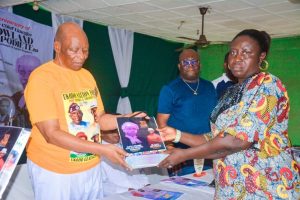
In 2022, the foundation returned to Government College Ughelli to install ceiling fans in the School House Hostel and provide more learning materials. Most recently in 2025, during the 30th remembrance of Chief Ekuogbe Akpodiete, it awarded cash prizes and educational materials to students from over eight schools that took part in a debate competition hosted at Government College Ughelli.
Security, Peacebuilding and Advocacy
Since 2020, the foundation has run a Security and Safety Education Project in government schools. At Government College Ughelli, veteran consultant Mr. Sylvester Obose trained over 50 people including teachers, students and the school security team.
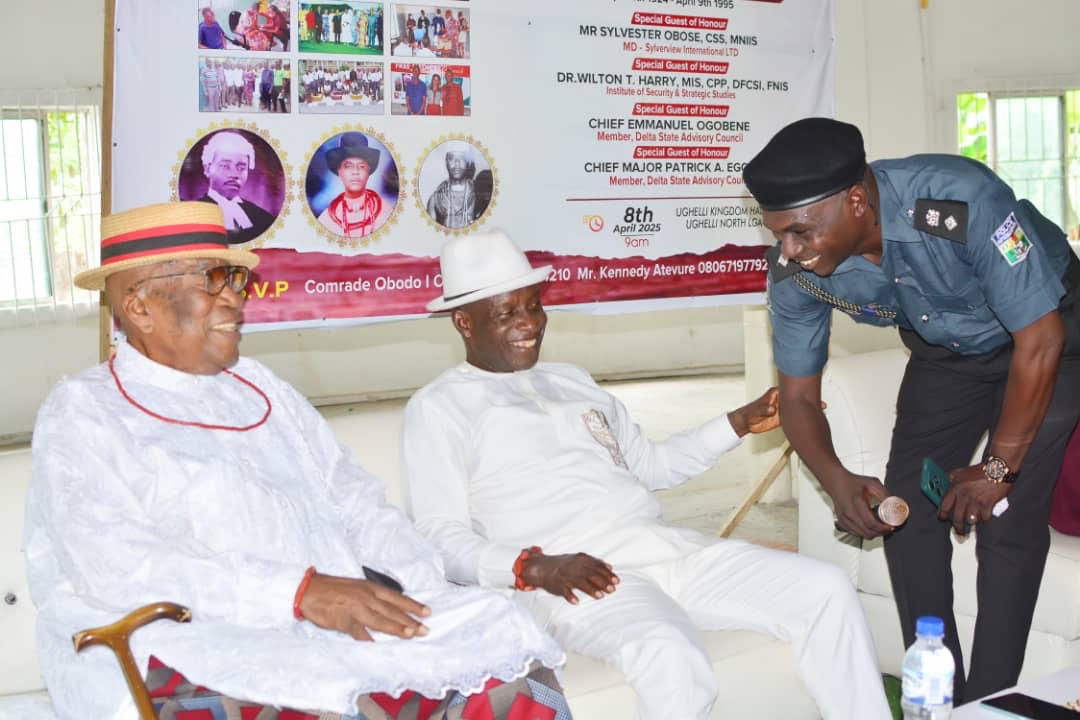
In 2025, two major security programs were held. A Memorial Lecture on Conflict Resolution and Community Security and Safety was organized at Ughelli Kingdom Hall where community leaders from Ughelli North & South including vigilantes were trained, members of the Delta State Advisory Council in attendance as Special Guests of Honour. Security communication gadgets were distributed to communities. Later, during the foundation’s 7th anniversary, another lecture on Conflict Resolution and Neighborhood Watch was held at Unity Hall, Ughelli South LGA Secretariat. Over 100 vigilante leaders and stakeholders attended, and the Divisional Police Officer, CSP Oluwole Oladipupo, commended the initiative. Mobile sound systems and gadgets were also distributed to communities.
In 2025, the foundation also submitted a proposal to the Delta State Government advocating for the creation of a Ministry of Security to strengthen the state’s framework ahead of state policing.
Humanitarian Support for Vulnerable Groups
In 2018, Dr. Akpodiete and the Director, Deacon Ogaga Ohwojero, visited prisons in Sapele and Warri with donations of rice, beans, garri, tissue, bathing and washing soap, plus educational materials. A similar donation was made in Ogwashi-Uku Prison through Barr. Lilian Eserinune. Prison officials including DCP Solomon Airiohuodion and Mr. Okonkwo Frank applauded the gesture.
In 2024, during the 29th remembrance of Chief Ekuogbe Akpodiete, the foundation visited Rose Ilogbo Foundation and Christ Treasured Royal Ministry in Ughelli with foodstuff and cash for orphaned children. Founders Mrs. Rose Ilogbo and Rev. Dr. Abraham Erhuotor expressed gratitude.
Women Empowerment and Social Welfare
The foundation runs yearly support for women and widows in U3. In 2025, during the 30th remembrance, over 50 women from Otor Ihwreko in Ughelli North received business grants and wrappers. Chief Dr. Linda Ikpuri urged them to invest the grants wisely.
In August 2025, more women across Ughelli North, South and Udu received grants and gift items. In 2026, over 100 widows across the three LGAs got cash donations and wrappers.
“Given the harsh economy of the country, we cannot afford to abandon our mothers and widows. This is why we have made it a yearly mandate to support them,” Dr. Akpodiete stated.
Human Capital and Skills Development
In 2018, the foundation held a two-day seminar on the fish farming value chain at Otor Iwhreko Town Hall for over 100 youths and women. In 2019, more than 70 participants were trained on digital skills for wealth creation in Ughelli.
In 2025, it hosted a Youth Empowerment and Leadership Summit in Otor Jeremi and also trained community leaders on conflict resolution to promote grassroots peace.
Water Projects and Sports Development
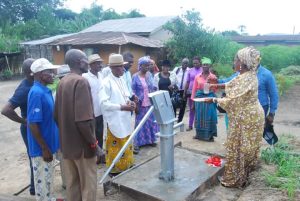
In April 2019, during the 24th remembrance, a borehole was commissioned in Okparabe, Ughelli South. Another borehole was commissioned that same year at Ogbavweni Grammar School.
The foundation has also invested in youth sports. In 2025, a novelty football match between Otor-Ihwreko Community Team and Rovers Football Team ended 1-1, with cash gifts for players and a call on the LGA to upgrade the pitch. In April 2026, another novelty match was held with cash support for players, and a renewed appeal to government to support sportsmen and women.
Healthcare Access
Since 2018, the foundation has prioritized healthcare through medical outreaches, drug distribution and free consultation in Otor Ihwreko, Okparabe and Otor-Udu. It was the first to enroll over 500 residents into health intervention programs across U3 and has pushed medical insurance coverage for indigents and community leaders.
The impact earned Dr. Akpodiete recognition as Health Insurance Ambassador by Governor Rt. Hon. Sheriff Oborevwori in both 2024 and 2025.
Activities lined up for the 8th anniversary include more school outreach, free medical services and expanded programs across U3.
In 2025, the foundation sent a proposal to Delta State government to rename ministry of riverine infrastructure to Ministry of Marine & Blue Economy in order for policy alignment with the federal government and economic diversification beyond oil.
Dr. Akpodiete reaffirmed the foundation’s commitment to partner with government, traditional rulers and communities to promote peace, learning and welfare in Delta.
Summary
The Olotu & Ekuogbe Rowland Akpodiete Foundation is marking 8 years of service in August 2026. Since 2018, it has impacted communities across Delta through education support, scholarships, school infrastructure and debate prizes; security education, community training and a proposal for a State Ministry of Security and Ministry of Marine & Blue Economy; humanitarian aid to prisons and orphanages; annual grants and welfare for women and widows; skills training in fish farming, digital tools and leadership; borehole projects in Okparabe and Ogbavweni; sports development through novelty matches; and major health outreaches that led to 500+ enrollments and two state recognitions for Dr. Akpodiete. The foundation says it will expand outreach during its August 2026 anniversary.

Fire Guts Kano Market, Destroys Six Houses, Shops, Warehouses

Moroccan Wife Has Been Away From Me for 11 Months — Husband Accuses Sheikh Gumi

Watch Wike delivering his speech at civic reception held in his honour today




-
 News19 hours ago
2027: Christian, Muslim youths sign peace accord in Abuja
-
 Metro18 hours ago
Protesters storm Katsina streets over rising bandit attacks, urge govt to step up action
-

 News11 hours ago
Court of Appeal Upholds Order Against Mark-Led ADC Congresses, Declares Exercises Null and Void
-

 News10 hours ago
Two Policemen fired over death of UNIPORT graduate in Port Harcourt
-

 Politics19 hours ago
(FULL LIST) 2027: ADC unveils governorship, deputy candidates in 28 states
-

 Entertainment18 hours ago
2Baba’s daughter laments separation of her parents
-

 News9 hours ago
‘Provid Evidence El-Rufai Paid Bandits To Kill Kaduna People’ – Ex-Gen Queries Defence Minister
-

 Politics18 hours ago
FBI records: I’m ready for scrutiny, unlike you, Atiku tells Tinubu